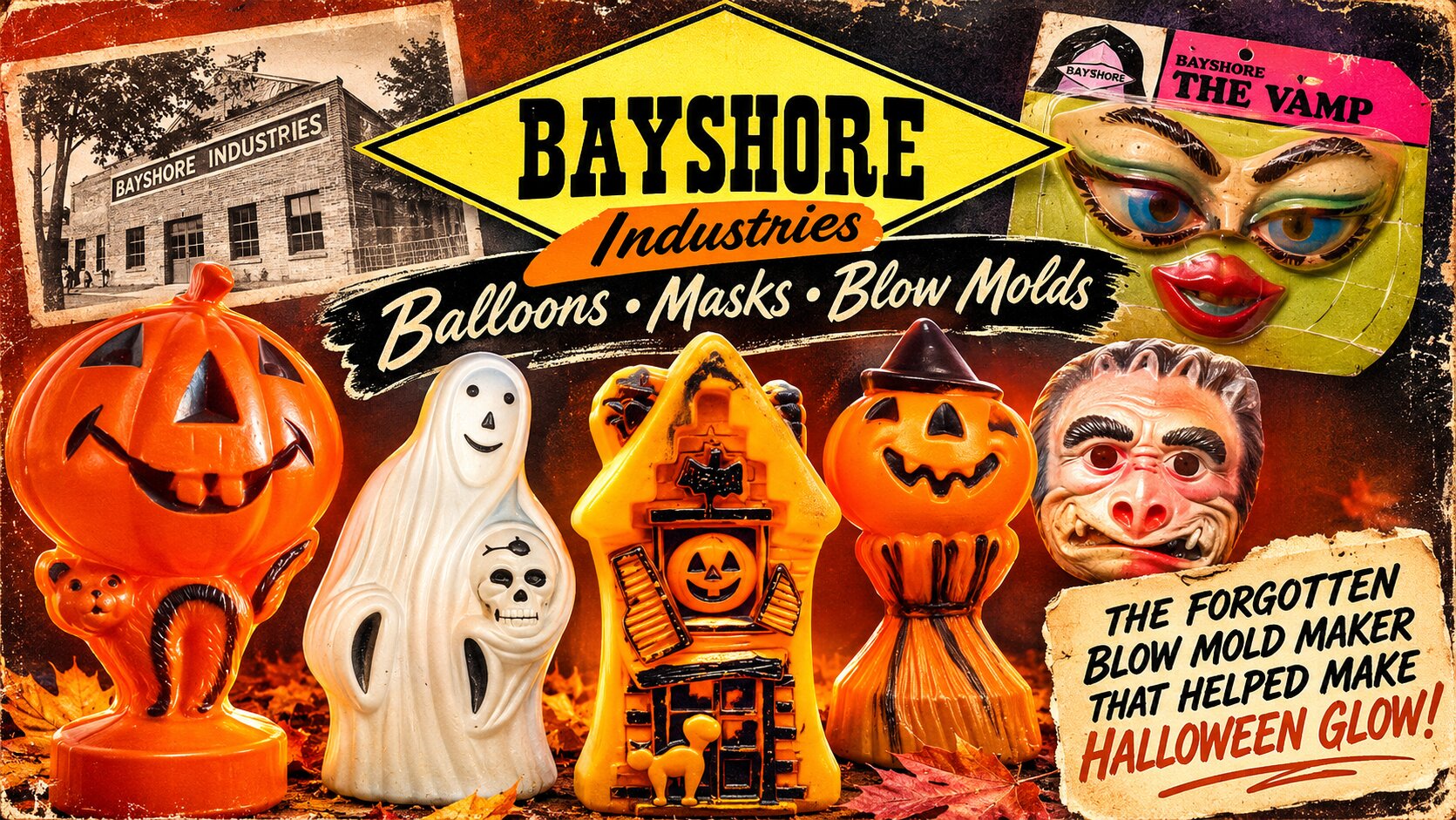
From rubber balloons and monster masks to glowing jack-o’-lanterns, haunted houses, and designs that survived through Empire and General Foam, the remarkable story of a company that helped shape vintage Halloween decorating.
By Curtiss Wayne Andrews
There’s something about an old Halloween blow mold that modern decorations just can’t duplicate. Maybe it’s the slightly uneven paint, the goofy expression, or the way a single light bulb makes an orange plastic pumpkin look as though it’s been glowing in somebody’s window since 1972.
You know the kind I’m talking about. A smiling jack-o’-lantern perched on a haystack. A black cat sitting beside a pumpkin. A miniature haunted house that looks more charming than frightening. These weren’t elaborate decorations, and nobody was confusing them with expensive works of art. They were inexpensive seasonal novelties, the sort of things you might have found at a neighborhood variety store, brought home in a paper shopping bag, and plugged into an outlet near the front window.
Today, some of those same decorations are treasured collectibles, and one of the companies responsible for making them deserves considerably more attention than it usually receives.
That company was Bayshore Industries.
If you’ve spent much time collecting vintage holiday blow molds, you’re probably familiar with Empire, Union Products, Poloron, and General Foam. Those names come up constantly, and for good reason. They produced many of the Santas, snowmen, candles, and other illuminated figures that helped define American holiday decorating for generations.
Bayshore’s story is a little different. Its roots were in rubber toys and Halloween novelties, and its most recognizable illuminated decorations were often small enough to sit on a tabletop. But don’t let their size fool you. Bayshore was part of an extraordinary period in American manufacturing when relatively simple plastic products became fixtures of family celebrations.
And here’s where the story gets particularly interesting: several Bayshore designs eventually found their way into Empire’s product lineup, while at least one of the company’s most memorable Halloween creations—the haunted house—continued to be manufactured by General Foam years afterward.
That’s quite a legacy for a company that originally started out making balloons.
From Balloons to Boogeymen: Bayshore’s Early Years
The Bayshore story begins in 1946 in Elkton, Maryland, where A. L. Gursha and Eugene Salinger established a business manufacturing rubber balloons. The name reportedly reflected the company’s location near the Chesapeake Bay, an appropriately cheerful beginning for a manufacturer that would eventually become associated with grinning pumpkins and some genuinely unsettling Halloween masks.
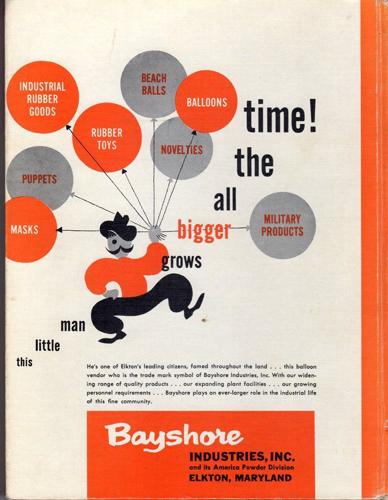
Balloons were a sensible product for the postwar years. American families were spending more on toys, parties, celebrations, and inexpensive novelties, and manufacturers were eager to supply the growing market. A company that could work with rubber and produce colorful novelty items had opportunities well beyond the balloon business.
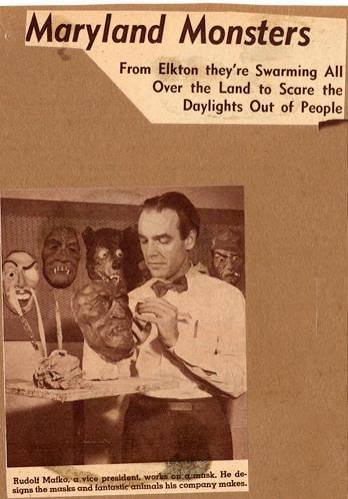
Bayshore gradually expanded into toys and seasonal merchandise, including rubber Halloween masks. By the 1950s, the company had developed a reputation for unusual novelty products, particularly the sort of monster masks that could make an ordinary neighborhood trick-or-treater look like something that had escaped from a low-budget horror movie.
And I mean that affectionately.
If you’ve ever seen an original mid-century Halloween mask, you know that many were far more disturbing than the slick, licensed costumes sold today. Faces were exaggerated, expressions were bizarre, and the rubber had a way of creating features that looked almost human but not quite. Some were funny. Others were downright creepy, especially when viewed under the harsh light of an old basement.
That was part of the appeal. Halloween was still very much a holiday of homemade costumes, dime-store decorations, and inexpensive tricks, and Bayshore understood the market. Its products weren’t intended to become museum pieces. They were designed to entertain, surprise, and occasionally scare the daylights out of somebody’s younger brother.
The company’s early history also reminds us that the American holiday decoration industry didn’t develop in isolation. Manufacturers moved between toys, novelty goods, costumes, and decorations depending on the materials and production methods available to them. A company making balloons one decade could find itself producing lighted plastic jack-o’-lanterns the next.
For Bayshore, that transition would eventually become its most enduring legacy.
A Move to New York and a New Chapter Under Miner Industries
By the early 1960s, Bayshore had entered a new phase of its history. The company became associated with Miner Industries, and production moved from Maryland to Amsterdam, New York, around 1961.
One particularly interesting account of this transition comes from a collector researching a Bayshore jack-o’-lantern and black cat decoration. Drawing on reporting from the Amsterdam Evening Recorder dated July 24, 1962, the researcher identified the company’s new manufacturing location as Building 65 on Willow Street, a facility previously occupied by Larc Products.
The same research identifies Eugene Swee as president and chairman of Miner Industries, with Alvin L. Gursha continuing as president of the Bayshore division.
Those details might seem rather dry compared with the glowing pumpkins, but they’re exactly the sort of information that makes researching defunct blow mold manufacturers so fascinating. A company name molded into the bottom of a decoration is one thing. Discovering where that decoration was manufactured, who ran the business, and how it fit into a larger corporate operation gives the piece an entirely different history.
Bayshore’s products from this period sometimes carried labels identifying the company as a subsidiary of Miner Industries. One surviving Halloween light-up decoration, for example, has been documented with a diamond-shaped yellow label naming Bayshore Industries, Inc., New York, New York, and stating that the item was made in the United States.
For collectors, a surviving label like that can be enormously useful. It helps connect the decoration to a particular corporate period, even if it doesn’t establish the exact year the individual piece left the factory.
The company was also producing a broader assortment of novelty merchandise, including hobby horses, bowling sets, balloons, and Halloween masks. Bayshore wasn’t exclusively a holiday decoration manufacturer, which helps explain why its history can be harder to reconstruct than that of companies remembered primarily for their illuminated lawn figures.
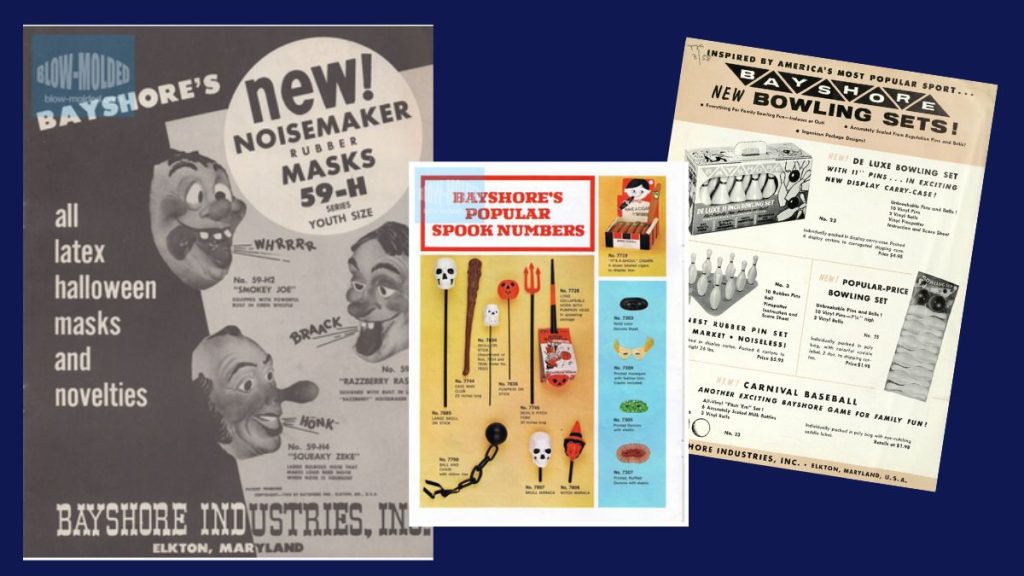
Its products were scattered across several categories, and much of the documentation has survived through advertisements, catalogs, packaging, and the efforts of collectors who refused to throw away what everyone else considered disposable.
The Plastic Revolution That Changed Holiday Decorating
By the 1960s, plastic was transforming the American household. Manufacturers were finding new ways to produce lightweight, inexpensive objects that would previously have required metal, wood, glass, or other materials.
Holiday decorations were particularly well suited to the new possibilities.
Blow molding allowed manufacturers to form hollow plastic objects by using air pressure to expand heated material inside a mold. The finished pieces could be relatively lightweight, decorated with paint, and illuminated from within. The process was especially useful for producing seasonal figures that needed to be affordable enough for ordinary families to purchase.
The best-known companies used the technology to create larger outdoor displays. Beco, Poloron, Union Products, and others helped establish the familiar tradition of glowing Santas, snowmen, choir singers, and nativity figures.
Bayshore found its own place in that market, with a particularly memorable assortment of Halloween decorations. The company produced candy pails, illuminated tabletop figures, and other seasonal novelties during the 1960s and 1970s.
What makes Bayshore especially interesting is the way its products combined the look of older Halloween decorations with the convenience of modern plastics. A smiling pumpkin or a black cat was hardly a new Halloween image, but a hollow plastic version with an electric light inside could be displayed year after year without worrying about a candle burning through the decoration.
It was practical, affordable, and just a little bit magical.
And while collectors today may associate blow molds primarily with Christmas, companies like Bayshore remind us that Halloween was developing its own illuminated plastic traditions at roughly the same time.
The Famous Bayshore Blow Molds Collectors Still Love
Bayshore’s Halloween lineup contained several designs that have become familiar to collectors, particularly those who appreciate the smaller tabletop decorations of the 1960s and 1970s. As I write about here, tabletop blow molds seem to be all the rage these days.
One of the most recognizable from Bayshore is the jack-o’-lantern and black cat combination. Another is the pumpkin perched on a haystack, sometimes accompanied by a witch’s hat. There were also scarecrow-themed lamps, haunted houses, and other novelty pieces designed to bring a little spooky atmosphere into the home.
These weren’t the towering lawn decorations that would eventually become associated with some of the industry’s larger manufacturers. Many Bayshore pieces were modest in size, which probably helped them find their way into kitchens, living rooms, bedrooms, and front windows.
That smaller scale is part of their charm today.
The Jack-o’-Lantern and Black Cat: A Bayshore Halloween Classic
Few images say vintage Halloween quite like a black cat and a grinning pumpkin. Bayshore combined the two into an illuminated decoration that remains one of the company’s most recognizable designs.
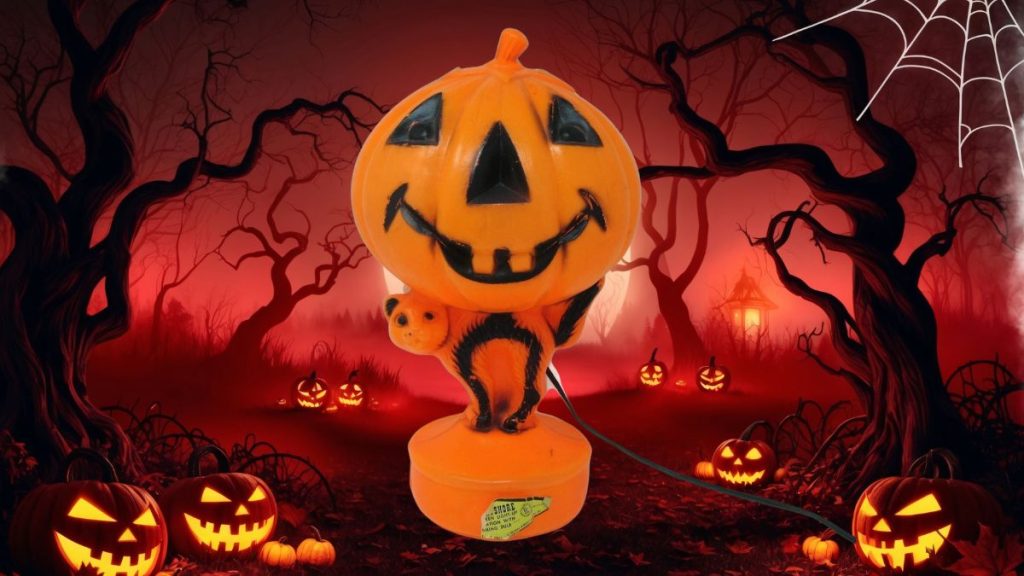
The appeal is easy to understand. The cat provides a little old-fashioned Halloween mystery, while the pumpkin gives the piece a cheerful expression that makes it more suitable for a family living room than a haunted attraction.
A collector writing for the website Euclid Boo documented an example that retained its original Bayshore label, including the company’s connection to Miner Industries. The researcher also recalled having one of the decorations as a child, which is precisely the kind of personal connection that makes these pieces so appealing today.
There’s something wonderful about a decoration that can survive long enough for someone to recognize it decades later and immediately remember where it sat in the family home.
A separate collector writing for Halloween Head documented finding a Bayshore cat-and-pumpkin lamp at an antique mall for $12.50 in 2018. The collector associated the design with a 1972 Bayshore catalog and added a replacement lighting kit to bring it back to life.
It’s the kind of story I hear repeatedly from blow mold enthusiasts. A forgotten decoration turns up in an antique store or thrift shop, somebody recognizes it, and suddenly an inexpensive piece of plastic becomes a connection to a childhood holiday.
The Pumpkin on Haystack: A Design That Refused to Disappear
Another memorable Bayshore design features a jack-o’-lantern resting on a haystack, often topped with a witch’s hat.
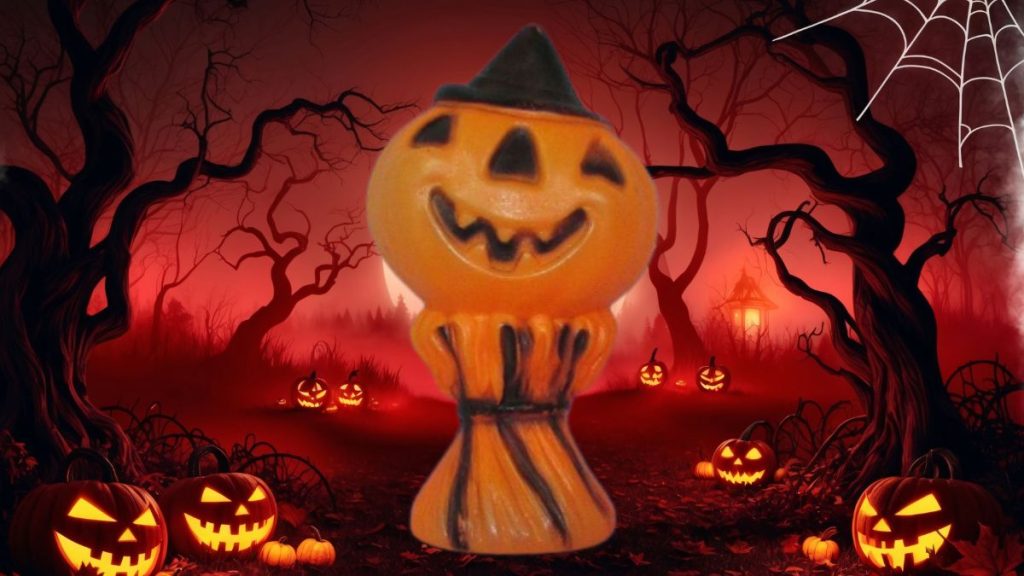
The arrangement is wonderfully old-fashioned. It looks like something that could have been sitting in a farmhouse window during the early 1970s, with the pumpkin grinning at passing trick-or-treaters while the light inside gives the whole decoration a warm orange glow.
But the haystack design has a much more complicated manufacturing history than its cheerful appearance suggests.
Collector research published by Making Make Believe, drawing on the Blow Molded reference archive, identifies versions associated with Bayshore, Norben Products, Empire, and General Foam. The design carries a 1969 marking on some examples, but related versions continued appearing long after Bayshore ceased production.
The differences between versions matter. Some have opaque haystacks, others translucent sections, and some were sold with little or no painted decoration. General Foam later produced its own versions during the 2000s.
This is exactly why I caution collectors against identifying a blow mold solely by its shape.
Two decorations can look remarkably similar while having very different manufacturing histories. A copyright date may refer to the original design rather than the year a particular example was produced, and the same basic figure can appear under several manufacturers over time.
The pumpkin-on-haystack design is a wonderful illustration of that problem. It’s also a reminder that a successful holiday decoration can outlive the company that introduced it by decades.
Bayshore’s Scarecrow Lamps
Scarecrows occupy an interesting place in vintage holiday decorating because they work just as well for autumn as they do for Halloween.
Bayshore’s scarecrow-themed illuminated decorations fit that tradition beautifully. They belong to an era when families often decorated for the entire fall season, leaving pumpkins, cornstalks, and harvest figures on display long before Halloween night arrived.
A scarecrow lamp didn’t necessarily need to be frightening. It simply had to look seasonal, provide a little light, and give the room that unmistakable feeling that summer was over and the holidays were approaching.
Bayshore scarecrow lamps are documented in vintage Halloween reference collections, although precise production years and variations deserve careful comparison with period catalogs.
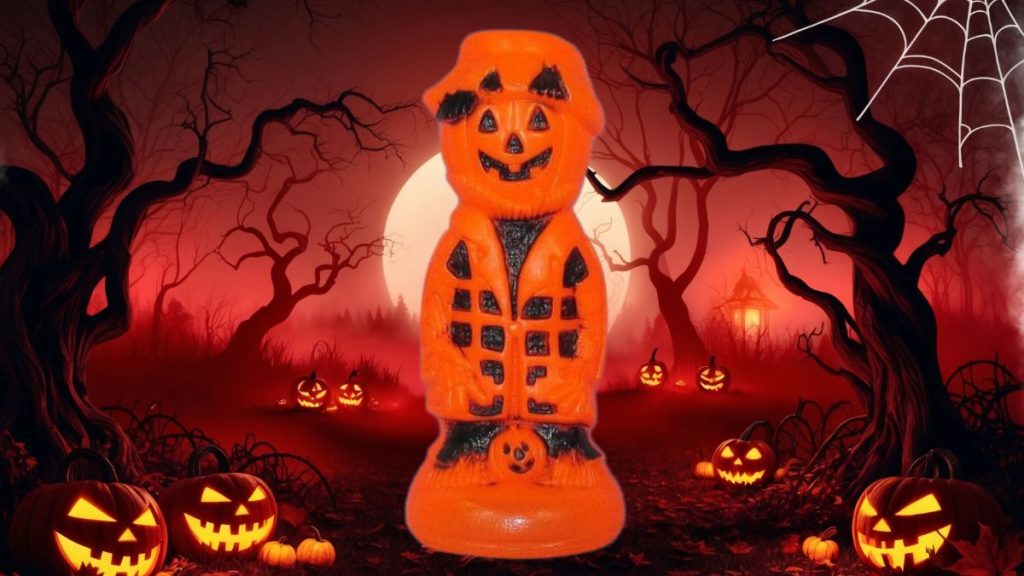
For collectors, these figures offer something slightly different from the more familiar jack-o’-lanterns. They bridge the gap between Halloween and Thanksgiving decorating, which makes them particularly appealing to anyone interested in the broader history of American seasonal displays.
The Haunted House: Bayshore’s Most Remarkable Survivor
Of all the decorations associated with Bayshore Industries, its illuminated haunted house may have the most fascinating story. I went into this in more detail here as part of my Halloween blow mold series.
Commonly described in collector references as a 17-inch lamp, the haunted house captured the playful side of vintage Halloween decorating. It had the kind of exaggerated architectural details and spooky charm that made these decorations so appealing to children.
There was no need for sound effects, motion sensors, or an elaborate display. You plugged it in, the windows glowed, and suddenly the corner of a room looked a little more haunted.
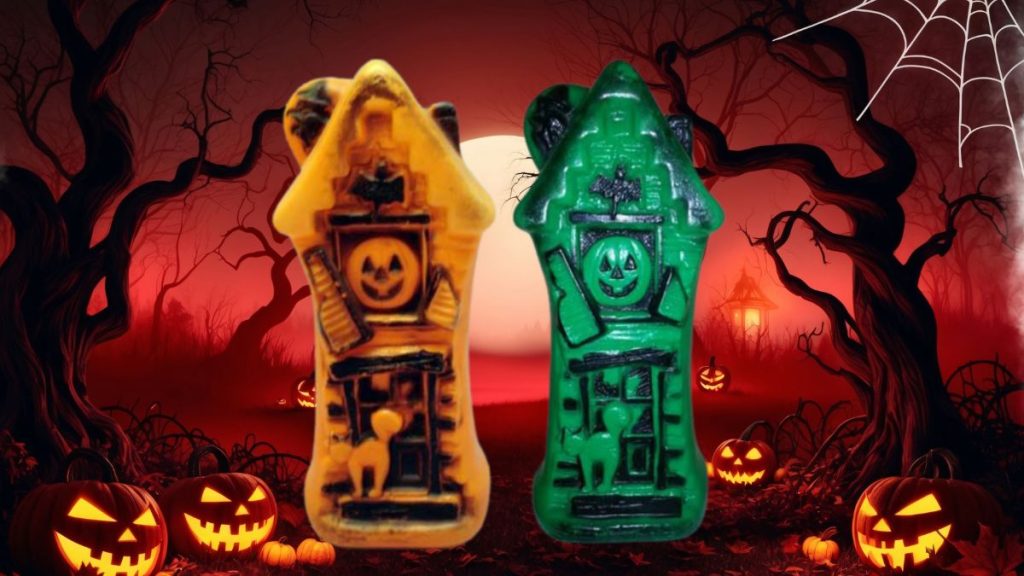
But the Bayshore haunted house has another distinction that makes it especially important to blow mold history.
Its design survived the disappearance of Bayshore Industries, continued under Empire Plastics, and was subsequently manufactured by General Foam Plastics.
That means a decoration associated with a relatively obscure manufacturer from the 1960s and 1970s eventually became part of the product histories of two much better-known blow mold companies.
For collectors, that’s a remarkable connection. It’s also a perfect example of why the story of a particular decoration doesn’t always end when its original manufacturer closes.
In Bayshore’s case, the haunted house had a considerably longer life ahead of it.
The 1972 Bayshore Catalog: A Window Into a Strange Little World
One of the most intriguing surviving pieces of Bayshore history is its 1972 Halloween product catalog, which has been discussed and reproduced by vintage Halloween enthusiasts.
For anyone who loves the visual culture of the early 1970s, catalogs like this are a treat.
They show what manufacturers were actually offering during a particular period, rather than relying on the memories of collectors or the dates stamped into surviving products. They’re also useful for identifying original product names, packaging, and the way decorations were marketed.
Bayshore’s catalog is especially interesting because it reflects the company’s broader novelty business. Its Halloween identity wasn’t limited to illuminated pumpkins. Rubber masks and other spooky merchandise were part of the same world.
One collector account even recalls a story about a mask designer finding inspiration in dreams, which seems entirely appropriate for a company that produced some rather unusual Halloween faces.
I can imagine a child flipping through a catalog like that in 1972 and deciding that the most frightening mask on the page was exactly what they needed for trick-or-treating. Their parents probably had other ideas, particularly if the costume involved wearing a rubber face that looked as though it belonged in a monster movie.
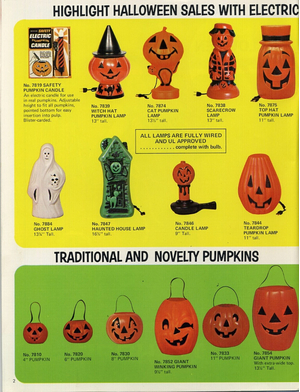
For historians, though, the catalog is more than a collection of amusing old products. It’s a snapshot of the seasonal novelty business at a time when American manufacturers were experimenting with materials, designs, and distribution.
And for Bayshore collectors, it’s one of the best places to begin when trying to separate documented products from decorations that have been incorrectly attributed to the company over the years.
What About Bayshore’s Christmas Blow Molds?
This is where Bayshore’s history becomes particularly interesting for collectors who primarily focus on Christmas.
The company appears in historical overviews of American blow mold manufacturers, including the Golden Glow of Christmas Past’s discussion of the industry’s early development. That reference places Bayshore among the companies that followed the first wave of illuminated Christmas decoration manufacturers.
But Bayshore’s best-documented surviving products are overwhelmingly associated with Halloween.
That doesn’t mean Christmas collectors should ignore the company. Quite the opposite. Bayshore belongs to the same postwar manufacturing story that gave us the classic illuminated Santas, snowmen, candles, and nativity figures we now associate with vintage Christmas displays.
The companies shared materials, manufacturing techniques, retail channels, and a growing consumer appetite for inexpensive decorations that could be reused year after year.
What I haven’t been able to establish from the surviving material is a sufficiently detailed, catalog-confirmed lineup of Bayshore Christmas figures. Rather than assign familiar Santas or snowmen to Bayshore without evidence, I’d prefer to leave that question open until original catalogs, packaging, or manufacturer documentation can settle it.
That’s one of the challenges of researching smaller blow mold manufacturers. The big names left behind enough products and documentation to make their histories relatively accessible. The smaller companies often require a little detective work, and sometimes the answers simply haven’t surfaced yet.
Still, Bayshore’s role in the larger industry is worth recognizing. Its Halloween decorations were part of the same American holiday culture that made illuminated plastic figures a fixture of Christmas decorating.
The glow didn’t belong to just one holiday.
The End of Bayshore Industries
Like many American novelty manufacturers, Bayshore eventually disappeared from the marketplace.
Collector histories generally place the end of Bayshore production around 1977, although accounts of the financial troubles involving its parent company, Miner Industries, differ slightly in their dates.
One history reports that Miner filed for bankruptcy in 1979, while research based on contemporary newspaper material points to financial difficulties and bankruptcy proceedings beginning around 1978.
Those discrepancies are worth acknowledging rather than smoothing over. The end of a company isn’t always a single event, particularly when subsidiaries, parent corporations, and manufacturing assets are involved.
What seems clear is that Bayshore’s years as an active producer of Halloween novelties came to an end during the late 1970s.
For many small manufacturers, that would have been the end of the story. The products would have disappeared from store shelves, the company’s name would have faded from memory, and whatever remained of its inventory might have been sold off or discarded.
But Bayshore’s decorations had another chapter ahead of them.
And that chapter involved Empire Plastics.
From Bayshore to Empire to General Foam: The Designs That Outlived Their Maker
One of the most fascinating aspects of Bayshore Industries’ history is that several of its designs didn’t disappear when the company closed. Instead, they found a second life with Empire Plastics, one of the most recognizable names in vintage holiday blow molds.
Empire acquired several Bayshore designs and incorporated them into its seasonal decoration lineup. This wasn’t particularly unusual in the blow mold industry, where successful designs and manufacturing molds could change hands as companies closed, reorganized, or sold off their assets.
But it makes identifying certain decorations considerably more interesting, especially when essentially the same figure appears under different manufacturers.
Perhaps the best example is Bayshore’s illuminated haunted house.
The original Bayshore haunted house was a charming little Halloween decoration, the kind of piece that looked equally at home on a tabletop or in a front window. With its spooky molded details and warm interior glow, it captured the spirit of old-fashioned Halloween decorating without requiring an elaborate display.
When Empire acquired several Bayshore designs, the haunted house became part of a much longer manufacturing story. Empire subsequently produced the design, and when General Foam Plastics later took over numerous Empire holiday decoration molds, the haunted house continued to be manufactured under the General Foam name.
Think about that for a moment.
A Halloween decoration associated with a company that disappeared in the 1970s managed to survive through two additional manufacturers, remaining in production long after Bayshore itself had faded into obscurity.
That’s a pretty remarkable lifespan for something originally intended as an inexpensive seasonal novelty.
It’s also a perfect illustration of why blow mold identification can be so tricky. A collector might encounter three haunted houses that look nearly identical, yet each could represent a different chapter in the design’s manufacturing history. Depending on the production run, molded markings, paint applications, plastic colors, lighting components, and packaging may provide clues about which company produced a particular example.
The haunted house also demonstrates something that doesn’t always receive enough attention in discussions of vintage blow molds: the design could be far more durable than the company that created it.
Bayshore may have disappeared, but Empire recognized the commercial appeal of several of its decorations. General Foam subsequently carried at least one of those designs forward, introducing it to another generation of Halloween enthusiasts who might never have heard the Bayshore name.
And that’s one of the reasons researching these manufacturers is so rewarding. What looks like an ordinary Halloween decoration can turn out to have a family tree of its own.
In the case of Bayshore’s haunted house, that family tree runs from Bayshore to Empire to General Foam, connecting three distinct chapters of American holiday blow mold history.
The same broader pattern can be seen in other seasonal designs that appeared under multiple manufacturers, including variations of the pumpkin-on-haystack decoration. While individual mold transfers and production dates still require careful documentation, these surviving figures demonstrate how designs could remain commercially useful for decades.
For collectors, it’s a wonderful reminder to look beyond the name stamped on the bottom. Sometimes the most interesting part of a decoration’s story happened decades before that particular example was manufactured.
Why Bayshore Blow Molds Are Worth Collecting
There’s a temptation in the vintage blow mold hobby to measure everything by rarity and resale value.
I understand the appeal. Finding an unusual decoration at a garage sale can be exciting, particularly when you discover that it has a history you never expected.
But Bayshore’s products remind me that the most interesting collectibles aren’t necessarily the largest or most expensive.
A small jack-o’-lantern that once sold for little more than a dollar can tell a surprisingly rich story about American manufacturing, holiday traditions, and the way ordinary families decorated their homes.
The appeal of Bayshore pieces lies partly in their scale. They’re manageable enough to display on a shelf or windowsill, and many have the unmistakable look of mid-century and early-1970s Halloween merchandise.
Their expressions are often cheerful rather than terrifying. The colors are bold, the designs are uncomplicated, and the light inside gives them a warmth that modern decorations sometimes struggle to reproduce.
For collectors who concentrate on Halloween, Bayshore offers an opportunity to explore a company that helped define the look of the holiday before elaborate outdoor displays became commonplace.
For collectors who focus on Christmas, Bayshore provides a useful reminder that blow molding was never limited to Santa Claus and snowmen. The same technology and manufacturing culture helped illuminate pumpkins, cats, scarecrows, haunted houses, Easter decorations, and other seasonal figures.
And for anyone interested in American industrial history, the company offers a fascinating example of how a business could evolve from rubber balloons to plastic holiday decorations in the space of a generation.
Identifying an Original Bayshore Decoration
If you come across a vintage Halloween blow mold that you suspect might be Bayshore, the first thing I’d recommend is examining the bottom and back of the piece.
Look for molded markings, paper labels, stickers, and any surviving information about the manufacturer. Bayshore products associated with Miner Industries may carry labels identifying the corporate relationship, which can be especially useful when researching the production period.
Don’t assume that a familiar shape automatically means the piece was made by Bayshore.
The pumpkin-on-haystack design is a perfect example of why that approach can lead collectors astray. Similar versions were produced by several manufacturers, and differences in paint, plastic, lighting arrangements, and markings can help distinguish one from another.
The haunted house provides an equally compelling example. A Bayshore original, an Empire production, and a later General Foam version may share the same basic appearance while representing very different periods in the design’s history.
Original packaging is particularly valuable when it survives. A box or label can provide a manufacturer name, product description, or other details that are missing from the decoration itself.
The condition of the lighting assembly also deserves attention. Many older tabletop decorations have lost their original bulbs or fixtures, and some have been fitted with replacements over the years. A replacement light doesn’t necessarily make a piece less enjoyable, but it’s worth documenting if you’re interested in originality.
And please be careful with old electrical components. A decoration that’s been sitting in a damp basement for forty years shouldn’t automatically be plugged into the nearest outlet simply because somebody wants to see it glow.
For research, I recommend comparing your piece with documented examples in the Blow Molded archive, surviving manufacturer catalogs, and collector photographs that show markings and construction details.
The more information we preserve about these decorations, the easier it becomes for future collectors to identify them accurately.
The Collectors Keeping Bayshore’s History Alive
One of the things I appreciate most about the blow mold community is how much historical information has been preserved by ordinary collectors.
Think about it. Bayshore has been gone for decades, and much of its merchandise was originally sold as inexpensive seasonal novelty goods. These weren’t products that people expected to become valuable historical artifacts.
Yet collectors saved the decorations, photographed the labels, tracked down old catalogs, and researched newspaper accounts of the company’s operations.
The website Euclid Boo, for example, documented the label and corporate history of a Bayshore cat-and-pumpkin lamp. Halloween Head connected a surviving decoration to the company’s 1972 catalog. More recently, Making Make Believe has explored Bayshore’s illuminated Halloween products and their relationships to later manufacturers.
Each of those efforts adds another piece to the puzzle.
I find that encouraging because the history of American holiday decorations isn’t preserved only in museums or corporate archives. Much of it survives in basements, garages, antique stores, and the homes of collectors who care enough to ask questions.
Sometimes the most useful historical document is a faded yellow sticker on the bottom of a plastic pumpkin.
And sometimes the person who finds it is the one who finally connects the dots.
Why Bayshore Belongs in the Story of The Glow That Won’t Go Out
When I wrote The Glow That Won’t Go Out: The Complete Collector’s Guide to Vintage Holiday Blow Molds, I wanted to explore more than the familiar glowing Santas and snowmen that many of us remember from childhood.
Those decorations are certainly a major part of the story. But the history of blow molds is also the history of the companies that manufactured them, the families who displayed them, and the collectors who recognized their importance long after the factories closed.
Bayshore Industries fits that story beautifully.
Here’s a company that began with rubber balloons in Maryland, expanded into toys and monster masks, moved into plastic seasonal novelties, and ultimately left behind decorations that are still being collected nearly fifty years after production ended.
And in some cases, the designs themselves enjoyed an even longer commercial life.
A decoration might look simple, but its history can be surprisingly complicated.
And once you begin researching the people and businesses behind these glowing figures, the hobby becomes about much more than finding another Santa for the front yard.
You begin discovering an entire chapter of American holiday culture that might otherwise be forgotten.
The Glow That Won’t Go Out explores that larger world, from the industry’s early manufacturers and iconic Christmas figures to Halloween collectibles, restoration, identification, and the remarkable community keeping these decorations alive.
Whether you’re a longtime collector or somebody who recently found a vintage pumpkin at an estate sale and wondered what it was, I hope the book gives you a deeper appreciation for the history behind these wonderful old decorations.
A Little Plastic Pumpkin With a Long Memory
I keep coming back to the image of a Bayshore jack-o’-lantern sitting in a window sometime around 1972.
Maybe it belonged to a family with three children who couldn’t wait for Halloween. Perhaps it sat beside a cardboard skeleton and a bowl of candy corn, glowing every evening throughout October.
After Halloween, somebody unplugged it, wrapped the cord around the base, and put it in a box until the following year.
The family probably didn’t think much about who manufactured it. They certainly weren’t wondering whether Bayshore Industries would still be in business fifty years later.
It was just part of Halloween.
And that’s what makes these decorations so special.
The factories may be gone, and the original catalogs may be difficult to find, but the pumpkins are still out there. Some are sitting on collectors’ shelves. Others are tucked away in attics, waiting for somebody to discover them.
And then there’s that haunted house, a decoration that somehow managed to keep going after Bayshore itself disappeared, passing through Empire and eventually General Foam.
I can’t help but appreciate the irony.
A haunted house that refused to die.
You couldn’t ask for a more fitting legacy from a vintage Halloween manufacturer.
Bayshore Industries may not be as famous as Empire, Poloron, or Union Products, but its place in the history of American holiday decorating deserves to be remembered.
Not bad for a company that started out making balloons.
Keep the History Glowing
If you enjoy discovering the forgotten manufacturers, unusual designs, and remarkable stories behind vintage holiday decorations, I invite you to explore my book, The Glow That Won’t Go Out: The Complete Collector’s Guide to Vintage Holiday Blow Molds.
The book explores the history of the hobby, the manufacturers that helped build it, iconic Christmas and Halloween figures, identification techniques, restoration and care, and the collectors who are preserving these pieces for future generations.
Because every old blow mold has a story. Sometimes it’s the story of a family Christmas. Sometimes it’s a childhood Halloween memory.
And sometimes it’s the story of a little company in Maryland that started with rubber balloons and created a haunted house that outlived its maker by decades.
Discover The Glow That Won’t Go Out on Amazon
Every blow mold has a story. Keep the glow alive.