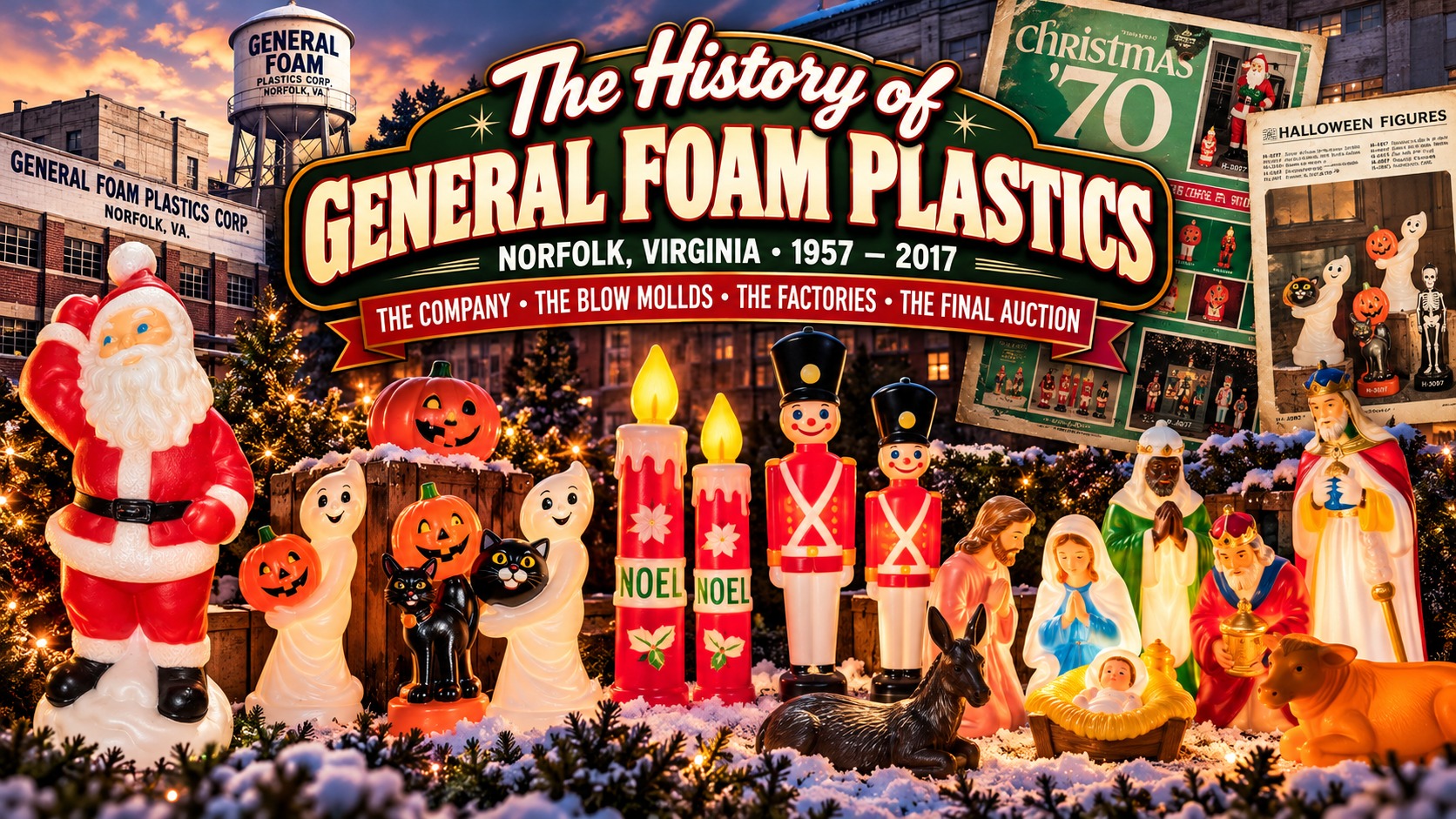
For 60 years, General Foam Plastics turned polyethylene into Christmas memories. Then it became something even more important: the caretaker of molds from companies that had disappeared before it.
By Curtiss Wayne Andrews
There is a peculiar moment that happens when you’ve been collecting blow molds long enough.
You turn one around.
You crouch down.
You brush off thirty years of dirt, dead spiders and whatever else has been living inside the base.
And there it is:
GENERAL FOAM PLASTICS CORP.
NORFOLK, VA.
MADE IN U.S.A.
For a lot of us, those words are almost as nostalgic as the decoration itself.
General Foam Santas stood beside suburban front doors.
Its candles flanked driveways.
Its soldiers guarded porches.
Its ghosts and witches came out every October.
And its Nativity figures appeared everywhere from family lawns to churchyards.
By the end of its life, General Foam wasn’t simply another blow mold manufacturer.
It had become the last great warehouse of American blow mold history.
The company possessed its own designs, but over decades it also accumulated molds with bloodlines running through Empire, Beco, Poloron, Santa’s Best and other vanished manufacturers. Collector histories describe General Foam as one of the industry’s great consolidators.
When General Foam finally stopped production in 2017, it therefore wasn’t merely another plastics factory closing.
It was as though somebody had locked the doors to the Smithsonian of glowing plastic.
And then auctioned off the exhibits.
This is the story of General Foam Plastics.
Norfolk, Virginia: Where It Started
General Foam Plastics was established in Norfolk, Virginia, in 1957.
Virginia corporate records give a particularly precise date: June 5, 1957.

That places General Foam’s birth at an interesting moment in American history.
The interstate highway system was new.
Suburbia was exploding.
Television was transforming advertising.
Plastics were becoming increasingly common in ordinary consumer products.
And Americans were buying houses with something previous generations hadn’t always possessed:
yards that needed stuff put in them.
General Foam found plenty of stuff to make.
Although collectors now associate the company primarily with Christmas and Halloween blow molds, its product universe was considerably broader.
The company manufactured artificial Christmas trees, wreaths and garlands, swimming pools, ponds, planters and molded plastic products, in addition to seasonal illuminated decorations. General Foam’s own later catalog described the company as a plastics-industry leader dating to 1957.
That matters.
Like Poloron and Union Products, General Foam wasn’t founded because somebody woke up one morning thinking:
America desperately needs a forty-inch glowing snowman.
It was a plastics manufacturer.
Blow molding became one particularly magical application of that technology.
The Factory on Princess Anne Road
For collectors who enjoy connecting objects to actual places, here’s an address worth remembering:
3321 East Princess Anne Road
Norfolk, Virginia 23502
That address appears in General Foam catalogs, government records and OSHA manufacturing data.
This wasn’t simply a corporate mailbox.
It was part of the physical world that produced the decorations.
Machines heated polyethylene.
Plastic parisons descended.
Molds closed.
Air pressure pushed molten plastic against cold metal.
Figures emerged.
Then came trimming.
Painting.
Electrical components.
Packaging.
Shipping.
Eventually a Santa manufactured in Norfolk could wind up at a Sears, Kmart, garden center or other retailer hundreds of miles away.
A family bought him.
They put him outside.
And thirty or forty years later somebody on Facebook Marketplace writes:
“Vintage Santa. Not sure how old. $20. Porch pickup.”
History has a sense of humor.
Who Actually Ran General Foam?
This is one place where I want to be careful.
Compared with Don Featherstone and Union Products, the publicly accessible historical record surrounding General Foam’s founders and early designers is surprisingly thin.
I haven’t found reliable documentation identifying a single charismatic founder or signature sculptor whom we can responsibly turn into “the Don Featherstone of General Foam.”
And I don’t think collectors should invent one just because it makes for a cleaner story.
Later corporate records do preserve some names.
Business records identify Jack Hall among General Foam’s presidents (2014-17 and findable on LinkedIn), while other records name company officers and employees including Heidi Hoppe, who served in financial/controller roles.
At the end of General Foam’s manufacturing era, William H. Arnold was its president and CEO. Virginia corporate filings identify Arnold as CEO/president, and collector histories also associate him with the company’s final closure announcement.
But the larger General Foam story belongs to hundreds of people whose names aren’t molded into the plastic.
Machine operators.
Painters.
Maintenance workers.
Tool-and-die personnel.
Packers.
Warehouse crews.
Truck drivers.
Office employees.
And later, the workers in Tarboro, North Carolina, who inherited one of the greatest collections of holiday blow-mold tooling ever assembled.
Because General Foam’s story changed dramatically in 2000.
General Foam Becomes the Great Collector
Here is where the company’s history gets fascinating.
Blow mold collectors collect blow molds.
General Foam essentially collected blow mold companies.
As competitors disappeared, tooling changed hands.
Designs migrated.
Names disappeared while the figures survived.
Collector histories associate General Foam with molds originating from companies including Beco Products, Poloron Products, Santa’s Best and Empire, among others.
That makes General Foam extremely important when trying to identify vintage pieces.
You can have two decorations that appear nearly identical…
but one says Empire.
Another says General Foam.
Maybe another variation traces back even farther.
That’s because in the blow mold industry, a company’s death didn’t necessarily kill its products.
The molds moved.
And General Foam became their great refuge.
Then Empire Fell
If there is one event that transformed General Foam from a major manufacturer into arguably the dominant American blow mold company, it was the collapse of Empire of Carolina.
Empire had become one of America’s great seasonal-plastic manufacturers.
But by 2000, it was in serious financial trouble.
General Foam stepped in.
A surviving asset-purchase agreement dated May 4, 2000 documents General Foam Plastics Corp. purchasing assets from Empire Industries and Empire of Carolina. The transaction included product lines, manufacturing equipment, intellectual property, inventory and real estate associated with Empire’s Tarboro operation.
Historical reconstruction of the transaction puts the seasonal/manufacturing assets at roughly $3.7 million, inventory at another $800,000, and the enormous Tarboro manufacturing facility at about $3 million.
And enormous is the right word.
The Tarboro complex encompassed approximately 1.2 million square feet.
General Foam had just inherited a Christmas empire.
Literally.
Tarboro Becomes Blow Mold Country
The acquisition meant General Foam now had two particularly important production centers:
Norfolk, Virginia
and
Tarboro, North Carolina.
Instead of immediately shipping Empire’s manufacturing overseas, General Foam continued making holiday figures and other molded-plastic products in Tarboro.
That preserved more than manufacturing capacity.
It preserved continuity.
Empire molds kept running.
Empire designs reached another generation.
Families buying a Nativity in 2005 might have had no idea that the basic sculpture they were putting in the yard traced back decades.
This is one of my favorite things about blow mold history.
The plastic object can look frozen in time while the company name underneath quietly changes.
The Nativity That Refused to Die
Perhaps no product demonstrates this better than the classic Empire/General Foam Nativity.

Empire produced versions of its familiar Nativity family beginning in the late 1960s. The assortment expanded over time to include shepherds, sheep, Wise Men, a camel, donkey, ox and other figures.
After General Foam acquired Empire’s assets, the Nativity returned under General Foam and remained in production through 2017.
Think about the lifespan of that design.
Vietnam.
Watergate.
Disco.
Reagan.
The Internet.
Facebook.
Smartphones.
And somewhere during all of it, somebody was putting essentially the same glowing Mary and Joseph on the lawn.
That’s not merely a successful product.
That’s an American Christmas tradition.
General Foam’s own marketing understood the emotional appeal. Its catalog described illuminated Nativities, candles, elves, angels, Santas, snowmen and soldiers appearing on millions of American lawns.
The company wasn’t selling polyethylene anymore.
It was selling December.
Santa, Naturally
Of course there were Santas.
Lots of Santas.
General Foam’s catalogs included everything from familiar yard-size figures to a Giant Life-Size Santa, along with sleigh Santas and inherited designs from earlier manufacturers. Surviving General Foam documentation also lists giant candles, lamp posts, angels, singers and Nativity figures.
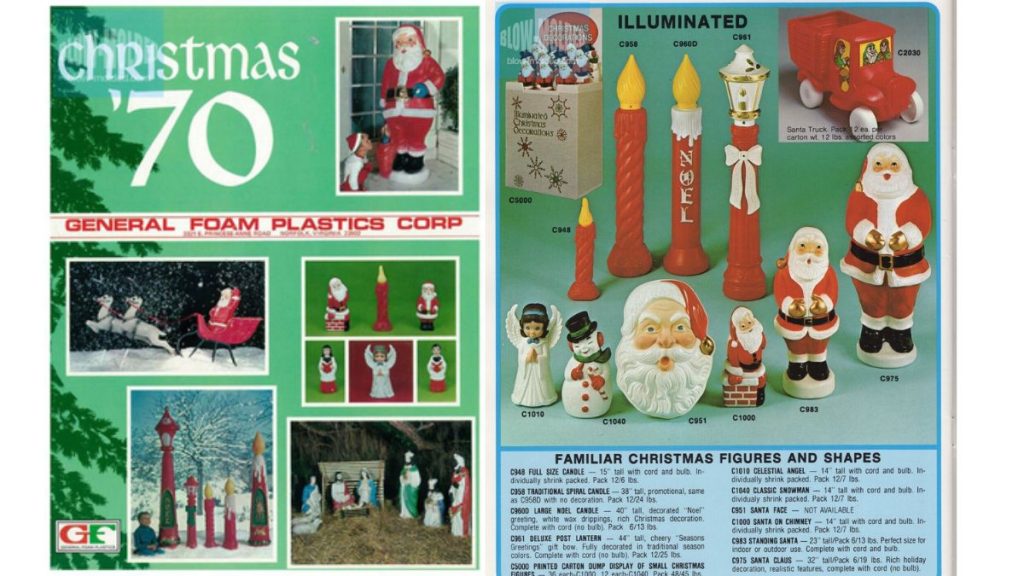
Its catalog became enormous.
That’s part of the fun—and frustration—of collecting General Foam.
Some designs were General Foam originals.
Some had Empire ancestry.
Some traced into other companies.
Some were revised.
Some were repainted.
Some appeared in multiple colors.
Some survived so long that grandparents and grandchildren could have bought versions of essentially the same decoration new.
General Foam wasn’t just making blow molds.
It was maintaining a library of them.
The Toy Soldiers Who Guarded America
If you’ve driven around American neighborhoods at Christmas, you’ve probably encountered the blow mold soldier.

Standing at attention Red jacket.
Black hat.
Cheerfully guarding a driveway against absolutely nothing.
Toy soldiers became one of the archetypal blow mold forms, and General Foam produced soldier designs that became fixtures of its seasonal assortment.
They worked because they’re almost perfectly suited to blow molding.
Tall.
Vertical.
Colorful.
Symmetrical.
Readable from the street.
Put two beside a front door and suddenly your suburban split-level has apparently acquired a royal guard.
This is the peculiar genius of blow molds.
They’re ridiculous.
And they work.
Candles: The Simplest Great Blow Mold
Then there are the candles.
A blow mold candle is essentially a giant illuminated plastic candle that cannot provide heat, cannot melt and cannot actually function as a candle.
Which makes it one of the most logically perfect Christmas decorations ever invented.
General Foam produced numerous candle variants, including large candles and spiral designs.
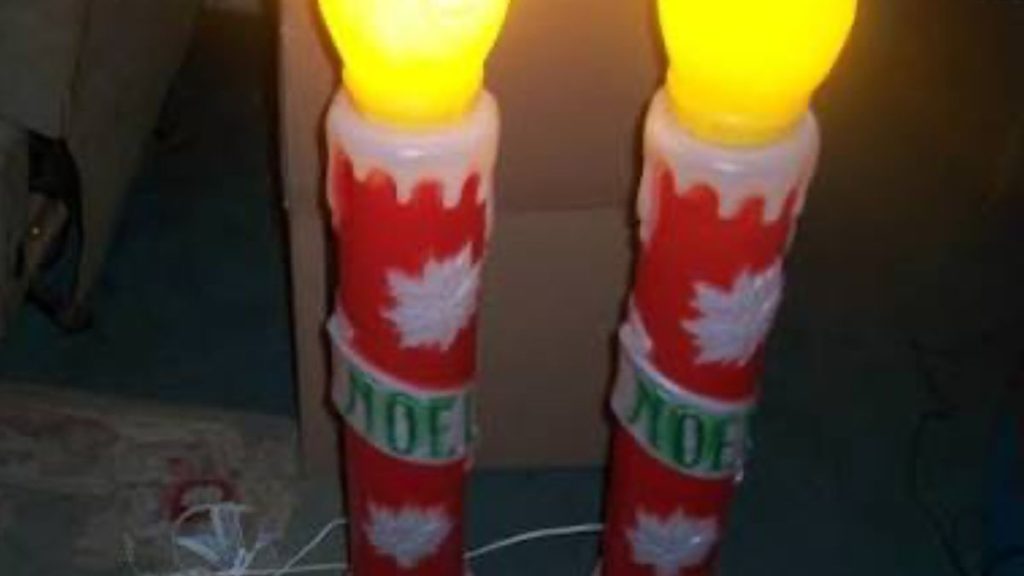
And we know those molds mattered because when General Foam’s assets were auctioned after the shutdown, Cado Products acquired a pallet containing different candle molds, along with several other recognizable designs.
Simple forms survive.
Sometimes simplicity is exactly what makes a design timeless.
Halloween Gets Weird
General Foam wasn’t content with Christmas.
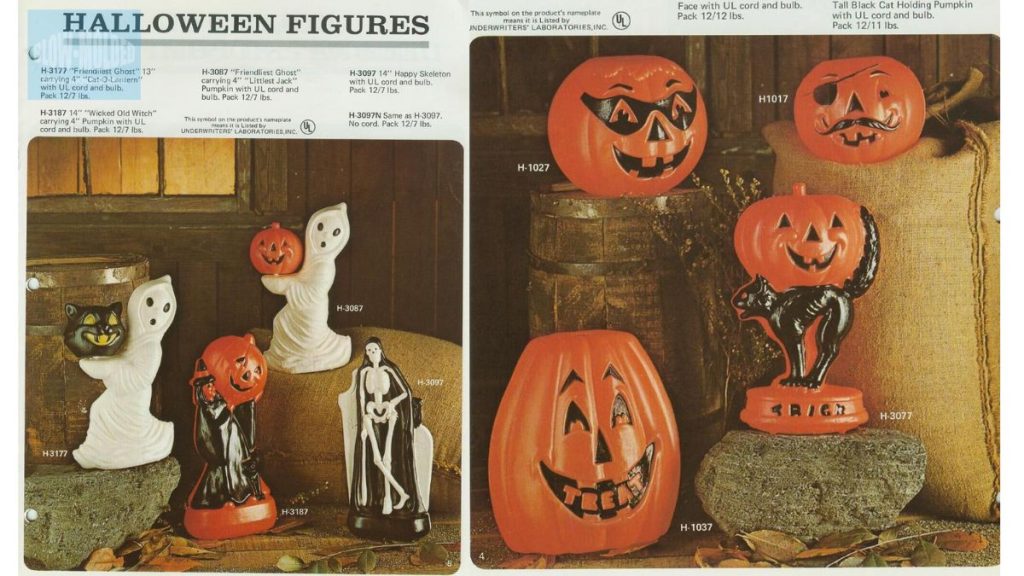
Its own marketing proudly mentioned Halloween monsters, ghosts and witches appearing at homes around the country.
And Halloween is where blow molding becomes especially fun.
Christmas has rules.
Santa should probably be red.
Snowmen should probably be white.
Mary shouldn’t look like she’s headed to a disco.
Halloween?
Anything goes.
Pumpkins.
Ghosts.
Witches.
Skeletons.
Monsters.
Black cats.
Candy pails.
General Foam even manufactured familiar blow-molded jack-o’-lantern trick-or-treat buckets, surviving examples of which remain marked with the Norfolk address.
These inexpensive objects were made for children to fill with candy.
Nobody was thinking:
Better preserve this carefully. It’ll be collectible in 35 years.
Which is precisely why good survivors become collectible.
The Blue Swimming Pool Connection
Here’s another General Foam object you may remember without realizing who made it.
The cheap molded plastic children’s swimming pool. Remember those?
General Foam manufactured pools alongside its seasonal products, and after acquiring Empire’s Tarboro operation it continued producing both holiday decorations and those familiar plastic pools there.
There’s something wonderfully American about the same industrial operation producing:
Baby Jesus and a kiddie pool.
But technologically, it makes sense.
Both are applications of large-scale plastic manufacturing.
Christmas collectors see magic.
The factory saw polyethylene.
General Foam Outlived Almost Everybody
This may be General Foam’s greatest achievement.
It survived.
Beco disappeared.
Poloron disappeared.
Union Products’ original operation closed.
Santa’s Best left the field.
Empire collapsed.
One by one, the giants vanished.
General Foam kept going.
By the 2000s and 2010s, that made the company increasingly unusual.
The American blow mold industry was contracting while decorating tastes were changing.
Inflatables became enormously popular.
Imported decorations became cheaper.
Retail shelf space became more competitive.
And the economics of manufacturing large hollow pieces of plastic filled mostly with air became difficult.
Think about the logistics.
A 40-inch Santa may not weigh much.
But he takes up a giant box.
That box takes up warehouse space.
Truck space.
Retail space.
And after Christmas?
Consumer storage space.
An inflatable can collapse into a fraction of that volume.
Collectors may prefer the rigid glowing Santa.
Retail logistics often prefer the box that fits twenty inflatables.
That’s a problem nostalgia can’t easily solve.
The Walmart Problem—or More Accurately, the Retail Problem
American retail changed dramatically during General Foam’s lifetime.
The company began in an era of local department stores, hardware stores and regional chains.
It ended in the age of big-box retail and e-commerce.
Large retailers increasingly controlled enormous purchasing volumes and valuable seasonal shelf space.
That creates pressure.
Lower prices.
More efficient packaging.
Fast inventory turns.
Imported products.
Decorations that take up less room.
General Foam was manufacturing something beloved but inherently awkward.
Blow molds are terrible roommates.
Ask any collector.
Buy three and suddenly the garage is negotiating terms of surrender.
That’s funny when you’re a collector.
It’s much less funny when you’re a national retailer calculating revenue per square foot.
And Then There Was China
The other pressure was one that devastated entire sectors of American manufacturing.
Overseas competition.
General Foam’s closure has repeatedly been attributed in part to difficulty competing with imported products, along with declining demand and the challenges of maintaining aging domestic manufacturing facilities.
This wasn’t unique to General Foam.
The same broad economic forces appear throughout the histories of America’s blow mold manufacturers.
Domestic labor.
Energy.
Resin.
Maintenance.
Tooling.
Transportation.
Retail price pressure.
Eventually the math becomes brutal.
And when the product you’re selling is a plastic snowman…
there’s only so much consumers will pay before they decide they don’t need the snowman.
Collectors reading this in 2026 may scream:
YES WE DO.
Unfortunately, nobody asked us.
The Warning Signs
By the mid-2010s, trouble was increasingly apparent.
North Carolina records show General Foam’s Tarboro operation appearing in the state’s Trade Adjustment Assistance system beginning in 2016, a program associated with workers affected by foreign competition.
Then came 2017.
After sixty years in business, General Foam announced that the end was coming.
Collector histories report that CEO William Arnold announced the Norfolk property was being put up for sale as the company confronted weak sales and overseas competition.
Production stopped.
Final merchandise moved through retailers.
Employees who had spent years making America’s plastic Christmas decorations lost their jobs.
General Foam’s Norfolk and Tarboro manufacturing operations shut down.
And just like that…
the last giant went dark.
March 6, 2018: The Auction
If you want a date that feels like the end of an era, use this one:
March 6, 2018.
At 9:00 a.m., an industrial auction began at General Foam’s Tarboro plant at 501 Daniel Street.
The surviving auction catalog is remarkably stark.
No nostalgia.
No sentimental speeches about Christmas mornings.
Just machinery.
Equipment.
Lot numbers.
Terms of sale.
The industrial remains of a company being dismantled.
Collectors saw something else.
The molds.
Decades of American Christmas history were suddenly assets in a liquidation.
One industry source estimated General Foam possessed around 350 holiday blow molds when it closed.
And this is where the story becomes painful.
Many molds apparently did not survive intact into another manufacturer’s catalog.
Some were purchased.
Some went to private buyers.
Others were reportedly scrapped.
Think about what an aluminum production mold represents.
It isn’t merely equipment.
It is the master.
Destroy the master and you haven’t destroyed every existing Santa.
But you’ve severed the easiest path to making another one exactly like him.
Cado Goes Shopping
Thankfully, not everything disappeared.
Cado Products attended the General Foam liquidation and acquired several important molds.

Collector documentation identifies purchases including versions of the Nativity set and Wise Men, Mrs. Claus, Dancing Santa, Toy Soldier and various candles.
And then something happened that collectors had almost stopped expecting.
Some old designs came back.
The Empire/General Foam Nativity lineage is particularly remarkable. After disappearing with General Foam’s closure, Cado eventually returned the familiar Nativity to production in 2024, including a Menards-exclusive release.
A mold born generations earlier had survived Empire…
survived General Foam…
survived an industrial liquidation…
and returned to a store shelf.
Tell me these things aren’t stubborn.
A Blow Mold Has a Family Tree
This is perhaps the single most important lesson General Foam teaches collectors.
The name molded into the plastic is only part of the story.
A General Foam figure might descend from:
Poloron.
Beco.
Santa’s Best.
Another predecessor.
Or General Foam itself.
Corporate ownership changed.
Tooling changed hands.
Names were machined out.
New names were added.
Paint schemes changed.
Lighting hardware changed.
Plastic changed.
Retail packaging changed.
The basic sculpture remained.
Industry archives specifically note that when assets transferred between manufacturers, tooling could be altered to replace or obscure previous manufacturer markings.
That’s why identifying blow molds is detective work.
And that’s why two collectors can stare at what appears to be the same snowman and spend twenty minutes discussing his bottom.
Context matters.
Why General Foam Still Matters So Much
General Foam doesn’t have one Pink Flamingo.
It doesn’t have the same almost mythical identity Poloron developed around its most spectacular early pieces.
Its importance is different.
General Foam became the bridge.
A bridge between the golden age of American blow mold manufacturing and the twenty-first century.
A bridge between Empire and modern collectors.
A bridge that kept old tooling in production long after the companies that created it disappeared.
And for millions of consumers, General Foam wasn’t vintage.
It was simply Christmas.
You bought the decoration at Kmart.
Or Sears.
Or a garden center.
Or eventually online.
You plugged it in.
You put it away in January.
You repeated the ritual next year.
Only after the factory closed did many people realize those objects weren’t guaranteed to exist forever.
Scarcity has a remarkable ability to make us appreciate ordinary things.
The Difference Between a General Foam and an Empire
This is where collecting gets especially interesting.
If General Foam acquired an Empire mold and continued producing the same basic figure, which version should you want?
The older one?
The rarer one?
The better-painted one?
The one you remember from childhood?
There’s no universal answer.
Some collectors chase earliest production.
Some prefer particular paint applications.
Some collect manufacturer variations.
Some want every version.
Others simply want the snowman Grandma had.
That’s what makes blow mold collecting unusually personal.
The most valuable piece isn’t always the one worth the most money.
Sometimes it’s the $25 Santa that stood outside your childhood home.
General Foam understood that accidentally.
It kept old forms alive long enough for several generations to develop memories around them.
Sixty Years of Plastic
Consider General Foam’s lifespan.
1957 to 2017.
Sixty years.
During that time America changed almost beyond recognition.
Shopping malls rose and declined.
Sears went from retail titan to near disappearance.
Kmart covered the country and then vanished from most of it.
Manufacturing moved overseas.
The Internet arrived.
Amazon arrived.
Smartphones arrived.
A reality TV billionaire became President.
Christmas decorating became bigger, brighter and more elaborate.
Inflatables invaded lawns.
LEDs replaced incandescent bulbs.
Yet General Foam kept manufacturing essentially the same wonderfully primitive idea:
Take a hollow piece of polyethylene.
Paint a face on it.
Put a bulb inside.
Make somebody smile.
There’s something almost defiant about that.
General Foam’s Most Important Product Wasn’t a Santa
After researching these companies for The Glow That Won’t Go Out, I’ve started thinking differently about General Foam.
Its most important contribution may not have been any individual decoration.
It was continuity.
When Empire disappeared, General Foam saved part of Empire.
When other manufacturers vanished, tooling survived through acquisition.
When America’s domestic blow mold industry collapsed around it, General Foam kept making the things.
Not forever.
But longer.
Long enough that a child born in the 1960s and a child born in the 2000s could both grow up looking at some of the same plastic faces glowing in December.
That’s extraordinary.
The Factory Is Gone. The Santas Aren’t.
Factories feel permanent when they’re operating.
They’re not.
Companies feel permanent when their products fill store shelves.
They’re not either.
General Foam disappeared.
Empire disappeared.
Poloron disappeared.
The original Union operation disappeared.
Retailers disappeared.
Catalogs disappeared.
Employees retired.
Buildings changed hands.
But the products escaped.
They’re in attics.
Garages.
Antique malls.
Estate sales.
Facebook Marketplace listings.
Church storage rooms.
Collectors’ basements.
And every December, thousands of them come back outside.
That’s why I called my book The Glow That Won’t Go Out.
Because this hobby isn’t really about plastic.
It’s about survival.
Things survive.
Memories survive.
Traditions survive.
Sometimes even molds survive.
And somewhere tonight, somebody is plugging in an old General Foam Santa.
The company that made him is gone.
But the light still works.
Discover the History Behind the Glow
General Foam Plastics is one chapter in the much larger story told in The Glow That Won’t Go Out: The Complete Collector’s Guide to Vintage Holiday Blow Molds.
The book explores the origins of blow molding, legendary manufacturers such as Union, Poloron, Empire and General Foam, identification, collecting, restoration, rare pieces and the people keeping this peculiar piece of American holiday history alive.
Because once you understand where these things came from…
you’ll never look at that plastic Santa in the same way again.