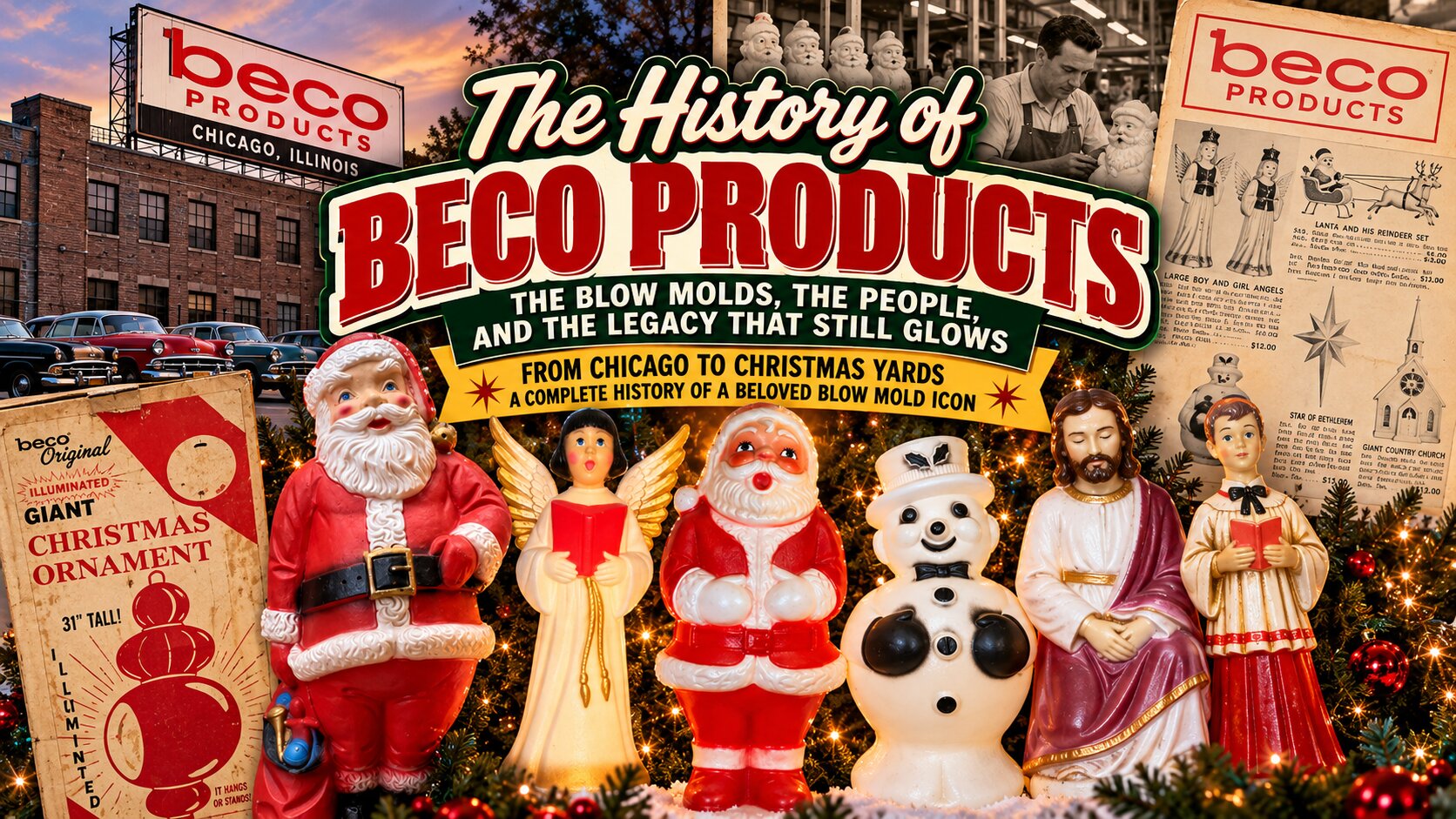
From Chicago’s manufacturing heyday to the Santas, snowmen and holiday decorations collectors still treasure, Beco Products helped illuminate American Christmases—and left behind a legacy that deserves to be remembered.
By Curtiss Wayne Andrews
There are certain names in the vintage blow mold world that practically announce themselves.
Union Products. Empire. General Foam. Poloron.
Mention any one of them to a serious collector, and you’re liable to get a fifteen-minute explanation of mold variations, paint applications, production dates and why the Santa sitting in somebody’s garage is actually worth three hundred dollars.
But there’s another name that deserves a place in that conversation.
Beco Products.
For generations of American families, Beco was part of the magic of Christmas. Its molded plastic decorations appeared on lawns, porches and beneath the warm glow of Christmas lights. They weren’t museum pieces. They were affordable decorations designed to make ordinary homes look a little more extraordinary.
And that’s precisely why they matter.
Today, Beco’s surviving decorations have become something their original manufacturers probably never imagined: collectible artifacts of mid-century American life.
In my book, The Glow That Won’t Go Out, I explore the companies, creative decisions and manufacturing innovations that helped build the vintage blow mold industry. Beco belongs in that story—not simply because of what it made, but because of what its surviving decorations reveal about the era that produced them.
To appreciate Beco, however, we have to travel back to a time when Christmas decorations were manufactured in American factories, plastic represented progress, and nobody imagined that a glowing snowman might someday become a prized family heirloom.
Before the Blow Molds: The Bernard Edward Company
Beco’s story begins not with Santa Claus, but with a company called the Bernard Edward Company in Chicago, Illinois.
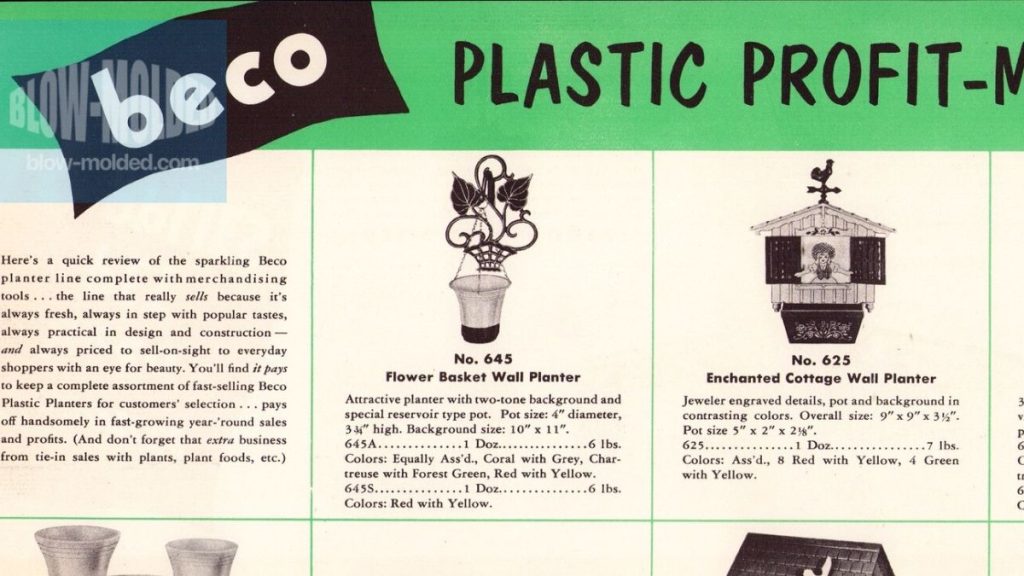
The precise founding date remains uncertain. Historical research published in the Journal of Antiques and Collectibles establishes that the company was operating by the late 1940s, manufacturing products that included drapery hardware and kitchen accessories.
These were practical household goods, made from materials including metal and plastic.
Nothing particularly glamorous.
No illuminated reindeer. No towering Santas. No carolers standing in the snow.
Just the everyday business of manufacturing things people needed.
But this was an important moment in American industrial history.
Plastic was rapidly becoming one of the defining materials of the postwar economy. Manufacturers were discovering that products traditionally made from wood, glass or metal could increasingly be produced in plastic.
The possibilities seemed almost limitless.
For a company already working with plastic household products, expanding into decorative merchandise represented a logical opportunity.
And Christmas offered something particularly attractive to manufacturers: a predictable annual selling season and a growing American appetite for festive home decorations.
Beco was positioned to take advantage.
A Little Mystery Surrounds the Name
The company’s transition from Bernard Edward Company to Beco Products can be traced through surviving packaging and legal records, although the exact corporate chronology isn’t entirely complete.
A trademark dispute with Ekco Products began in 1950, concerning marks used in the late 1940s. By 1954, the legal dispute had produced a finding that the marks were sufficiently distinguishable.
More revealing for Christmas collectors is a surviving carton for Beco’s injection-molded Angel Singers. Its labeling identifies Beco Products Corporation as the successor to the Bernard Edward Company.
That piece of packaging is a small historical treasure.
It helps establish that Beco was manufacturing plastic Christmas decorations by approximately the mid-1950s, before its famous blow-molded lawn figures became widespread.
And it illustrates something I find endlessly fascinating about this hobby.
Sometimes the most important historical evidence isn’t the decoration itself.
It’s the box somebody almost threw away.
Chicago: The Industrial Home of Beco Products
Beco was a Chicago company, operating in one of America’s great manufacturing cities.
Chicago’s industrial economy provided the infrastructure that made a company like Beco possible: manufacturing expertise, access to transportation, retailers, suppliers and a large workforce accustomed to making consumer goods.
Its headquarters and manufacturing identity are consistently associated with Chicago, Illinois.
However, the surviving collector histories I’ve reviewed do not establish a reliably verified street address for every phase of Beco’s operations. I would rather leave that detail open than attach an incorrect address to the company’s history.
The same caution applies to its workforce.
Unlike Union Products, whose famous designer Don Featherstone became a public figure, Beco has left behind relatively little widely accessible documentation identifying its designers, production managers and factory employees.
That doesn’t mean those people weren’t important.
Quite the opposite.
Somebody sculpted those faces.
Somebody engineered the molds.
Somebody worked out how to illuminate a large hollow plastic Santa evenly.
Somebody applied the paint that gave each figure its personality.
And somebody packed those decorations into cartons destined for department stores across America.
We know their work.
We just don’t know nearly enough of their names.
That’s one of the frustrating—and intriguing—parts of reconstructing American manufacturing history.
The products survive long after the people who made them disappear from the public record.
When Christmas Decorations Became Three-Dimensional
By the late 1950s and early 1960s, plastic Christmas decorations were undergoing a transformation.
Earlier molded decorations frequently used hard plastic components formed through injection molding. These could be attractive, but they weren’t necessarily the large, hollow, internally illuminated lawn figures that collectors associate with classic blow molds. I go into this in further detail here when discussing the much sought-after Raylite angel.
Blow molding offered different possibilities.
A hollow plastic form could be manufactured by inflating heated plastic inside a mold. The result could be relatively lightweight, weather-resistant and large enough to make an impression on a suburban front lawn.
Add an internal light bulb, and the figure became something special.
Suddenly, Santa didn’t have to be a flat silhouette nailed to the garage.
He could stand in the yard.
A snowman could greet visitors.
A choir of angels could illuminate a front porch.
And an entire Nativity scene could glow against a December night.
Beco was among the early companies helping bring that vision to American consumers.
Beco’s Greatest Achievement: Santa Takes Flight
If there’s one product that deserves special attention in the Beco story, it’s the company’s remarkable Santa-and-reindeer display.
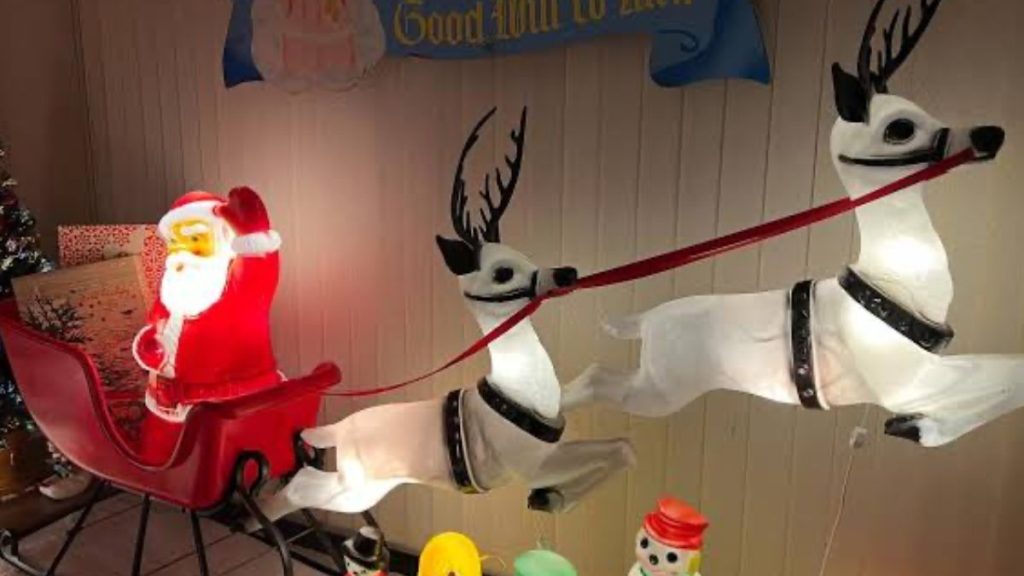
Some collector histories suggest that Beco may have introduced one of the first fully three-dimensional blow-molded Santa-and-sleigh sets for consumers around 1963 or 1964.
That date—and the claim of being first—remain unconfirmed.
What we can document is that Beco’s Santa-and-reindeer display appeared in both the 1966 Sears and JCPenney catalogs.
Think about that for a moment.
In the mid-1960s, families browsing those catalogs could purchase a dimensional Christmas display that previously might have seemed more appropriate for a department-store window.
Santa Claus.
His sleigh.
A pair of snowy white reindeer.
An entire Christmas fantasy, manufactured in plastic and available to ordinary households.
There was one interesting limitation.
In the early catalog version, Santa was internally illuminated, but the reindeer were not. They required an external spotlight.
Later versions addressed that problem.
It’s a wonderful reminder that these decorations weren’t born perfect.
They evolved.
Manufacturers experimented, revised and improved their designs as they learned what worked in actual front yards.
And Beco was helping establish the visual language that generations of Christmas decorators would embrace.
The Animated Santa That Was Ahead of His Time
Beco didn’t limit itself to stationary decorations.
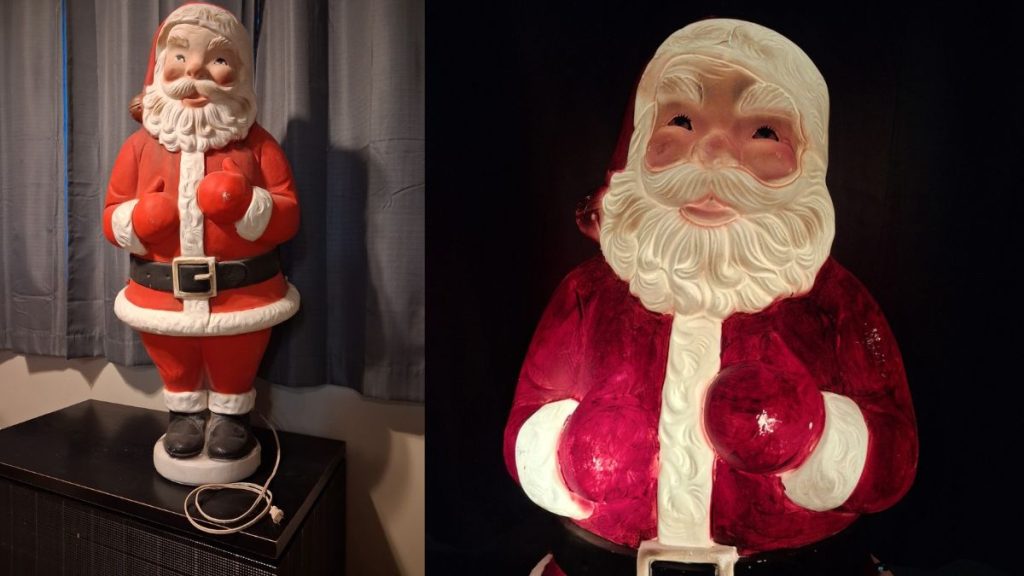
One of its most fascinating products was a 42-inch animated Santa Claus.
This wasn’t simply a large plastic figure with a light inside.
The Santa was constructed in two sections, with a motor that created a rocking or bowing motion.
When assembled and plugged in, the figure illuminated and moved.
In 1966, Sears offered this animated Santa for $16.50.
For perspective, that was a meaningful purchase in a household Christmas decorating budget of the era.
It’s easy to overlook how ambitious such a product was.
The manufacturer needed to combine a large decorative sculpture, an electrical lighting system and a mechanical movement mechanism in a consumer product that could be shipped, assembled and displayed.
This was much more than a plastic Santa.
It was a little piece of mid-century holiday engineering.
And it anticipated the animated lawn displays and moving Christmas decorations that would become commonplace decades later.
The Beco Choir: Faces That Still Make Collectors Smile
Not every important Beco decoration needed a motor.
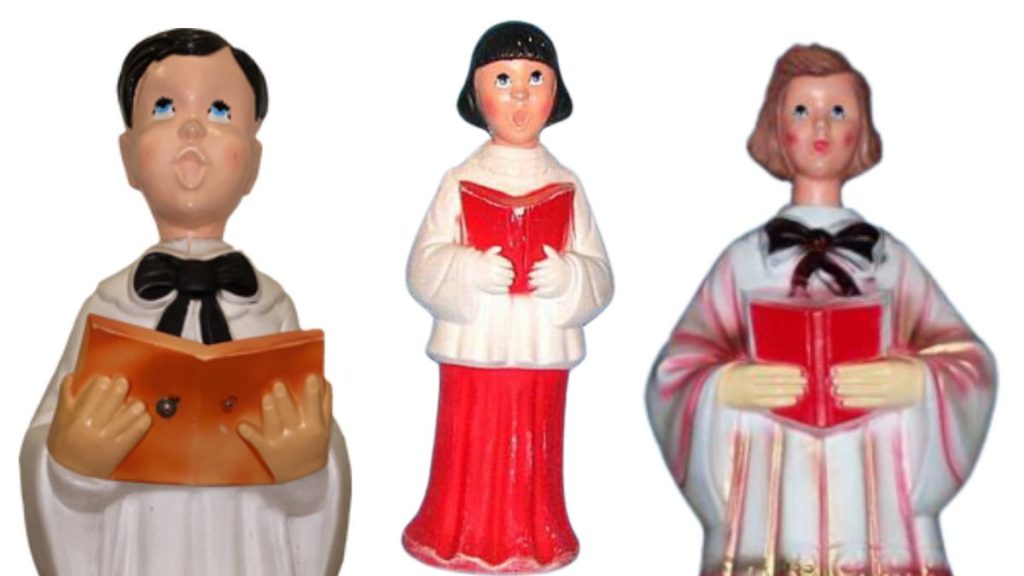
Some of its most memorable pieces were its choir children and angel singers.
Beco offered singing figures in a range of sizes, from approximately 12-inch tabletop decorations to versions reaching around 40 inches.
There were also larger choir figures, including a documented 29-inch singer.
What makes these figures so appealing is their character.
A choir figure is essentially a person standing still and singing.
That doesn’t sound particularly exciting on paper.
But the sculptor has to communicate the entire idea through a frozen expression.
The face must suggest a song.
The posture must feel animated even when the figure isn’t moving.
The details have to be visible in daylight but also work after dark.
And the decoration needs to remain charming rather than vaguely unsettling.
That’s harder than it sounds.
The best vintage choir figures seem to possess personalities.
You can almost imagine them performing in front of a department store, outside a church or beside the family Christmas tree.
It’s the kind of craftsmanship that helps explain why collectors continue seeking out these pieces long after their original retail lives ended.
Santas, Snowmen, Candles and an Entire Christmas World
Beco’s catalog extended far beyond its most famous displays.
Historical accounts document a broad selection of Christmas decorations, including Santas, candles, Nativity figures, choir singers and oversized ornaments.
Some ornaments were designed to hang from buildings; others could be secured outdoors.
The company produced decorations in different sizes and formats, making its merchandise accessible to customers with different spaces and budgets.
This range was commercially important.
Not everyone could afford a large Santa-and-sleigh display.
Not everyone had a sprawling suburban yard.
But a smaller glowing figure could fit on a porch.
A candle could flank a doorway.
A tabletop singer could brighten a window.
Beco wasn’t simply selling decorations.
It was helping families create Christmas scenes.
And once a family started building a display, the temptation to add another figure the following year was practically inevitable.
Collectors today understand that phenomenon better than anyone.
One Santa becomes two.
Two become a snowman.
The snowman needs a candle.
The candle looks lonely without a choir.
And eventually the garage becomes a plastic retirement community.
Why Beco Blow Molds Have Such a Distinctive Glow
One of Beco’s most interesting contributions wasn’t immediately visible from the outside.
It was the company’s lighting system.
Many Beco figures used a bottom-mounted assembly featuring a metal rod that held the bulb near the center of the decoration.
The assembly attached to a base plate that locked into the bottom of the figure.
The advantage was relatively even illumination.
Rather than concentrating light near one side of the decoration, the bulb could illuminate much of the sculpted body.
The disadvantage?
Changing a burned-out bulb could be an adventure.
Because the lighting assembly was accessed from underneath, a collector might need to lift the entire figure, remove the base plate and replace the bulb.
Try doing that when the ground is frozen and the Santa has been sitting outside in January weather.
Suddenly, modern replacement light cords start looking pretty appealing.
Still, this construction is a valuable identification clue.
The mounting plate, internal rod and original electrical hardware can help distinguish certain Beco pieces from later decorations made by other manufacturers.
As I emphasize in The Glow That Won’t Go Out, the underside of a vintage decoration can be just as interesting as its face.
Sometimes more interesting.
A manufacturer mark, unusual mounting mechanism or distinctive electrical opening can reveal the history of a piece that otherwise looks like an ordinary old Christmas decoration.
The Giant Santa That Outlived His Maker
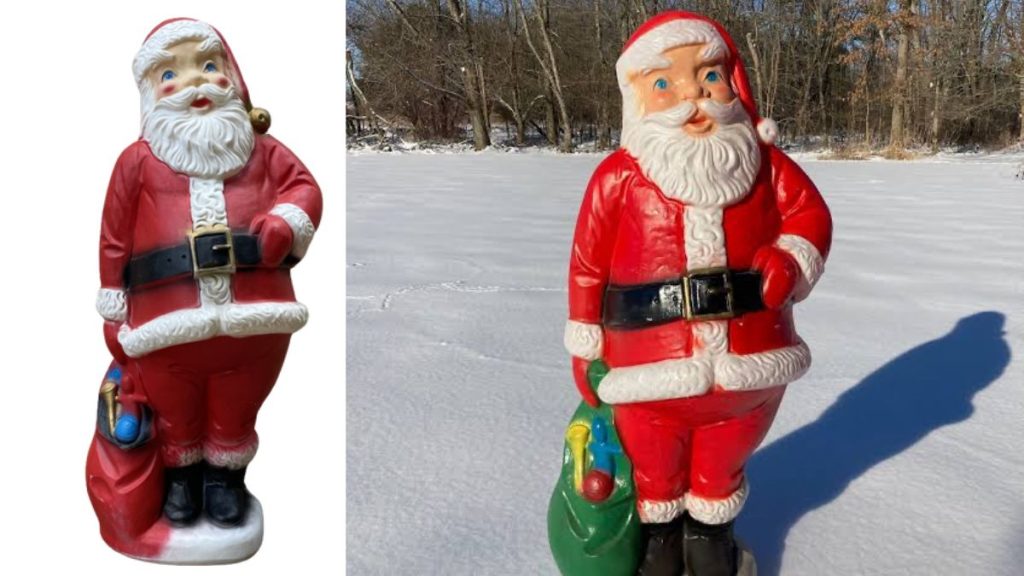
Among the designs associated with Beco is a towering Santa Claus standing approximately five feet tall.
Collector documentation identifies a Beco version from the 1960s and subsequent production by General Foam Plastics beginning around 1970.
The design underwent changes over the years, including variations in size and paint treatment.
This is an especially interesting chapter in blow mold history because it demonstrates how the disappearance of a manufacturer didn’t necessarily mean the disappearance of its designs.
A mold could change ownership.
Production could move.
A new company could introduce different colors, modify a base or change a lighting arrangement.
To the average shopper, it was still a familiar Santa.
To a collector, those differences can reveal decades of manufacturing history.
It’s one of the reasons identifying vintage blow molds can become such a fascinating detective exercise.
The character may look familiar.
The company behind it might be a completely different story.
The Beginning of the End: MSL Industries
Beco’s story took a major turn in 1965, when the company was acquired by MSL Industries.
For a company that had helped establish the market for plastic holiday decorations, this was the beginning of a significant transformation.
The Beco name continued for a period after the acquisition.
But in 1968, MSL discontinued the Beco name in favor of MSL Plastics.
Then, in 1970, many of the company’s cast-aluminum molds were acquired by General Foam Plastics.
This distinction matters.
It would be misleading to describe Beco as simply shutting its doors on one particular day and disappearing.
The history is more complicated.
The original company was acquired.
Its name was retired.
Some of its tooling passed to another manufacturer.
And production of designs associated with Beco continued beyond the end of the Beco brand.
Historical collector research suggests that production of the original Beco-associated pieces may have ceased in the late 1970s or early 1980s, but the exact endpoint is uncertain.
That’s a very different kind of demise from a factory suddenly going dark.
Beco’s identity faded while parts of its manufacturing legacy lived on.
General Foam and the Second Life of Beco
The transfer of Beco tooling to General Foam Plastics is one of the most consequential parts of this history.
General Foam would become a major name in blow mold manufacturing, producing holiday decorations for decades.
It also became associated with tooling and designs from earlier companies.
The result was an unusual form of industrial inheritance.
A decoration designed in one era could reappear years later under a different manufacturer’s name.
A family buying a Santa in the 1980s might not realize that its design had roots in the 1960s.
A collector finding that Santa today might recognize the sculpt but need to examine the markings, lighting hardware and production details to identify the particular version.
This is why the history of vintage blow molds can’t be told as a series of completely separate companies.
Their stories overlap.
Their molds migrated.
Their designs survived changes in ownership.
And their products remained part of American Christmas long after their original corporate names disappeared.
The People Behind Beco: An Important Missing Chapter
One of the things that makes researching Beco both rewarding and frustrating is the scarcity of documented personal histories.
We can trace the Bernard Edward Company.
We can examine the trademark dispute.
We can identify the company’s Christmas products in department-store catalogs.
We can follow its acquisition by MSL and the subsequent movement of tooling to General Foam.
But the people who actually created Beco’s distinctive figures are harder to identify.
Who sculpted its most recognizable Santa?
Who designed the animated mechanism?
Who supervised the production of the choir singers?
How many people worked in the Chicago operation during its busiest years?
The historical sources available to me don’t provide reliable answers. I’m interested in the human stories.
And I think it’s important to acknowledge that rather than invent a romantic factory history around unnamed workers.
Still, those unanswered questions are worth pursuing.
Somewhere, there may be old employee newsletters.
Family photographs.
Pay stubs.
Factory snapshots.
Retired workers’ recollections.
Or a catalog bearing the name of a designer whose work still glows on collectors’ lawns.
If those records survive, they could add an entirely new dimension to Beco’s story.
Because the history of these decorations isn’t only about plastic.
It’s about the people who made them.
Why Hope Holubowicz Loves Her Beco Santas
All of this manufacturing history helps explain why Beco is important.
But to understand why people still love Beco, I think it’s worth listening to someone who actually lives with these decorations.
In my recent collector spotlight,
“Dad, I Have a $500 Emergency”: Inside Hope Holubowicz’s Vintage Blow Mold Obsession, Hope described her affection for Beco Santas and Don Featherstone Halloween decorations.
What stood out wasn’t their potential resale value.
It was their appearance.
Hope loves their wonderfully kitschy personalities.
As she put it in our interview:
“I am a 1990s baby living in a 1950s Christmas!”
That sentence might be the most concise explanation of the vintage blow mold hobby I’ve ever heard.
Hope has built a collection of roughly 300 decorations, with a strong preference for older pieces.
Her childhood memories of Christmas shopping trips with her father helped establish that affection.
Today, her Beco Santas represent more than an attractive collection.
They’re part of an entire nostalgic world she’s recreated around herself.
And I think Beco is particularly well suited to that kind of collecting.
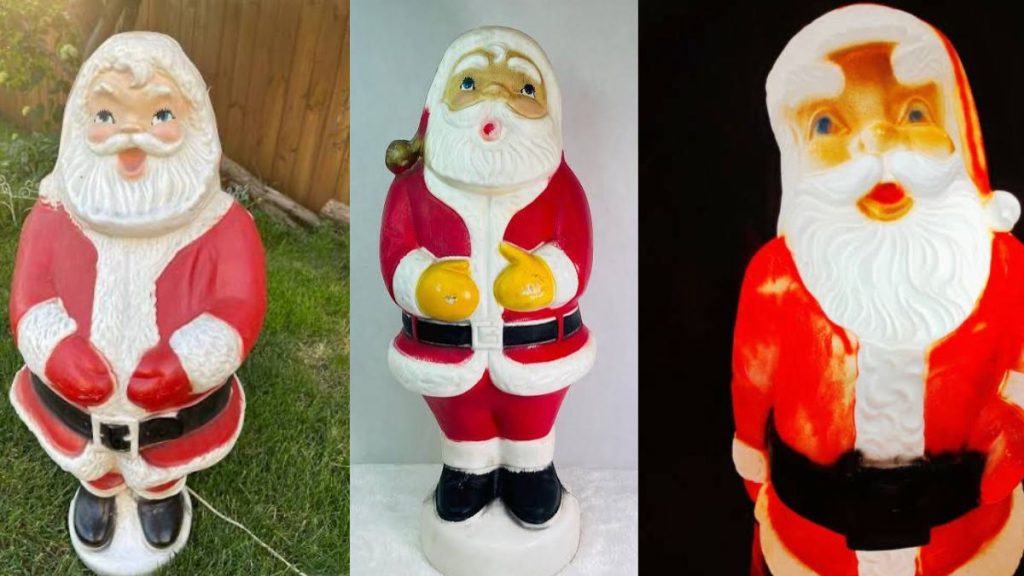
These figures have an unmistakable old-fashioned charm.
They’re playful.
Sometimes exaggerated.
Occasionally a little strange.
They come from an era when Christmas decorations weren’t expected to look photorealistic.

A Santa could have enormous cheeks, an oversized beard and a grin that seemed almost too enthusiastic.
That was part of the appeal.
Beco’s decorations weren’t trying to reproduce reality.
They were trying to reproduce the feeling of Christmas.
And collectors like Hope understand the difference.
Why Beco Remains So Admired
Beco doesn’t have the immediate name recognition of Union Products and its famous Pink Flamingo.
It didn’t survive as a familiar retail brand into the modern era.
And unlike some later manufacturers, it doesn’t have decades of easily searchable corporate publicity explaining every chapter of its history.
Yet serious collectors continue to seek out its decorations.
Why?
First, Beco was an early innovator.
Its Santa-and-sleigh displays and animated decorations helped demonstrate the potential of large, three-dimensional holiday lawn figures.
Second, its designs have personality.
The choir figures, Santas and other decorations capture a distinctly mid-century interpretation of Christmas.
Third, its construction is interesting.
The company’s lighting systems and production methods provide clues for collectors who enjoy identifying and dating their finds.
Fourth, its designs have historical reach.
Through later manufacturers, some Beco-associated molds continued appearing long after the original company name disappeared.
And finally, there’s nostalgia.
A Beco Santa isn’t just a piece of old plastic.
It’s a connection to the Christmas displays of an earlier generation.
A reminder of department-store catalogs, glowing front lawns and the excitement of seeing decorations appear each December.
The company may be gone.
But that feeling hasn’t disappeared.
How to Identify a Vintage Beco Blow Mold
If you discover a vintage Santa, choir figure or other holiday decoration that you suspect might be Beco, start with the physical evidence.
Look for molded manufacturer markings, surviving paper labels, original packaging and model numbers.
Examine the lighting system, especially whether the piece uses a bottom-mounted assembly with a central support rod.
Pay attention to the sculpt, size and paint application.
Compare the decoration with documented catalog images whenever possible.
And remember that a design associated with Beco may have been manufactured later by General Foam or another successor.
The original sculpt alone isn’t always enough to establish the date or manufacturer of a particular example.
That distinction can be particularly important when purchasing expensive vintage pieces.
A collector should understand whether they’re buying an early Beco production, a later version made from related tooling, or a different decoration with a similar appearance.
Condition matters, too.
Original paint, structural damage, missing electrical components and previous repairs can all affect desirability.
But perhaps the most important lesson is this:
Don’t assume that an unmarked or unfamiliar decoration has no history.
Sometimes the most interesting pieces are the ones that require a little research.
The Company Disappeared. The Christmas Magic Didn’t.
The original Beco name vanished from production decades ago.
Its corporate identity was absorbed into larger manufacturing operations.
Its tooling passed into other hands.
And many of the people who made its decorations have disappeared from the accessible historical record.
Yet Beco is still here.
It’s here in Hope Holubowicz’s beloved Santas.
It’s here in vintage Christmas collections.
It’s here in surviving catalog pages, original cartons and the occasional estate-sale discovery.
It’s here whenever someone plugs in a decades-old decoration and watches it illuminate a room—or a front lawn—just as it did generations ago.
I find that remarkable.
A company that began by manufacturing practical household goods helped create decorations that became emotional touchstones.
Its products were intended to be seasonal merchandise.
Instead, they became family traditions.
And eventually, they became history.
That may be the greatest achievement of Beco Products.
Not that it manufactured plastic Christmas decorations.
But that it manufactured something people still care enough to preserve.
Beco’s name may have faded. Its glow never really did.
Discover More in The Glow That Won’t Go Out
The story of Beco Products is just one chapter in the larger history of America’s vintage holiday blow mold industry.
In The Glow That Won’t Go Out, I explore the manufacturers, creative personalities, production techniques and collectors who helped turn these decorations into enduring pieces of American nostalgia.
From Union Products and Empire to General Foam, Poloron and the collectors preserving their creations today, it’s a celebration of the plastic holiday figures that continue to bring joy to generations.
Whether you’re identifying an estate-sale Santa, researching an unfamiliar manufacturer or simply remembering the decorations you grew up with, there’s a much bigger story behind that familiar glow.
Explore The Glow That Won’t Go Out on Amazon.
Because every vintage blow mold has a history.
And some of those histories are still waiting to be discovered.