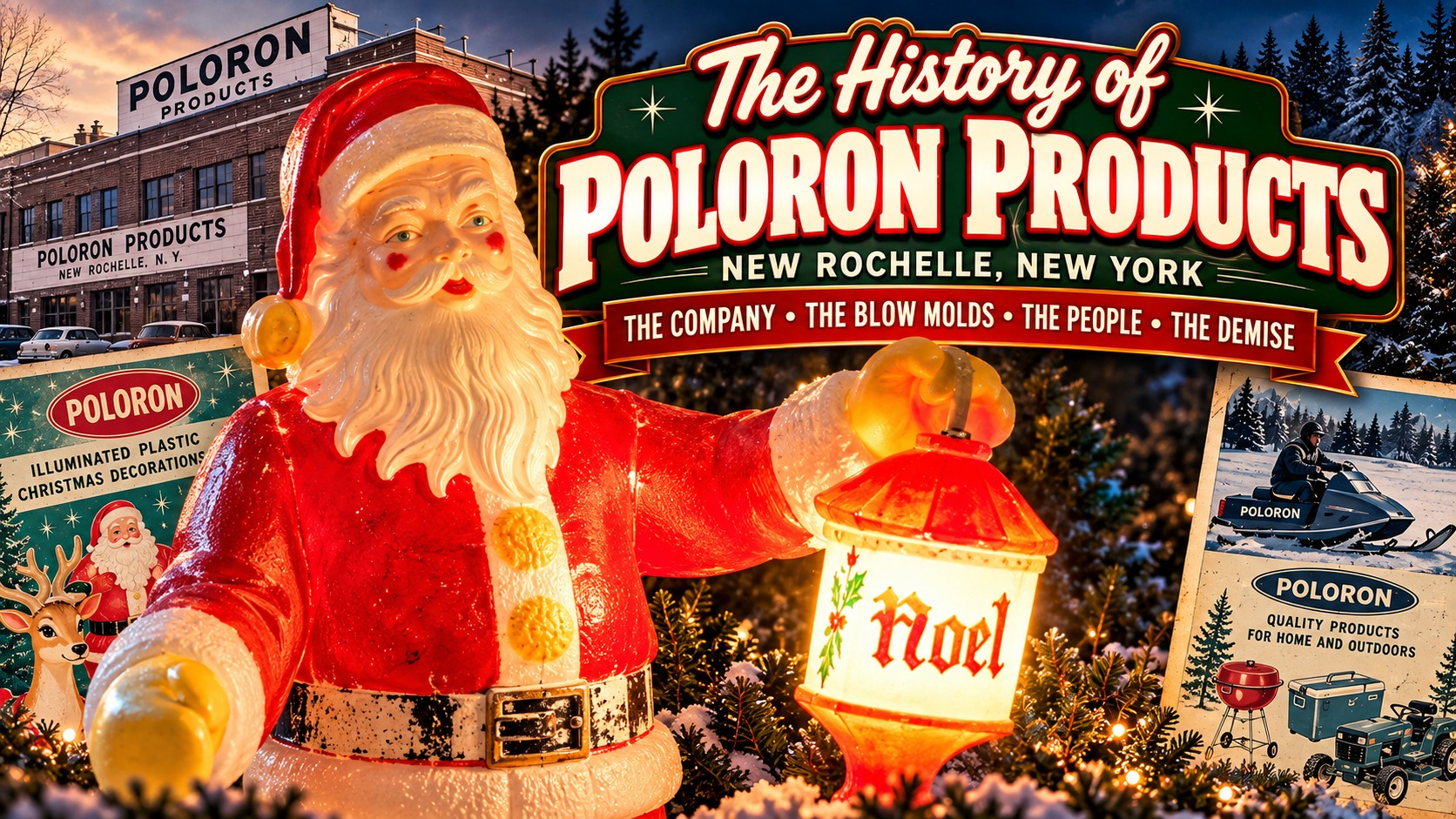
Before collectors chased its choir children, animated Santas and elaborate Nativity sets, Poloron was building coolers, grills, lawn equipment—and eventually even snowmobiles and houses. Its spectacular rise and disappearance is one of the strangest stories in blow mold history.
By Curtiss Wayne Andrews
There are vintage blow molds you recognize.
And then there are vintage blow molds that make collectors stop what they’re doing.
A four-foot Poloron choir child standing in the corner of an estate sale can do that.
So can one of the company’s elaborate Nativity figures.
And if you stumble across a genuine five-foot Poloron Animated Swinging Santa holding his illuminated Noel lantern, you might want to cancel whatever plans you had for the rest of the afternoon.
Because Poloron wasn’t subtle.
Union Products gave us Don Featherstone and the Pink Flamingo. Empire became one of the giants of mass-market Christmas blow molds. General Foam eventually accumulated an enormous catalog of American molds.
Poloron Products seemed determined to prove that hollow plastic Christmas decorations could be spectacular.
Big figures.
Heavy plastic.
Detailed paint.
Metallic gold accents.
Mechanical movement.
Multiple light bulbs.
Entire Nativity scenes.
Santa and sleigh displays that could practically take over a front yard.
Collectors admire Poloron today because the company made some extraordinarily ambitious decorations.
But the most surprising thing about Poloron?
Christmas decorations were only one tiny part of what this company did.
At various points, Poloron was involved with picnic coolers, grills, furniture, lawn tractors, travel trailers, snowmobiles, Christmas ornaments, modular housing and more. Contemporary accounts describe a company that grew into something resembling a small manufacturing conglomerate, operating roughly a dozen factories across the eastern United States.
Somewhere along the way, it also produced some of the most desirable blow molds ever made.
This is the story of Poloron Products.
Before the Blow Molds
The surviving histories don’t agree perfectly on Poloron’s founding year.
The Journal of Antiques and Collectibles and other historical sources place the beginning of Poloron Products in New Rochelle, New York, in 1937. Some collector databases use 1938. Given the stronger documentary trail supporting 1937, that’s the date I’ll use here—with the caveat that you’ll encounter 1938 in blow mold references.
And Poloron did not begin as a Christmas blow mold company.
That’s important.
Like several great names in blow mold history, Poloron existed before illuminated polyethylene Santas became a suburban decorating phenomenon.
The company manufactured utilitarian consumer products including picnic jugs, coolers, outdoor grills and braziers, and Christmas tree stands. A Poloron trademark filing later recorded commercial use of its name on outdoor grills and braziers as early as 1947.
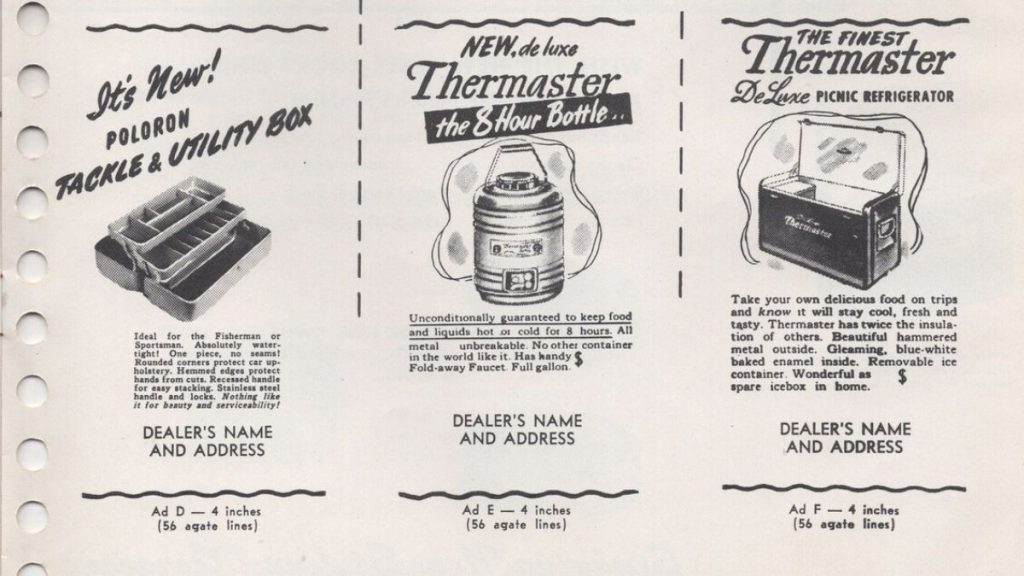
A 1957 patent provides another fascinating glimpse into the company.
Robert P. Brown of White Plains, New York, assigned Poloron a patent for an improved grill-lifting mechanism used in charcoal braziers. The patent identifies Poloron Products as a New York corporation based in New Rochelle.
In other words, before Poloron was figuring out how to illuminate Santa…
it was figuring out how to move your hamburger closer to the charcoal.
American manufacturing was nothing if not versatile.
New Rochelle Was the Brain—But Poloron Became Much Bigger
Poloron’s corporate headquarters became associated with 165 Huguenot Street in New Rochelle, New York. A 1968 SEC filing lists precisely that address. Today what sits there is a giant luxury apartment complex.
But Poloron wasn’t simply one New York factory pumping out snowmen.
As the company expanded, manufacturing spread across multiple locations.
One especially interesting operation was in Ruston, Louisiana.
Poloron arrived there in 1955. At its height, roughly 170 employees reportedly manufactured picnic jugs, ice chests, folding chairs, TV trays and other products. Christmas decorations eventually became part of the operation as well.
There were facilities elsewhere.
A federal court case documents Poloron moving a massive industrial press from New Rochelle to its Batesville, Mississippi plant in 1959.
The company also operated in Michigan City, Indiana, where lawn tractors—and later snowmobiles—were assembled. A 1973 industry directory identifies Joseph D. Brown as president of Poloron Products of Indiana at 110 Menke Road.
This was no little Christmas-decoration workshop.
Poloron had become a serious multi-state manufacturing operation.
The Browns and the People Behind Poloron
One frustration in researching old blow mold companies is that we often know far more about the plastic figures than the people who made them.
Poloron is no exception.
Collector references identify Robert P. Brown and Joseph D. Brown among the company’s principal executives. Robert Brown’s connection is particularly well documented: he appears as a Poloron inventor on the 1957 grill patent, and by the mid-1970s a Polytechnic Institute document described him as the retired chairman of Poloron Products.
Joseph Brown appears in records as president of Poloron’s Indiana operation.
The company’s leadership evolved as Poloron expanded. Benjamin B. Hampton, for example, served as executive vice president and director from 1971–73 and then president and CEO in 1973–74, according to published biographical records.
But focusing exclusively on executives misses something important.
Poloron was also hundreds of factory workers.
Machine operators.
Painters.
Assemblers.
Packers.
Tooling personnel.
Production managers.
Shipping crews.
The Ruston operation alone had about 170 employees and an annual payroll reportedly reaching roughly $1 million before its 1973 closure.
Those are the largely anonymous people behind the collectibles sitting in our garages and basements today.
Every hand-painted choir child passed through somebody’s hands before it reached Sears.
Then Christmas Got Plastic
By the early 1960s, blow-molded Christmas decorations were emerging as a new consumer category.
Beco in Chicago was an early force. Union Products was entering the field. NOMA/Tico was involved.
And Poloron joined them.
Specialist histories generally place Poloron’s first blow-mold Christmas figures in the mid-1960s, although some collector histories date its entry as early as 1963. What can be documented firmly is that Poloron filed a federal trademark in July 1967 covering “decorative plaques and seasonal ornaments.”
That gives us a useful historical anchor.
By the latter half of the 1960s, Poloron was firmly in the holiday-decoration business.
And it didn’t approach the category timidly.
What Made a Poloron Look Like a Poloron?
Collectors sometimes develop the ability to recognize a manufacturer before turning a piece over.
Poloron makes that possible.
The company became known for substantial plastic, detailed sculpting and unusually elaborate paint applications. Surviving examples often remain remarkably impressive decades later.
Then there’s the gold.
Oh, Poloron liked gold.
Metallic gold paint became one of the company’s visual signatures.
You’ll find it decorating choir books.
Cassock trim.
Candles.
Angel wings.
Even Santa’s beard.
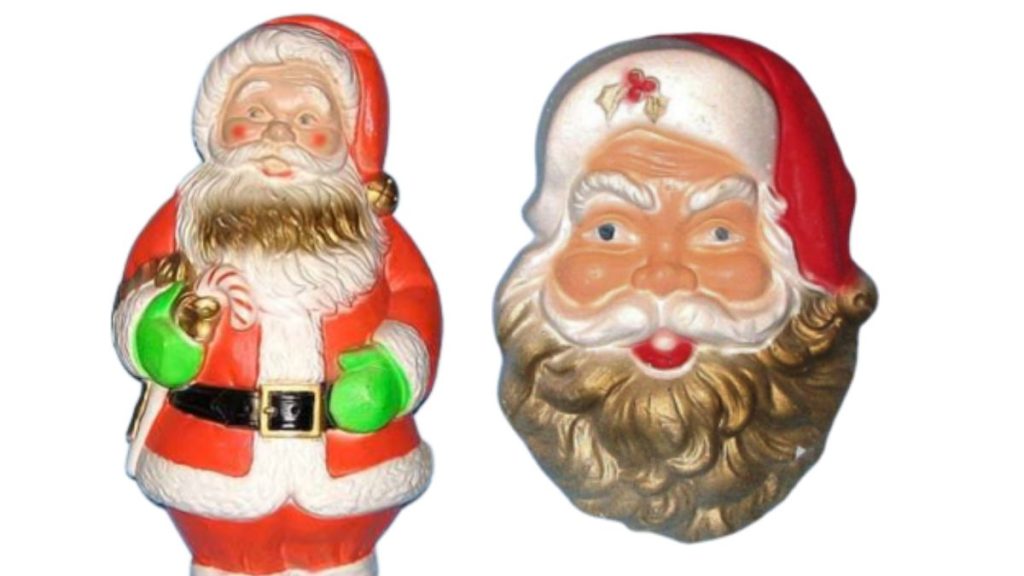
In daylight, it can give Poloron pieces an unusually rich appearance.
At night, something interesting happens.
Metallic paint isn’t especially interested in cooperating with the light bulb inside the blow mold. It blocks more illumination than translucent paint, meaning heavily painted areas can become dark when the figure is illuminated.
That’s why a gold-painted Poloron Santa beard can suddenly appear dramatically shadowed at night.
It’s not necessarily damage.
It’s physics.
And it’s part of the character.
Poloron’s Choir Children: Four Feet of Christmas
If I had to select one Poloron family that captures what collectors love about the company, the 48-inch choir figures would be near the top.
Introduced in 1969, the original group included two girls and a boy, with identical bodies fitted with interchangeable heads. A highly prized African American choir boy joined the line in 1970.
And these things weren’t small.
Four feet tall.
Put several together and you didn’t have a Christmas decoration.
You had a congregation.
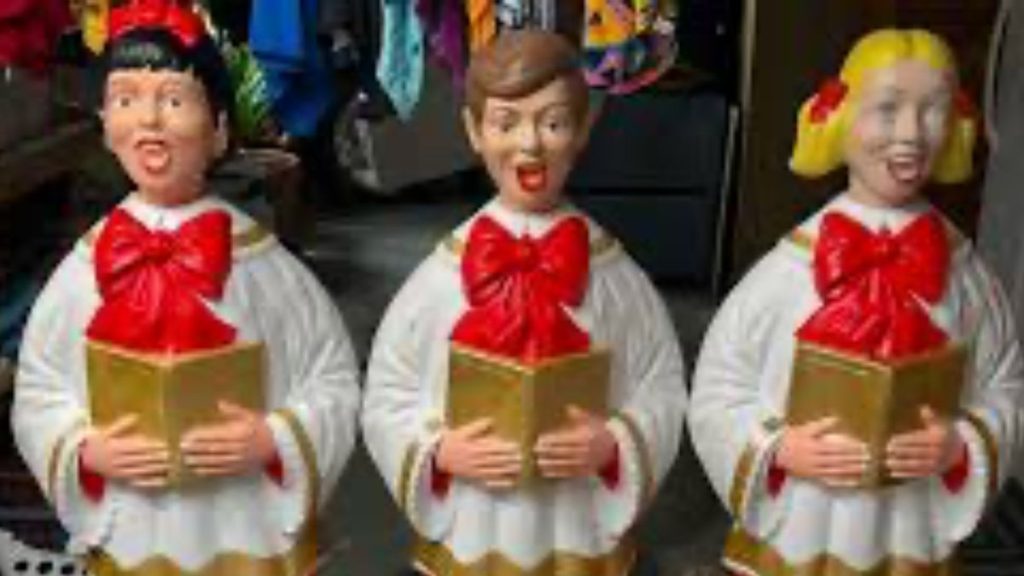
Poloron also engineered an elaborate lighting arrangement.
The choir figures used a heavy steel back-mounted assembly. A medium-base bulb illuminated the body while a separate C7 bulb illuminated the head.
That’s important because Poloron wasn’t simply making a hollow figure and sticking a light behind it.
It was designing the illumination around the sculpture.
Unfortunately, Poloron’s head attachment created a preservation problem.
The removable heads used a grooved neck that snapped into the body. Owners sometimes struggled to remove them for bulb replacement, and surviving choir figures can show splits or damage around the neck.
A design intended to make servicing easier eventually created one of the things collectors inspect most carefully.
Fifty years later, engineering decisions become identification clues.
The Nativity Sets
Then there are the Poloron Nativities.
For many collectors, these are among the company’s defining achievements.
Poloron produced Nativity figures in different sizes, creating large illuminated displays populated by the Holy Family, Wise Men, shepherds, animals and other figures.
These weren’t little tabletop decorations.
A complete outdoor Nativity could become the centerpiece of an entire Christmas display.

And Poloron’s sculptural approach worked beautifully here.
Faces had character.
Robes had folds.
Animals had dimension.
Paint brought out details.
Gold accents reinforced the almost church-pageant richness of the pieces.
Most importantly for collectors, the Nativity story didn’t end when Poloron did.
Some of those molds would survive the company itself.
More on that shortly.
Santa Needed a Sleigh
Poloron also understood something manufacturers have known forever:
If people like Santa…
sell them the rest of Santa.
The company created elaborate Santa-and-sleigh displays.
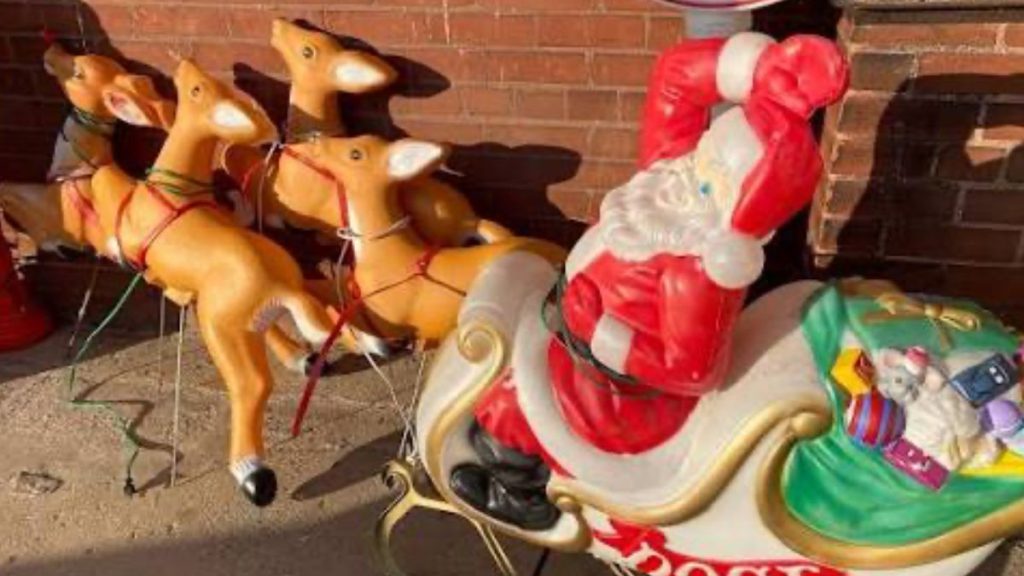
Beco had already pioneered a three-dimensional Santa sleigh arrangement. Poloron responded with its own fully illuminated interpretation featuring a red sleigh, waving Santa and streamlined brown reindeer.
Then Poloron kept tinkering.
In 1971, it introduced a white version of the sleigh.
In 1972, another configuration paired the sleigh with a whimsical Santa carrying his sack of toys. The reindeer featured blow-molded bodies with hard-plastic injection-molded antlers, and even the reins received little jingle bells.
That’s peak Poloron.
They could have stopped at:
Plastic deer.
Instead:
Should the reins have bells?
Absolutely.
And Then Poloron Made Santa Move
Now we arrive at one of the legends.
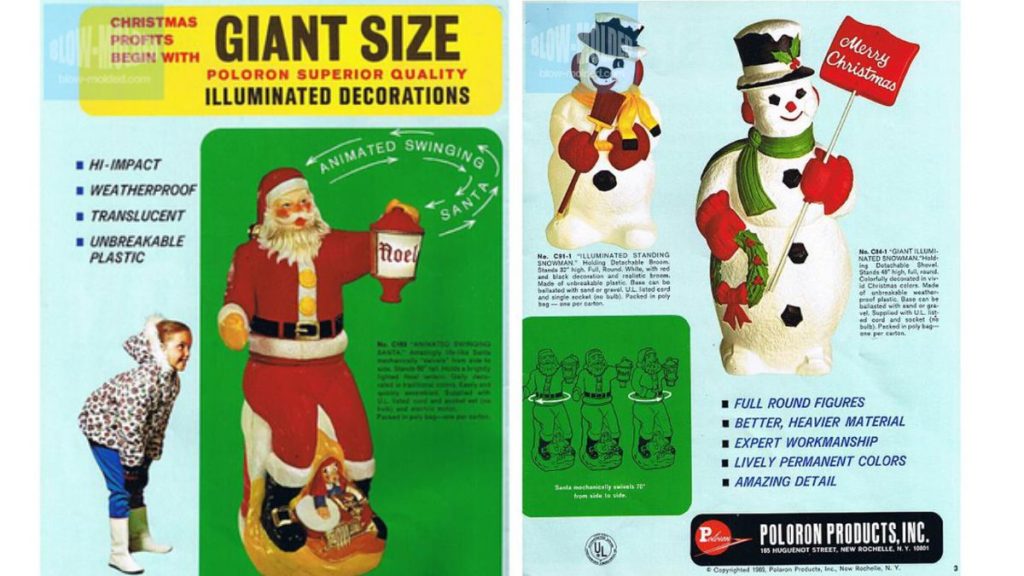
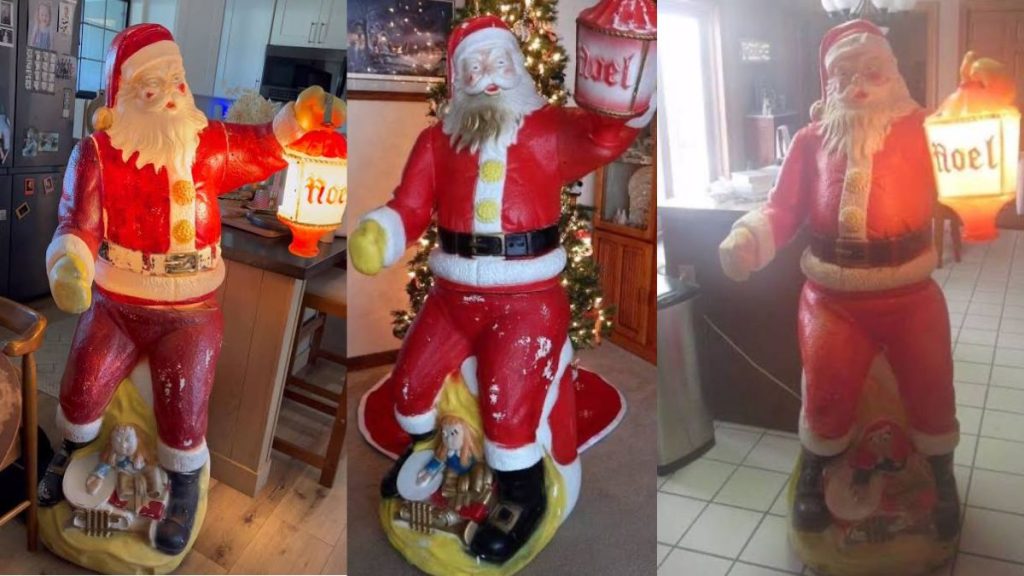
The 1969 Poloron Giant Animated Santa Claus.
Five feet tall.
Illuminated.
Holding a Noel lantern.
And mechanically animated so that his upper body moved from side to side at the waist.
Today, the Animated Santa is regularly described in collector circles as a Holy Grail piece.
And it’s easy to understand why.
Most blow molds do one trick.
They glow.
Poloron apparently looked at that and thought:
Not enough. Make Santa move.
The original mechanism used sturdy components, and the figure combined the qualities that define the best Poloron pieces—large scale, detailed sculpture, substantial construction and theatrical presentation.
It wasn’t merely yard décor.
It was a show.
Poloron also ventured into other mechanical blow molds, including an animated snowman. Collector histories date the company’s mechanical line to this same late-1960s period.
This is one reason Poloron commands such respect.
The company was willing to make things complicated.
Complicated isn’t cheap.
But complicated can become memorable.
Soldiers, Candles, Angels and the Rest of the Poloron Universe
Poloron’s catalog stretched well beyond the marquee pieces.
There were Santas, angels, candles, lanterns, toy soldiers, snowmen, deer, choir figures and smaller plastic ornaments and tabletop decorations.
The Drummer Boy, for example, became one of the designs that outlived its original manufacturer.
Poloron produced it in the 1970s. Later owners of the tooling continued manufacturing versions of the figure through Holiday Innovations, Empire and eventually General Foam—with the design surviving in production, in altered form, all the way to 2017.
Think about that.
A design born during the Nixon era was still being manufactured when people were using smartphones to photograph it.
That’s an extraordinary manufacturing afterlife.
Sears Helped Put Poloron in America’s Yards
Poloron had another enormous advantage:
distribution.
Its products were sold through some of the biggest merchandising channels in America.
Historical accounts of the Ruston plant specifically mention Sears, Montgomery Ward and S&H Green Stamps among the ways Poloron products reached consumers.
This matters enormously when understanding blow mold nostalgia.
A child didn’t need to live near a Poloron factory.
They could encounter these figures in a catalog. Like the Sears Wishbook I write about here.
Or a department store.
Or a neighbor’s yard.
A family could order a Christmas decoration and suddenly that glowing figure became part of the holiday landscape for the next twenty years.
That’s how consumer products become memories.
Poloron Wasn’t Really a Christmas Company
And now the story gets weird.
Because while collectors understandably think of Poloron as a blow mold manufacturer…
Poloron apparently thought of itself as a company that could manufacture almost anything.
At its height, the company made or became involved with:
picnic products,
charcoal grills,
institutional furniture,
lawn equipment,
travel trailers,
camping equipment,
Christmas decorations,
snowmobiles,
and eventually modular homes.
Historical accounts describe a mini-conglomerate with roughly a dozen factories spread across the eastern United States.
This kind of diversification wasn’t unusual during the conglomerate-happy 1960s and early 1970s.
Companies expanded.
Acquired businesses.
Entered hot new markets.
And Poloron looked at one particularly fashionable industry and apparently decided:
Sure. Why not snowmobiles?
Yes, Poloron Made Snowmobiles
If you’re standing in your garage staring at a Poloron choir boy, here’s a sentence you probably weren’t expecting:
The company that made him also built snowmobiles.
Poloron entered the booming snowmobile market around 1970. Production took place at its Michigan City, Indiana lawn-tractor plant, using components from established suppliers, including Polaris.
There was a Poloron snowmobile known as the Tornado.
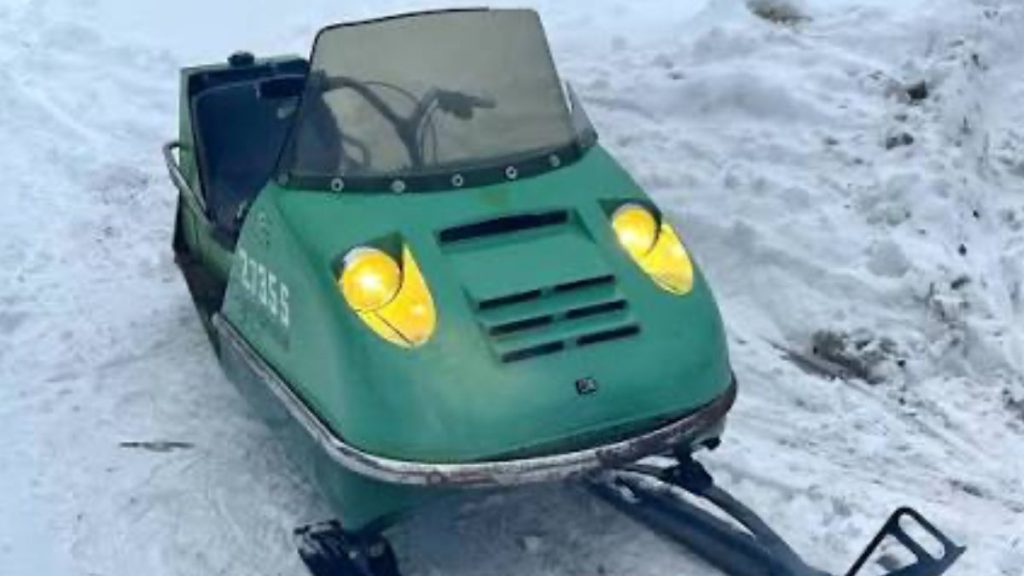
There was also the rare Stallion.
They were competitive machines, at least on paper.
But the snowmobile boom attracted enormous numbers of manufacturers, and the market couldn’t sustain them all.
Poloron was one of many companies that discovered the difference between entering a hot industry and surviving one.
It’s also an early clue to the larger problem.
Poloron had become very spread out.
Even Shiny Brite Entered the Story
Here’s another unexpected intersection with Christmas history.
In 1972, Max Eckardt & Sons—the company associated with the legendary Shiny Brite Christmas ornament brand—merged with Poloron as American manufacturers struggled against increasingly inexpensive imported merchandise.
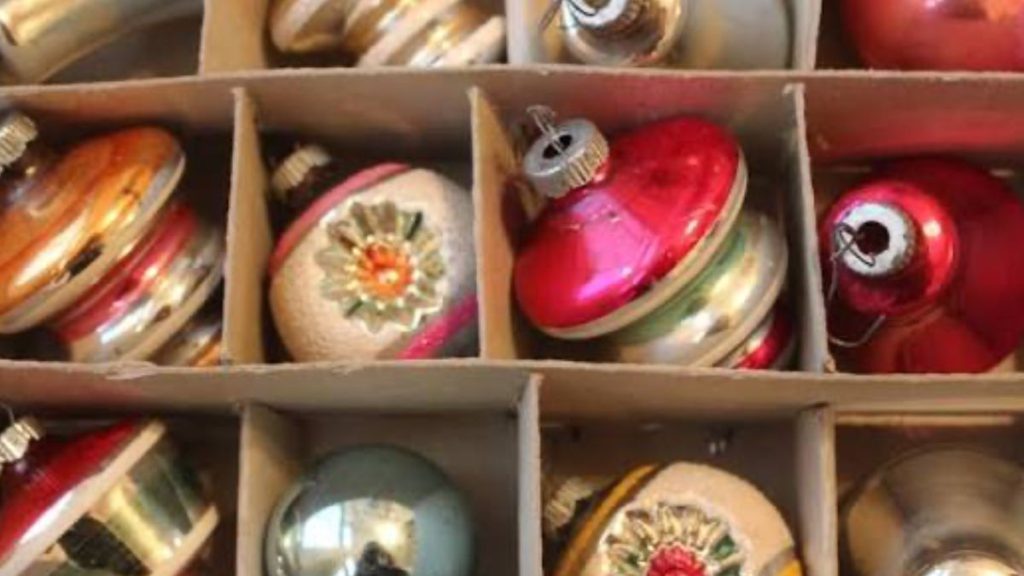
For a period, Poloron wasn’t merely connected with illuminated lawn decorations.
It was also connected to one of the most recognizable names in American glass Christmas ornaments.
That tells you how broad Poloron’s holiday business had become.
It also tells you something else.
The economic pressure was already building.
Trouble at the Factory Gates
The decline of Poloron wasn’t one dramatic moment.
It was a contraction.
During the early 1970s, the company began closing plants and reducing operations.
Ruston provides a particularly vivid example.
Its factory closed in 1973, eliminating that substantial local payroll and roughly 170 manufacturing jobs. A local historical account attributes the decline heavily to competition from lower-cost imported products.
That’s a story that would repeat across American manufacturing.
The very products Poloron specialized in were vulnerable.
Plastic consumer goods.
Seasonal merchandise.
Outdoor products.
Items competing largely on retail price.
Manufacturing them domestically became increasingly difficult when retailers could source less expensive alternatives overseas.
And Poloron had another problem.
It had diversified aggressively.
The company wasn’t merely defending Christmas decorations.
It was juggling businesses ranging from lawn equipment to housing.
The Blow Mold Lights Go Out
Collector records indicate that Poloron ceased blow mold production in June 1979, as the company increasingly concentrated on other operations, including modular housing.
Think about how strange that must have seemed from inside the company. And I ponder, why hasn’t someone made a docu-series about it? It’s a fascinating subject, at least to me.
Some of the Christmas products Poloron had created were destined to survive for decades.
Collectors would eventually pay serious money for them.
People would build websites cataloging them.
Entire online communities would obsess over manufacturing variations.
But from a corporate perspective in 1979?
They were just another product line.
And apparently no longer the product line management believed would carry the company forward.
It didn’t work.
Poloron entered bankruptcy in 1981, and collector histories place the final end of the company in 1982.
A company that had spent more than four decades manufacturing an astonishing variety of American consumer goods disappeared.
But here’s the wonderful thing about blow molds.
The company can die without the product dying.
The Great Migration of the Poloron Molds
When a blow mold manufacturer disappears, collectors should ask one question:
Where did the tooling go?
Because those aluminum molds can have lives considerably longer than the corporations that commissioned them.
After Poloron’s collapse, portions of its holiday tooling began migrating through the industry.
Empire acquired Poloron Nativity tooling and produced selected figures, including the camel and Wise Men.
Then in 1988, Plastic Toy & Novelty created the Holiday Innovations brand and acquired much of the remaining Poloron holiday tooling.
Suddenly familiar faces returned.
Choir children.
Whispering Santa.
Giant Snowman.
Even the Giant Animated Santa.
Holiday Innovations reproduced many classic Poloron designs, although collectors note differences in construction, paint quality and mechanical components compared with the originals.
Then Holiday Innovations failed.
And the molds moved again.
From Poloron to Holiday Innovations to Empire
After Holiday Innovations ceased operations around 1991, Empire Plastics acquired much of the tooling.
That meant another generation of shoppers could encounter shapes originally designed during Poloron’s heyday.
Then Empire itself disappeared.
And General Foam Plastics acquired Empire’s assets around 2000–2001, including designs whose lineage could be traced back through Empire and Holiday Innovations to Poloron.
This is why identifying a blow mold can become tricky.
Two figures can look nearly identical.
One might be Poloron.
Another Holiday Innovations.
Another Empire.
Another General Foam.
Same basic sculpture.
Different decade.
Different plastic.
Different paint.
Different lighting hardware.
Different markings.
That’s also why knowing the history of the molds matters as much as knowing the history of the companies.
The Strange Immortality of a Blow Mold
There’s something almost poetic about this.
Corporations think in fiscal years.
Collectors think in generations.
Poloron disappeared more than four decades ago.
Yet a Poloron Santa may still come out of someone’s attic every November.
A choir child may still stand beside a Christmas tree.
A Nativity may still illuminate a church lawn.
A deer may still be attached to its old sleigh.
The company couldn’t survive.
The plastic did.
And somehow that feels completely appropriate.
Why Collectors Love Poloron
There are plenty of reasons Poloron occupies such a special place in the hobby.
The first is quality.
Early Poloron pieces can feel substantial compared with later cost-reduced blow molds. Thick plastic and elaborate painting helped many survive remarkably well.
The second is design ambition.
Four-foot choir figures.
Huge Nativities.
Mechanical decorations.
Elaborate sleigh sets.
Poloron wasn’t afraid of spectacle.
The third is visual identity.
Those metallic gold accents, detailed faces and rich paint schemes give many Poloron pieces an unmistakably vintage appearance.
The fourth is scarcity.
Original Poloron production ended decades ago. Some figures had relatively limited runs. Others were damaged, discarded or left outside for years.
And finally, there is the history.
When you own a Poloron, you’re not merely holding an old Christmas decoration.
You’re holding a survivor from an American manufacturer that once operated factories around the country and made everything from picnic coolers to snowmobiles.
That’s a pretty good story for a plastic snowman.
Original Poloron or Later Reproduction?
This is where collectors need to slow down.
Finding a familiar Poloron design does not necessarily mean you’ve found a Poloron-manufactured example.
Because the tooling traveled.
Look for manufacturer markings.
Examine the light kit.
Study the paint pattern.
Compare plastic characteristics.
Look at construction details.
Research known production years.
Pay attention to modifications made by later manufacturers.
Holiday Innovations sometimes retained original Poloron markings in molds, further complicating identification.
A mold tells you the ancestry of the design.
It doesn’t automatically tell you who manufactured the particular piece in your hands.
That’s an important distinction.
And it’s exactly the kind of detective work that makes this hobby so addictive.
Poloron Didn’t Make Decorations. It Made Memories.
I keep coming back to this while researching the companies behind The Glow That Won’t Go Out.
Poloron wasn’t trying to create collectibles.
Neither was Union.
Neither was Empire.
These companies were making merchandise.
Something for Sears to sell.
Something for a family to put outside.
Something to make a front yard look a little more magical in December.
Then something unexpected happened.
Kids remembered them.
They remembered the giant choir child beside Grandma’s porch.
The Nativity their father assembled every December.
The Santa that glowed outside their bedroom window.
The deer that always tipped over when the wind picked up.
Eventually those kids grew up.
And some of them wanted those decorations back.
That’s when merchandise became nostalgia.
And nostalgia became collecting.
The Company Is Gone. The Glow Isn’t.
Poloron Products disappeared in the early 1980s.
Its factories closed or changed hands.
Its workers moved on.
Its corporate divisions vanished.
Its products scattered across America.
And its holiday tooling passed from company to company like some strange industrial inheritance.
Holiday Innovations.
Empire.
General Foam.
Then even those companies disappeared.
Yet the figures remain.
That’s the remarkable thing about blow mold history.
A company can close.
A catalog can disappear.
A factory can be demolished.
A retailer can go bankrupt.
But somewhere, in somebody’s basement, there’s still a four-foot choir boy waiting for December.
Plug him in.
Poloron lives again.
Discover the Companies Behind the Glow
Poloron Products is one chapter in the much larger story behind The Glow That Won’t Go Out: The Complete Collector’s Guide to Vintage Holiday Blow Molds.
The book explores the manufacturers, designers, manufacturing techniques, identification clues, restoration, collectors and strange pieces of American history behind the illuminated plastic decorations that refuse to disappear.
Because when you know who made the Santa…
you start seeing more than Santa.
You see the factory.
The designer.
The retailer.
The family that bought him.
And the decades he somehow survived.
That’s when collecting becomes history.