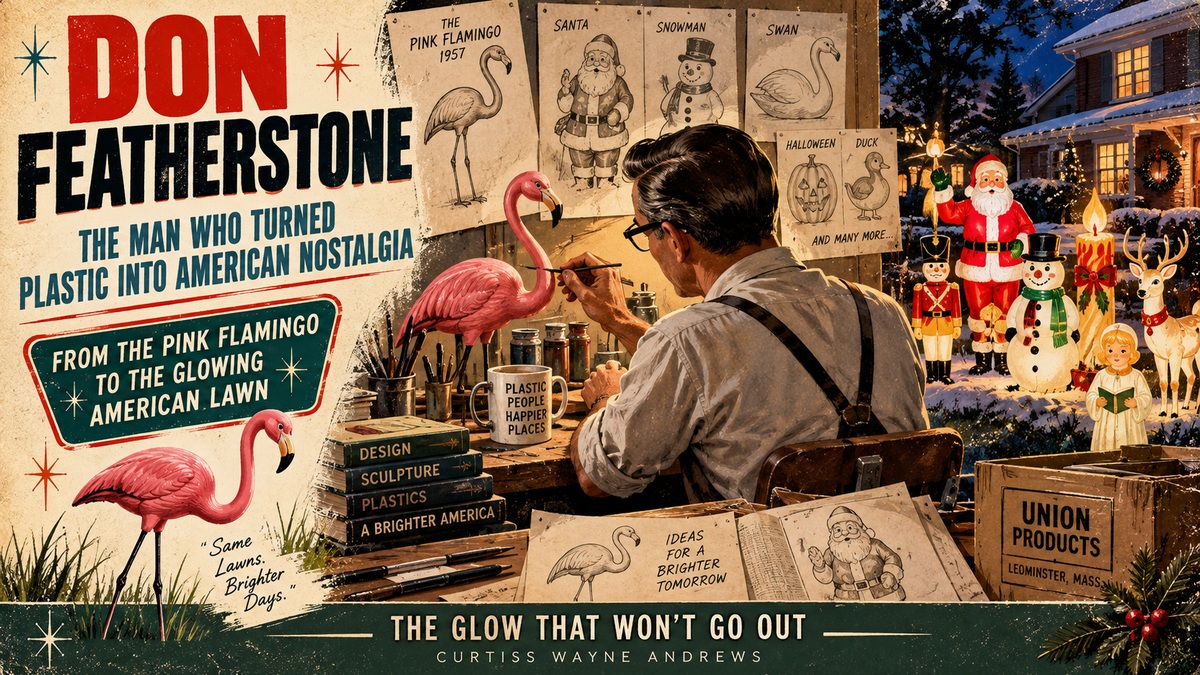
From the Pink Flamingo to Christmas Santas, Don Featherstone helped create the colorful plastic world collectors are still chasing today.
There is a peculiar moment that happens when a blow mold collector spots an old piece at an estate sale.
You see the plastic first.
Then the shape.
Then the paint.
Then you flip it over.
You’re looking for a manufacturer’s mark, a date, a name—anything that might answer the question every collector asks:
What exactly did I just find?
And there is one name capable of making that discovery considerably more interesting:
Featherstone.
Long before vintage blow molds became prized pieces of holiday nostalgia, before collectors hunted Facebook Marketplace at dawn and drove three hours because somebody listed an old Santa as “plastic Christmas decoration $20,” there was Donald Featherstone.
And before the Santas, witches, ghosts, swans and countless pieces of plastic lawn art associated with his career, there was a bird.
A very pink bird.
THE FLAMINGO THAT CHANGED EVERYTHING
Don Featherstone arrived at Union Products in Leominster, Massachusetts, as a young art-school graduate in the 1950s.
Leominster wasn’t an accidental location. The Massachusetts city had become a center of America’s rapidly expanding plastics industry. Union Products was part of that world, manufacturing colorful decorations intended to transform the increasingly uniform yards of postwar suburbia.
Featherstone had studied sculpture at the Worcester Art Museum’s school. Suddenly, instead of making fine art for galleries, he was being asked to create animals out of plastic.
It turned out to be the perfect assignment.
His early three-dimensional work for Union included figures and animals, but in 1957 came the assignment that would follow him for the rest of his life:
Make a flamingo.
There was one problem.
Massachusetts wasn’t exactly overflowing with flamingos.
Featherstone found his reference material in National Geographic. Working from photographs, he sculpted the birds in clay—one standing upright and another bending down as though feeding. Steel production molds were then created from the sculptures.
The result was absurd, elegant and unmistakable.
Two coral-pink birds standing on thin metal legs.
The American lawn would never be quite the same.


TROPICAL GLAMOUR FOR THE SUBURBS
The flamingo arrived at precisely the right moment.
Postwar American suburbs were exploding. Houses could look remarkably similar, and homeowners were looking for inexpensive ways to make their little patch of America feel different.
Featherstone understood that.
He later explained that the flamingo gave an ordinary homeowner a bit of tropical elegance that could instantly distinguish one suburban yard from another.
It was affordable.
It was colorful.
And absolutely nobody was going to confuse it with the neighbor’s shrubbery.
Millions eventually entered American yards. The flamingo transcended lawn decoration and became a symbol of suburbia, Florida fantasy, kitsch, rebellion and eventually nostalgia. Smithsonian’s National Museum of American History now holds Featherstone flamingos in its collection.
But collectors interested in holiday blow molds should remember something important:
The flamingo was only the beginning.
FROM FLAMINGOS TO AN ENTIRE PLASTIC UNIVERSE
Featherstone remained with Union Products for more than four decades.
And he kept sculpting.
Union’s catalogs eventually stretched far beyond lawn birds. The company’s output encompassed Christmas, Halloween, Thanksgiving, Valentine’s Day, St. Patrick’s Day and patriotic decorations, along with planters, animals and assorted lawn ornaments. Featherstone’s career ultimately took him from designer to company president before his retirement in 2000.
That enormous output helped establish the visual vocabulary that vintage-plastic collectors recognize immediately today.
There were Santas.
There were snowmen.
There were holiday figures and Christmas lawn decorations.
There were ducks, geese, swans and other animals.
There were planters, mushrooms and garden figures.
There were Halloween pieces and seasonal characters.
By the late 1990s, Union’s range included more than 200 plastic lawn-art pieces, including Halloween figures and numerous versions of Santa Claus.
This was plastic designed to make people smile.
And that distinction matters.
THE ARTISTRY COLLECTORS SOMETIMES MISS
Look carefully at a great vintage blow mold.
Ignore the fact that it’s plastic for a moment.
Look at the posture.
The expression.
The folds in Santa’s coat.
The curve of an animal’s neck.
The way a face changes when illuminated from inside.
Someone had to sculpt that.
That’s one reason Featherstone’s background matters. He wasn’t simply an executive approving novelty decorations. He was a trained sculptor working within the limitations—and possibilities—of mass-produced plastic.
The manufacturing process demanded something very different from traditional sculpture.
A form had to be visually readable from a distance.
It had to survive being molded.
It needed enough depth to catch light.
It needed recognizable features without delicate details that manufacturing couldn’t reproduce reliably.
And, once Union moved increasingly into blow molding in the 1970s, many designs had another unusual requirement:
They had to look good with a light bulb glowing inside them. Union initially produced its famous flamingos using molded halves; Smithsonian’s Lemelson Center notes that Union shifted the birds to blow-molding technology in the early 1970s.
That combination of sculpture, manufacturing and illumination is part of what makes classic blow molds so distinctive.
They weren’t paintings translated into plastic.
They were designed as plastic objects.
SO WHAT ACTUALLY COUNTS AS A “FEATHERSTONE”?
This is where collectors need to be careful.
You’ll occasionally see a marketplace listing that says:
RARE VINTAGE FEATHERSTONE BLOW MOLD!!!
Sometimes that description is useful.
Sometimes it means:
I saw the word Featherstone somewhere on the internet and would now like $375.
The historically accurate distinction is that Union Products was the manufacturer.
Don Featherstone designed an enormous number of products during his decades at Union, but it isn’t safe to assume that every Union Products mold was personally sculpted by him simply because Union made it.
The Journal of Antiques and Collectibles specifically warns collectors about this confusion.
That’s important when identifying vintage pieces.
Union Products and Don Featherstone are inseparable parts of the same story—but they aren’t interchangeable terms.
THE SIGNATURE THAT COLLECTORS LOOK FOR
Then there’s the signature.
By the 1980s, knockoff flamingos had become common enough that Union needed a way to distinguish the authentic article.
For the flamingo’s 30th anniversary, Featherstone’s signature was incorporated into the production mold.
Suddenly, the artist’s name wasn’t merely part of the history.
It was physically part of the object.
The signature also became a useful dating clue. Smithsonian notes that signed vintage examples were made from the original molds, while historical accounts place the addition of Featherstone’s signature around the flamingo’s 30th anniversary.
After Featherstone retired, Union removed the signature.
Collectors noticed.
And they weren’t happy.
A boycott campaign followed, objecting to the removal of the creator’s name. The signature ultimately returned.
Think about how strange—and wonderful—that is.
People were defending the artistic attribution of a plastic lawn flamingo.
But that tells you everything about what Featherstone had become.
He wasn’t merely the guy who designed a lawn ornament anymore.
He was its artist.
WHY ORIGINAL FEATHERSTONE PIECES MATTER TO COLLECTORS
There are plenty of old plastic decorations.
Why do collectors react differently when Featherstone’s name or a desirable Union pedigree enters the conversation?
Because collectors aren’t really collecting plastic.
They’re collecting provenance.
An older Union piece can connect several worlds at once: American plastics manufacturing, postwar suburban culture, mid-century design, seasonal decorating and childhood memory.
A signed Featherstone flamingo adds something else:
a direct connection to the person who created one of America’s most recognizable pieces of popular design.
Age also creates scarcity.
Early flamingos were made differently from later versions. Smithsonian notes that older polystyrene examples could become brittle and crack—particularly where their metal legs entered the body—and could fade badly after years outdoors. Later polyethylene versions were more durable.
That means surviving early examples aren’t simply old.
They survived exactly the environment they were designed to inhabit.
Sun.
Rain.
Snow.
Garage rafters.
Basements.
Moving trucks.
Kids.
Lawnmowers.
And several decades of homeowners deciding whether that ridiculous pink bird was worth keeping.
For collectors, survival itself becomes part of the story.
CHRISTMAS MAY BE WHERE FEATHERSTONE’S LEGACY GLOWS BRIGHTEST
The flamingo became the celebrity.
But the holiday decorations may be where Featherstone’s influence feels most personal.
A flamingo lived on the lawn.
A Christmas blow mold lived in your childhood.
It stood beside Grandma’s porch.
It guarded the front steps.
It glowed beneath the living-room window.
Maybe it was Santa.
Maybe a snowman.
Maybe a candle, angel or toy soldier.
And when those decorations disappeared from stores, something strange happened.
People began wanting them back.
Not replacements.
The originals.
The scratches didn’t necessarily ruin them.
The faded paint didn’t always make them undesirable.
Sometimes those imperfections made them more powerful.
Because collectors weren’t trying to recreate a department-store display.
They were trying to recreate a feeling.
And Featherstone spent a career helping manufacture that feeling.
WHEN “TACKY” BECOMES AMERICANA
The pink flamingo spent decades being mocked as the ultimate example of bad taste.
Featherstone knew the joke.
He embraced it.
Yet history played a funny trick on everyone.
The disposable plastic lawn ornament became a museum object.
The inexpensive Christmas decoration became collectible.
The stuff people once shoved into garages became the stuff collectors now drive across state lines to find.
In 1996, Featherstone even received the Ig Nobel Prize for Art for the flamingo.
It’s easy to laugh at that.
But there’s something genuinely significant underneath it.
Featherstone helped democratize decoration.
You didn’t need an expensive sculpture.
You didn’t need a professionally landscaped estate.
You needed a lawn and a few dollars.
And suddenly there could be two flamingos standing outside your ranch house.
Or Santa glowing beside your driveway.
THE END OF UNION—BUT NOT THE END OF THE GLOW
Featherstone retired in 2000 after more than four decades with Union.
Union Products itself eventually closed in 2006. The molds and rights changed hands, and Cado later acquired Union’s assets and continued producing the famous flamingos and other designs.
Featherstone died in 2015 at age 79.
But walk through an antique mall in November.
Visit a holiday flea market.
Scroll through a blow mold collector group.
Look at a print ad for the ABC show RJ Decker (a fictional Florida-based PI show).
Drive through an older neighborhood in December.
He’s still there.
Sometimes it’s a flamingo.
Sometimes it’s a Santa.
Sometimes it’s simply the design language of an era when somebody figured out that hollow molded plastic, a little paint and a light bulb could become something people would remember for the rest of their lives.
WHY DON FEATHERSTONE STILL MATTERS
There are designers who make expensive things.
There are artists whose work hangs in museums.
And then there are people who quietly change what ordinary life looks like.
Don Featherstone did that.
He helped turn America’s lawns into canvases.
He helped make molded plastic part of the visual language of the American holiday.
And he proved—perhaps accidentally—that something doesn’t have to be expensive to become meaningful.
That’s why collectors still flip over old plastic decorations looking for names and marks.
That’s why original Union pieces survive.
That’s why people still hunt Featherstone flamingos.
And that’s why a decoration somebody bought for a few dollars decades ago can now feel almost irreplaceable.
Because eventually you’re no longer collecting plastic.
You’re collecting the glow of somewhere you’ve already been.
WANT TO KNOW THE STORIES BEHIND THE BLOW MOLDS?
Don Featherstone and Union Products represent just one chapter in the remarkable history of America’s glowing plastic holiday decorations.
The Glow That Won’t Go Out explores the manufacturers, designers, collectors, forgotten molds and Christmas traditions that turned humble plastic lawn decorations into one of America’s most beloved forms of holiday nostalgia.
From Empire and General Foam to Union Products and beyond, it’s a celebration of the decorations we grew up with—and the collectors making sure they keep glowing.
→ Discover The Glow That Won’t Go Out