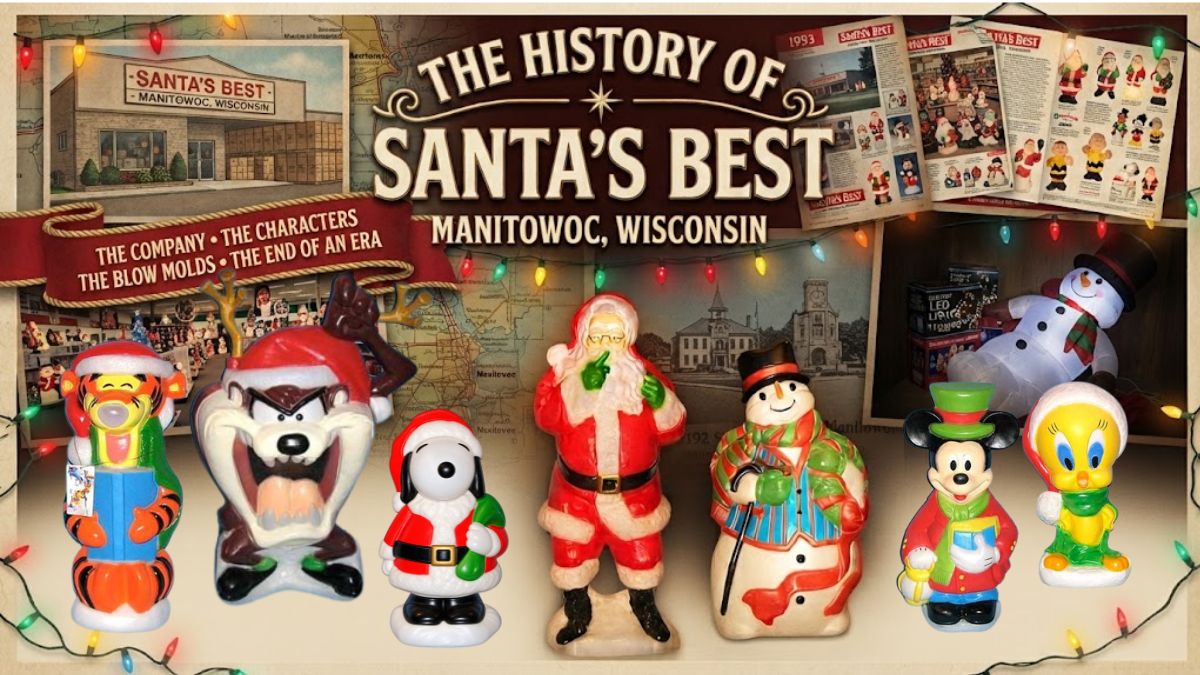
From its roots in American Christmas manufacturing to Disney, Peanuts, Looney Tunes and some of the strangest character blow molds ever made, Santa’s Best helped drag the illuminated plastic lawn ornament into the pop-culture age.
By Curtiss Wayne Andrews
There is a moment every blow mold collector eventually experiences.
You’re at an estate sale, flea market or antique mall.
Across the room you spot plastic.
You move closer.
And instead of another Santa, snowman or candle, you’re suddenly staring at…
Taz.
Or Mickey Mouse.
Or Winnie the Pooh.
Or Snoopy.
Or Tweety.
Or some enormous plastic cartoon character that looks as though Saturday morning television escaped from the screen, swallowed a Christmas light bulb and landed in somebody’s front yard.
Welcome to the wonderfully strange world of Santa’s Best.
If Union Products represents the artistic, mid-century origins of American plastic lawn decoration, and Poloron represents the oversized theatrical ambition of the late 1960s and 1970s, Santa’s Best represents something different.
Licensing.
Characters.
Brands.
1990s retail.
Christmas decorations colliding with the entertainment business.
And yet Santa’s Best has a more complicated history than simply “the company that made cartoon blow molds.”
Its roots stretch back much further than many collectors realize. Its corporate identity passed through several configurations. Its manufacturing moved between the United States, Mexico and China. And by the time its blow mold line disappeared in 2003, the economics of American Christmas decorating had fundamentally changed.
Even more confusingly:
Santa’s Best itself didn’t disappear.
The blow molds did.
And that’s an important distinction.
So let’s untangle the story.
First, We Need to Clear Up the Santa’s Best Timeline
Researching Santa’s Best is tricky because there are effectively two histories happening simultaneously.
There’s the history of the Santa’s Best name.
And there’s the history of the Santa’s Best blow mold line.
They aren’t identical.
Collector references commonly date Santa’s Best as a blow mold manufacturer/distributor beginning around 1991, with operations associated with Manitowoc, Wisconsin. Blow Molded
But the Santa’s Best name is considerably older.
Federal trademark records show the mark in commercial use for Christmas-related merchandise as early as 1961, and a Santa’s Best trademark was filed in 1967 by Rennoc Games & Toys, Inc. of Millville, New Jersey. The goods included Christmas stockings, cloth ornaments, tree skirts and other holiday merchandise. Justia Trademarks
Another trademark associated with Santa’s Best—NATIONAL—was filed all the way back in 1953 for Christmas tree decorations including icicles, artificial snow, garlands and angel hair. Justia Trademarks
So Santa’s Best did not suddenly materialize in 1991 because somebody decided the world desperately needed an illuminated plastic Tasmanian Devil.
The company had deep roots in the Christmas-decoration business.
The blow molds were a later chapter.
And what a chapter they became.
From Rennoc to Santa’s Best
The Rennoc connection is particularly important.
Trademark records show Rennoc Corporation using the Santa’s Best name by 1989, with an address in Vineland, New Jersey. Another filing records first use of the Santa’s Best mark in January 1989. USPTO Report
By the early 1990s, Santa’s Best had emerged as a significant seasonal-products business in its own right.
And the company’s scope was much broader than blow molds.
Santa’s Best dealt in the entire universe of Christmas decorating:
artificial trees,
garlands,
tinsel,
ornaments,
lights,
wreaths,
tree accessories,
outdoor decorations,
and seasonal novelties.
Patent records from the period are revealing.
A 1991 decorative-garland patent lists William F. Protz Jr. as inventor, with National Tinsel Manufacturing Company as the original assignee and Santa’s Best later associated with the invention. Google Patents
Later Santa’s Best patents cover everything from specialized garland-manufacturing methods to light clips and even an eye structure for blow-molded yard figures, credited to inventor Claude Nethercutt in 2000. TREA
That’s the Santa’s Best people sometimes miss.
This wasn’t merely a company ordering plastic cartoon characters from a factory.
There were product designers.
Engineers.
Salespeople.
Seasonal-merchandise specialists.
Inventors.
Manufacturing personnel.
And an entire operation trying to solve the question that every Christmas company faces:
What are people going to put in their houses and yards this year?
Manitowoc, Wisconsin, Becomes Part of the Story
Collector records associate Santa’s Best with Manitowoc, Wisconsin, beginning around 1991. Blow Molded
Manitowoc would remain important enough that even the modern Santa’s Best business lists a location at 1133 South 16th Street in Manitowoc. LinkedIn

That Wisconsin connection matters because blow mold collectors sometimes imagine every manufacturer as operating like Union Products in Leominster or General Foam in Virginia: raw plastic enters one end of a giant American factory and a finished Santa comes out the other.
By the 1990s, the manufacturing world had changed.
Santa’s Best was operating in a global consumer-products economy.
Its blow molds would be manufactured in multiple countries.
Its products would carry licensed characters from enormous entertainment companies.
And its business was increasingly about design, sourcing, licensing, manufacturing and retail distribution working together.
The old plastic Santa was becoming a global product.
Then Santa’s Best Discovered Characters
This is where Santa’s Best becomes unmistakably Santa’s Best.
Traditional blow mold manufacturers generally built their catalogs around familiar holiday archetypes.
Santa.
Snowman.
Angel.
Nativity.
Candle.
Toy soldier.
Choir child.
Reindeer.
Santa’s Best certainly produced traditional Christmas imagery too.
But the company leaned hard into something that would distinguish it from earlier manufacturers:
licensed characters.
And suddenly the blow mold yard became a television set.
Mickey Mouse Goes Outside
Disney characters were a major part of the Santa’s Best identity.
Mickey.
Minnie.
Winnie the Pooh.
Tigger.
And other familiar characters appeared as illuminated outdoor decorations.
That sounds completely normal today.
It wasn’t always.
Earlier Christmas yards were dominated by generic seasonal characters. Santa’s Best helped push blow molds further into a world where a child could recognize the exact character standing on the lawn.
Collector histories specifically note that Santa’s Best produced numerous Disney character blow molds. Antiques Attic
This was a major shift.
The decoration wasn’t merely:
a bear.
It was:
Winnie the Pooh.
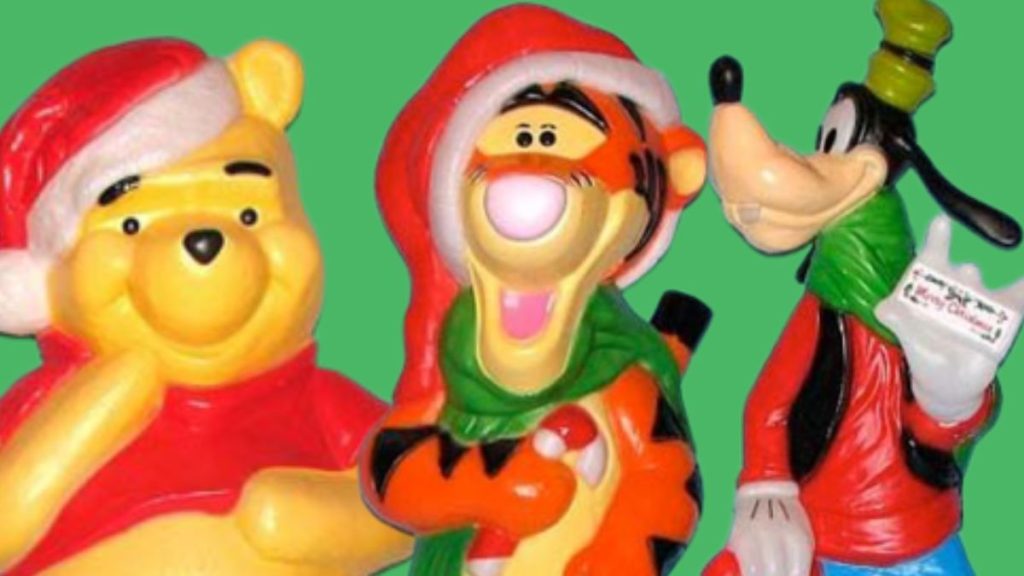
That’s an entirely different consumer proposition.
You’re no longer just selling Christmas.
You’re selling Christmas plus an emotional attachment to an existing character.
And Santa’s Best understood the power of that combination.
Snoopy, Charlie Brown and the Peanuts Gang
Then there was Peanuts.
Few licensed properties fit Christmas more naturally.
Charlie Brown and Christmas had been linked in American culture since A Charlie Brown Christmas debuted in 1965.
Snoopy decorating his doghouse?
Practically made for a suburban yard.
Santa’s Best produced Peanuts blow molds that have become highly recognizable collector pieces.
And this is where the company’s catalog begins to feel less like an old-fashioned Christmas-decoration line and more like a snapshot of late-20th-century American popular culture.
Disney.
Peanuts.
Looney Tunes.
Classic Christmas.
All of it glowing together.
And Then Things Got Looney
The Looney Tunes pieces may be where Santa’s Best becomes most gloriously ridiculous.
Tweety.
Bugs Bunny.
Sylvester.
Taz.
Characters created for theatrical cartoons decades earlier suddenly became enormous hollow plastic yard decorations.
This was the 1990s.
Of course Taz got a blow mold.
He was everywhere.
T-shirts.
Coffee mugs.
Car decals.
Baseball caps.
Denim jackets.
And eventually:
your front lawn.
One of the great pleasures of researching The Glow That Won’t Go Out has been discovering how closely blow mold history follows the broader history of American consumer culture.
You can almost date certain pieces without looking at the markings.
The characters tell you.
The Taz Problem—and Why Dating Blow Molds Can Be Tricky
As I write about here, Santa’s Best’s Tasmanian Devil has become one of the company’s most talked-about pieces.
And it also illustrates a problem collectors encounter constantly:
memory isn’t documentation.
Listings and social-media posts sometimes assign very specific dates to old blow molds without explaining where those dates came from.
A seller sees “1997” somewhere.
Another seller repeats it.
A collector repeats the seller.
Google indexes everybody.
Suddenly 1997 becomes “fact.”
That’s why manufacturer histories need to be approached carefully.
Production date.
Copyright date.
Tooling date.
Character copyright.
Catalog year.
Retail purchase year.
Those are not necessarily the same thing.
With Santa’s Best, the safest approach is to identify a piece through its molded markings, construction, packaging when available, catalog evidence and documented production history rather than trusting a date repeated in online listings.
The plastic usually tells a better story than eBay does.
Santa’s Best Didn’t Forget Traditional Christmas
It’s easy to get distracted by Mickey and Taz.
But Santa’s Best produced a much broader assortment.
Collector catalogs document categories including:
angels, animals, candy-themed figures, Mrs. Claus, Nativity sets, Santas, sleighs and snowmen, alongside Disney, Looney Tunes, Peanuts and Winnie the Pooh characters. Blow Molded
That combination is important.
Santa’s Best wasn’t abandoning traditional Christmas.
It was expanding what a Christmas yard could contain.
You could have Santa.
A Nativity.
A snowman.
And Mickey Mouse.
Nobody was enforcing thematic continuity.
It was Christmas.
Plug everything in.
The Santa’s Best Look
Santa’s Best pieces are interesting because they belong to a transitional era of blow mold production.
Many older molds from Poloron, Beco or early Union have an unmistakably mid-century sculptural quality.
Santa’s Best pieces often look more like 1990s consumer products.
Brighter.
Cleaner.
More character-driven.
More reliant on recognizable licensed imagery.
The faces become especially important.
When you’re manufacturing Mickey Mouse or Bugs Bunny, “close enough” isn’t really close enough.
A generic snowman can have practically any smile.
Mickey has to look like Mickey.
That required much more specific tooling and decoration.
It’s telling that Santa’s Best received a design patent in 2000 specifically involving an eye structure for blow-molded yard figures. TREA
The face mattered.
Because now the face belonged to somebody.
Manufacturing Goes Global
Here’s another major difference between Santa’s Best and many earlier American blow mold manufacturers.
Much of the Santa’s Best line was manufactured outside the United States.
Collector documentation identifies China and Mexico as manufacturing sources for Santa’s Best blow molds. Blow Molded
Again, that’s not an incidental footnote.
It’s part of the larger story of American manufacturing.
Union Products had grown out of Leominster’s enormous domestic plastics industry.
Poloron operated factories across several American states.
Empire manufactured domestically.
General Foam maintained American blow molding operations for decades.
By the Santa’s Best era, global manufacturing had become increasingly normal.
The company could design and market Christmas products in the United States while sourcing manufacturing elsewhere.
That business model would eventually become standard across huge portions of the seasonal-decoration industry.
Santa’s Best was living through the transition.
Santa’s Best Was Also an Inventor
One thing I don’t want to lose in the character discussion is the company’s technical side.
Patent records identify several people connected to Santa’s Best product development.
William F. Protz Jr. appears on garland technology.
William L. Lehman appears on multiple patents involving spiral and multi-strand garlands.
Edward Ruff appears on another decorative-garland invention.
And Claude Nethercutt is credited with the blow-mold eye design. Google Patents
These aren’t names most blow mold collectors know.
Maybe they should be.
One of the goals of documenting manufacturer history is to remember that “Santa’s Best” wasn’t a person.
It was people.
Somebody drew the product.
Somebody engineered it.
Somebody solved the manufacturing problem.
Somebody negotiated the license.
Somebody painted the prototype.
Somebody figured out how to package a giant plastic cartoon character without destroying it.
Somebody convinced a retailer:
Yes, your customers absolutely need a glowing Tasmanian Devil.
And apparently they were right.
The Retail Machine
Santa’s Best products reached consumers through major retailers across North America.
This is another reason so many people remember them.
Blow molds historically depended on mass retail.
Sears helped spread Poloron.
Discount stores helped spread Empire.
Hardware and department stores sold Union.
By the 1990s and early 2000s, Santa’s Best was competing for space in a very different retail environment dominated by large chains and seasonal merchandising programs.
Christmas had become enormous business.
And shelf space was ruthless.
A four-foot plastic character occupied a lot of it.
Which brings us to one of the fundamental problems with blow molds.
Blow Molds Are Terrible Retail Products
Collectors, please don’t send angry emails.
I love them too.
But from a logistics standpoint?
They’re ridiculous. And yes, we’re still thinking about that Buc-ee blow mold.
Imagine you’re a retailer.
You can stock a box containing dozens of strings of Christmas lights.
Or…
one giant hollow Santa.
You can stack artificial wreaths.
Or…
one Mickey Mouse that occupies half the pallet.
You can ship compact decorations efficiently.
Or…
you can pay to transport what is essentially air surrounded by polyethylene.
Blow molds are lightweight.
But they’re bulky.
They consume warehouse space.
Truck space.
Shelf space.
And consumer storage space.
For decades, Americans accepted those disadvantages because there wasn’t anything quite like them.
Then something arrived that changed the equation.
The Inflatable Is Coming
By the early 2000s, outdoor Christmas decorating was changing dramatically.
Airblown inflatables solved several of the blow mold’s biggest problems.
A giant inflatable Santa could collapse into a relatively small box.
Retailers could put many more units on a shelf.
Consumers could store them more easily.
Manufacturers could ship them more efficiently.
And suddenly the Christmas yard could contain decorations far larger than traditional blow molds without requiring an entire garage to store them.
General Foam would eventually confront the same problem. Collector histories cite inflatables as one factor in the broader decline of traditional blow mold sales. Blow Mold Wiki
Santa’s Best encountered the transition earlier.
And in 2003, the company’s blow mold chapter ended.
2003: The Final Santa’s Best Blow Molds
Collector documentation identifies 2003 as Santa’s Best’s final year of blow mold production.
The product assortment had been reduced.
And something especially interesting happened during that final year:
General Foam Plastics manufactured Santa’s Best blow molds. Blow Molded
That’s one of those wonderful intersections in blow mold history.
General Foam had become a kind of gravitational center for the dying American blow mold industry.
Molds and product lines from older manufacturers repeatedly found their way into its orbit.
Beco.
And now Santa’s Best.
By 2003, Santa’s Best was no longer relying solely on the overseas production that had characterized much of its blow mold era.
Some of the company’s last pieces were being produced by one of America’s great surviving blow mold manufacturers.
And then…
the line stopped.
But Santa’s Best Didn’t Die
This is where Santa’s Best differs significantly from Poloron or Empire.
If we’re discussing the blow mold company, then yes:
2003 is effectively the end.
But if we’re discussing Santa’s Best itself?
The story continued.
And continues.
Today, Santa’s Best describes itself as a supplier of Christmas decorations including LED lighting, pre-lit trees, wreaths and outdoor lighted décor. The company lists its headquarters in Riverwoods, Illinois, along with locations in Manitowoc and Hong Kong. LinkedIn
Its current headquarters is listed as:
3750 W. Deerfield Road
Riverwoods, Illinois
The modern business describes itself as privately held and relatively small, with LinkedIn listing 11–50 employees. LinkedIn
So saying “Santa’s Best went out of business” isn’t accurate.
Santa’s Best got out of blow molds.
That’s a much more interesting story.
The Company Followed Christmas Somewhere Else
And perhaps that’s the best way to understand what happened.
Santa’s Best didn’t stop believing in Christmas decorations.
It followed the market.
LED technology exploded.
Pre-lit artificial trees became enormously popular.
Lighting became more sophisticated.
Consumers wanted decorations that were easier to assemble and store.
Retailers wanted products that were easier to ship.
Santa’s Best evolved.
The blow mold didn’t fit the company’s future.
At least not then.
Ironically, collectors were about to spend the next twenty years proving that plenty of people still wanted them.
Why Santa’s Best Blow Molds Matter Today
Santa’s Best occupies a fascinating position in blow mold history.
It isn’t one of the earliest manufacturers.
It isn’t the longest-running.
And its blow mold era was relatively brief.
Yet collectors still care enormously about the pieces.
Why?
First: the characters.
Santa’s Best captured a particular moment when licensed entertainment properties became central to Christmas merchandising.
Second: variety.
Traditional Christmas and pop culture coexisted in the same catalog.
Third: nostalgia.
For collectors who grew up during the 1980s and 1990s, these aren’t their grandparents’ blow molds.
They’re their blow molds.
That’s an important generational shift.
A collector born in 1955 might remember a Poloron choir child.
Someone born in 1985 may remember Mickey or Taz.
Both memories are legitimate.
Both become nostalgia.
And They’re Getting Older
Here’s something that will make some of us uncomfortable.
A Santa’s Best blow mold made in 1995 is now more than 30 years old.
That’s vintage.
I’m sorry.
I don’t make the rules.
The decorations many collectors still mentally classify as “newer blow molds” are aging into legitimate historical artifacts.
Their paint fades.
Their plastic becomes brittle.
Their cords disappear.
Their licensed characters become tied to a specific period of pop culture.
And suddenly a giant plastic Taz isn’t just ridiculous.
He’s ridiculous and historically interesting.
Which is even better.
Turn It Over
As with Poloron, Empire and Union, don’t identify a Santa’s Best piece solely from the front.
Turn it over.
Look for manufacturer information.
Country of origin.
Copyright markings.
Character licensing information.
Mold numbers.
Electrical hardware.
Construction details.
Packaging, if you’re lucky enough to find it.
Remember that a copyright date associated with a character or design does not necessarily establish the manufacturing year of your particular decoration.
The history of a blow mold is rarely printed neatly on one label.
You have to investigate.
That’s half the fun.
Santa’s Best Captured the Moment Christmas Met Pop Culture
That’s ultimately why I think Santa’s Best deserves a full chapter in the history of blow molds.
Union Products represents one era.
Poloron represents another.
Empire and General Foam each represent enormous chapters of their own.
Santa’s Best represents the moment when the Christmas yard became something else.
Not just holiday imagery.
Entertainment imagery.
Characters kids already loved could now become part of Christmas itself.
Mickey could stand beside Santa.
Snoopy could join the snowman.
Taz could apparently celebrate Christmas despite having demonstrated absolutely no qualifications for the position.
Nobody cared.
Plug him in.
The Glow Went Out—Then Became Collectible
Santa’s Best stopped producing blow molds in 2003. Blow Molded
At the time, that probably looked like a sensible business decision.
The market was changing.
Manufacturing was changing.
Retail was changing.
Outdoor decorating was changing.
Inflatables were arriving.
LEDs were coming.
The future didn’t look like hollow plastic.
And yet here we are.
Collectors hunt the pieces.
Photograph them.
Restore them.
Trade them.
Catalog them.
Argue about production dates.
Drive hours to buy them.
And occasionally pay amounts of money that would have made the person who bought one at retail thirty years ago ask:
“You’re paying HOW MUCH for that thing?”
That’s the wonderful irony behind so much of The Glow That Won’t Go Out.
The companies thought they were manufacturing disposable seasonal merchandise.
They didn’t realize they were manufacturing memories.
Santa’s Best just happened to make some of those memories look like Bugs Bunny.
Discover More in The Glow That Won’t Go Out
Santa’s Best is one part of the much larger story explored in The Glow That Won’t Go Out: The Complete Collector’s Guide to Vintage Holiday Blow Molds.
The book traces the manufacturers, designers, manufacturing methods, identification clues, collectors and cultural history behind America’s illuminated plastic holiday decorations—from the early pioneers through the great manufacturers and into the modern revival.
Because when you turn over an old plastic Christmas decoration and find a manufacturer’s name…
you haven’t reached the end of the story.
You’ve found the beginning.