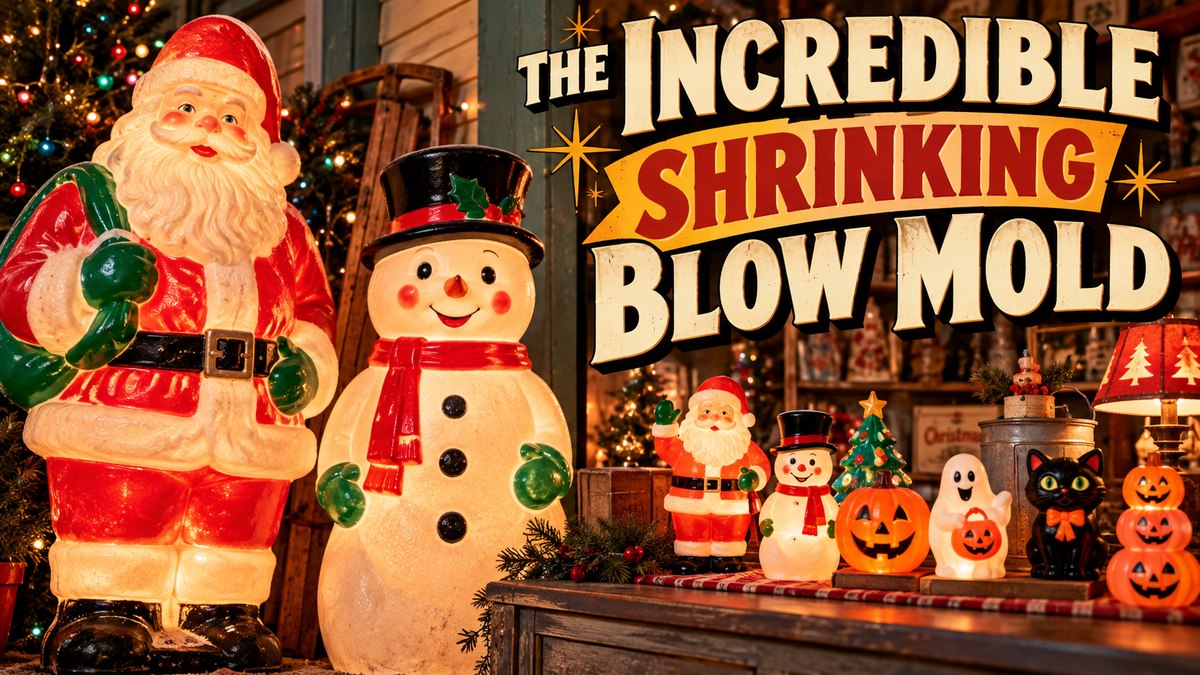
From four-foot Santas to eight-inch jack-o’-lanterns, the newest generation of blow molds is finding a home on mantels, bookshelves, kitchen counters, and anywhere else there’s room for a little holiday glow.
By Curtiss Wayne Andrews
There was a time when owning a blow mold required three things: a front yard, an electrical outlet, and a willingness to explain to your spouse why a four-foot plastic Santa needed his own storage space for eleven months of the year.
Today? You might only need a bookshelf.
Something interesting is happening in the world of holiday decorating. The big, illuminated plastic figures that once dominated suburban lawns are finding smaller cousins popping up everywhere—from big-box retailers to specialty holiday shops.
The Santa who once stood guard beside your driveway has apparently downsized to a studio apartment.
And collectors seem perfectly happy to welcome him home.
Honey, I Shrunk the Santa

To understand the appeal of today’s miniature blow molds, it helps to remember what made their larger predecessors so memorable.
During the golden age of illuminated plastic holiday decorations, companies such as Union Products, Empire, and General Foam produced Santas, snowmen, angels, pumpkins, ghosts, and other figures intended to be seen from the sidewalk—or even from a passing car. Poloron really owned the big blow mold lane with its giant animated Santa.
A three- or four-foot Santa wasn’t exactly subtle. That was the point.
These decorations transformed ordinary homes into glowing neighborhood landmarks. Their charm came from their exaggerated features, cheerful expressions, colorful plastic, and the unmistakable warmth of a light bulb shining through molded plastic.
But the same characteristics that made them wonderful also made them inconvenient.
Large blow molds take up space. Lots of it.
Ask any serious collector about storage, and you’ll probably hear a story involving a garage, a basement, an attic, or an increasingly complicated negotiation over the guest bedroom.
That’s where the smaller versions enter the picture.
They offer something that sounds almost contradictory: the same oversized nostalgia in a much smaller package.
The Tabletop Takeover Is Real
This isn’t simply a matter of collectors discovering old miniature decorations at estate sales. Retailers are actively offering compact, newly manufactured blow molds designed for indoor decorating.
Consider some of the current offerings:
- Target’s Hyde & EEK! Boutique includes eight-inch illuminated pumpkins, a 12-inch ghost holding a pink pumpkin, and other compact Halloween characters.
- Home Depot lists a 14-inch Gemmy Nightmare Before Christmas Oogie Boogie blow mold specifically intended for tabletops, mantels, and entry tables.
- At Home offers illuminated Halloween pumpkins in sizes ranging from approximately four inches to 16 inches.
- Lowe’s and Walmart continue offering larger figures alongside compact and mid-sized Halloween characters.
These are actual retail examples, not merely collector speculation.

The little pumpkin
Target’s eight-inch lighted pumpkins illustrate how a familiar outdoor decoration can become an inexpensive indoor accent.

The licensed character
Gemmy’s 14-inch Oogie Boogie brings pop-culture recognition to the traditional illuminated-plastic format.
What’s notable isn’t just the size. It’s the variety.
Modern tabletop offerings extend beyond the familiar smiling Santa or classic jack-o’-lantern. We’re seeing novelty animals, licensed entertainment characters, pastel colors, and playful Halloween designs that would have looked rather unusual in a 1960s suburban Christmas display.
The modern blow mold isn’t necessarily trying to recreate Grandma’s front yard exactly.
Sometimes it’s trying to capture the feeling of Grandma’s front yard, then squeeze it onto a kitchen counter next to the coffee maker.
Halloween May Be Leading the Miniature Parade
Christmas gets much of the attention in blow mold collecting, but Halloween has become an especially interesting laboratory for smaller designs.
Pumpkins are natural candidates for miniaturization. Their simple shapes, expressive faces, and translucent orange plastic work beautifully at almost any size.
A small illuminated jack-o’-lantern can sit on a windowsill. A ghost can glow beside a stack of vintage horror novels. A black cat can take up residence on a mantel without alarming the actual household cat.
Retailers are also experimenting with combinations that feel more whimsical than traditional.
Walmart’s 2026 Halloween assortment, for example, has included lighted ghostly dogs, pumpkin cats, and stacked ghosts, alongside much larger pieces such as a six-foot skeleton nutcracker.
That contrast is important.
The market isn’t abandoning big blow molds. It’s expanding the number of places where blow molds can live.
And there’s a broader seasonal appetite behind it. The National Retail Federation projects $13.5 billion in Halloween consumer spending for 2026, with 42% of surveyed consumers planning to decorate their homes or yards. That’s not blow-mold-specific sales data, but it illustrates the substantial audience for Halloween decorating.
The Apartment-Friendly Blow Mold
Here’s a theory: the tabletop blow mold may be introducing the hobby to people who would never have considered collecting the larger versions.
Think about someone living in an apartment, condo, dorm room, or small house.
A four-foot snowman might not be practical. But a glowing eight-inch pumpkin? That’s easy.
The barriers to entry become smaller along with the decoration.
There’s less storage to worry about. The purchase price can be relatively modest. And the display doesn’t require permission from a homeowners association that treats a plastic Santa like a zoning violation. Oh, and live in a sketchier area prone to theft? Keeping things indoors might be wise.
Another advantage is portability.
Many newer compact figures use battery-powered LED lighting rather than the traditional cord-and-bulb arrangement. Target’s 12-inch ghost, for instance, uses three AA batteries and is intended for indoor or sheltered outdoor use.
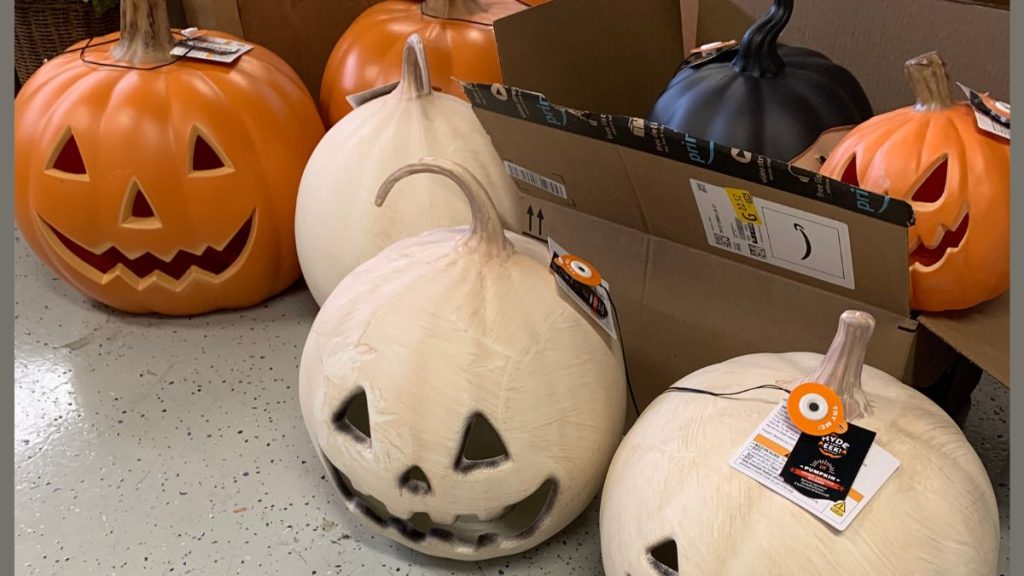
You can place it almost anywhere without searching for an outlet or running a cord behind the furniture.
Of course, purists may argue that a vintage blow mold should glow from a proper bulb, preferably one that has been warming the inside of a plastic Santa since the Reagan administration.
But convenience has a way of winning people over.
Are Small Blow Molds Actually Better?
That depends on what you’re looking for.
| Traditional large blow molds | Modern tabletop blow molds |
|---|---|
| Command attention outdoors | Create intimate indoor displays |
| Often become neighborhood landmarks | Fit shelves, mantels, and windowsills |
| Require substantial storage | Easier to store and rotate |
| Classic examples have collector history | New examples offer accessible entry points |
| Often use replaceable corded bulbs | Many use integrated LEDs or batteries |
| Can be visually spectacular | Easy to group into themed collections |
The biggest difference may be emotional.
A towering vintage Santa can transport someone directly back to a childhood Christmas Eve. A tiny modern Santa might create a new memory for a child who has never seen one of the originals.
Neither experience cancels out the other.
And one isn’t automatically more collectible simply because it’s larger.
A scarce vintage tabletop figure with documented history may be far more interesting to a serious collector than a mass-produced four-foot decoration sold today.
Condition, manufacturer, age, rarity, originality, and demand all matter.
Size is only part of the story.
The Collector’s Dilemma: When Small Becomes a Big Problem
There’s another consequence of the tabletop trend that nobody should underestimate.
Small blow molds are dangerously easy to justify.
A collector might hesitate before bringing home another life-sized Santa. That purchase requires planning, transportation, storage, and possibly a prepared explanation.
But a $5 pumpkin?
What’s the harm?
Then comes a ghost.
Then a cat.
Then another pumpkin, because this one has a different face.
Before long, an innocent little Halloween display has consumed an entire bookcase.
It’s the same collecting psychology in miniature: one interesting piece leads to another, and suddenly you’ve assembled a glowing plastic community with its own housing shortage.
Retailers may be making blow molds easier to collect, but they certainly aren’t making it easier to stop collecting them.
What’s Really Trending: Nostalgia Without the Storage Commitment
It’s tempting to declare that tabletop blow molds are taking over the industry. But that would be overstating the evidence.
We can clearly see more compact options in current retail assortments, and retailers are embracing nostalgia and whimsy in holiday merchandise more broadly. What we don’t have is reliable public sales data proving that tabletop blow molds are outselling traditional large figures.
What we can identify are several interesting developments.
First, holiday nostalgia is moving indoors. The same aesthetic that once belonged exclusively on the lawn now works as year-round collector décor or a seasonal accent inside the home.
Second, newer designs are broadening the audience. Classic Santa and snowman figures coexist with licensed characters, quirky animals, and unconventional colors.
Third, compact designs encourage collecting in groups. One four-foot Santa makes a statement. Eight little illuminated pumpkins create a display.
And fourth, manufacturers and retailers are serving multiple generations at once. Someone who remembers vintage blow molds from childhood might buy a modern miniature for sentimental reasons. A younger shopper may simply think a glowing ghost holding a pink pumpkin is adorable.
Both customers are participating in the revival of an old decorating tradition.
But Please, Don’t Retire the Four-Foot Santa

For all the appeal of miniature blow molds, I hope the large versions never disappear.
There’s something irreplaceable about driving through a neighborhood in December and seeing an enormous illuminated Santa standing beside a snowman, a reindeer, and perhaps a plastic choir boy whose expression suggests he’s been singing the same carol since 1974.
A tabletop decoration can evoke that memory.
But it cannot completely recreate the experience of seeing an entire yard glowing against the winter darkness.
The scale is part of the magic.
In many ways, the tabletop revival works because those large figures came first. They established the shapes, characters, colors, and emotional associations that today’s manufacturers can reinterpret.
The little guys are standing on the shoulders of plastic giants.
A Small Future for a Very Big Tradition
One of the central ideas behind my book, The Glow That Won’t Go Out, is that blow molds are more than holiday decorations.
They’re vessels for memories.
They remind us of houses we grew up in, grandparents who decorated with enthusiasm, neighborhood displays that made us slow down, and Christmas mornings that somehow felt brighter because a glowing Santa was standing outside the window.
The newer tabletop versions are carrying that tradition into places the original manufacturers might never have imagined.
Apartments. Offices. Bookshelves. Kitchen counters. Tiny porches.
And maybe that’s the most encouraging development of all.
The hobby doesn’t have to remain limited to collectors with enormous displays, overflowing garages, and enough extension cords to illuminate a small airport.
There’s room for the person with a single glowing pumpkin, too.
Because whether your Santa stands four feet tall or fits in the palm of your hand, the important part hasn’t changed.
It’s still the glow that matters.
Discover the history behind the glow
In The Glow That Won’t Go Out, I explore the fascinating history of America’s illuminated plastic holiday decorations—from the manufacturers that helped make them household favorites to the passionate collectors preserving their legacy today.
Through historical research, personal stories, and collector interviews, the book celebrates the decorations that made our holidays brighter and the people determined to keep them glowing.
Available now in Kindle, paperback, and hardcover. Oh, and there’s an audiobook version as well.