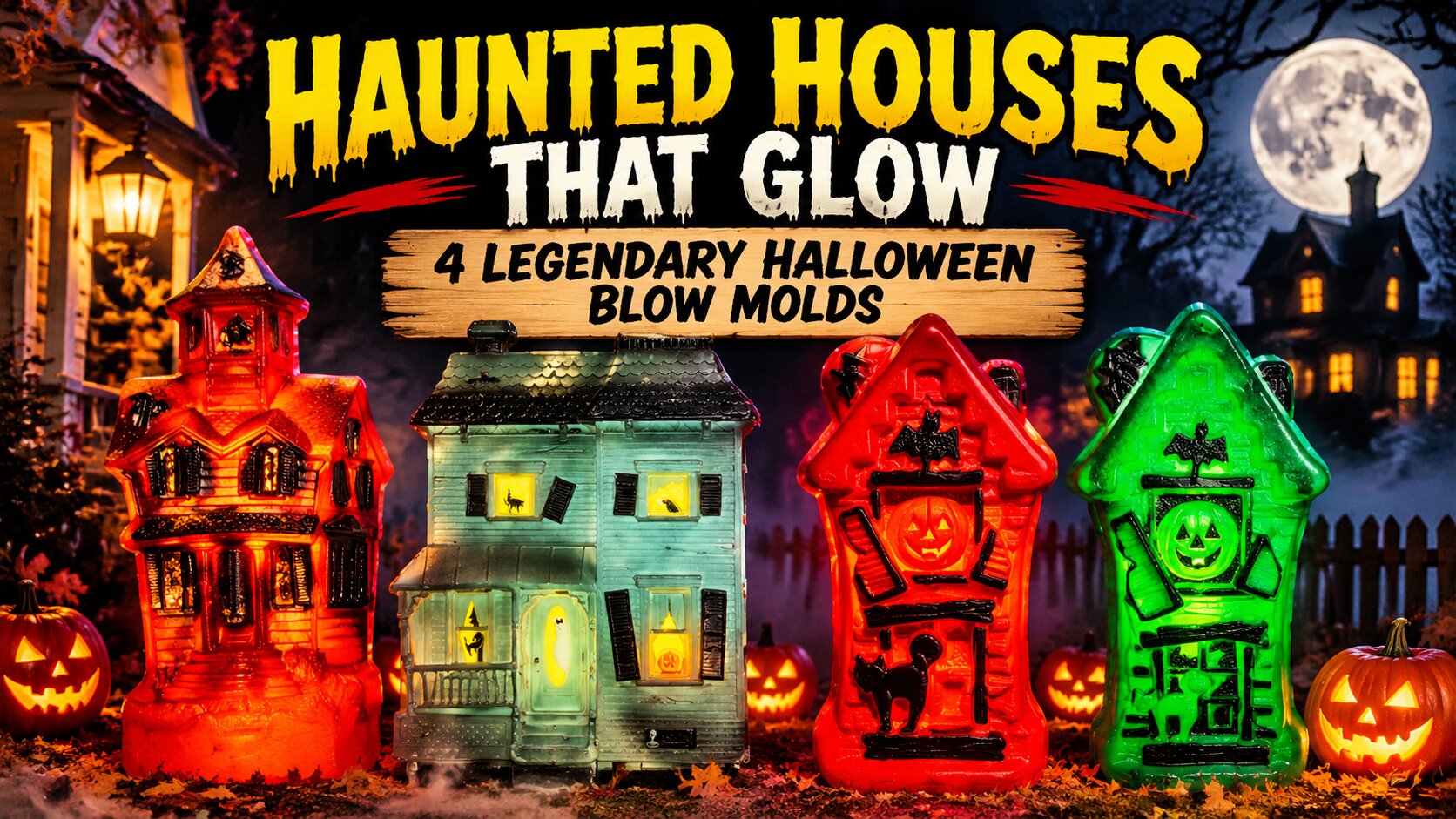
From Don Featherstone’s wonderfully creepy Psycho House to the orange and green classics of Empire and Bayshore, these miniature haunted mansions prove you don’t need a twelve-foot skeleton to make Halloween unforgettable.
By Curtiss Wayne Andrews
Every neighborhood has that one house.
You know the one.
The shutters are crooked. The porch light flickers. The yard looks like nobody’s mowed it since the Carter administration.
And every October, the place somehow looks better than ever.
Now imagine shrinking that house down to about seventeen inches, making it out of hollow plastic, and sticking a light bulb inside.
Congratulations.
You’ve just described one of my favorite categories of vintage Halloween decorations.
The haunted house blow mold.
I’ve always thought these were some of the cleverest decorations ever produced. A witch is a witch. A ghost is a ghost. But a haunted house? That’s an entire Halloween story squeezed into one glowing piece of plastic.
A crooked roof. A suspicious window. Maybe a black cat, a flying witch, or a bat that looks like it pays the mortgage.
And somehow, every little detail works.
For collectors, these miniature mansions have become some of the most desirable pieces in the hobby. A few are genuine bucket-list finds. Others are more attainable, but no less charming.
And unlike certain modern Halloween decorations that require an electrical engineering degree and a dedicated storage unit, these houses have one simple job.
Plug in.
Look spooky.
Repeat every October.
Let’s visit four favorites that deserve a place in the neighborhood.
1. Don Featherstone’s Haunted House: The Psycho House With a Famous Designer
If there’s a haunted house blow mold that deserves its own creepy organ music, this might be it.
Don Featherstone’s Haunted House, produced by Union Products in the mid-1990s, is one of those decorations that makes collectors stop scrolling.
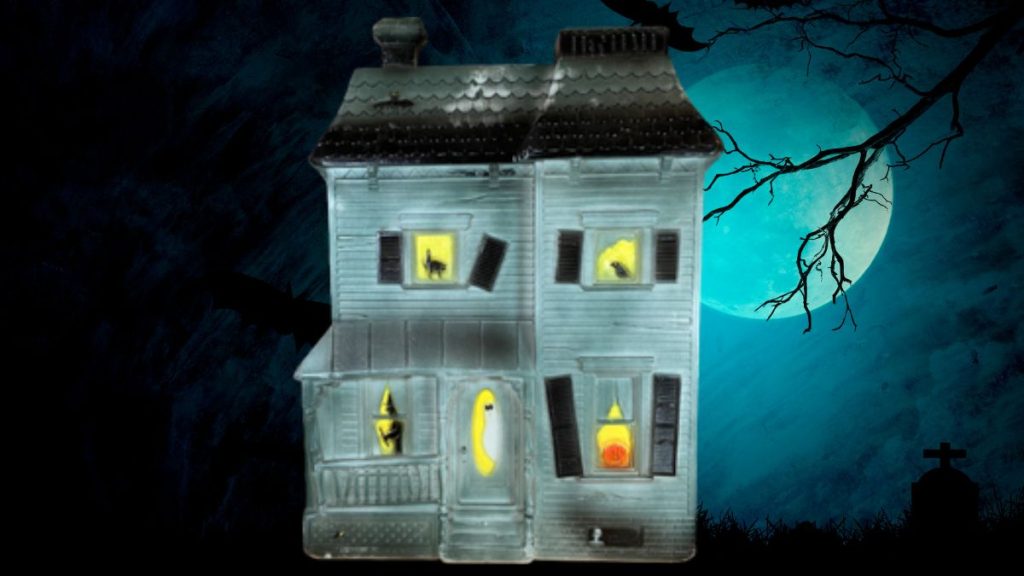
It’s tall. It’s crooked. It’s packed with little Halloween characters.
And it looks like the kind of house where a real estate agent would conveniently forget to mention the basement.
Collectors sometimes call it the Psycho House, a nickname that makes sense the moment you see it.
There’s something vaguely Norman Bates about the architecture.
The roof rises at odd angles. The building looks uncomfortable in its own skin. And the whole thing has the slightly deranged personality of a house that might start talking to you after midnight.
It’s wonderful.
From Pink Flamingos to Haunted Mansions
Don Featherstone is best remembered as the creator of the pink plastic flamingo, which he designed for Union Products in 1957.
That’s a pretty remarkable claim to fame.
Imagine creating something so recognizable that people are still putting it on lawns nearly seventy years later.
But Featherstone’s career extended far beyond flamingos.
He designed hundreds of plastic figures and decorations for Union Products, including a remarkable assortment of Halloween characters.
His Haunted House is a great example of why his work deserves attention.
The design isn’t just a building.
It’s a collection of miniature Halloween scenes.
Depending on where you look, you’ll find a bat on the roof, a black cat, a crow, a witch, a jack-o’-lantern, and a ghost near the entrance.
It’s like somebody took every character from a 1960s Halloween party invitation and gave them separate apartments.
And somehow, the arrangement doesn’t feel crowded.
It feels alive.
The House With a Thousand Little Details
The Featherstone house stands approximately 24 inches tall, making it noticeably larger than many earlier tabletop haunted house decorations.
It’s also relatively shallow, so it can sit against a wall, in a window, or as the centerpiece of a porch display.
That combination makes it particularly appealing.
You get a lot of visual impact without needing to sacrifice half your garage to store it.
The sculpting is what really sells the piece.
The uneven roofline.
The textured walls.
The tiny characters peering out from different parts of the building.
And once the light comes on, those details become even more interesting.
Suddenly, the house looks occupied.
Very occupied.
Which raises an obvious question.
Who exactly is collecting rent from the ghost?
The Classic Version and the Mysterious Version Two
Collectors also discuss a harder-to-find Version Two of the Featherstone Haunted House, distinguished by a different, more spray-painted-looking finish.
That variation has developed a reputation of its own.
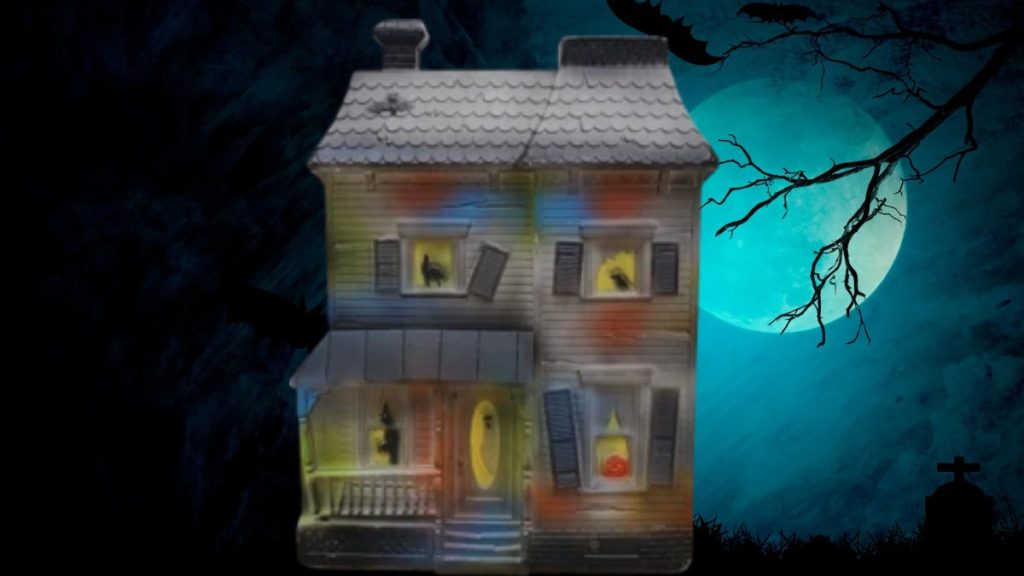
The appeal is understandable.
With vintage blow molds, paint can completely change the personality of a piece.
A different spray pattern can make a roof look darker, bring out architectural details, or give the entire house a more weathered appearance.
And because these decorations weren’t always painted with the kind of machine-perfect consistency we expect today, variations can be fascinating.
But there’s an important distinction between a documented factory variation and an unusual paint job.
Before paying a premium for something advertised as Version Two, I’d want to see clear comparisons with known examples, original markings, and evidence that the finish was factory-applied.
I haven’t found enough reliable manufacturer documentation to establish a precise production history or rarity ranking for the Version Two designation.
That doesn’t make the variation uninteresting.
It simply means collectors should do their homework.
A little mystery is fun.
An expensive mystery with a questionable repaint?
Less fun.
What Is the Featherstone Haunted House Worth?
Here’s where things get interesting.
In October 2024, a vintage Union Products Haunted House sold for $527, according to Antique Trader.
That’s serious money for a piece of illuminated plastic.
Other examples have appeared with asking prices in the several-hundred-dollar range, although asking prices and actual sales are two very different things.
Condition plays a major role.
Paint wear, cracks, missing lighting components, repairs, and structural dents can all affect what a buyer is willing to pay.
And because this house has so many molded details, there’s plenty to inspect.
Still, the appeal goes beyond resale value.
It’s a Don Featherstone design.
It’s an elaborate Halloween scene.
And it represents one of the more imaginative pieces Union Products produced.
For collectors who appreciate both the designer and the holiday, that’s a pretty compelling combination.
2. Jones Auction House’s Red Haunted House: Bringing a 1960s Classic Back From the Dead
Here’s a story I particularly enjoy.
Usually, when we talk about vintage blow molds, we’re talking about companies that disappeared, factories that closed, and decorations that collectors are desperately trying to preserve.
The Jones Auction House Haunted House turns that story around.
Instead of watching another old design vanish, somebody decided to bring it back.
And they did it with a lot of respect for the original.
A New House With Old Bones
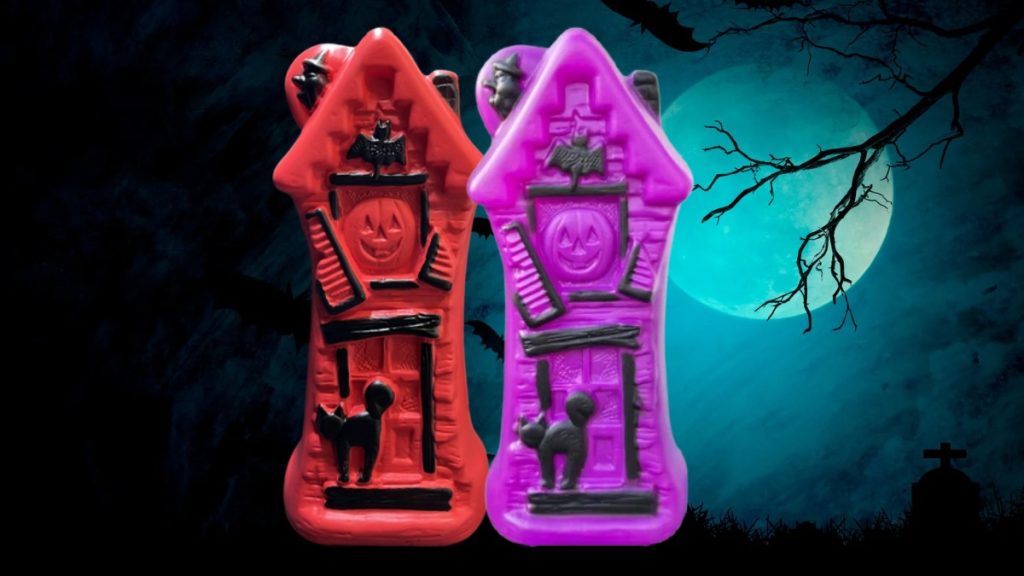
Jones Auction House, known for its blow mold auctions (and featured in my book The Glow That Won’t Go Out), revived a classic 1960s Haunted House design.
But this wasn’t simply a matter of finding an old factory mold and switching on the machinery.
According to the company, the original decoration was 3D-scanned to create a new production mold.
That’s a fascinating marriage of old and new technology.
A vintage Halloween decoration that once sat in somebody’s front window became the starting point for a modern American-made collectible.
The finished house stands approximately 17 inches tall, 7 inches wide, and 5 inches deep.
It’s compact.
It’s sturdy.
And it has the same wonderfully lopsided personality that made the original design so appealing.
Why Red?
The revival’s most obvious difference is the color.
Instead of simply reproducing the familiar orange or green versions, Jones introduced a striking red Haunted House.
It’s a smart choice.
Red works beautifully with Halloween’s black-and-orange palette, but it also gives the decoration a slightly different personality.
The red house looks a little more sinister.
Like the property has been condemned.
Twice.
Jones also noted that the red color could work for Christmas decorating, which is an interesting bonus.
Personally, I think the house still looks like it has a ghost living in the attic.
But I suppose even ghosts deserve a Christmas tree.
The Beauty of Imperfect Paint
One of my favorite details about the Jones revival is the company’s decision to use hand-sprayed paint.
And yes, that includes overspray.
For anyone unfamiliar with vintage blow molds, overspray is what happens when paint extends beyond the intended details.
Modern manufacturing often treats that as a flaw.
Vintage collectors sometimes see it differently.
Those soft edges and imperfect spray patterns are part of the look.
They’re reminders of a time when these decorations weren’t finished with perfectly aligned digital printing.
Jones deliberately recreated that older appearance.
Not because the company couldn’t produce something cleaner.
Because the original character mattered.
That’s a distinction I appreciate.
A modern reproduction can be technically perfect and still feel completely wrong.
Sometimes a little messiness is exactly what makes something look right.
A Revival Worth Celebrating
Jones marked its new houses with JAH initials on the back, making them distinguishable from vintage examples.
That’s important.
Collectors should always be able to tell an original from a reproduction.
The revival was introduced in red in 2022, with a purple version following in 2025.
And the fact that people wanted new versions of this old design says something about the hobby.
These decorations aren’t popular simply because they’re old.
They’re popular because the designs still work.
A crooked little house with glowing windows was charming in 1969.
It’s charming now.
And if it means another generation gets to experience that feeling, I’m all for it.
3. Empire’s Haunted House: A Crooked Orange Mansion From North Carolina
If the Featherstone house is a sprawling haunted mansion, Empire‘s classic Haunted House is the creepy little property at the end of the street.
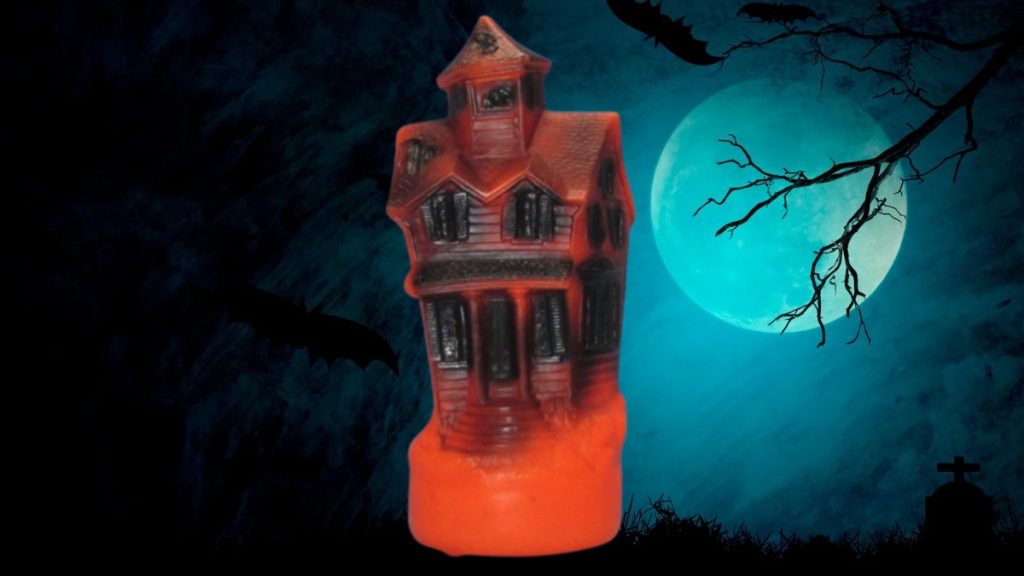
The one with the boarded-up windows.
The questionable foundation.
And a listing that probably says “great potential for the right buyer.”
Empire’s version is a personal favorite of many collectors because of its unusual shape.
The house appears to be perched on a hill, with steps leading toward a rounded porch.
There are columns.
Damaged-looking shutters.
A battered roof.
And a bat lurking near the attic.
It’s not a realistic building.
And that’s what makes it so good.
The Empire Years
Empire Plastics began in Tarboro, North Carolina, in 1953.
The company initially made toys before becoming one of the major manufacturers of illuminated holiday decorations.
For decades, Empire helped fill American neighborhoods with glowing Santas, snowmen, witches, pumpkins, and other seasonal characters.
Its Haunted House reflects the company’s ability to make a relatively small decoration feel much larger than it is.
The design is associated with the late 1960s and 1970s, and collector references identify a 1969 example.
The classic orange plastic is accented with black paint that emphasizes the building’s worn-out appearance.
And those details are everything.
The crooked perspective makes the house look unstable.
The windows look suspicious.
The whole building appears to be leaning toward you.
It’s the architectural equivalent of a witch’s crooked smile.
Why the Design Works
Here’s what I love about Empire’s house.
It doesn’t need a bunch of characters hanging out of the windows.
The building itself is the monster.
The strange angles and exaggerated details tell you everything you need to know.
Nobody lives here.
At least nobody you’d want to meet.
And when the light comes on, the orange plastic gives the entire structure a warm, eerie glow.
It’s less haunted mansion and more haunted storybook.
The kind of illustration you might have found in an old children’s Halloween book.
What Collectors Pay
Empire’s Haunted House has been attracting collector interest for years.
In 2013, Halloween collector and historian Mark Ledenbach documented a 1969 Empire example that sold for $66.
That may sound modest by current standards, but it’s an interesting historical reference.
The design was already appreciated by knowledgeable collectors more than a decade ago.
Today, online asking prices can be considerably higher, especially for clean examples.
But don’t assume every listed price represents the market.
The actual value depends on condition, completeness, originality, and what buyers are paying at the time.
If you find one, inspect the roofline and the small architectural details carefully.
Cracks and damage can be easy to miss.
And don’t overlook the paint.
A little wear adds character.
Heavy fading can make the entire house lose its spooky personality.
4. Bayshore’s Orange and Green Haunted Houses: Little Mansions With Big Personalities
Now we come to a company that deserves more recognition in the history of vintage Halloween decorating.
Bayshore Industries.
If you’re familiar with vintage Halloween masks, candy containers, and novelty decorations, you’ve probably encountered the name.
Bayshore’s roots go back to 1946, when the company was established in Elkton, Maryland.
It began with rubber products before expanding into toys, masks, and seasonal novelties.
By the 1960s and 1970s, Bayshore was producing an assortment of molded-plastic Halloween decorations.
And its Haunted House Lamp is one of the most memorable.
Orange or Green? Why Not Both?
Bayshore produced the house in two well-known color schemes.
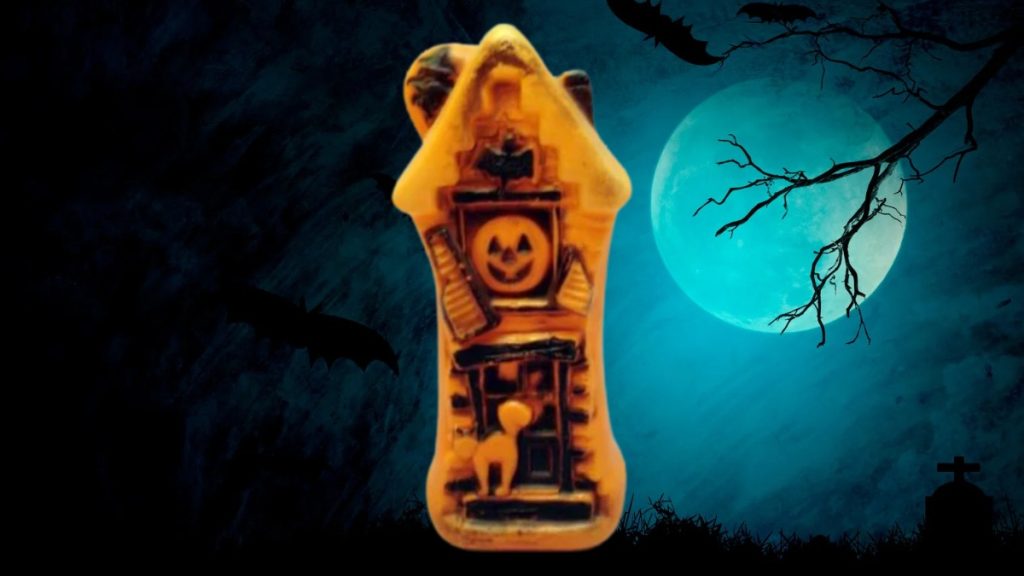
Orange and green.
Both versions stand approximately 17 inches tall.
Both feature a delightfully rundown little house.
And both are loaded with Halloween details.
A black cat.
A jack-o’-lantern.
A bat.
A witch flying across the moon.
Crooked shutters and weathered architectural details.
It’s an impressive amount of Halloween packed into one small decoration.
The orange version feels familiar.
Classic.
Like a glowing pumpkin transformed into a haunted mansion.
The green version has a different mood.
A little stranger.
A little more supernatural.
Like somebody built a house next to a radioactive swamp.
Personally, I can understand why collectors want both.
Once you see them side by side, choosing one feels like an unnecessary compromise.
Of course, that’s how collections get out of hand.
You start by buying one haunted house.
Then you need the other color.
Then you find a different paint variation.
Then somebody mentions a matching witch.
And suddenly your dining room looks like a municipal Halloween display.
The Charm of the Bayshore Sculpt
Bayshore’s Haunted House is packed with storytelling.
Every detail gives your eye somewhere to go.
The crooked shutters suggest neglect.
The cat adds a little mischief.
The witch and bat make the scene unmistakably Halloween.
And the glowing windows bring the whole thing together.
It’s the kind of decoration you can look at for several minutes and still notice something new.
That’s impressive for a piece of plastic originally sold as a seasonal novelty.
Bayshore eventually ceased production in 1977.
Its parent company’s later financial problems and the sale of novelty tooling helped scatter parts of its manufacturing legacy.
Which makes surviving examples especially interesting.
They’re reminders of a company that helped define the look of Halloween long before giant inflatables and animatronic monsters took over store shelves.
The Collector’s Challenge
Bayshore’s houses are desirable, particularly in clean condition with strong original paint.
But identifying them can take some care.
Similar designs circulated through different manufacturers, and older Halloween molds were sometimes reused or reproduced.
That’s why it’s important to examine the maker’s marks rather than relying entirely on the appearance.
An orange haunted house isn’t automatically a Bayshore.
And a green one isn’t necessarily older or rarer simply because a seller says so.
Look for documented markings.
Compare the details.
And be cautious about listings that use several manufacturer names interchangeably.
If you’re paying collector prices, you deserve to know what you’re buying.
Why Haunted House Blow Molds Are So Special
Here’s the thing about these little houses.
They do something most Halloween decorations can’t.
They create an entire world.
A witch is a character.
A pumpkin is a symbol.
A ghost is a familiar shape.
But a haunted house gives all those characters somewhere to live.
It invites you to imagine what’s happening behind the windows.
Who’s upstairs?
Why is the roof crooked?
What’s that strange light in the attic?
And why does the black cat look like it knows something?
It’s storytelling without a single word.
That’s a big part of why these pieces still resonate.
They remind us of the Halloween we imagined as children.
The haunted house at the end of the street.
The spooky mansion in an old cartoon.
The mysterious building in a storybook that nobody was supposed to enter.
Except, of course, the main character.
Who always entered anyway.
Because apparently fictional people have never heard of basic personal safety.
The Art of Making Plastic Look Haunted
Another reason these houses stand out is the sculpting.
Think about the challenge facing the designers.
They had to create something recognizable, interesting, and affordable.
The finished piece needed to survive mass production.
It had to be hollow.
It had to accommodate a light.
And it needed to look good from a distance.
That’s a lot to ask of a seasonal decoration.
The best designers understood that realism wasn’t the goal.
Personality was.
So they exaggerated everything.
Crooked roofs.
Oversized windows.
Strange staircases.
Leaning walls.
The result was architecture that looked almost alive.
And when illuminated, the houses became miniature Halloween stages.
A glowing window could suggest somebody was home.
A dark doorway could make the entire building feel mysterious.
A bat on the roof was all you needed to complete the scene.
Simple tricks.
Great results.
Collecting Haunted Houses: What Matters Most?
If you’re looking to add one of these houses to your collection, there are a few things worth checking before you hand over your money.
First, identify the manufacturer.
Union Products, Empire, Bayshore, and Jones Auction House have different production histories.
And even when designs look similar, the markings can tell very different stories.
Next, examine the structure.
Haunted houses often have thin or projecting details that can become damaged during storage.
Rooflines, chimneys, window edges, and corners deserve particular attention.
Then look at the paint.
Hand-sprayed decoration was part of the original character of many older pieces.
Some overspray is normal.
But heavy repainting, fading, or missing details can affect collector appeal.
Check the lighting components, too.
A working original assembly can be desirable, but safety comes first.
Old cords and sockets should be inspected before use.
Finally, compare completed sales.
Not the highest asking price.
Not the listing with seventeen exclamation points and the word “RARE” written in capital letters.
Actual sales.
A seller can ask $900 for a plastic haunted house.
That doesn’t mean anybody is going to pay it.
The Haunted House Market: From Affordable Classics to Collector Grails
One of the nice things about this category is that there are several ways to participate.
You don’t have to spend hundreds of dollars to enjoy a haunted house blow mold.
A modern Jones Auction House revival offers the vintage look without requiring you to find a sixty-year-old original.
Empire and Bayshore examples can be more challenging, particularly if you want a specific color or exceptionally clean condition.
And the Don Featherstone house occupies a special place because of its distinctive design, size, and association with one of America’s most recognizable plastic lawn-decoration artists.
For collectors, that gives the category some depth.
You can focus on manufacturers.
You can collect color variations.
You can look for original packaging.
Or you can simply buy the house that reminds you of Halloween when you were eight years old.
There’s no wrong way to enjoy these things.
Well, maybe one.
Don’t buy a cracked haunted house for an outrageous price just because the seller says it’s haunted.
If it actually comes with a ghost, that’s a separate negotiation.
The Houses That Never Really Closed
Most of the companies that created these decorations are gone.
Union Products closed.
Empire’s assets passed to General Foam.
Bayshore disappeared decades ago.
But the little houses they made are still here.
Some sit in carefully arranged collector displays.
Others appear in antique shops every October.
A few probably remain buried in attics, waiting for somebody to discover that Grandma’s old Halloween decoration is now a sought-after collectible.
And thanks to companies like Jones Auction House, some classic designs are finding their way back into production.
I love that.
Because the appeal of these pieces was never really about the plastic.
It was about what happened when you turned on the light.
Suddenly, an ordinary window became a haunted mansion.
A front porch became a Halloween scene.
And a little hollow house could make the whole room feel like October.
That’s pretty impressive.
Especially when you consider that the original technology was basically a molded plastic shell and a light bulb.
No motion sensors.
No prerecorded screams.
No subscription service required.
Just a crooked little house, glowing in the darkness.
And somewhere inside, I’m convinced, a ghost is still trying to figure out how to pay the property taxes.
Keep the Glow Alive
Haunted houses are just one part of the fascinating world of vintage holiday blow molds.
In my book, The Glow That Won’t Go Out: The Complete Collector’s Guide to Vintage Holiday Blow Molds, I explore the manufacturers, designers, collectors, and unforgettable decorations that helped make Christmas and Halloween such memorable parts of American life.
From Don Featherstone’s imaginative designs to the glowing classics produced by Empire, Union Products, and other manufacturers, the book celebrates the decorations we grew up with and the stories behind them.
Some are easy to find.
Others take years of searching.
And a few are the kind of pieces that make a collector’s heart skip a beat when they appear at an estate sale.
Discover The Glow That Won’t Go Out on Amazon
Curtiss Wayne Andrews is the author of The Glow That Won’t Go Out and writes about vintage Americana, forgotten manufacturers, and the collectibles that keep our memories alive for Paper Sack Publishing.