The forgotten giants of Main Street Christmas, the collectors rescuing them, and why these oversized pieces of holiday history have become some of the most fascinating treasures in the blow mold world.
By Curtiss Wayne Andrews
There’s collecting blow molds.
And then there’s collecting something so enormous that you have to figure out whether it’ll fit through your garage door before you even think about buying it.
Welcome to the wonderful, slightly ridiculous world of municipal blow molds.
These aren’t the little plastic Santas that once sat beside your grandmother’s front steps.
We’re talking about giant illuminated decorations that hung over downtown streets, welcomed shoppers into department stores, and helped turn ordinary American towns into Christmas wonderlands.
Huge Santas. Oversized ornaments. Towering candles. Massive snowmen. Decorations built to be seen from a moving car, sometimes from halfway down the block.
And for a certain breed of collector, they’re the ultimate prize.
I’ve been fascinated by these pieces for a while, especially after talking with Ed, known as @sickeddie on Instagram, who deals in oversized municipal holiday decorations.
When you start looking at Christmas through the eyes of someone who handles these giants, you realize something.
The decorations weren’t simply bigger.
They belonged to a completely different world.
Before Christmas Came in a Cardboard Box
Think back to the downtown Christmas displays of the 1950s, 1960s, and 1970s.
Main Street wasn’t just a place to buy things.
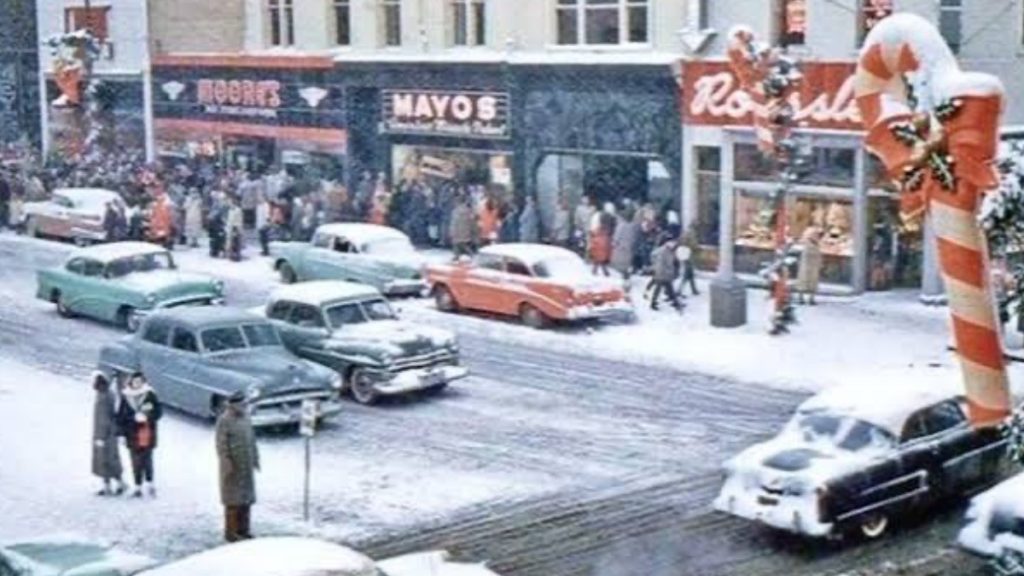
For many families, it was where Christmas officially began.
Department store windows became miniature theatrical productions. Streetlights sprouted illuminated wreaths and garlands. Santa Claus appeared on rooftops, above store entrances, and occasionally in proportions that suggested he’d been eating the entire town’s supply of Christmas cookies.
Families would pile into the car and drive downtown just to see the lights.
And towns took those displays seriously.
A decorated Main Street meant holiday spirit, civic pride, and, of course, shoppers.
Merchants wanted people walking past their windows.
Chambers of commerce wanted visitors.
Town officials wanted a downtown that looked festive, welcoming, and prosperous.
That created a market for commercial-scale holiday decorations.
Some were metal-framed displays covered with garland or illuminated with strings of lights. Others used fiberglass, molded plastic, or combinations of materials.
And among them were the oversized plastic figures collectors now refer to as municipal blow molds.
What Exactly Is a Municipal Blow Mold?
The term municipal blow mold is collector shorthand rather than a strict manufacturing category.
Generally, it describes an oversized molded-plastic holiday decoration intended for commercial, civic, or large public displays.
These pieces might have been installed along downtown streets, attached to utility poles, suspended above sidewalks, or displayed outside shopping centers.
Some were freestanding. Others required brackets, heavy mounting arms, or custom supports.
And they weren’t all technically blow molded.
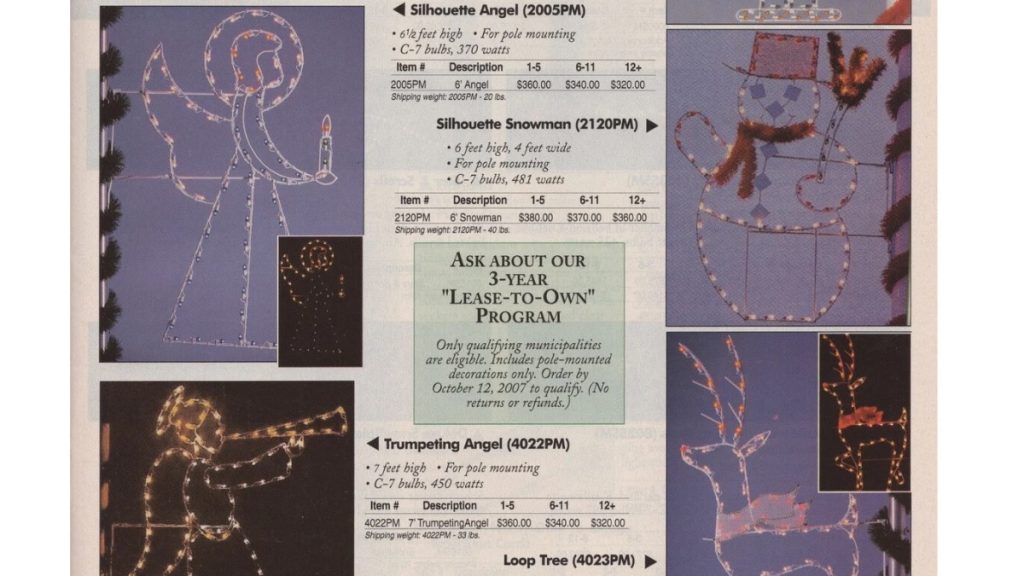
Just as with early NOMA decorations, some oversized holiday figures were made using other plastic-forming methods or combined plastic shells with metal support structures.
That distinction matters if you’re trying to identify a manufacturer or date a particular piece.
But collectors tend to group these large commercial decorations together because they share the same appeal.
They’re big.
They’re old.
And they look like Christmas escaped from a 1965 department store window.
How Big Are We Talking?
A typical residential blow mold might stand two or three feet tall.
A larger lawn Santa could reach four or five feet.
Municipal pieces could go well beyond that, particularly when they were part of a larger assembled display.
A single oversized ornament might measure roughly 20 inches across. Commercial candle decorations could approach 40 inches tall. Larger figures and multi-piece installations could occupy an entire storefront or street display.
And size isn’t always the whole problem.
An oversized decoration might have a heavy steel bracket attached to the back.
A suspended figure could require reinforced hanging points.
A giant ornament might be light enough to carry but awkward enough to make you reconsider every decision that led to buying it.
That’s the part people don’t always appreciate when they see these pieces online.
You might fall in love with a massive vintage Santa in a photograph.
Then the seller tells you it comes with an industrial mounting arm and won’t fit in a standard shipping box.
Suddenly, collecting becomes a transportation problem.
But that’s also part of the adventure.
The Manufacturers Behind the Magic
Unlike the familiar residential blow mold market, municipal holiday decorating wasn’t dominated by one simple group of manufacturers.
Different companies supplied decorations for downtown streets, commercial properties, and public displays.
Some made molded-plastic figures. Others specialized in large ornaments, pole-mounted decorations, or complete commercial lighting systems.
The residential blow mold industry provides some useful connections.
Beco Products, one of the early pioneers of illuminated plastic Christmas decorations, produced large holiday pieces, including oversized ornaments and decorative lamp-post elements.
Poloron Products became known for its impressive large-scale figures, including a five-foot animated Santa introduced in 1969.
That Santa wasn’t necessarily a municipal commission, but it demonstrated just how ambitious illuminated plastic decoration manufacturing had become. Its upper body moved from side to side, creating the kind of theatrical effect that would have been right at home in a department store display.
Poloron also produced a giant animated snowman and other elaborate figures.
Meanwhile, Empire Plastics and General Foam helped bring large illuminated decorations into homes, businesses, and public spaces.
The line between residential and commercial use wasn’t always clear.
A figure originally sold for a large private display might eventually end up outside a business.
A downtown decoration could be rescued years later and placed in someone’s front yard.
And a piece sold through a commercial decorator might have been manufactured by a company better known for entirely different products.
That’s why identifying municipal decorations often requires more detective work than simply looking for a familiar company name molded into the plastic.
The Street-Pole Decorations That Defined Downtown Christmas
One of the most recognizable types of municipal holiday decoration was the street-pole display.
Picture a row of downtown light poles.
Each one has a large illuminated ornament, Santa, candle, or seasonal figure mounted high above the sidewalk.
The decorations repeat down the street, creating a glowing corridor of Christmas cheer.
That’s the kind of sight people remember decades later.
And the engineering was more complicated than it looked.
A decoration mounted several feet above a sidewalk had to withstand wind, rain, snow, and repeated installation.
Its support hardware mattered.
So did its weight.
A piece that looked delicate from the ground might have been attached to a surprisingly substantial steel arm.
Those original brackets and mounting assemblies are especially interesting today.
Collectors don’t always have a use for them, but they help explain how the decoration was intended to be displayed.
Remove the hardware, and you might have a beautiful oversized Santa.
Keep it, and you have a much more complete piece of municipal Christmas history.
Giant Ornaments: Christmas Tree Decorations for Buildings
There’s something inherently funny about an ornament that’s too big to hang on any tree you own.
Yet oversized ornaments were perfect for commercial Christmas displays.
Beco and other manufacturers offered large decorative shapes that could be suspended or incorporated into elaborate installations.
Some surviving municipal-scale ornaments are several feet tall.
Imagine seeing a row of enormous illuminated ornaments hanging above a shopping district.
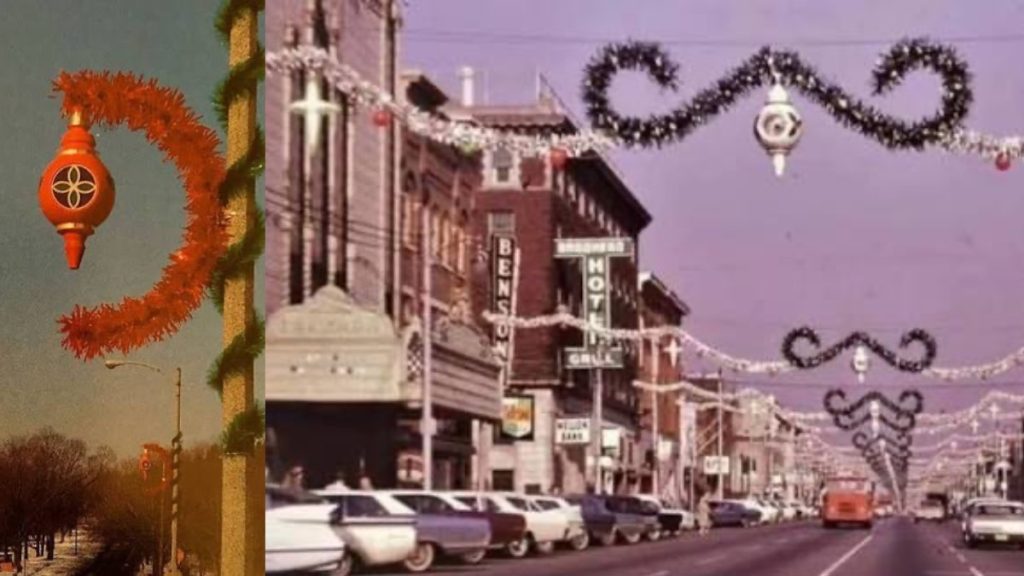
They would have been impossible to miss.
And that was the point.
Municipal decorations weren’t designed to reward someone standing two feet away examining the paint.
They had to read clearly from a distance.
Bright colors. Familiar silhouettes. Simple, bold shapes.
A giant ornament didn’t need intricate details.
It needed to look like Christmas from across the street.
Today, those same proportions make them incredibly appealing to collectors.
One enormous ornament can completely transform a display.
Of course, it can also completely consume your available storage space.
Every hobby has its sacrifices.
The Famous Municipal Santa With a Rather Unfortunate Nickname
Collectors have a way of giving memorable names to unusual decorations.
One particularly interesting municipal piece is the large seated Santa often referred to as “Cletus Claus.”
Some collectors also call him “Broke Neck Santa.”
Which probably wasn’t the nickname his original manufacturer had in mind.
A documented example, attributed in a resale listing to General Plastic, measures approximately 38 inches tall while seated, with an arm span of about 36 inches.
The piece has heavy-duty hanging hooks attached to its hands.
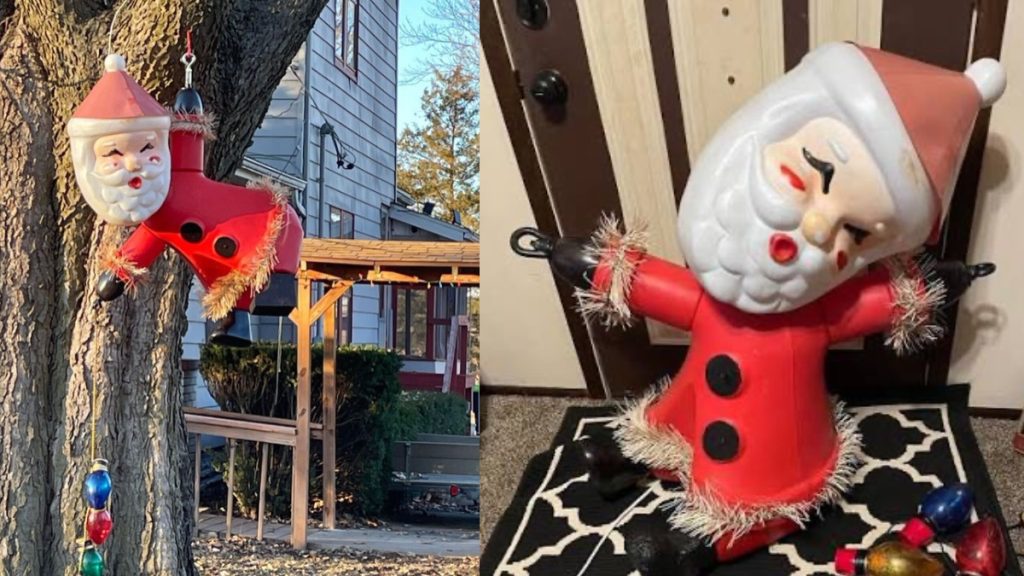
That’s a major clue about its original purpose.
This wasn’t simply a Santa designed to sit beside someone’s front door.
It was built for suspension or installation as part of a larger holiday display.
And those unusual proportions help explain why collectors find it so appealing.
It’s strange.
It’s oversized.
It’s unmistakably vintage.
And it has the sort of personality that modern mass-produced decorations often lack.
A Santa like that doesn’t quietly blend into your collection.
He becomes the collection’s main character.
What Happened to All Those Downtown Decorations?
This might be the saddest part of the story.
For decades, towns stored their holiday decorations in municipal buildings, maintenance garages, warehouses, and public works facilities.
Every November, crews would retrieve them.
They’d inspect the wiring, repair broken lights, load the decorations onto trucks, and install them throughout downtown.
Then, after New Year’s, everything came down again.
Year after year.
Eventually, tastes changed.
Downtown shopping districts struggled as suburban malls grew.
Old decorations became expensive to maintain.
Some pieces were damaged by weather or years of handling.
Others simply looked outdated to the people making decisions about holiday displays.
A town might replace its old plastic Santas with modern LED snowflakes.
A shopping center might switch to lightweight banners.
A department store could close altogether.
And suddenly, a decoration that had greeted thousands of families every December was sitting in a warehouse with no plans to use it again.
Some were auctioned.
Some were donated.
Others were sold as surplus or passed along to employees.
And undoubtedly, some ended up in dumpsters.
Imagine that.
A giant Santa that once watched over an entire downtown Christmas season, thrown away because nobody wanted to pay to store him.
Fortunately, not all of them disappeared.
Some found their way into private collections.
And that’s where people like Ed come into the story.
One of the reasons I wanted to explore municipal blow molds was my conversation with Ed, better known as @sickeddie on Instagram.
Ed deals in these oversized vintage decorations, and his involvement offers a glimpse into a side of collecting that most people never experience.
Finding a 30-inch snowman at an estate sale is one thing.
Finding a giant municipal decoration that once hung above a downtown street is something else entirely.
These pieces can require special transportation, storage, restoration, and a buyer who understands exactly what they’re getting.
And unlike ordinary residential blow molds, municipal decorations often come with a complicated history.
Where was the piece displayed?
Who originally owned it?
Was it part of a matching set?
Does the original mounting hardware still exist?
Has it been repainted or modified?
Those questions can make a tremendous difference to collectors.
My conversation with Ed reinforced my interest in the people who deal in these pieces and help keep them circulating among collectors.
Because when an old municipal decoration leaves a warehouse or private collection, there’s no guarantee it will ever find another owner willing to preserve it.
Sometimes the biggest challenge isn’t finding a buyer.
It’s finding someone who has enough room.
And possibly a very understanding spouse.
Where Do You Find Municipal Blow Molds?
Here’s the frustrating answer.
Almost anywhere.
And almost nowhere.
Unlike ordinary vintage blow molds, municipal pieces don’t typically turn up in large quantities at neighborhood garage sales.
They were often owned by businesses, shopping centers, municipalities, or commercial decorators.
That means the best opportunities may come from places most collectors wouldn’t initially consider.
Municipal surplus auctions are a logical starting point.
Towns occasionally sell equipment and decorations they no longer use. Public works departments and local government auction platforms can be worth watching.
Shopping center liquidations are another possibility.
When an older mall or retail property closes, its seasonal decorations may be sold along with fixtures and other equipment.
Estate sales and commercial storage cleanouts can produce unexpected discoveries, particularly when a former decorator, retailer, or municipal employee accumulated pieces over the years.
Facebook Marketplace, eBay, and collector groups are also worth checking.
Try searching for terms such as municipal Christmas decoration, vintage street pole Santa, giant Christmas blow mold, and commercial holiday display.
And don’t overlook specialized dealers.
Someone like Ed may know where unusual pieces are circulating long before they appear in a public listing.
There’s another approach I find especially interesting.
If you remember a particular decoration from your hometown, start asking questions.
Contact the local historical society.
Look through old newspaper photographs.
Ask longtime business owners whether they remember who supplied the town’s Christmas decorations.
You might discover that the giant Santa you remember from childhood still exists.
Maybe he’s sitting in a warehouse.
Maybe somebody bought him at an auction years ago.
Or maybe he’s hanging in a collector’s garage, waiting for another chance to glow.
What Are Municipal Blow Molds Worth?
Now we get to the question that makes collectors lean forward in their chairs.
How much are these things actually worth?
The answer depends heavily on the piece.
A common residential blow mold and a rare commercial-scale decoration can look similar in photographs, but their markets are very different.
Municipal pieces are harder to find, harder to ship, and often more difficult to identify.
That creates a strange resale situation.
A rare decoration might attract serious collector interest.
But its enormous size can also limit the number of people willing to buy it.
And that means asking prices aren’t always a reliable indication of actual value.
A seller can list a giant Santa for $2,000.
That doesn’t mean somebody will pay $2,000.
On the other hand, a knowledgeable collector might recognize an unusual municipal piece at a local auction and purchase it for a fraction of what another buyer would eventually pay.
A 2022 eBay sale archive documents a lot of oversized Beco municipal ornaments, including pieces approximately 40 inches tall, offered for local pickup.
A January 2024 record documents a 38-inch municipal Santa with original hanging hardware.
Those examples show that the market exists, but they don’t establish a universal price guide.
For collectors trying to estimate value, I would pay attention to five things:
- Rarity and identification. A documented, unusual municipal design may attract more interest than an unidentified oversized decoration.
- Condition. Cracks, missing pieces, damaged mounting points, and poor repainting can affect desirability.
- Completeness. Original brackets, electrical assemblies, and matching components may add value.
- Provenance. A documented history connecting a decoration to a particular town or commercial display can make it more compelling.
- Transportation. Freight costs, local pickup requirements, and storage needs can dramatically affect what a buyer is willing to pay.
For actual pricing, completed sales of the same design are far more useful than active listings.
And if you can’t find comparable sales?
That’s when conversations with experienced dealers become particularly valuable.
Sometimes the market for a specific municipal decoration consists of only a handful of people who know exactly what it is.
The Hidden Costs of Owning a Giant Santa
Let’s say you find the municipal decoration of your dreams.
It’s magnificent.
It’s rare.
It has the kind of vintage face that makes you wonder whether the sculptor had ever actually met Santa Claus.
And the price is right.
Congratulations.
Now you have to get it home.
Transportation can be a major expense, especially for oversized or fragile pieces.
Some decorations can’t be shipped economically through ordinary parcel services.
Others may require a trailer, a cargo van, or careful custom packing.
Then there’s storage.
A four-foot residential Santa can usually be squeezed into a garage.
A collection of municipal ornaments, giant figures, and steel mounting arms can start to resemble a small public works department.
Restoration brings its own challenges.
Old plastic may be brittle.
Paint can be faded.
Original electrical components may be unsafe.
And municipal mounting hardware deserves particular care because it was designed for specific installation conditions.
An old bracket that once held a decoration above a street shouldn’t automatically be trusted for a modern installation.
If you’re planning to display a municipal piece outdoors, especially overhead, have the mounting and electrical systems properly evaluated.
There’s a big difference between preserving a vintage decoration and trusting decades-old hardware to hold it above someone’s head.
Why These Pieces Mean So Much to Collectors
I think municipal blow molds occupy a special place in the hobby because they represent something larger than individual family traditions.
A residential blow mold might remind you of your parents’ house.
A municipal decoration can remind an entire town of its childhood.
Think about that.
Thousands of people may have walked beneath the same illuminated Santa.
Generations of children may have seen the same giant ornament on their way to visit a department store Santa Claus.
Families might have posed for photographs beneath a decoration without ever knowing who made it.
Those pieces became part of the town itself.
Not officially, perhaps.
Nobody was issuing historical preservation certificates for giant plastic snowmen.
But emotionally?
Absolutely.
They were landmarks.
They marked the arrival of Christmas just as surely as the first snowfall or the appearance of holiday displays in store windows.
And when they disappeared, something familiar disappeared with them.
That’s what makes rescuing one so meaningful.
You’re preserving a decoration.
But you’re also preserving a piece of shared memory.
The Ultimate Christmas Display Statement
There’s another reason collectors love municipal blow molds.
They look incredible.
A well-preserved oversized decoration has a presence that ordinary residential figures simply can’t match.
Place a giant vintage ornament beside a group of classic Santas and snowmen, and suddenly the entire display feels different.
It looks less like a front yard.
More like Main Street, 1972.
That’s especially appealing to collectors who build elaborate holiday scenes.
Some people want to recreate the Christmas displays they remember from childhood.
Others want to build something their neighborhood has never seen.
Municipal decorations make both possible.
Of course, there’s a fine line between creating a spectacular Christmas display and accidentally turning your driveway into a seasonal tourist attraction.
But if you’ve read my thoughts on neighborhood blow mold displays, you already know I’m fascinated by that line.
And I’m fairly certain municipal collectors crossed it years ago.
The Real Holy Grail Might Be the Story
Here’s something I’ve come to appreciate while researching vintage blow molds.
Rarity matters.
Condition matters.
Original paint and manufacturer markings matter.
But sometimes the most interesting thing about a decoration is where it’s been.
Imagine acquiring a giant Santa that once hung above Main Street in a small Midwestern town.
Maybe you find a photograph of it from 1968.
There it is, suspended above a row of parked cars, with a department store sign in the background.
Then you discover another photograph from 1982.
Same Santa.
Different cars.
Different storefronts.
A whole generation has passed, but the decoration is still there.
Now imagine being the person who saves that Santa when the town finally decides to replace its decorations.
You haven’t simply acquired an unusual collectible.
You’ve become the next caretaker of something that helped define Christmas for thousands of people.
That’s a responsibility.
And it’s also a privilege.
When Main Street Christmas Comes Home
I sometimes wonder how many giant municipal decorations are still sitting in forgotten storage spaces.
Maybe there’s a huge plastic Santa above an old hardware store.
Perhaps a set of oversized ornaments is gathering dust in a municipal maintenance building.
Or maybe a giant snowman that once greeted Christmas shoppers is leaning against the wall of somebody’s barn.
I hope collectors keep finding them.
And I hope the people who discover them recognize what they’re looking at.
Because these decorations were built for a very different America.
An America where downtown Christmas shopping was an event. A pre-internet, pre-Amazon society.
Where families drove into town just to see the lights. Where a smiling plastic Santa hanging from a street pole could make an ordinary December evening feel magical.
Those days aren’t entirely gone.
But the decorations that defined them are becoming harder to find.
That’s why people who collect, restore, and deal in municipal blow molds are doing something worthwhile.
They’re keeping a little piece of Main Street Christmas alive.
And thanks to collectors like Ed, some of these forgotten giants are getting another chance to shine.
The next time you see an enormous vintage Santa or a gigantic illuminated ornament, take a closer look.
It might have spent decades watching over a downtown street.
It might have appeared in thousands of family photographs.
It might have been one of the first things children looked for every Christmas.
And now, after all those years, somebody has brought it home.
That’s the thing about municipal blow molds.
They’re not just bigger decorations.
They’re bigger memories.
Keep the Glow Alive
The story of municipal blow molds is just one fascinating chapter in the history of America’s illuminated holiday decorations.
In my book, The Glow That Won’t Go Out, I explore the manufacturers, collectors, and remarkable plastic creations that transformed Christmas and Halloween decorating into an American tradition.
From classic residential Santas and snowmen to the people preserving rare and unusual pieces, it’s a celebration of the history, craftsmanship, and memories behind the decorations we love.
Because sometimes the most important thing about an old blow mold isn’t what it’s worth.
It’s how many people remember seeing it glow.