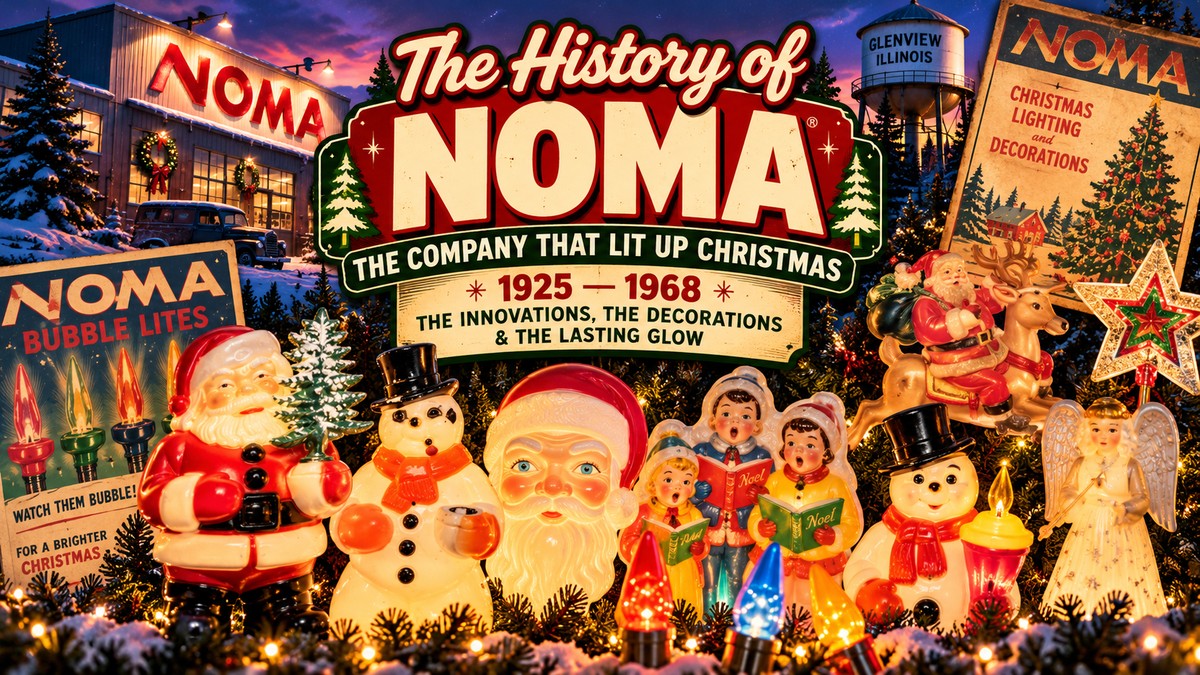
From bubble lights and glowing Santas to a Christmas empire that eventually went dark, NOMA helped shape the holidays we remember.
By Curtiss Wayne Andrews
There was a time when putting up Christmas lights required patience, a sturdy ladder, and a willingness to question your own sanity.
You’d drag a dusty cardboard box out of the attic, untangle what appeared to be 400 feet of electrical spaghetti, and spend the next hour figuring out which bulb had decided to ruin Christmas.
Then, finally, you’d plug everything in.
And there it was.
Magic.
Long before inflatable Santas bounced around suburban lawns and LED lights turned houses into miniature Las Vegas casinos, one company helped America fall in love with illuminated Christmas decorations.
Its name was NOMA.
If you collect vintage Christmas lights or plastic holiday decorations, you’ve probably encountered the name. Maybe you’ve found an old NOMA Santa at an antique mall. Perhaps you remember the company’s famous bubble lights dancing on your grandparents’ Christmas tree.
But NOMA’s story goes much deeper than a few nostalgic decorations.
This was once one of the biggest names in Christmas lighting. And its influence helped pave the way for the glowing plastic Santas, snowmen, and other holiday figures that collectors treasure today.
How 15 Companies Helped Change Christmas
NOMA’s story began in the 1920s, when electric Christmas lights were still finding their way into American homes.
Back then, decorating a tree with electricity wasn’t nearly as convenient as it is today. Light sets could be expensive, complicated, and occasionally temperamental.
In 1925, roughly 15 manufacturers joined forces under the National Outfit Manufacturers Association. The following year, the businesses consolidated into what became the NOMA Electric Corporation.
The goal was straightforward: make Christmas lighting easier to manufacture, sell, and use.
Albert Sadacca, whose family operated an electrical business, was among the important figures associated with NOMA’s early development.
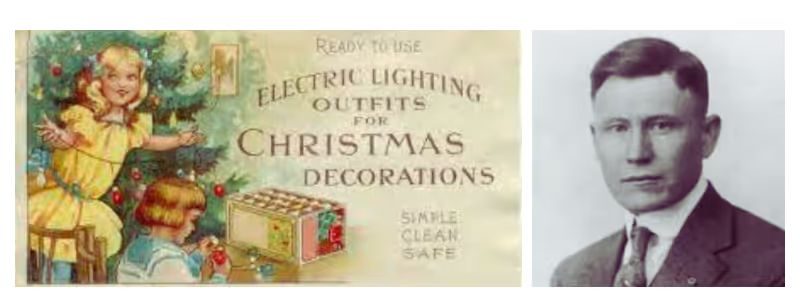
Other industry leaders helped build the new company into a serious force in decorative lighting.
And it worked.
By the late 1920s, NOMA had become one of the most recognizable names in Christmas lights.
The company wasn’t simply selling electrical equipment. It was selling a feeling.
A glowing Christmas tree meant warmth, celebration, and the promise that something wonderful was just around the corner.
That’s a pretty powerful thing to manufacture.
Even the Great Depression Couldn’t Turn Off Christmas
When the Great Depression arrived, you might have expected decorative Christmas lighting to become an easy expense for families to eliminate.
After all, nobody needed electric lights to celebrate Christmas.
But people wanted them.
And sometimes, when life gets especially difficult, those small traditions become even more meaningful. You can liken it to the 2020 resurgence of blow molds after COVID hit.
NOMA continued promoting holiday lighting throughout the Depression years, helping establish the idea that electric Christmas decorations belonged in the American home.
As the decades passed, its products became more elaborate.
There were colorful light sets, novelty decorations, illuminated figures, and increasingly inventive ways to brighten the holidays.
By the postwar years, NOMA had become a Christmas institution.
Then the company introduced a product that would become one of its most beloved creations.
The Bubble Light: Christmas Magic in a Glass Tube
If you’ve ever watched an old-fashioned Christmas bubble light warm up, you know the anticipation.
At first, nothing happens.
You stare at the little glass tube, wondering whether the thing still works.
Then a tiny bubble appears.
Another follows.
Suddenly, a miniature stream of bubbles starts rising through the colored liquid.
It’s mesmerizing.
And for children growing up in the 1940s, 1950s, and 1960s, it must have seemed like something from the future.
NOMA helped popularize bubble lights after acquiring rights to designs developed by inventor Carl Otis. The company’s versions became commercially successful in 1947.
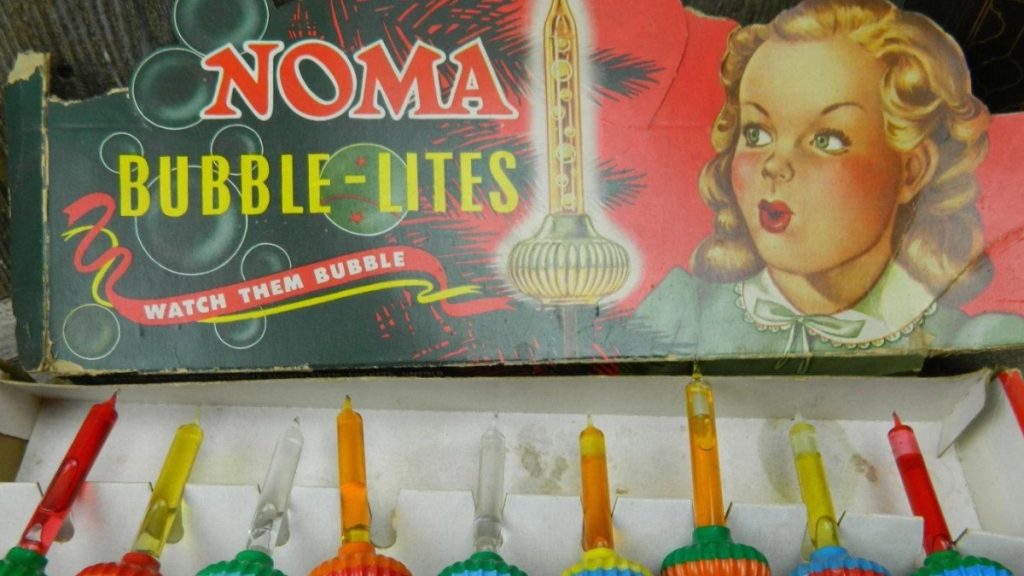
The famous NOMA Biscuit bubble light, with its distinctive plastic base, became a Christmas classic.
Families loved them because they were different from ordinary bulbs. They moved. They shimmered. They gave a Christmas tree a personality of its own.
NOMA even introduced a rocket-inspired bubble light in 1961, tapping into America’s growing fascination with the space race.
Imagine that.
One minute you’re admiring a Christmas tree. The next, you’re celebrating the future of space exploration.
Today, original NOMA bubble lights remain highly collectible, especially when they survive with their packaging and original components.
They’re fragile, quirky, and sometimes frustrating to restore.
Which, come to think of it, describes a good portion of vintage Christmas collecting.
1953: When NOMA Started Thinking Beyond Light Bulbs
The early 1950s brought major changes to NOMA.
In 1953, the company reorganized its Christmas lighting operations around NOMA Lites, Inc.
At the same time, it was becoming increasingly involved in plastic decorations and components.
That timing couldn’t have been better.
America was entering a golden age of inexpensive consumer plastics.
Manufacturers could create colorful decorations that were lightweight, relatively affordable, and easy to reproduce.
For Christmas companies, the possibilities seemed endless.
Why stop at putting lights on a tree when you could make Santa himself glow?
NOMA began offering a growing assortment of illuminated plastic holiday decorations.
Some were designed for windows. Others hung on walls or doors. A few were small enough to sit on a dresser or serve as night lights.
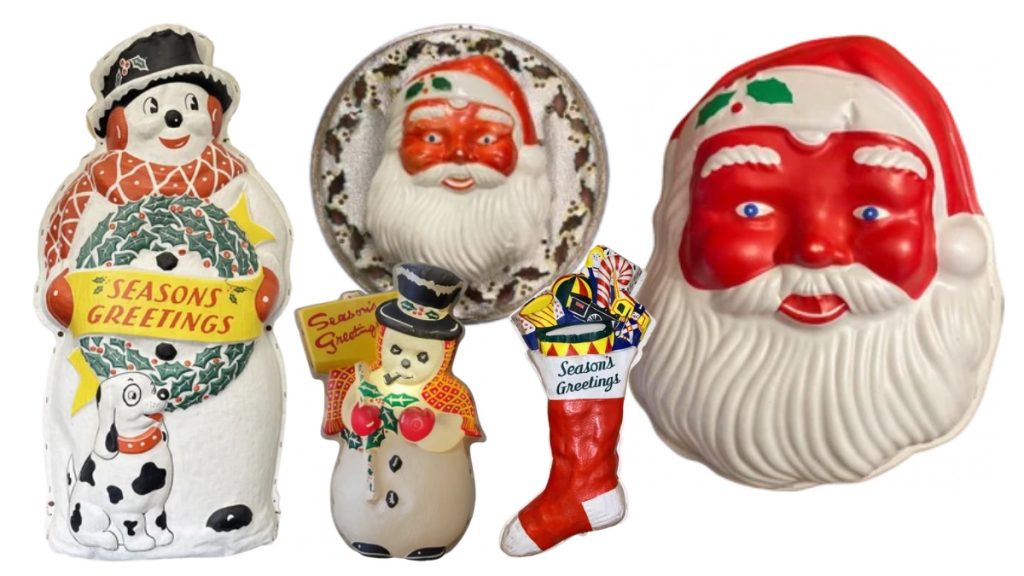
And while collectors often associate NOMA’s later blow mold activity with Glenview, Illinois, the company’s manufacturing history was spread across several locations.
NOMA Lites operated a major facility in St. Joseph, Missouri, while a related plastics business, TICO, operated in New York.
That’s worth remembering when identifying a vintage piece. A NOMA label doesn’t automatically mean it came from Glenview.
Still, the Glenview connection remains part of the company’s midcentury collecting history.
And the decorations associated with this era are some of the most interesting pieces NOMA ever sold.
The Famous NOMA Decorations Collectors Still Search For
The Illuminated Santa Wall Plaques
Imagine walking down a suburban street in 1957.
Christmas lights glow in the windows. A wreath hangs on nearly every front door. Somewhere down the block, Bing Crosby is probably singing about snow.
Then you spot something unusual.
A large, illuminated Santa Claus hanging on the side of a house.
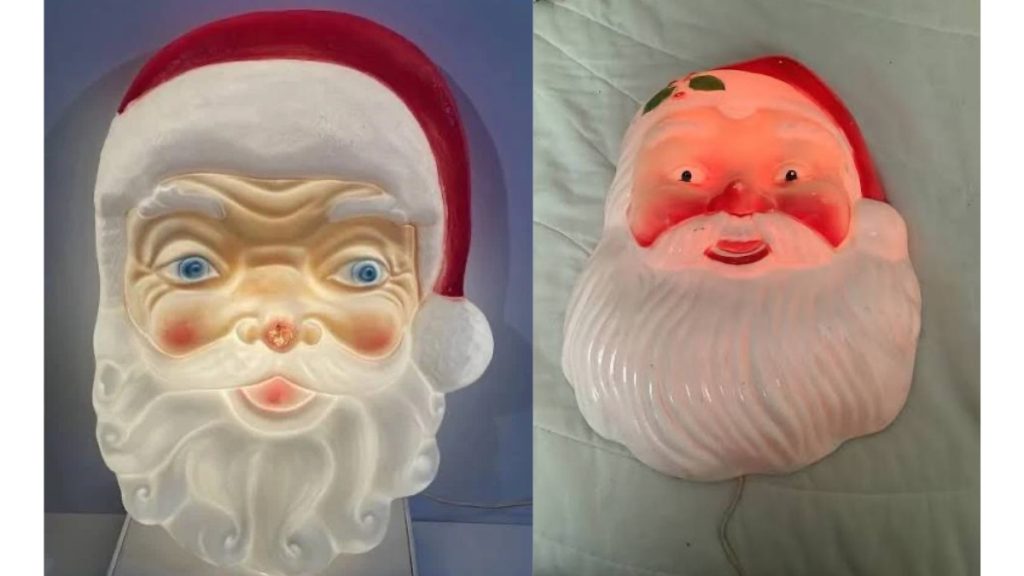
He’s bright red, smiling, and carrying a wreath and Christmas present.
That was the appeal of NOMA’s oversized Santa wall decorations.
One documented version stands approximately 30 inches tall and uses shaped plastic with a backing panel and interior lighting.
It wasn’t a traditional freestanding lawn blow mold.
Think of it more as an illuminated Christmas sign with personality.
And it certainly had personality.
These pieces helped introduce homeowners to the idea that Christmas decorations could be large, colorful, three-dimensional, and illuminated from within.
Today, surviving examples are fascinating reminders of how American holiday decorating was changing.
The Santa and Snowman Figures With an Unexpected Past
Here’s where the story gets especially interesting.
Some of the small illuminated Santa and Snowman figures associated with NOMA actually began with another company.
Royal Electric operated a Christmas decoration factory in Pawtucket, Rhode Island.
In 1955, a devastating fire destroyed the facility.
Afterward, some of Royal’s remaining inventory and tooling passed into the hands of other manufacturers, including NOMA.
Among the designs connected to this transition were charming illuminated Santa and Snowman figures.
Certain versions held bubble lights. Others featured miniature Christmas trees.
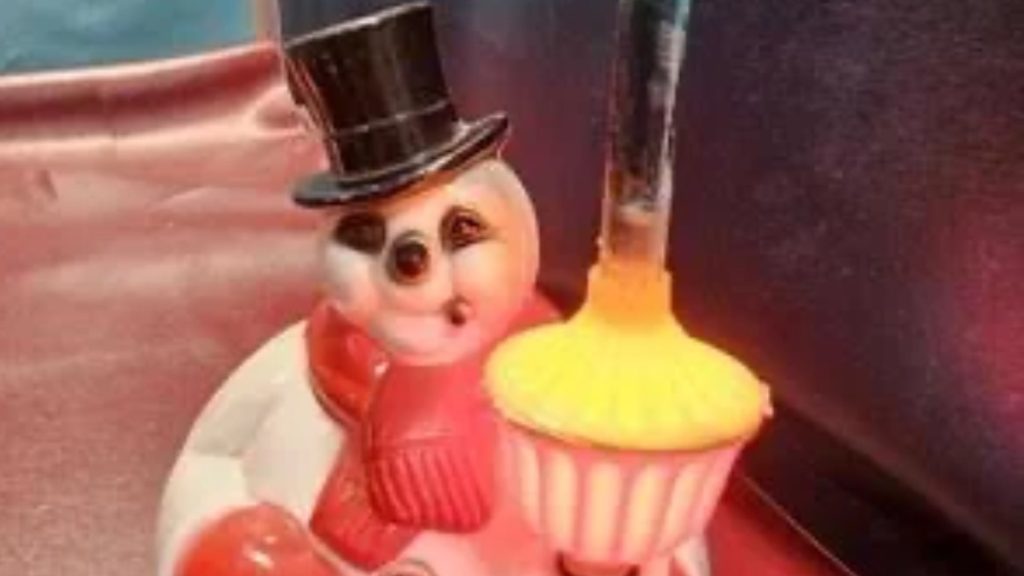
They were small, colorful, and perfectly suited for a child’s bedroom or a cozy holiday display.
The Snowman is generally considered harder to find than the Santa.
But the real fascination is the manufacturing history.
A collector might discover one of these figures in its original NOMA packaging and naturally assume NOMA created it.
Not necessarily.
The design had a life before NOMA.
And that’s one of the things I love about researching vintage decorations. The more you investigate, the more you discover how interconnected these companies really were.
Molds changed hands. Products were rebranded. Designs survived their original manufacturers.
Sometimes a single plastic Santa has a more complicated family tree than the people displaying him.
Santa Faces, Window Lights, and Other Holiday Oddities
NOMA also marketed illuminated Santa faces and other plastic wall decorations.
Some were made from rigid plastic. Others used thin, vacuum-formed plastic shells.
Many were designed to hang in windows or on walls, where their internal lights could bring the figures to life.
These weren’t the enormous lawn decorations that became popular in later decades.
They were smaller expressions of the same basic idea.
Make something recognizable.
Make it colorful.
Put a light inside.
Then let Christmas do the rest.
NOMA’s product lines also included tree toppers, novelty lights, and other seasonal decorations.
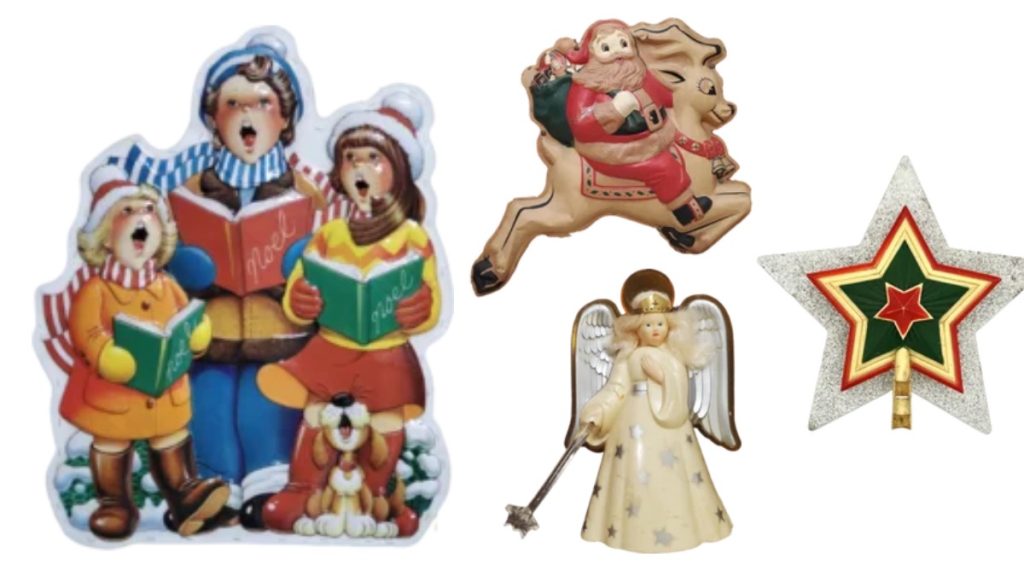
That variety makes collecting the brand particularly enjoyable.
You never quite know what you’ll find.
A NOMA Collecting Mystery: Is It Actually a Blow Mold?
Here’s something that can start a surprisingly lively conversation among vintage Christmas collectors.
Not every illuminated plastic decoration is technically a blow mold.
I know. Try explaining that at a holiday flea market.
Today, the term blow mold gets used pretty loosely. If it’s old, plastic, and lights up, someone will probably call it a blow mold.
But the manufacturing process matters.
A traditional blow mold is made by inflating heated plastic inside a mold, creating a hollow figure.
Many early NOMA decorations were made differently.
Some used vacuum-formed plastic, where a heated sheet was shaped over a mold. Others were assembled from molded pieces or included cardboard or fiberboard backing panels.
The result might look similar when illuminated, but the construction tells a different story. I go into this more here when discussing the famed Raylite angel.
Why should collectors care?
Because understanding those differences helps identify a decoration’s age, manufacturer, and place in holiday history.
An early NOMA Santa wall plaque isn’t simply an older version of a later polyethylene lawn Santa.
It represents a different chapter in the evolution of illuminated Christmas decorations.
And that chapter deserves just as much attention.
The 1960s: When the Christmas Empire Started Losing Its Glow
By the early 1960s, NOMA was facing a problem that would eventually affect countless American manufacturers.
Imported products were getting cheaper.
Much cheaper.
Foreign-made Christmas lights were flooding the market, and companies with established American factories struggled to compete on price.
For NOMA, the pressure was enormous.
The company had spent decades building a reputation around manufacturing and innovation. Now it was fighting competitors that could produce similar products at a fraction of the cost.
Its catalogs increasingly included merchandise sourced from other manufacturers.
Some of the familiar NOMA products began disappearing.
In 1963, the company’s classic Biscuit bubble light gave way to a different design associated with Peerless.
For customers who had grown up with the originals, it was another sign that the business was changing.
Then came the biggest blow.
NOMA Lites filed for bankruptcy in 1965.
The company was reorganized, and the NOMA name continued appearing on products in subsequent years.
But by the late 1960s, the original American manufacturing empire was largely a thing of the past.
That’s why collectors often use 1968 as a dividing line when discussing NOMA’s classic era.
The name survived.
The company that built its reputation did not survive in the same form.
And that’s a story we’ve seen repeatedly in the history of vintage holiday decorations.
The products outlive the businesses that made them.
Why NOMA Still Matters to Collectors
There are plenty of reasons to collect NOMA.
Some people love the bubble lights.
Others hunt for illuminated Santas, snowmen, and unusual plastic decorations.
A few specialize in original boxes, catalogs, or electrical accessories.
But I think NOMA’s appeal goes beyond any single product.
The company helped shape the way Americans decorated for Christmas.
Before neighborhoods were filled with glowing plastic figures, NOMA helped make electric Christmas lighting part of everyday holiday life.
It made decorations more colorful, more playful, and more accessible.
And it encouraged manufacturers to keep experimenting.
Without that early enthusiasm for illuminated decorations, the classic blow mold industry might have developed very differently.
There’s also the emotional side of collecting.
Maybe your grandmother had NOMA bubble lights on her tree.
Maybe you remember a glowing Santa in the front window of a house you passed every December.
Or perhaps you found an old plastic snowman at an estate sale and couldn’t explain why it immediately made you smile.
That’s the wonderful thing about these decorations.
They have a way of bringing back memories you didn’t even realize you’d kept.
How to Identify a Vintage NOMA Decoration
If you find an old NOMA decoration, resist the urge to identify it based on appearance alone.
Start by examining how it was made.
Is the plastic hollow and seamless? Does it have a flat backing panel? Was it assembled from multiple pieces?
Those details can tell you quite a bit.
Look for original labels, packaging, molded markings, and catalog numbers.
Check the electrical components, too, but be careful. Many surviving decorations have replacement cords, sockets, or bulbs.
A newer plug doesn’t necessarily mean the decoration itself is new.
Watch for heat damage and brittle plastic, especially around old lighting assemblies.
On the smaller Santa and Snowman figures, missing accessories can make identification tricky. A piece that originally held a bubble light or miniature Christmas tree may look completely different without it.
And don’t assume that every NOMA-branded decoration originated with NOMA.
As the Royal Electric story shows, designs sometimes passed between manufacturers.
That’s why I always encourage collectors to research the history behind a piece rather than relying entirely on the name printed on the box.
The details are often where the best stories begin.
The Company Disappeared. The Christmas Memories Didn’t.
I sometimes wonder what the people working in NOMA’s factories would think if they could see today’s vintage Christmas collecting community.
Would they be surprised that people still hunt for decorations they manufactured more than 60 years ago?
Would they believe someone might spend an entire weekend restoring an old bubble light or searching for a missing accessory from a plastic Santa?
Probably.
After all, these were consumer products.
They were designed to be sold, enjoyed, packed away, and eventually replaced.
Nobody expected them to become family heirlooms.
Yet here we are.
Collectors carefully preserve the boxes. They track down old catalogs. They repair cracked plastic and replace worn electrical components.
They share photographs, trade stories, and celebrate discoveries that would seem completely insignificant to anyone outside the hobby.
And every December, they plug those old decorations back in.
A Santa lights up.
A snowman glows.
A bubble light finally starts bubbling.
For a moment, the years seem to disappear.
NOMA may no longer be the Christmas powerhouse it once was, but the company left something behind that no bankruptcy could erase.
It helped teach America what Christmas could look like after dark.
And more than half a century later, we’re still enjoying the view.
Keep the Glow Alive
If the story of NOMA fascinates you, there’s a whole world of vintage holiday decorating history waiting to be explored.
In my book, The Glow That Won’t Go Out, I explore the manufacturers, collectors, and unforgettable plastic decorations that helped turn American front yards into glowing Christmas and Halloween wonderlands.
From the earliest illuminated figures to the classic blow molds that became neighborhood traditions, it’s a celebration of the history, craftsmanship, and memories behind these remarkable decorations.
Because the real magic isn’t simply finding an old Santa or snowman.
It’s discovering the story behind it.
Explore The Glow That Won’t Go Out on Amazon
Curtiss Wayne Andrews is the author of The Glow That Won’t Go Out and a contributor to Paper Sack Publishing, where he explores vintage Americana, forgotten manufacturers, and the collectibles that keep our memories alive.