
By Curtiss Wayne Andrews
Somewhere between the closing of Kmart stores and the disappearance of America’s last major legacy blow mold manufacturers, a new generation of collectors was discovering the very Christmas decorations that many retailers had given up on. Among them was Cole Kutch, a young holiday decorating enthusiast who would eventually turn a childhood tradition with his father into a Christmas display featuring more than 500 blow molds.
Today, the owner of Kutch House Displays is doing much more than collecting illuminated pieces of plastic. He’s repairing vintage decorations, restoring animated department store figures, experimenting with 3D printing and bringing back long-forgotten pieces of municipal Christmas history. And when he’s not busy preparing for Christmas, he’s working as a small engine mechanic.

If you’re concerned about what will happen to the blow mold hobby when an older generation of collectors begins to downsize, people like Cole should give you plenty of reason for optimism.
It All Started with Two Candles and a Nativity
Like so many of the collectors I’ve interviewed, Cole can trace his fascination with Christmas decorating back to his earliest childhood memories. Around 2010 or 2011, he and his father began decorating their house with a few lights and inflatables placed around the bushes. It was a relatively modest affair until his uncle gave him two blow mold candles and a Nativity set.
Cole would eventually purchase his first Santa blow mold at Kmart, shortly before General Foam Plastics went out of business in 2017. There’s something particularly interesting about the timing of that purchase. While longtime collectors were mourning the loss of General Foam and wondering whether traditional blow molds would disappear from store shelves altogether, Cole was just getting started.
For those of us who grew up wandering through the Christmas departments of Kmart, Sears, Target and other retailers, it’s easy to forget that younger collectors didn’t experience the golden age of blow molds the way we did. Many were introduced to these decorations during the industry’s decline. Yet here we are, watching some of those same kids grow into remarkably passionate collectors determined to preserve what remains of it.
The story reminds me of my discussion with mega-collector Brandon Gress who got the blow mold bug in his childhood upon discovering the famed Grand Venture snowman, which I wrote about here.
From a Few Christmas Lights to More Than 500 Blow Molds
The Kutch Christmas House has grown considerably since those early days of decorating bushes with his father. Today, the display includes more than 500 blow molds, a walking path for visitors, a garage display and an assortment of custom-built decorations that can’t be found anywhere else.
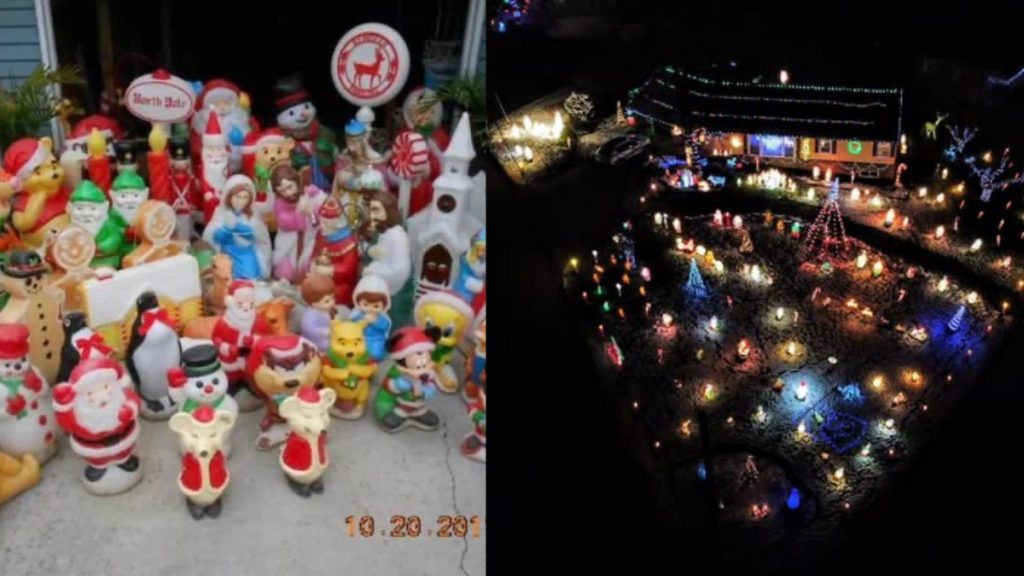
Cole begins installing Christmas lights in October, followed by the blow molds shortly after Halloween. The process takes several weeks, with this year’s grand lighting ceremony scheduled for November 28. Of course, anyone who has ever put together an elaborate Christmas display knows that the work begins long before the first extension cord is plugged in.
“It takes months of planning and I plan all year around,” Cole told me. “I make custom creations that you can only see at my display.”
That’s one of the things I particularly appreciate about displays like Cole’s. As much as I enjoy seeing a beautifully arranged collection of vintage blow molds, there’s something special about visiting a Christmas display where the decorator has put his own creative stamp on things. You may recognize many of the individual pieces, but you’ll never see them presented quite the same way anywhere else.
What Happens When a Small Engine Mechanic Collects Blow Molds?
During the summer months, Cole spends much of his time working on quads and tractors. His experience with mechanical components, welding and fabrication has given him a rather useful set of skills when it comes to Christmas decorating.
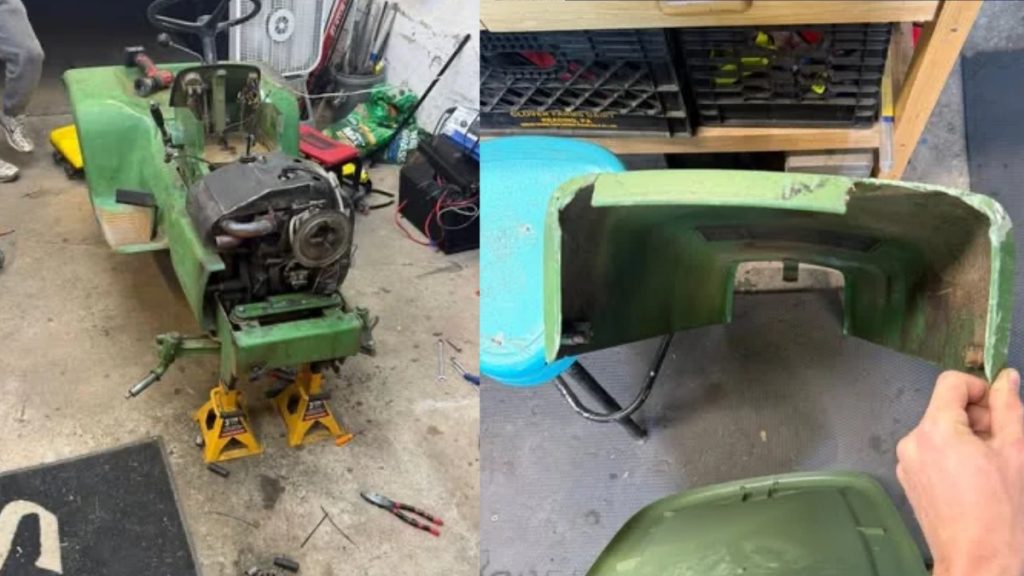
Even as a child, Cole was finding ways to repurpose everyday objects into holiday decorations. One of his early creations was an illuminated snowman made from a drum set. Over the years, he graduated to repairing damaged blow molds, repainting them with an airbrush and creating more elaborate custom pieces. His story echoes that of Hoarding for the Holidays star Nick who I profiled here.
That mechanical background is especially valuable in a hobby where many of the most desirable decorations are several decades old. Motors fail, plastic cracks, paint fades and replacement parts aren’t always readily available. Sometimes the only thing standing between a vintage Christmas decoration and the landfill is somebody willing to spend a Saturday afternoon figuring out how to make it work again.
Fortunately, Cole seems to enjoy that process almost as much as collecting the decorations themselves.
Bringing a Piece of Municipal Christmas History Back to Life
One of Cole’s most fascinating recent projects involves a subject I’ve previously written about here at Paper Sack Publishing: municipal blow molds.
For decades, communities across America purchased enormous illuminated Christmas decorations to place along Main Streets, in town squares and on municipal buildings. These were often considerably larger than the decorations available to homeowners, and surviving examples can be exceptionally difficult to find today.
In an upcoming article I deep dive the history of General Plastics of Marion, Indiana and explore some of these oversized Christmas creations, including the enormous figure known as Clete.
Cole has taken his appreciation for this somewhat obscure chapter of Christmas decorating history in an entirely different direction. After getting back into 3D printing, he created his own reproduction of a vintage municipal blow mold, which he calls “Cletus.” The custom creation is part of this year’s Kutch Christmas House display.

I find this particularly exciting because technology like 3D printing presents some interesting possibilities for the future of the hobby. There are vintage Christmas decorations that exist today only in old manufacturer catalogs, faded photographs or the collections of a fortunate few. What if some of those long-forgotten designs could be recreated for another generation to enjoy?
3D printing is also opening up a whole new world of blow mold repair & restoration as illuminated in my conversation with Tony DePasquale.
Nothing will replace the historical significance of an original vintage blow mold, but I’d certainly rather see a lost Christmas design brought back to life than have it disappear from our collective memory altogether.
The Poloron Mechanical Santa That Finally Came Home
Although Cole has incorporated more recently manufactured blow molds into his display over the past two years, his heart remains with the vintage pieces. One manufacturer in particular stands out: Poloron Products.
“Nothing beats the vintage ones, especially the Poloron company,” Cole said. “This company is one of my favorites and I love the colors and details they put in.”
Among his favorite Poloron designs are the company’s fawn and its highly desirable Mechanical Santa. The latter had been on Cole’s collecting wish list practically from the beginning, but as any collector of vintage Poloron decorations will tell you, finding the right piece at the right price can require an extraordinary amount of patience.
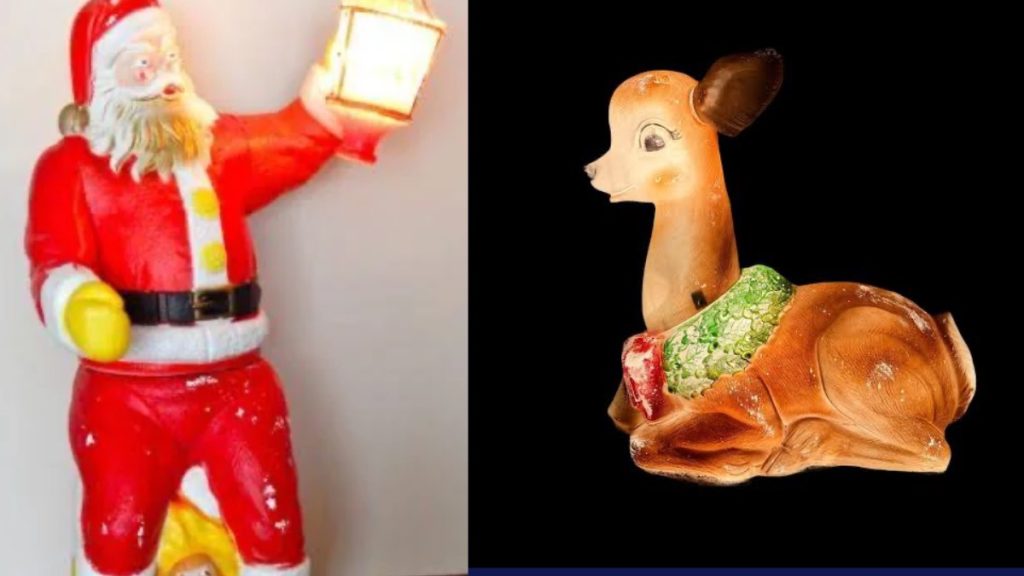
This past fall, Cole spotted a Mechanical Santa on Facebook Marketplace at a price he couldn’t pass up. A couple of hours of driving later, he finally had one of his most coveted Christmas decorations in his possession.
He’s currently restoring the Santa and hopes to have it ready for this year’s display. As for whether it might eventually find its way back onto Facebook Marketplace, don’t count on it.
“I plan to keep him forever,” he said.
I suspect quite a few readers can relate to that sentiment. There’s a considerable difference between buying a decoration because it happens to be a good deal and finally acquiring something you’ve been searching for over the better part of a decade. At that point, it’s no longer just another piece in the collection.
Remember When Department Stores Were Christmas Destinations?
One of my favorite questions to ask collectors is where they would go if they could travel back in time and visit a department store’s Christmas department. For some, it’s a chance to revisit the Sears Christmas Wish Book in real life. Others would make a beeline for the blow mold aisle at Kmart or Woolworth’s.
Cole’s answer was Macy’s, but not necessarily because of its selection of blow molds.
He’s also a collector of animated department store Christmas figures, the kinds of mechanical characters that once populated elaborate store windows and Christmas displays. Over the past several years, he’s been acquiring and restoring some of these figures, many of which were designed for commercial rather than residential use.
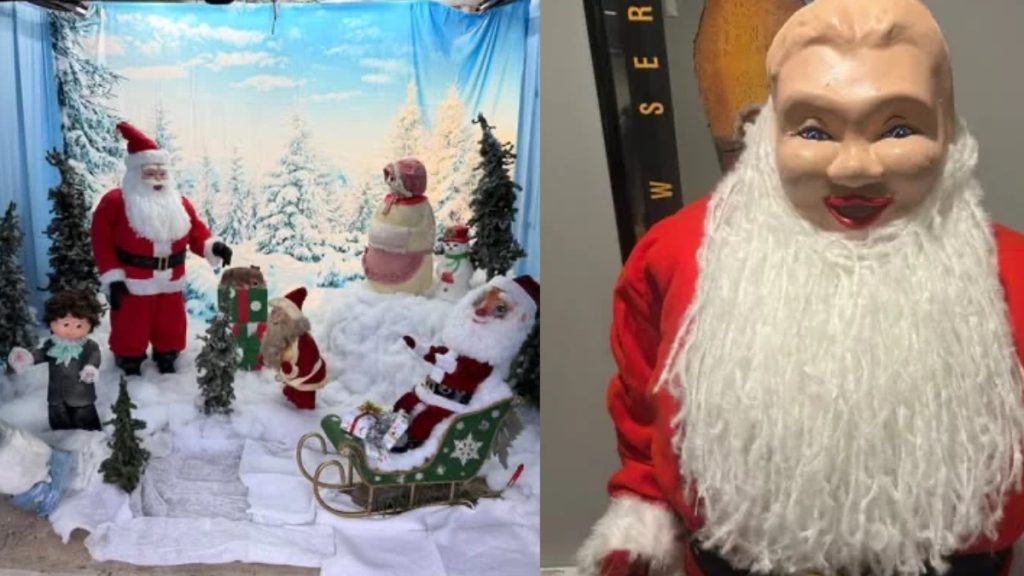
Last year, Cole created his first department store-inspired Christmas scene in his garage, featuring animated figures that he had restored to their original condition. The display is returning this year, alongside several new custom municipal Christmas creations.
For generations of Americans, a trip to a downtown department store during the holidays was an event in itself. Children pressed their noses against store windows filled with animated elves, moving reindeer, toy workshops and elaborate winter wonderlands. You didn’t necessarily have to buy anything to enjoy the experience, and for many families, visiting those windows became as much a part of Christmas as decorating the tree.
As traditional department store Christmas displays have become less commonplace, collectors like Cole are helping preserve another piece of American holiday history. I love the idea that children visiting his garage may get a small taste of what it was like to visit a department store at Christmastime decades ago.
This part of Cole’s story resonates big time with me as I continue to search for my grandparents’ lost store-display Harold Gale Santa.
The Next Generation of Blow Mold Collectors Has Arrived
One of the recurring themes in my conversations with blow mold collectors has been the growing presence of younger enthusiasts. It’s an encouraging development, particularly given how uncertain the future of the industry appeared following the closures of so many legacy manufacturers.
Cole has noticed an increase in both demand and the number of new collectors entering the hobby. He’s also enthusiastic about modern manufacturers producing decorations inspired by vintage designs, believing that reproductions give people an opportunity to enjoy pieces they might otherwise never be able to afford or locate.
“I see this hobby becoming very popular, this past couple of years is just the start,” he said. “I see lots of young collectors joining in the future.”
It’s a perspective worth paying attention to. While those of us who remember Empire, Union Products, Poloron and General Foam in their heyday may occasionally grumble about the quality or pricing of modern blow molds, the availability of new decorations is helping introduce the hobby to people who weren’t even born when many of those manufacturers were in business. In my conversation with Brandon Gress, I was reminded of both this and the importance of companies like Gemmy in today’s retail landscape.
Today’s newly purchased Santa might very well become somebody’s cherished vintage Christmas decoration 30 years from now. After all, the decorations we now spend considerable amounts of money chasing were once ordinary seasonal merchandise sitting on the shelves of discount department stores.
More Than Just a Yard Full of Christmas Decorations
Every year, hundreds of people come out to see the Kutch Christmas House during its grand lighting ceremony and throughout the holiday season. For Cole, seeing people enjoy something he’s spent much of the year working on is one of the most rewarding aspects of the hobby.

“It puts a smile on my face when everyone is happy and enjoys the display that I’ve worked hard on,” he said.
Cole already has projects lined up for next Christmas, with plans to continue expanding his display and creating more one-of-a-kind decorations. He also has some advice for anyone who is just beginning their blow mold collecting journey: be patient.
There are still decorations he’s been searching for over the past seven years that he hasn’t managed to find. As frustrating as that might occasionally be, the anticipation of discovering something rare and unexpected is part of what keeps collecting interesting.
“The best thing about this hobby is there are lots of rare and unique pieces!” Cole said. “Enjoy the hunt!”
From those first two candles and a Nativity set to a collection of more than 500 blow molds, Cole has come a long way since decorating the bushes with his father. And considering everything he’s already accomplished, I have a feeling we’ve only seen the beginning of what Kutch House Displays will become.
For more about Cole’s incredible exhibition, click here.
Coming Soon: Celebrating the History of The Great Christmas Light Fight
Speaking of extraordinary Christmas displays, I’ve been working on something special here at Paper Sack Publishing for fans of ABC’s The Great Christmas Light Fight.
Coming soon is an in-depth interview with blow mold enthusiast and Christmas decorating historian Brian Michael, also known as “The Librarian.” We’ll be exploring his passion for holiday decorating, his connection to The Great Christmas Light Fight and the television series that introduced millions of Americans to some of the country’s most spectacular residential Christmas displays.
I’ll also be launching a special 14-part retrospective series chronicling the history of The Great Christmas Light Fight, revisiting the memorable displays, personalities, decorating trends and extraordinary creativity that have made the show a holiday television tradition.
With the series currently on hiatus, what better time to revisit some of the Christmas magic it has brought into our living rooms over the years?
Keep the Glow Going
If you enjoy stories like Cole’s and have ever wondered about the companies, colorful characters and forgotten history behind America’s illuminated plastic Christmas decorations, I invite you to check out my book, The Glow That Won’t Go Out: The Complete Collector’s Guide to Vintage Holiday Blow Molds.
From the legendary manufacturers that helped define American holiday decorating to the collectors and enthusiasts keeping these traditions alive today, the book celebrates a uniquely nostalgic piece of our holiday heritage.
Available in paperback, hardcover, audiobook and Kindle editions.
Get your copy of The Glow That Won’t Go Out on Amazon
Keep collecting, keep decorating, and keep the glow going!