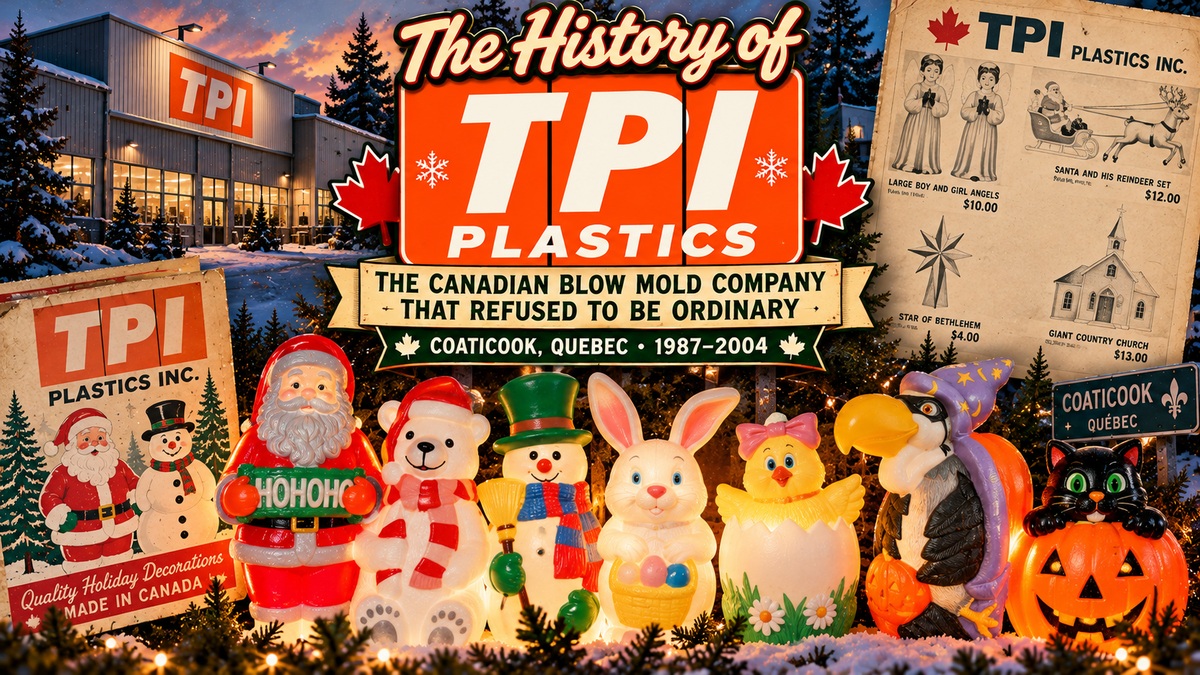
From a Quebec plastics factory to some of the most wonderfully strange Halloween decorations ever produced, TPI helped define a colorful chapter of holiday decorating history—before disappearing just as collectors were beginning to appreciate what made it special.
By Curtiss Wayne Andrews
There are certain vintage blow mold manufacturers whose products are instantly recognizable.
Union Products gave us Don Featherstone and the Pink Flamingo.
Empire helped populate American lawns with generations of glowing Santas, snowmen and holiday characters.
General Foam carried many beloved designs into the modern era.
And then there was TPI.
A Canadian company that apparently looked at the traditional lineup of Christmas decorations and thought, You know what this neighborhood really needs? A buzzard.
Not a reindeer.
Not a friendly little elf.
A buzzard.
And somehow, that’s a perfect introduction to one of the most interesting manufacturers in vintage blow mold history.
TPI Plastics, based in Coaticook, Quebec, produced holiday decorations from the late 1980s until 2004. During that relatively short period, it created Christmas, Halloween and other seasonal figures that collectors continue to seek out more than two decades after production ended.
Some were traditional.
Some were charming.
Some were genuinely peculiar.
And a few have become the kinds of collectibles that inspire people to drive across state lines, negotiate with strangers on Facebook Marketplace and explain to their spouses why a giant plastic pumpkin absolutely qualifies as an emergency purchase.
In my book, The Glow That Won’t Go Out, I explore the manufacturers and collectors who helped transform ordinary seasonal decorations into pieces of American—and Canadian—cultural history.
TPI deserves a prominent place in that story.
Not because it was the oldest manufacturer.
Not because it was the biggest.
But because it helped prove that, even in an increasingly crowded holiday decorating market, there was still room for a little imagination.
The Beginning: Tucker Plastics and a Factory in Quebec
TPI’s story begins in the Eastern Townships region of Quebec, Canada.
Collector histories identify the company as Tucker Plastics Inc., with operations beginning in 1958 as a traditional plastics manufacturer and first producing blow molds starting in 1987. Its holiday decorations were marketed under the familiar TPI name, and later corporate records identify TPI Plastics Inc., also known in French as Les Plastiques TPI Inc.
The company operated in Coaticook, a community near the Vermont border.
This location mattered.
Although American manufacturers dominated much of the early blow mold industry, Canada developed its own manufacturing tradition, producing decorations for domestic buyers and the wider North American market.
TPI became part of that tradition.
Its products carried the distinctive markings that collectors now look for: TPI, Made in Canada and, on many pieces, molded copyright dates.
Unlike companies whose history reaches back to the postwar plastics boom, TPI emerged at a moment when blow molds were already established Christmas merchandise.
It didn’t have to convince shoppers that a glowing plastic Santa belonged in their front yard.
That battle had already been won.
Instead, TPI could compete through variety, recognizable designs, manufacturing capability and new interpretations of familiar holiday characters.
And as the company’s surviving catalogs demonstrate, it wasn’t afraid to experiment.
Coaticook: The Headquarters Behind the Glow
A corporate record for TPI Plastics Inc. identifies its registered office as:
271 St-Jacques Street South, Coaticook, Quebec, Canada.
The record also identifies the bilingual corporate name, Les Plastiques TPI Inc., and lists corporate changes during 2001 and 2002.
Les Plastiques Tpi Inc.
That provides an unusually concrete geographic connection to the company.
But there is an important distinction.
A registered corporate address doesn’t necessarily establish the location of every manufacturing department, warehouse or office throughout the company’s history.
And the accessible historical record doesn’t provide a complete inventory of TPI’s facilities.
Still, Coaticook remains central to the company’s identity.
Today, collectors encountering a TPI figure at an American estate sale may be surprised to discover that the decoration originated in Quebec.
It’s a reminder that the history of Christmas blow molds was never exclusively American.
It was North American.
And some of its most interesting contributions came from north of the border.
The People Behind TPI: A Story Still Waiting to Be Told
One of the challenges of researching defunct plastics manufacturers is that their products often survive far better than their personnel records.
TPI is no exception.
Canadian corporate records identify Stéphane Bonin and Angy Potvin as directors in the available filing history. But those records alone don’t establish who founded the original Tucker Plastics operation, who served as its principal designers or who managed holiday-decoration production during its peak years.
Les Plastiques Tpi Inc.
I haven’t found reliable documentation establishing the company’s original employee count, its complete leadership roster or the names of the sculptors responsible for its best-known characters.
And those are important gaps.
Someone had to design that strange Halloween buzzard.
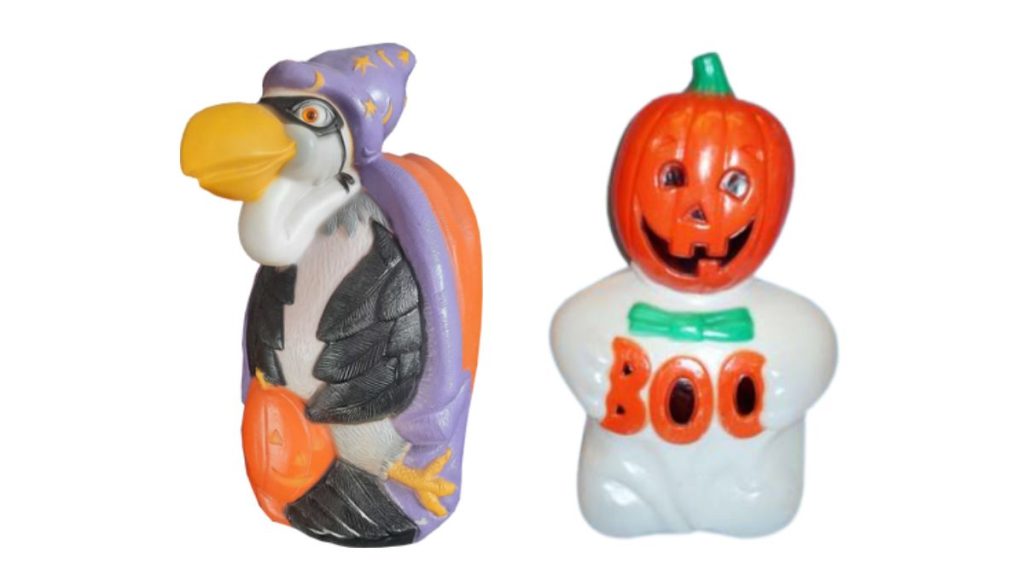
Someone decided a pumpkin-headed character should have the personality of a neighborhood eccentric.
Someone developed the tooling for the company’s Christmas figures.
And somebody had to make sure thousands of hollow plastic decorations emerged from the production process looking more or less like the intended characters.
That last part is probably harder than it sounds.
Blow molding requires coordination between design, tooling, plastic processing, cooling, trimming, painting, electrical assembly and packaging.
One badly designed seam can spoil a face.
One awkwardly positioned light bulb can turn a cheerful snowman into something resembling an illuminated medical experiment.
These weren’t just plastic products.
They were manufactured sculptures.
And while the artists and factory employees behind TPI remain largely anonymous in the sources available today, their work has become an enduring part of holiday decorating history.
I would love to see former TPI employees or their families help fill in those missing chapters.
Because somewhere in Quebec, there may be photographs, catalogs, employee records and personal recollections that tell a much richer story.
TPI’s Christmas Decorations: Familiar Traditions, Canadian Personality
Although TPI is particularly celebrated for its Halloween products, Christmas was an important part of its business.
Surviving examples document Santas, snowmen, Nativity figures, candles, carolers and other illuminated decorations.
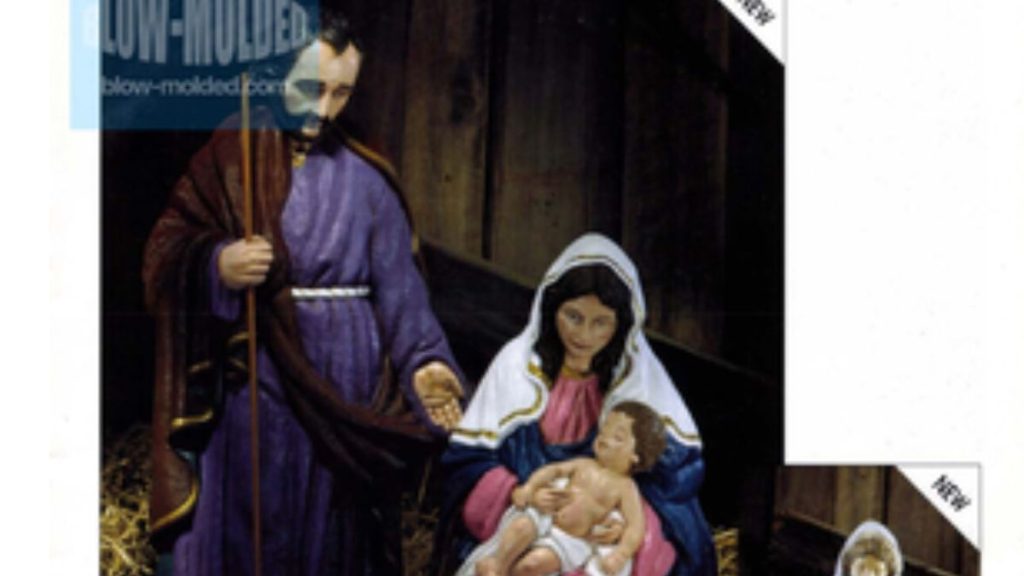
Among the better-documented pieces are Nativity figures carrying TPI copyright dates from the 1990s.
A surviving 1997-marked Nativity group includes Joseph, Mary with the infant Jesus and lambs. Auction documentation records molded TPI markings and bilingual electrical-component labeling.
That bilingual detail is especially interesting.
It provides another connection to the company’s Canadian manufacturing background.
For a collector, those markings are more than incidental production information.
They’re historical evidence.
A figure may have crossed an international border, passed through several households and spent twenty years in somebody’s basement.
But the molded marking can still connect it to the factory where it originated.
The Nativity Figures
TPI’s religious decorations are especially appealing because they combine traditional Christmas imagery with the practical realities of illuminated plastic construction.
A Nativity figure has to accomplish several things at once.
It must look reverent.
It must remain recognizable from a distance.
It needs enough sculptural detail to communicate clothing, faces and gestures.
And it must illuminate attractively after dark.
That’s a challenging combination.
The best examples don’t simply glow.
They seem to become part of a larger scene.
Joseph standing beside Mary.
The infant Jesus illuminated in her arms.
Animals completing the tableau.
For families who grew up with illuminated Nativity scenes, those figures can carry an emotional significance that goes far beyond their original retail price.
The Christmas Candles
TPI also produced illuminated Christmas candles.
Surviving examples include NOEL candles with TPI and Made in Canada markings, including an example dated 1988.
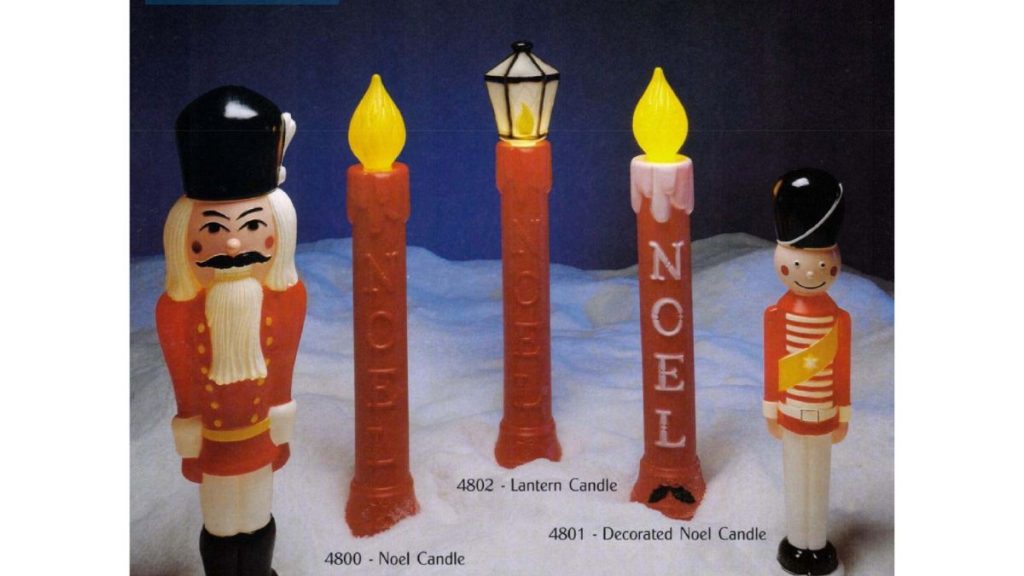
Candles are among the most enduring forms of blow mold decoration.
They’re simple.
They’re instantly recognizable.
And they work almost anywhere.
A pair can frame a doorway.
Several can line a walkway.
One can stand beside Santa and somehow make the entire display feel more complete.
They’re also a reminder that a manufacturer didn’t need to create an elaborate animated character to make something memorable.
Sometimes all you needed was a plastic candle, a glowing flame and a front porch.
The Curious Case of TPI’s Clear Ice Figures
One of TPI’s more unusual contributions was a series of clear, ice-like blow molds.
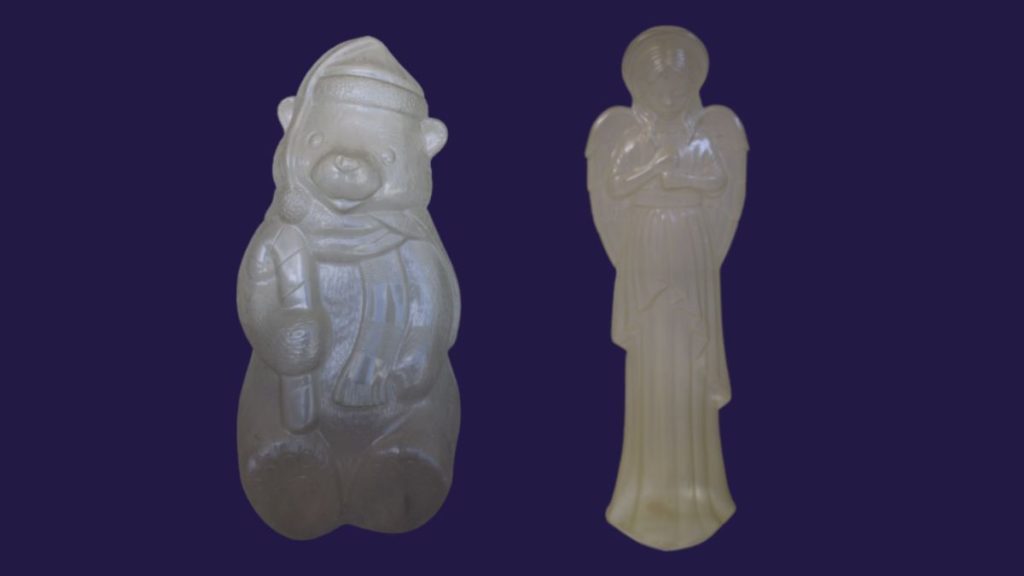
These figures presented a fascinating design challenge.
Traditional blow molds often rely on translucent colored plastic and painted details to create their nighttime appearance.
Clear plastic behaves differently.
Put a light bulb inside a transparent figure and, instead of seeing a beautifully illuminated sculpture, you may simply see a light bulb.
That’s not quite the magical effect the manufacturer was hoping for.
A 2022 Chicago Magazine collector profile describes this very problem.
The collector explained that the TPI ice figures had been sold for a relatively short period and were difficult to illuminate effectively using conventional internal lighting.
Her solution was to use reflected light against a white background, making the sculptural details more visible at night.
I love that story.
It’s a perfect example of the relationship between manufacturers and collectors.
The manufacturer creates something unusual.
The original design has limitations.
Years later, a collector discovers a creative way to make it work.
And suddenly, a forgotten decoration becomes the centerpiece of a modern display.
That’s part of the beauty of this hobby.
The original factory may be gone.
But the experimentation continues.
Halloween: Where TPI Really Let Its Imagination Run Wild
If Christmas was TPI’s dependable business, Halloween was where the company could show off its personality.
And what a personality it had.
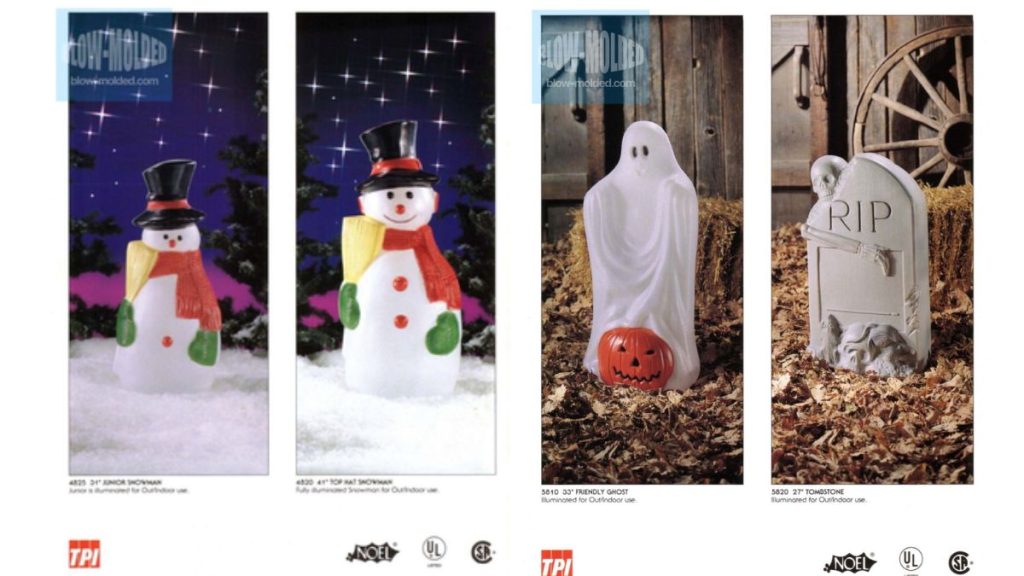
The company’s surviving 2004 Halloween catalog is a wonderful window into the imagination of its designers.
Consider some of the characters it offered:
- Mr. Pumpkin Man: A 33-inch pumpkin-headed figure with enough personality to become the star of a Halloween display.
- The Buzzard: A 27-inch decoration that is wonderfully unconventional. How many other manufacturers thought Halloween needed a large plastic vulture?
- Witch with Broom: A 23-inch character representing a familiar Halloween tradition.
- Cat in a Pumpkin: A 27-inch design combining two of Halloween’s most recognizable symbols.
- Pumpkin on a Post: A towering 43½-inch decoration designed to make an impression.
- Ghost with Tombstone: A 36-inch scene that offered something more elaborate than a simple smiling ghost.
- Pumpkin Boo Ghost: A 24½-inch figure offered in different color treatments.
- Sweetheart Pumpkin: A smaller 17-inch character with a distinctly playful appearance.
The catalog also included tombstones, cauldrons, pumpkin baskets and other seasonal accessories.
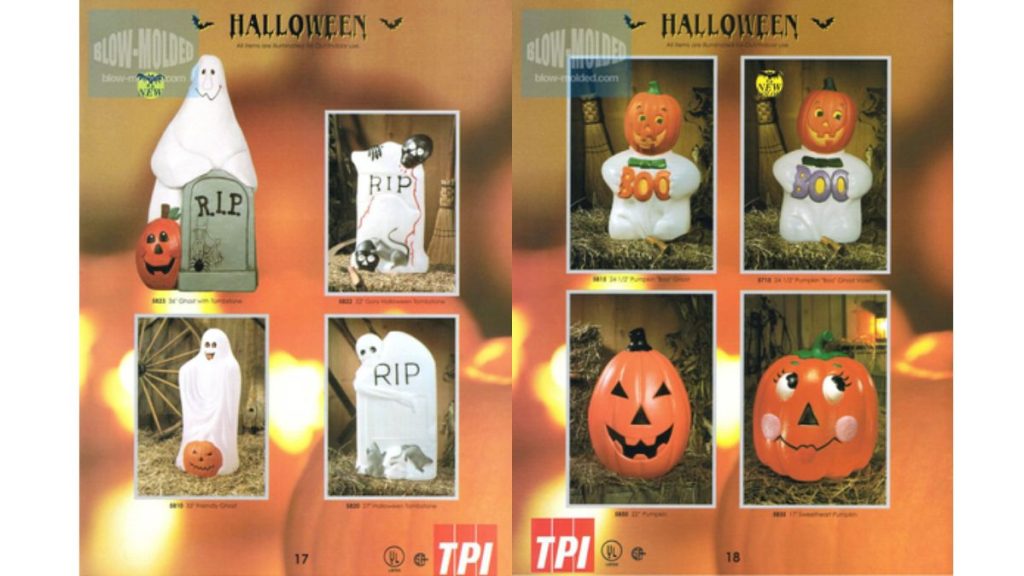
What strikes me about that assortment is the willingness to be different.
TPI wasn’t simply manufacturing a row of interchangeable jack-o’-lanterns.
It was creating characters.
And characters are what collectors remember.
A pumpkin can be purchased almost anywhere.
But a particular pumpkin with a distinctive expression, an unusual shape or a memorable sculpt becomes something else entirely.
It becomes a piece someone hunts for.
A decoration they recognize immediately.
A character they might spend years trying to acquire.
The Buzzard: Because Apparently Halloween Needed One
I keep coming back to the buzzard.
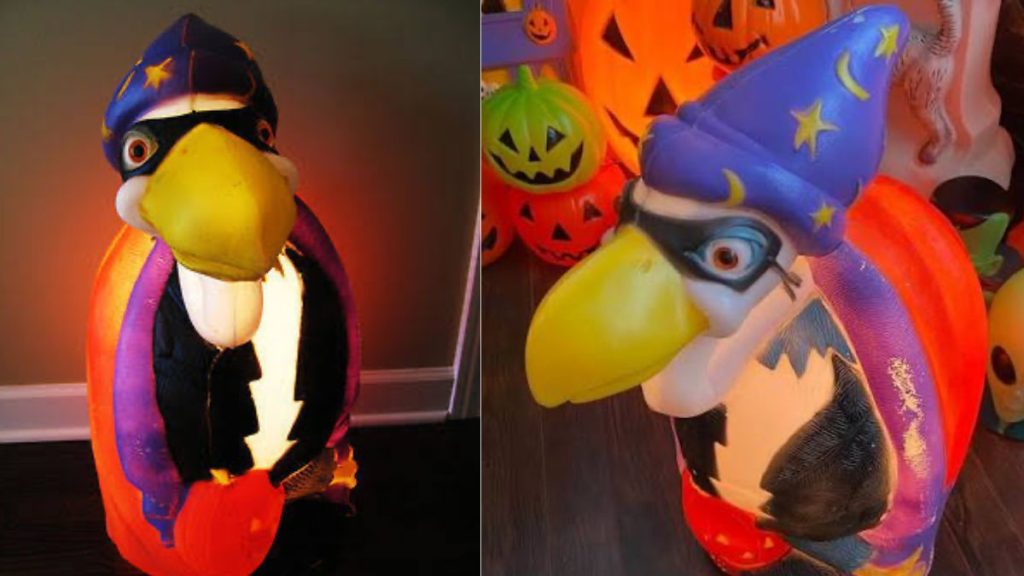
It’s such an odd choice.
And I mean that as a compliment.
Halloween manufacturers have an established collection of characters they can reliably sell.
Witches.
Ghosts.
Skeletons.
Pumpkins.
Black cats.
TPI looked at that lineup and apparently decided to include a large bird associated with death and decay.
Which, when you think about it, is actually rather appropriate.
A buzzard perched beside a tombstone or haunted house can create a more interesting scene than another generic pumpkin.
It adds personality.
It adds atmosphere.
It’s memorable.
And it demonstrates that TPI was thinking beyond individual decorations.
Its products could help collectors build an entire Halloween environment.
That’s the sort of creative thinking that keeps a defunct manufacturer interesting decades later.
Why the 2004 Catalog Matters So Much
The 2004 TPI Halloween catalog is especially significant because it documents the company’s final period of holiday-decoration production. I encourage anyone who reads this to jump over to blow-molded and just take a few minutes to browse through it.
It preserves model numbers, product names, dimensions and variations that might otherwise have been forgotten.
For collectors, that’s invaluable.
Imagine finding an unusual plastic Halloween character at an estate sale.
There’s no original box.
The paint is worn.
The owner has no idea where it came from.
You suspect it’s TPI, but you’re not certain.
A surviving catalog can help establish what the manufacturer called it, how tall it was supposed to be and whether different versions existed.
That’s the difference between guessing and documenting.
And when a company no longer exists, its catalogs can become the closest thing collectors have to an official historical record.
The End of TPI: A Company Sold, Then a Trail of Tooling
TPI’s original run as a holiday blow mold manufacturer ended in 2004.
According to industry sources, Tucker Plastics sold to Farley Technologies that year. Farley continued producing blow molds for a few years before selling an unknown amount to Cado who now continues to produce several TPI designs such as the Angel, Noel Candle and Snowman with Penguin.
Additionally, after the bankruptcy of Holiday Innovations (who owned the original Poloron molds) in 1991, TPI purchased a large amount of their duplicate molds in conjunction with MAC Plastics to produce starting in 1992. Most of these designs were modified in some way from the originals, likely due to copyright issues as Empire owned the majority of the master Poloron molds. Several of these Poloron molds were later manufactured by MAC for Sun Hill industries and subsequently Grand Venture by their successor Falcon Plastics.
It’s a remarkably complicated history for a collection of holiday decorations.
The company disappeared.
The molds survived.
Ownership changed.
The tooling moved again.
That’s the part I find particularly frustrating.
Because in the blow mold industry, the original mold is often the most valuable connection between the past and the future.
A sculptor can create a beautiful character.
An engineer can turn that sculpture into production tooling.
A factory can manufacture thousands of examples.
But when the original tooling disappears, is destroyed or simply sits unused, the design’s commercial future becomes uncertain.
It’s possible to recreate a decoration.
But recreating the original sculpt, proportions, textures and expression isn’t always easy.
And for collectors, those differences matter.
Did TPI Go Out of Business Because Blow Molds Were Dying?
It’s tempting to tell the story that way.
The 2000s saw changing consumer preferences, increasing competition from imported decorations and the rise of inflatable lawn displays.
Traditional plastic holiday decorations were facing a more difficult retail environment.
But those broad industry trends don’t establish the precise financial reasons for TPI’s sale.
The available sources document the ownership changes and the end of TPI’s original production run. They do not provide enough financial information to confidently identify a single cause.
That’s an important distinction.
A company can disappear because of declining demand, debt, succession problems, ownership changes, operational challenges or some combination of factors. It happens all the time and there’s usually never just “one thing” that leads to the demise.
Without internal records or contemporary reporting explaining TPI’s specific circumstances, attributing its downfall solely to inflatables or overseas manufacturing would be speculation.
What we can say is that TPI’s disappearance marked the end of a distinctive period of Canadian holiday blow mold production.
And its designs have not enjoyed the kind of widespread revival that some earlier American molds experienced.
The Great TPI Mystery: Where Are the Molds Today?
This is one of the most intriguing unanswered questions in the company’s history.
We know Cado got their hands on some, but what about the rest?
We don’t have the present location, ownership or condition of every TPI mold.
Were they stored?
Resold?
Separated into different collections?
Repurposed?
Scrapped?
The sources I’ve reviewed don’t provide a definitive answer.
And that’s a significant gap.
Because the tooling is more than old industrial equipment.
It’s the physical means of recreating an entire generation of holiday decorations.
If the original TPI molds still exist in usable condition, at least some of the company’s characters could theoretically be produced again.
Whether that would make economic or commercial sense is another question entirely.
But imagine seeing Mr. Pumpkin Man return to store shelves.
Or the Buzzard.
Especially the Buzzard.
I suspect there are collectors who would place an order immediately.
Why TPI Remains So Collectible
TPI occupies a fascinating position in the blow mold world.
Its decorations are old enough to be nostalgic, but recent enough that many collectors remember seeing them in stores. You’ll likely come across a TPI in your local antique mall. I spotted my ’92 snowman at a Long Beach, CA antique dealer.
Its production run was relatively short compared with some of the major American manufacturers.
And its designs have not been routinely reproduced under successor brands.
That combination makes surviving examples particularly interesting.
But scarcity alone isn’t the reason collectors love TPI.
It’s the company’s personality.
The Halloween lineup is inventive.
The Christmas figures capture the charm of late-20th-century decorating.
The Nativity scenes preserve a traditional visual style.
And the unusual clear ice figures demonstrate that TPI was willing to experiment with materials and illumination.
In other words, TPI wasn’t merely copying what everyone else was doing.
It had ideas of its own.
That’s why its disappearance matters.
The blow mold industry didn’t just lose another manufacturer.
It lost a source of creative variety.
How to Identify a Vintage TPI Blow Mold
If you find a vintage Christmas or Halloween figure and suspect it might be TPI, start with the markings.
Look for the TPI name, a copyright date or Made in Canada lettering molded into the plastic.
Examine the base, back and electrical access area.
Some surviving TPI decorations have bilingual labeling, reflecting their Canadian origin.
Compare the figure with documented catalog images, especially the company’s 2004 Halloween assortment.
Model numbers, dimensions and original color variations can be particularly useful.
But remember that a molded copyright date doesn’t always establish the exact year a particular decoration was manufactured.
A mold could remain in use for several years.
A 1997 marking may identify the design’s copyright rather than the production date of the example sitting in front of you.
And as with other vintage manufacturers, condition matters.
Original paint, cracks, repairs, missing light kits and previous modifications can affect both historical integrity and collector desirability.
For expensive purchases, it’s worth comparing multiple documented examples rather than relying entirely on a seller’s description.
Sometimes a little research is the difference between discovering a rare piece and paying a rare-piece price for something ordinary.
A Canadian Company That Left a Lasting Glow
TPI’s story isn’t as long as Union Products.
It doesn’t stretch back to the earliest days of American plastic lawn ornaments.
And it doesn’t have a famous designer whose name became inseparable from the company’s creations.
Instead, its history is concentrated into a relatively brief period.
From the late 1980s to 2004, a plastics manufacturer in Coaticook, Quebec, created decorations that became part of Christmas and Halloween traditions across North America.
Then the company was sold.
Its tooling passed through different hands.
And the familiar TPI name gradually disappeared from store shelves.
But the decorations didn’t disappear.
They survived in attics.
In garages.
In basements.
At estate sales.
And eventually, in the collections of people who recognized that these strange, cheerful, sometimes downright bizarre plastic figures deserved another chance to shine.
I think that’s what makes TPI such a compelling chapter in blow mold history.
The company didn’t need a century of manufacturing experience to leave a lasting impression.
It needed imagination.
A little technical ingenuity.
And apparently, a willingness to manufacture a giant Halloween buzzard.
TPI may have stopped producing blow molds in 2004. But its characters are still finding new homes, new collectors and new opportunities to glow.
And that’s a pretty remarkable legacy for a company that no longer exists in the form collectors remember.
Discover More in The Glow That Won’t Go Out
TPI Plastics is just one of the fascinating manufacturers whose work helped shape the world of vintage holiday blow molds.
In my book, The Glow That Won’t Go Out, I explore the history of these decorations, the companies that manufactured them, the people who collected them and the remarkable ways they’ve survived.
From the early pioneers to the manufacturers that kept the tradition alive through the 1990s and 2000s, the story of blow molds is really a story about American—and Canadian—nostalgia.
It’s about the objects we grew up with.
The traditions we remember.
And the collectors determined to preserve them.
Discover The Glow That Won’t Go Out on Amazon.
Because the next time you find a dusty old Santa or an unusual Halloween character at an estate sale, take a closer look.
You might be holding a little piece of manufacturing history.
And if it happens to be a TPI buzzard?
You might want to buy it.
I certainly wouldn’t blame you.