E-BOOK / PAPERBACK & HARDCOVER / AUDIOBOOK OUT NOW!

The Company That Made Plastic Glow: The Complete History of Union Products

From Leominster’s plastics boom to Don Featherstone, the Pink Flamingo and generations of glowing Santas, snowmen and holiday icons, Union Products helped turn molded plastic into American nostalgia.

By Curtiss Wayne Andrews

If you collect vintage blow molds long enough, certain names stop sounding like manufacturers and start sounding like family names.

Empire.

General Foam.

Beco.

Poloron.

And then there is Union Products.

For many collectors, finding UNION PRODUCTS — LEOMINSTER, MASS. molded into the bottom of a decoration is enough to make them turn it over for a second look.

There’s a reason.

Union wasn’t merely another company that happened to manufacture plastic Christmas decorations.

It existed in one of the most important places in the history of American plastics. It employed one of the medium’s most famous designers. It produced decorations that ranged from Christmas and Halloween to lawn-and-garden absurdity. And one Union creation escaped the category entirely to become one of the most recognizable objects in American popular culture.

The Pink Flamingo.

But reducing Union Products to the flamingo is a little like reducing Disney to Mickey Mouse.

Technically understandable.

Wildly incomplete.

For readers of The Glow That Won’t Go Out—and collectors trying to understand why Union pieces remain so beloved—it’s worth going back to Leominster and telling the larger story.

Because before plastic Christmas decorations became nostalgic…

plastic itself was the future.


Before Union Products, There Was “Plastic City”
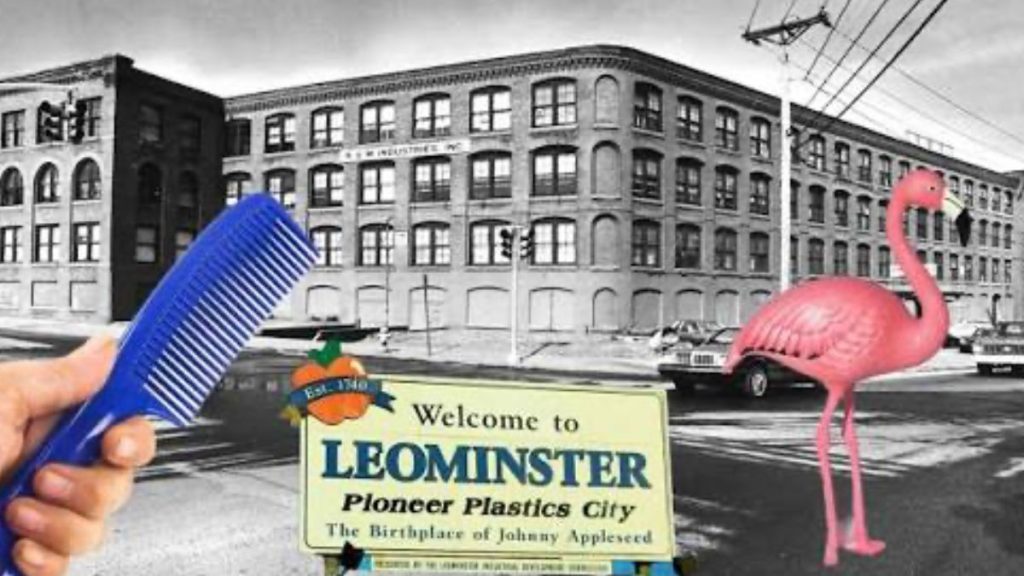
Leominster Massachusetts plastics city, pink flamingo & comb

To understand Union, you first have to understand Leominster, Massachusetts.

Union didn’t randomly appear there.

Leominster had already spent generations becoming a manufacturing center. The area was initially famous for comb production, first using natural materials such as horn. The arrival of celluloid transformed the industry, and Leominster increasingly became associated with plastics manufacturing.

By the time Don Featherstone joined Union in 1957, Leominster reportedly had roughly 60 plastics factories employing about 5,500 people—around 80 percent of the city’s workforce. 

Think about that.

Today we look at an old plastic Santa and see nostalgia.

Leominster once looked at plastic and saw industry.

Jobs.

Factories.

Innovation.

Injection molding.

New materials.

New ways of mass-producing consumer goods.

This was an ecosystem, and Union Products grew out of it.

Historical accounts generally date the company’s beginning to the mid-1940s; collector references commonly cite 1946, while the Journal of Antiques and Collectibles dates the beginning of operations to 1947. That small discrepancy is worth acknowledging rather than pretending the surviving record is perfectly uniform. 

Initially, Union produced hard-plastic injection-molded goods and flat plastic lawn decorations before increasingly embracing three-dimensional molded forms. 

And that transition would change everything.


Enter Don Featherstone

If Union Products has a central character, it is Donald Featherstone. I write about him in more detail here.

Featherstone was born in Worcester, Massachusetts, in 1936 and studied art at the Worcester Art Museum School. Soon after finishing school, he took a job at Union.

Imagine that career transition.

You study sculpture and art.

You graduate.

And your professional canvas becomes…

plastic lawn ornaments.

Featherstone later joked about the disconnect himself. But Union needed exactly what an art-school graduate could provide.

The company wanted to move beyond relatively flat lawn decorations and into three-dimensional plastic forms.

That required somebody who could actually sculpt them.

Featherstone’s early assignments included animals. For a duck, he went so far as to obtain a living duck and study it. 

Union was essentially combining an old artistic process—observing, drawing and sculpting—with a very modern industrial one.

An artist created the form.

Tooling translated it into a mold.

Plastic manufacturing made it repeatable.

Then thousands of identical sculptures could leave Leominster and land on American lawns.

Fine-art training had met mass-market plastic.

That combination would become Union’s superpower.


And Then Came the Flamingo

In 1957, Featherstone created the object that would forever be attached to his name.

The plastic Pink Flamingo.
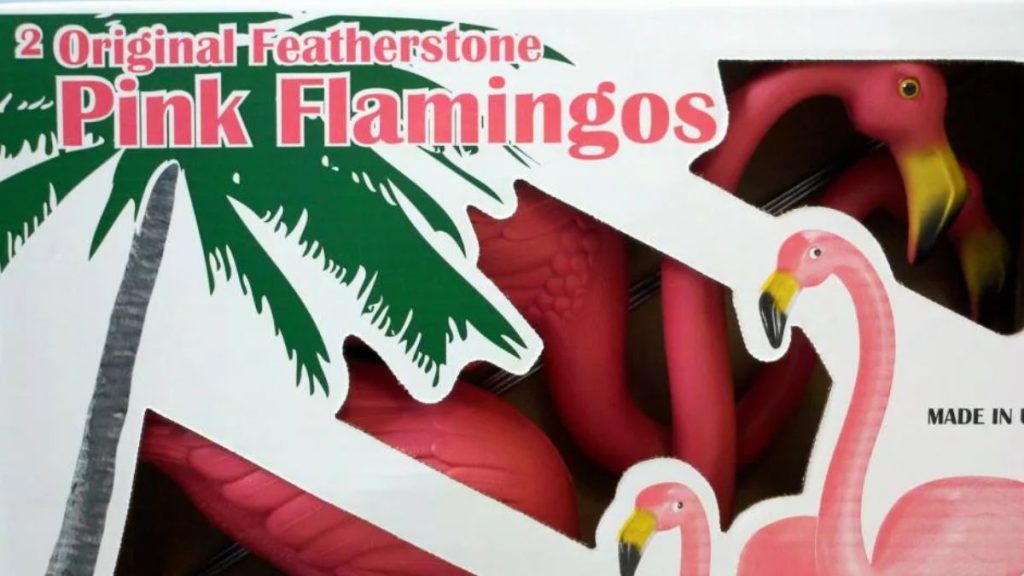
2 Original Featherstone Pink Flamingoes in box

Because finding an actual flamingo wandering around Massachusetts proved somewhat difficult, Featherstone worked from photographs, including imagery published by National Geographic. He sculpted the birds in clay before they were translated into production tooling. 

The familiar pair featured two poses:

One upright.

One feeding.

They were unmistakably pink.

They were ridiculous.

They were wonderful.

And America bought them.

Sears carried the flamingos, and contemporary reporting describes early pairs selling for only a few dollars. Millions eventually spread across American lawns. 

Something strange had happened.

Union had manufactured a lawn decoration.

America turned it into a cultural symbol.


The Pink Flamingo Became Bigger Than Union

The flamingo eventually came to represent practically everything people loved—or hated—about postwar suburban America.

Artificiality.

Optimism.

Mass production.

Tropical fantasy.

Suburbia.

Kitsch.

Camp.

Bad taste.

Good bad taste.

And eventually nostalgia for all of the above.

The Smithsonian’s National Museum of American History describes Featherstone’s molded-plastic flamingo as evolving from ordinary lawn ornament into one of the best-known icons of American pop-culture kitsch. 

That transformation matters to blow mold collectors.

Because the exact same thing eventually happened to the Christmas decorations.

A plastic snowman wasn’t originally manufactured as a collectible.

It was merchandise.

A Santa was something you bought at a store and put beside the front door.

A candle illuminated the porch.

A Nativity went in the yard.

Nobody was putting them into climate-controlled storage because they thought someone would be debating production variations on Facebook fifty years later.

They were inexpensive pieces of popular culture.

Time turned them into artifacts.


Don Featherstone Was Much More Than the Flamingo Guy

This is where Union’s history gets unfairly compressed.

Featherstone didn’t design one bird and spend the next four decades admiring it.

He became extraordinarily prolific.

Published estimates differ depending on what is counted: contemporary sources credit him with more than 600 or 650 designs, while collector literature has placed his output even higher. 

By the late 1990s, Union itself reportedly offered more than 200 varieties of plastic yard art, including numerous Santas and other seasonal figures. 

And that variety is central to understanding Union.

The company wasn’t simply making Christmas decorations.

Its catalogs encompassed Christmas, Halloween, Thanksgiving, Valentine’s Day, St. Patrick’s Day and Independence Day, along with planters, animals and other lawn-and-garden pieces. 

Union was manufacturing a plastic version of the American calendar.


Christmas, Union Style

For today’s blow mold collector, this is where the company becomes especially interesting.

Union’s holiday output included the kinds of forms that now define vintage blow mold collecting:

Santas. Snowmen. Candles. Carolers. Nativity figures. Angels. Soldiers. Elves. Animals. Seasonal characters and yard decorations.

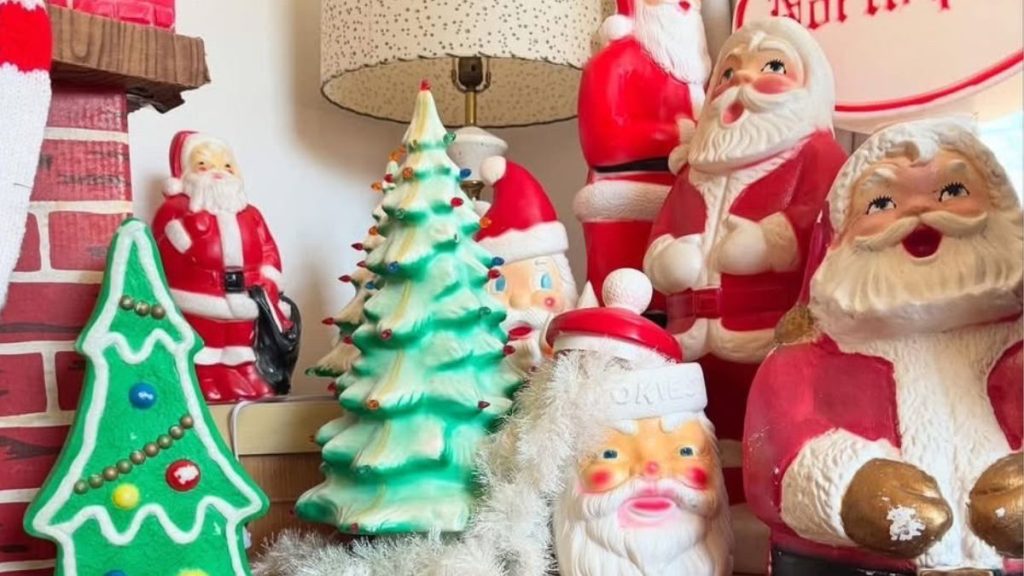
Variety of Union Products blow molds, Santas, elf, angel teddy bear, candle, toy soldier
Images courtesy of blow-molded.com

What made many of them memorable wasn’t merely that they illuminated.

It was their personality.

Union’s strongest pieces have faces.

Expressions.

Character.

The sculptural sensibility matters.

Look closely at a good vintage mold and you begin to see that the decoration isn’t simply a hollow plastic shell.

Someone sculpted the folds.

The beard.

The smile.

The buttons.

The eyes.

The posture.

The texture.

That’s why certain molds remain recognizable even when the paint has suffered.

The sculpture is doing much of the work.

And that’s one reason Union remains so respected.


The Christmas Decoration Was Also Industrial Design

It’s easy to romanticize these pieces so much that we forget how they were made.

They were industrial products.

The goal was to manufacture a three-dimensional object efficiently enough that an ordinary family could afford to buy one.

That creates fascinating constraints.

The figure has to look good.

But it also has to release from tooling.

It needs structural integrity.

It needs paint decoration that can be repeated.

If illuminated, light needs to travel through the plastic effectively.

It needs to survive packaging and shipping.

It has to stand properly.

And most importantly:

somebody has to want it badly enough to take it home.

This is where blow molds become a particularly interesting intersection of sculpture, manufacturing and retail design.

Union excelled at that intersection.


Why Union Pieces “Glow” So Well

Collectors often talk about the appearance of vintage blow molds when illuminated.

There isn’t one universal Union formula—materials, thicknesses, paints and manufacturing practices varied across products and eras—but older blow molds can have a visual character that modern collectors immediately recognize.

The light isn’t simply sitting on the surface.

It’s inside the sculpture.

The plastic becomes the diffuser.

Painted details sit over illuminated polyethylene.

A Santa that looks slightly odd in daylight can suddenly become magnificent after dark.

That transformation is the entire magic trick.

It’s also why photographs rarely capture exactly what collectors love about these things.

You have to see a yard full of them glowing.


Halloween Before Halloween Became an Industry

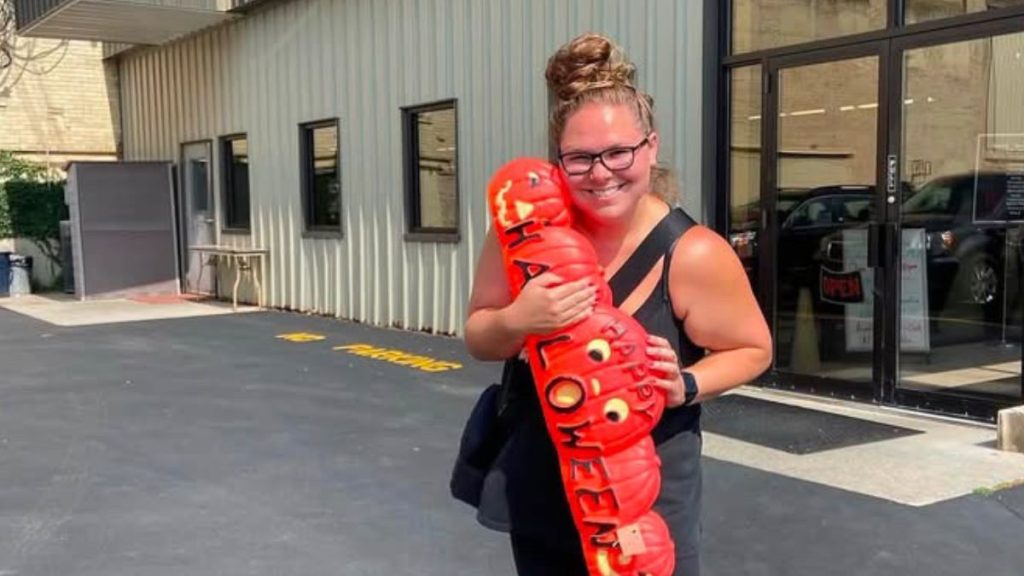
Union’s importance isn’t limited to Christmas. Remember Hope‘s “holy grail” piece – the Featherstone “Happy Halloween” jack o’lantern.

Vintage Halloween blow molds have become a collecting category unto themselves, and Union participated in a much broader seasonal catalog that included Halloween decorations. Collector histories document everything from ordinary seasonal forms to decidedly strange creatures and characters. 

And vintage Halloween has something Christmas doesn’t.

Scarcity of historical merchandise.

For decades, Christmas was the giant decorating holiday.

Halloween merchandise existed, of course, but the enormous seasonal retail machine we know today developed later.

That makes surviving vintage Halloween plastics especially appealing.

Pumpkins.

Witches.

Ghosts.

Black cats.

Haunted imagery.

Oddball characters.

Variety of Union Products Halloween blow molds including ghost, black cat, bear, grim reaper, Bela Lugosi, Happy Halloween jack o'lantern sign & haunted house
Images courtesy of blow-molded.com

For collectors, the stranger the better.

Union understood strange.

Remember:

this is the company whose greatest contribution to civilization may be putting millions of pink flamingos on people’s lawns.


Not Every “Featherstone” Is a Featherstone

Here’s an important collector distinction.

You’ll sometimes hear people casually refer to Union blow molds as “Featherstones.”

That’s understandable.

But it can be misleading.

Don Featherstone was Union’s extraordinarily important designer and eventually its president and co-owner.

Union Products was the manufacturer.

Not every Union piece should automatically be attributed to Featherstone personally without documentation tying that design to him.

The Journal of Antiques and Collectibles has specifically cautioned collectors about using “Featherstone” as though it were simply another name for all Union molds. 

That’s exactly the kind of distinction collectors should preserve.

Manufacturer attribution and designer attribution are not the same thing.


The Signature on the Flamingo’s Rear End

The flamingo offers one of the most entertaining examples of product authentication imaginable.

By the 1980s, knockoffs were everywhere.

So Union needed a way of distinguishing the genuine article.

Around the flamingo’s 30th anniversary, Featherstone’s signature was incorporated into the tooling.

Where?

On the bird.

More specifically…

its rear underside.

Millions of people had bought the flamingo.

Now collectors could flip one over and look for Don’s signature.

It was essentially the plastic lawn-ornament equivalent of an artist signing a canvas.

The signature also became a useful dating clue. Sources generally place signed original Union birds beginning around 1987. The signature was removed after Featherstone’s retirement, prompting enough backlash that the decision became a minor cause célèbre among flamingo enthusiasts. 

Imagine designing something so beloved that people protest when your autograph disappears from its plastic butt.

That’s a legacy.


Featherstone Went From Employee to Owner

There’s another part of the Union story I particularly like.

The 21-year-old art-school graduate hired to sculpt plastic animals didn’t remain simply a designer.

Featherstone spent decades with the company.

He rose through its ranks.

And in 1996, Featherstone and two other longtime employees purchased Union Products. 

The artist had become an owner.

Eventually he served as president.

Think about the arc:

Art school.

Plastic duck.

Pink flamingo.

Hundreds of designs.

Corporate leadership.

Ownership.

Few people have careers quite like that.


Union Tried to Reinvent Its Greatest Hit

The company didn’t simply freeze the flamingo in 1957.

Union experimented with variations.

There were different colors and special runs.

A Snomingo arrived in the 1990s.

Union Products white flamingo blow mold, the Snomingo

Then came the Realmingo, a larger and more realistic interpretation unveiled in 1998. 

Featherstone understood something that today’s blow mold manufacturers are rediscovering:

Nostalgia and novelty can coexist.

Collectors want the familiar.

But they also want something they haven’t seen before.

It’s the same tension running through today’s blow mold revival.

Bring back an old favorite?

People want it.

Create something completely new?

People want that too.

Just don’t mess it up.

Collectors will let you know.


Then the Economics Changed

Union’s story eventually ran into the same forces that reshaped huge portions of American manufacturing.

Competition intensified.

Manufacturing costs changed.

Retail changed.

Imported goods became increasingly significant.

Plastic resin became more expensive.

Energy costs mattered.

And producing bulky, relatively inexpensive plastic lawn decorations in Massachusetts became increasingly difficult economically.

By 2006, Union Products was in trouble.

The company announced that its Leominster operation would close.

Contemporary reports cited rising plastic-resin and electricity costs as well as financial difficulties. 

And suddenly the media weren’t merely reporting the closure of a plastics factory.

They were reporting the possible extinction of the Pink Flamingo.

Union ceased production in Leominster in 2006.

An era had ended.


Except Union Didn’t Completely Die

This is where the story gets better.

The tooling survived.

And tooling is everything.

When a manufacturer closes, collectors often assume the product is gone forever.

But if the original molds survive, resurrection remains possible.

After Union’s closure, HMC International acquired rights and tooling and planned renewed flamingo production in New York. 

Production later became associated with Cado in nearby Fitchburg, Massachusetts.

Eventually Cado acquired Union Products and its intellectual property/assets, allowing production under the Union name to continue. Cado says the acquisition preserved production of Featherstone’s famous flamingo in the region where it originated. 

That makes Union unusual.

The original company closed.

But its identity—and at least part of its manufacturing heritage—survived.


The Flamingos Came Home

There’s something wonderfully appropriate about Cado’s involvement.

Union was born in the Massachusetts plastics ecosystem.

And after a detour through changing ownership, production became rooted again in central Massachusetts.

By 2016, Cado told WBUR it was manufacturing roughly 50,000 to 60,000 pink flamingos annually. 

Think about that for a moment.

An object designed by a 21-year-old artist in 1957…

made using a technology that once represented America’s manufacturing future…

mocked for decades as tacky suburban junk…

was still being manufactured nearly sixty years later.

That’s not failure.

That’s immortality in polyethylene.


Why Union Products Remains So Admired

Ask collectors why Union matters and you’ll get different answers.

Some love Featherstone.

Some love the flamingo.

Some collect Santas.

Others want Halloween.

Some are hunting obscure variants.

Some simply remember these pieces from childhood.

But I think Union’s enduring appeal comes down to five things.

First, the sculpting. Many Union pieces have unmistakable personality. They’re decorations rather than merely plastic forms.

Second, variety. Union wasn’t confined to one holiday or one visual language. The company’s catalog became a sprawling universe of lawn and seasonal art.

Third, history. Union is connected to Leominster’s extraordinary plastics-manufacturing heritage.

Fourth, Featherstone. Having a documented artist behind so many mass-market plastic objects gives collectors a human connection that’s often missing from industrial products.

And fifth:

Union made fun things.

That’s easy to underestimate.

Not everything has to be serious. The company created blow molds in the likenesses of The Three Stooges! How can you not love that?

Sometimes you need a glowing Santa.

Sometimes you need a snowman.

Sometimes you need a plastic bird so aggressively pink that your neighbors question your judgment.

Union understood this.


The Difference Between Collectible and Important

There are rare blow molds.

There are expensive blow molds.

There are blow molds collectors desperately want.

But historical importance is a different question.

Union Products matters because its story extends beyond the hobby.

The Smithsonian has preserved Featherstone’s flamingo as an object of American cultural history. 

That’s significant.

An inexpensive molded-plastic lawn ornament crossed an invisible line.

It stopped being merely merchandise.

It became Americana.

And that’s ultimately what happened to the best vintage holiday blow molds too.

They became pieces of memory.


Look at the Bottom

This is one reason I tell collectors not to judge an old blow mold only from the front.

Turn it around.

Look underneath.

Search for markings.

Manufacturer names.

Numbers.

Copyright information.

Old electrical openings.

Paint patterns.

Seams.

Construction details.

Because once you know the manufacturers, a random plastic Santa at an estate sale becomes something else.

It becomes a clue.

Union Products. Leominster, Massachusetts.

Now you’re holding a piece connected to one of America’s great plastics-manufacturing cities.

You’re holding something from the same company that gave the world the Pink Flamingo.

You’re holding a survivor from an industry that once employed thousands of people in central Massachusetts.

The decoration hasn’t changed.

Your understanding of it has.

That’s what collecting history does.


The Glow Really Didn’t Go Out

When Union’s Leominster factory closed in 2006, it would have been easy to write the ending there.

Factory closes.

Jobs disappear.

Molds get scattered.

Company becomes a paragraph in manufacturing history.

But that’s not quite what happened.

Collectors kept the pieces.

People kept hunting them.

Featherstone’s work became increasingly celebrated.

The flamingo survived.

Tooling survived.

Production survived.

And the Union name survived.

More importantly, the objects became something their creators probably never anticipated.

Heirlooms.

That plastic snowman Grandma put outside?

Someone wants it.

The Santa your parents bought decades ago?

Someone remembers it.

That weird Halloween figure your neighbor displayed every October?

Someone is searching for one right now.

Union Products manufactured decorations.

Time turned them into memories.

And collectors turned those memories into history.

That’s why Union remains one of the essential names in blow molds.

Not simply because of what the company made.

But because so much of it is still glowing.


Discover More in The Glow That Won’t Go Out

Union Products is only one branch of the much larger story told in The Glow That Won’t Go Out: The Complete Collector’s Guide to Vintage Holiday Blow Molds.

The book explores the history and evolution of blow molding, major manufacturers, identification clues, collecting, restoration and the people keeping this unusual corner of American holiday history alive.

Because the next time you find an old plastic Santa at an estate sale, turn him over.

There may be a story molded into the bottom.
The Hunt Never Ends: Inside The Blow Mold Boys of Massapequa Park

What started with two friends, $300 and some replacement light cords has grown into a small business built around vintage Christmas, hard-to-find blow molds—and the eternal problem of where to store all this plastic.

By Curtiss Wayne Andrews

There comes a point in almost every serious blow mold collector’s life when a troubling realization sets in:

You need parts.

Maybe you found the perfect vintage Santa at a yard sale.

The paint is good.

The plastic isn’t cracked.

The price was right.

You bring him home, turn him around and discover that the electrical components appear to have last been inspected during the Carter administration.

Or maybe there’s no cord at all.

Or the backing plate is missing.

Or the clips are gone.

Suddenly your great $20 find has become a restoration project.

That’s part of the world Thomas and his longtime friend stepped into when they started The Blow Mold Boys in Massapequa Park, New York.

But Thomas isn’t merely selling parts.

He’s a collector himself.

And like so many people I’ve interviewed while writing The Glow That Won’t Go Out, his story begins long before there was a business.

It begins with Dad.


It Started in Dad’s Yard

What first got you interested in blow molds?

Thomas: I got interested when I was a little kid. My dad used to put out blow molds, and I ended up developing a love for them.

As I got older, I started buying new pieces for my dad’s house. When I eventually moved, I took them with me.

Today, Thomas estimates his collection has grown to more than 100 pieces, spread across Christmas, Halloween and a smaller number of Easter blow molds.

Sound familiar?

It should.

One of the most consistent things I’ve discovered while talking to collectors is that the obsession rarely starts with the collector.

It starts with somebody else.

Dad put them outside.

Grandma had a Santa.

The neighbors had a snowman.

The family drove around looking at Christmas displays.

Eventually the child who stared at those glowing figures grows up, gets a house…

…and realizes he can buy them himself.

This is how trouble starts.


Old School Wins

Thomas owns newer pieces, but ask him where his heart is and there’s not much hesitation.

Vintage.

Do you have favorite pieces?

Thomas: I like the old-school ones because they were made better. The paint jobs were better on them and lasted longer.

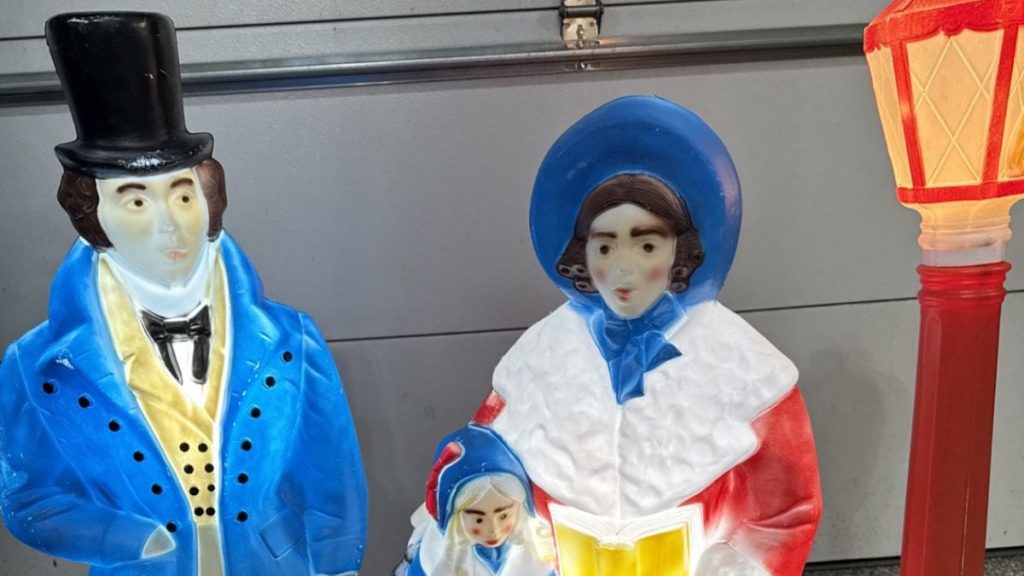
Some of my favorite pieces are the Victorian Dickens Christmas Carolers. I wish they had come out with more in that style.

I also have the four elves, which are really cool.

The Victorian-style carolers make sense as favorites.

vintage Victorian-style blow mold Carolers

They don’t simply look like Christmas decorations.

They look like Christmas itself—the idealized version we’ve collectively inherited from greeting cards, department-store windows and old holiday movies.

Thomas has plenty of more common molds too.

But that’s another thing collectors learn eventually:

Common doesn’t mean bad.

The Santa everybody’s seen a hundred times might be exactly the Santa somebody remembers from childhood.

Rarity can make something expensive.

It doesn’t necessarily make it meaningful.


Two Friends, $150 Each—and a Bunch of Light Cords

Then came the business.

Not with investors.

Not with a warehouse.

Not with some elaborate five-year entrepreneurial plan.

It started with Thomas asking his friend for help sourcing a light cord.

How did The Blow Mold Boys begin?

Thomas: The shop started about three years ago, in 2023.

We started out selling single C7 light cords.

The first year we didn’t sell many of them, and we thought it was a bust.

Then the next year, the C7 singles sold out.

That’s when things got interesting.

Thomas and his friend had each put approximately $150 into the venture.

Three hundred dollars total. Sounds like a winning Shark Tank pitch.

The first year wasn’t particularly encouraging.

Then customers showed up.

The partners reinvested what they made, purchasing additional cords and expanding into other products.

And Thomas found another way to feed the business:

buying and reselling blow molds.

Thomas: As we were doing that, I was buying blow molds and flipping them for more money to help with the business, which we still do today.

The Blow Mold Boys originated basically because I asked my friend to help me get light cords. I knew he was more savvy with that, and he did it.

We both started with $150 each.

We don’t take much of our profit for ourselves because we keep buying more products.

That’s a wonderfully unglamorous small-business origin story.

“Hey, can you help me get some light cords?”

Three years later, you’re running a blow mold business.


Selling the Stuff That Keeps the Old Stuff Glowing

Light cords were the beginning.

Today, The Blow Mold Boys carry a considerably broader selection of replacement electrical and mounting components.

Thomas lists:

C7 single light cords, C7 double light cords, E26 large-bulb light cord kits, backing plates, plastic and metal butterfly clips, C7 vampire sockets, male and female vampire plugs, and SPT-1 wire.

This might not sound as exciting as finding a rare Poloron at an estate sale.

But it’s an important part of keeping vintage blow molds alive.

A decoration manufactured decades ago can survive beautifully while its electrical hardware does not.

Plastic lasts.

Parts disappear.

Cords deteriorate.

Sockets fail.

Backing plates get lost.

And that’s how a perfectly good blow mold ends up sitting unlit in a garage.

It’s one of the themes I kept encountering while writing The Glow That Won’t Go Out.

Preservation isn’t always glamorous.

Sometimes saving Christmas means replacing a cord.


What Actually Sells?

Thomas gets to see another side of collecting that individual collectors don’t necessarily see:

what people are actually buying.

What kinds of blow molds are consistently popular?

Thomas: A lot of the more popular pieces I sell are the soldiers, Santas and snowmen.

People also like the hard-to-find ones.

There’s just one problem with those.

Thomas: Usually when I get those, I keep them.

And there it is.

The fundamental flaw in opening a business that sells the exact things you personally collect.

Imagine running a bakery while being incapable of selling any particularly good cake.

Thomas buys blow molds partly to resell.

Then something unusual appears.

He looks at it.

The business owner says:

Sell it.

The collector says:

Absolutely not.

Guess which one wins?


The Haunted House That Never Made It to the Customer

Thomas gave me a perfect example.

What’s the best part of running the shop?

Thomas: The best part about running my shop is that me and my buddy have been best friends for years.

We like to bring vintage Christmas back to people’s houses.

And the best part is the hunt for the blow molds.

You’re always on the hunt for pieces that you never thought you could find—or something you didn’t want to pay that high price for. Hello, HGTV or A&E – here’s your next holiday reality show.

One business purchase included a Halloween haunted-house blow mold.

Presumably, the rational plan was:

Buy collection.

Separate inventory.

Price haunted house.

Sell haunted house.

Make profit.

Instead:

Thomas kept the haunted house.

And apparently this wasn’t an isolated incident.

Thomas: Usually when I get it, I keep it for my own collection. For example, the Halloween haunted house I picked up in a lot for our business, but I ended up keeping it for myself—as I have with many other ones too.

I just can’t keep them all.

This is why accountants should probably never allow blow mold collectors to classify inventory.


What Should You Charge for a Vintage Blow Mold?

If Thomas sees the buying and selling side regularly, I wanted to know whether he had a formula for pricing.

The answer is refreshingly simple.

There isn’t one.

What’s your advice to somebody selling a blow mold?

Thomas: There’s no real advice I can give to someone trying to sell their blow molds because every year people want different ones.

One year I can sell soldiers like crazy. Other years I have trouble.

You’ve got to find what people like and price it not too high, not too low.

That’s an important lesson for anyone who looks at a price online and assumes:

That’s what mine is worth.

Not necessarily.

Collector markets move.

Demand changes.

Condition matters.

Location matters.

Season matters.

And most importantly:

An asking price is not automatically a selling price.

The hottest item this Christmas might sit unsold next year.

Thomas sees soldiers, Santas and snowmen move consistently, but even those categories fluctuate.

So if you’re selling?

Research comparable pieces.

Look at condition.

Pay attention to what people are actually purchasing.

And price it where another human being might realistically want to buy it.


The Thrill of the Hunt Is Still the Best Part

For all the practical aspects of running The Blow Mold Boys—cords, clips, sockets, inventory and pricing—the thing Thomas enjoys most isn’t especially complicated.

Finding stuff.

That’s the addiction underneath the entire hobby.

You don’t know what’s at the next yard sale.

You don’t know what somebody is about to list online.

You don’t know what’s hiding in the back of a garage.

You don’t know whether the lot you’re buying for resale contains something you’ve been hunting for yourself for ten years.

Thomas said it perfectly:

“You’re always on the hunt for pieces that you never thought you could find.”

Anyone can order something that’s readily available.

The unforgettable finds are the ones you weren’t expecting.

The haunted house buried in a lot.

The Santa priced incorrectly at an estate sale.

The decoration you’ve refused to pay collector prices for suddenly sitting in front of you for twenty bucks.

That’s why collectors keep looking even after they have 100 pieces.

Or 300.

Or 1,000.

You’re never searching only for another blow mold.

You’re searching for the find.


From Dad’s Yard to The Blow Mold Boys

There’s something appropriately circular about Thomas’s story.

His dad put blow molds outside.

Thomas fell in love with them.

As he got older, he bought new pieces for Dad’s display.

Eventually those pieces followed Thomas when he moved.

The collection grew.

Then a need for replacement lighting turned into a conversation with a friend.

Two buddies each put in $150.

They tried selling C7 cords.

It didn’t work particularly well.

Until it did.

Then they reinvested.

Added products.

Bought blow molds.

Sold blow molds.

Kept too many blow molds.

And somewhere along the way, The Blow Mold Boys became a business.

Not because somebody looked at market research and identified a lucrative opportunity in illuminated polyethylene Christmas decorations.

Because two friends liked this stuff.

That’s how some of the best niche businesses begin.


There’s Just One Problem

Thomas has more than 100 blow molds.

He buys additional blow molds for the business.

Sometimes he sells them.

Sometimes he accidentally becomes emotionally attached to the inventory and moves it into his personal collection.

So what is the hardest part of simultaneously operating The Blow Mold Boys and being a collector?

Thomas asks the question every serious blow mold collector eventually confronts:

“Where do you store it?”

There it is.

The final boss of blow mold collecting.

Not price.

Not rarity.

Not faded paint.

Square footage.

A ceramic Christmas ornament can fit in a box.

A blow mold Santa is basically another person living in your house.

Snowmen don’t nest.

Soldiers don’t fold.

Haunted houses stubbornly remain the size of haunted houses.

Eventually every collector looks around and realizes they no longer own a garage.

They own a blow mold storage facility that happens to have a garage door.

And yet Thomas keeps hunting.

Of course he does.

Because somewhere out there is another piece he never expected to find.


Keeping the Glow Alive—One Cord at a Time

I’ve spent a lot of time thinking about why the people surrounding this hobby became such an important part of The Glow That Won’t Go Out.

Thomas represents another piece of that ecosystem.

There are the collectors who save these decorations.

The restorers who repair them.

The historians who document them.

The manufacturers creating new ones.

The people running displays.

And there are small businesses supplying the decidedly unromantic parts that allow an old decoration to light up again. Guys like Thomas. Guys like Tony DePasquale at blowmolds.com.

A vintage Santa without a functioning light is still a Santa.

But plug in a new cord…

Put him outside…

Wait until dark…

And suddenly somebody driving past sees exactly what Thomas saw when he was a kid looking at his father’s display.

That’s how this keeps going.

One collector becomes another.

One Christmas becomes the next.

And one old piece of plastic gets another December to glow.

Maybe Thomas and his buddy aren’t simply selling cords after all.

They’re selling another Christmas.


Meet the People Keeping the Glow Alive

Thomas and The Blow Mold Boys of Massapequa Park, New York, are part of a growing community of collectors, sellers, restorers and enthusiasts keeping vintage holiday blow molds in circulation.

The Glow That Won’t Go Out: The Complete Collector’s Guide to Vintage Holiday Blow Molds by Curtiss Wayne Andrews explores the manufacturers, history, identification, restoration and collecting culture behind these glowing pieces of American holiday history.

Because finding the blow mold is only half the story.

You’ve still got to plug the thing in.

The Glow That Won’t Go Out: Inside Brandon Gress’s Life With Thousands of Blow Molds

From a childhood K-Mart snowman to Hoarding for the Holidays, thousands of blow molds, a legendary Christmas display—and one unforgettable Angel Teddy Bear hunt

By Curtiss Wayne Andrews

Today, I officially release a book about blow molds.

But here’s the thing.

The Glow That Won’t Go Out was never really supposed to be a book about plastic.

Yes, it’s filled with blow molds.

Santas. Snowmen. Reindeer. Candles. Nativity figures. Empire. General Foam. Union Products. Poloron. Beco. The manufacturers, the markings, the history, the hunt, the restoration and all the wonderfully obsessive details collectors care about.

But somewhere along the way, while researching and writing the book, something became obvious:

The interesting part isn’t simply what survived.

It’s why people refuse to let it disappear.

And I’m not sure anyone illustrates that better than Brandon Gress.

Readers of The Glow That Won’t Go Out already meet Brandon in the book through my look at Episode 3 of Hoarding for the Holidays, appropriately titled “Let It Blow (Mold).”

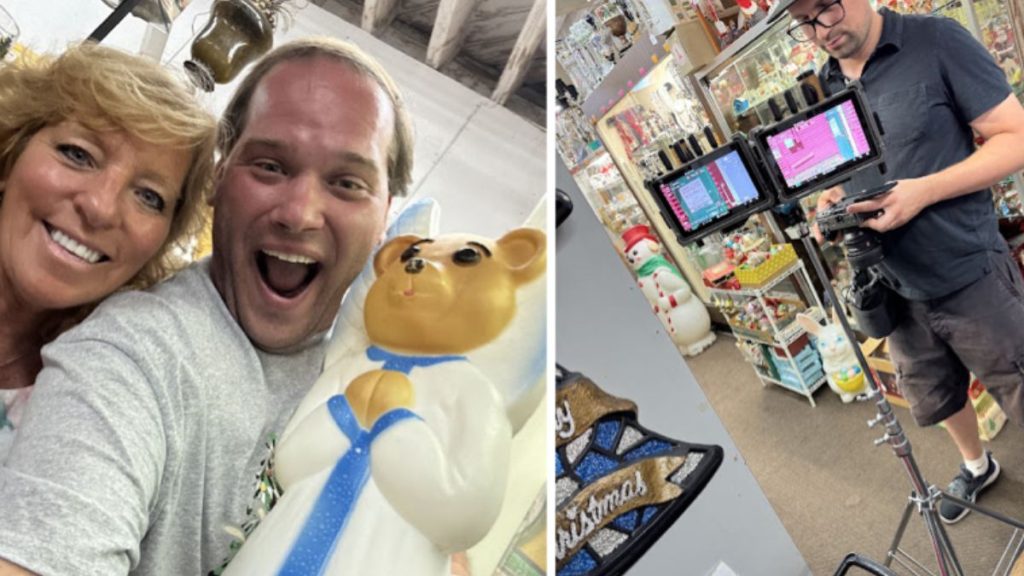
In the episode, Brandon and his mother, Lori, hunt for vintage Christmas decorations, go dumpster diving, laugh at themselves, and pursue a particularly elusive Angel Teddy Bear blow mold.

There’s even a wonderfully perfect ending to that particular story.

After finally finding the Angel Bear he had been hunting…

Brandon discovered another one he already owned buried in his storage shed two days later.

Collectors, I assume, require no explanation whatsoever.

But the television episode only scratches the surface.

Brandon’s relationship with blow molds began long before television cameras showed up. His collection now extends well into the thousands, and his family’s Christmas display has become an annual tradition for thousands of visitors.

It has also raised thousands of dollars for a children’s hospital.

So for the launch of The Glow That Won’t Go Out, I wanted to go back to Brandon.

I wanted to hear the story behind the story.

And appropriately enough, it begins with a snowman.


The $20 Snowman That Started Everything

When did you first get started collecting blow molds?

Brandon Gress: Blow molds have always been a part of my life.

Growing up in the early 2000s, you couldn’t pass a neighbor’s house without at least one holiday blow mold in their yard. Better yet—you couldn’t walk into any big-box store that did not sell blow molds.

I still have vivid memories of seeing blow molds in my local K-Mart and Walmart. And I still kick myself for not getting some of the pieces as a child!

My love for blow molds came from merely being exposed to them.

There were two houses by me that shaped my love for them. A home in Holmdel, New Jersey, on Richard’s Way, was the first time I remember being enamored by these pieces of plastic.

Another home right around the corner from me became my all-time favorite. “The house behind Toys R Us” became my inspiration for years.

The owner of this house, a fellow blow molder and exceptional friend, Tom, has become one of my closest friends in the hobby.

Making my mom and family members drive me by these houses became obsessive—and still is part of my holiday tradition.

Brandon Gress's childhood Grand Venture snowman blow mold from K-Mart
The one that started it all: Brandon’s Grand Venture snowman from K-Mart, a childhood gift from his grandmother.

Then came the piece that changed everything.

Brandon: For me, it was a small Grand Venture snowman from K-Mart.

Like any other five-year-old—ha!—I became obsessed with these plastic light-up pieces because of a snowman my grandmother bought me from the box store.

This blow mold, which would become a staple in my bedroom Christmas display—that every child has, of course!—is still used in my displays outside.

The tattered, faded K-Mart tag still clings to the backside of the piece as a reminder of simpler times and the catalyst for my lifelong blow mold obsession of well over a couple thousand molds.

That snowman is one of my favorite things in Brandon’s story.

Because it’s easy to look at a collection numbering in the thousands and assume collecting is about accumulation.

But there’s the original snowman.

Still there.

Still displayed.

Still wearing its battered K-Mart tag.

That’s what collecting is really about.


The Houses That Created a Collector

Richard's Way Christmas display in Holmdel New Jersey that inspired Brandon Gress
Richard’s Way in Holmdel, New Jersey—the Christmas display Brandon credits with helping ignite his fascination with blow molds.
Brandon Gress and his cousins visiting the Richard's Way Christmas display around 2004
Brandon and his three cousins at the Richard’s Way Christmas display, circa 2004.

Look at that photograph and then look at Brandon’s display today.

There’s your origin story.

A kid gets driven past a spectacular Christmas house.

He stares at the lights and glowing plastic figures.

He asks to go back.

And back.

And back.

Eventually he starts building his own version.

This is how traditions propagate.

Not through instruction manuals.

Through wonder.

Christmas blow mold display known by Brandon Gress as the House Behind Toys R Us
The “House Behind Toys R Us,” another childhood inspiration—and the home of Tom, who would eventually become one of Brandon’s closest friends in the hobby.

Brandon’s tastes today run all over the blow mold world, although he admits a particular affection for cartoon-character molds and Empire Santas.

Choosing a single favorite, he says, would be like choosing a favorite child.

And as an elementary-school teacher?

He knows better.

His collection now extends well beyond a couple thousand molds, and some of his European auction purchases have cost thousands of dollars. 

Brandon’s justification?

There are worse things to spend money on.

Every collector just nodded.


Then Television Called

If you watched Hoarding for the Holidays, you might assume Brandon’s collection was discovered specifically for that program.

Actually, television already knew the Gress family.

Their displays have appeared on ABC’s The Great Christmas Light Fight, Hallmark Channel’s Ready, Set, Glow, AOL’s All Is Bright and HGTV’s Hoarding for the Holidays. According to Brandon, his family never applied for any of them; casting producers approached them. 

How did Hoarding for the Holidays happen?

Brandon: I was contacted by a casting producer explaining they were looking for “passionate Christmas enthusiasts who were crazy about collecting.”

Needless to say, we fit that bill!

We agreed to film with them and the rest is history.

On three excruciatingly hot August afternoons, we donned our Christmas best and played like it was the holidays.

We filmed all around town—anywhere from my own yard to antique stores—and even dumpsters.

We had a BLAST filming for this show.

Brandon Gress filming Hoarding for the Holidays with vintage blow molds
Behind the scenes of Hoarding for the Holidays: the Angel Teddy Bear hunt, filming the episode—and yes, dumpster diving.

But there was one complication.

Brandon didn’t know the show’s title until filming had finished.

And then he saw the word:

Hoarding.

He wasn’t thrilled.

He worried that a genuine collecting passion might be presented as something exploitative or pathological. After talking with the production team, however, he was reassured that the title was tongue-in-cheek. When Brandon finally saw the finished episode, he says he was exceptionally proud of it and felt it captured just how hardcore holiday collectors can be. 

That matters.

Because the best part of Brandon’s segment isn’t the size of the collection.

It’s the relationship at the center of it.


A Mother, a Son and a Completely Reasonable Dumpster Dive

One of my favorite elements of Episode 3—and something I wrote about in The Glow That Won’t Go Out—is Brandon’s relationship with his mother, Lori.

She doesn’t merely tolerate the hobby.

She’s in it.

When Brandon finds a goose blow mold at the thrift store, puts a wig on it and deadpans “add to cart,” Lori laughs.

When he decides discarded Christmas plastic might be waiting in neighborhood trash?

Mom drives.

There’s something important buried underneath the comedy.

Collecting can be generational.

A parent decorates.

A child remembers.

The child grows up.

Eventually those same decorations become something worth preserving because they’re attached to a person, a place and a particular December. A lot of this reminded me of my own mother who passed in 2024 and her extensive strawberry & Precious Moments collections, detailed in the book I co-authored, Hoarders of History.

That’s how a piece of molded plastic becomes an heirloom.


The Great Angel Teddy Bear Hunt

And then there’s the bear.

Every serious collector has one.

The piece that somehow keeps escaping.

The one you search for at antique stores, flea markets, auctions, Marketplace and every other place collectors congregate.

Brandon’s white whale was the Angel Teddy Bear blow mold.

Brandon Gress filming Hoarding for the Holidays with vintage blow molds
Mission accomplished: Brandon and Lori with the elusive Angel Teddy Bear during filming for Hoarding for the Holidays.

The episode turns the search into a miniature Christmas adventure. It reminded me of American Pickers but with Brandon and Lori playing the parts of Mike & Frank, but sweeter!

And eventually, Brandon gets it.

The elusive Angel Teddy Bear appears at a thrift store in Red Bank, not far from home.

Victory.

Celebration.

Embrace the bear.

Roll credits.

Except blow mold collecting had one more joke to tell.

Two days later, Brandon found the Angel Teddy Bear he already owned buried in his crowded storage shed.

That may be the single most blow-mold-collector ending ever filmed.

When your collection reaches several thousand pieces, apparently you can become your own estate sale.


When a Christmas Display Becomes Something Bigger

This is where Brandon’s story changes.

Because the Gress House Holiday Light Spectacular isn’t merely a place to put the collection.

It has become part of the community.

Tell me about the display.

Brandon: My Christmas display—without sounding too cliché—has become a staple in my community.

“The Gress House Holiday Light Spectacular,” as it has become famously known on all social media platforms, started when I was very young.

I always decorated outside, but now it is next level.

I started doing it simply because it made me happy.

While it still makes me happy, it has so much more meaning now.

For one, it has become a holiday tradition for THOUSANDS of visitors annually.

Gress House Holiday Light Spectacular Christmas display with vintage blow molds
The Gress House Holiday Light Spectacular—a childhood passion that grew into an annual community tradition.
Gress House Holiday Light Spectacular Christmas display with vintage blow molds
The Gress House display in 2025, packed with illuminated blow molds and Christmas lights.

Then Brandon told me something that changes how you see those photographs.

Around 2013, the family began using the display to support a Children’s Miracle Network-affiliated hospital in New Jersey. Brandon says the display has raised thousands of dollars through the years. In 2023, the family’s contributions were recognized as part of a hospital expansion with a dedicated Post Office Play Area, chosen because of its natural connection to Christmas and letters to Santa. 

Post Office Play Area supported by Gress House Holiday Light Spectacular fundraising
The Post Office Play Area supported by the Gress family’s holiday-display fundraising—a reminder that a Christmas decorating obsession can become something much bigger.

Brandon summed it up better than I could:

“It is truly crazy to think that some lights and pieces of plastic can bring so many people together.”

That’s the sentence.

That’s the entire book.


Vintage Empire Meets Brand-New Gemmy

I also wanted Brandon’s opinion on one of the livelier debates in blow mold collecting:

Old versus new.

His answer?

Why choose?

What’s your take on the newer generation of blow molds?

Brandon: I am in no way a blow mold purist.

In fact, my display is filled with new and old. A 1970s Santa sits alongside Gemmy counterparts from a few years ago.

It is all about your decorating style.

While some complain about the new blow molds coming out—how they flood the market and “just don’t make them like they used to!”—I feel quite the contrary.

I think Gemmy introducing these blow molds has been great for collectors.

I think we are in the blow mold renaissance.

That’s an interesting perspective, particularly from someone with such an enormous vintage collection.

Brandon argues that newer molds give younger collectors an affordable entry point while licensed characters can attract people who may never have gone hunting for a vintage Empire Santa. His own displays freely mix old and new.  I write more about the old vs new debate here.

And then comes my favorite detail.

When Brandon was in fourth grade, he wrote to Gemmy for a persuasive-writing assignment asking the company to make the Miser Brothers.

Nearly twenty years later?

They’re available as holiday decorations.

Teacher-approved persuasive writing, apparently.

New Gemmy Christmas blow molds in Brandon Gress's collection for the 2026 season
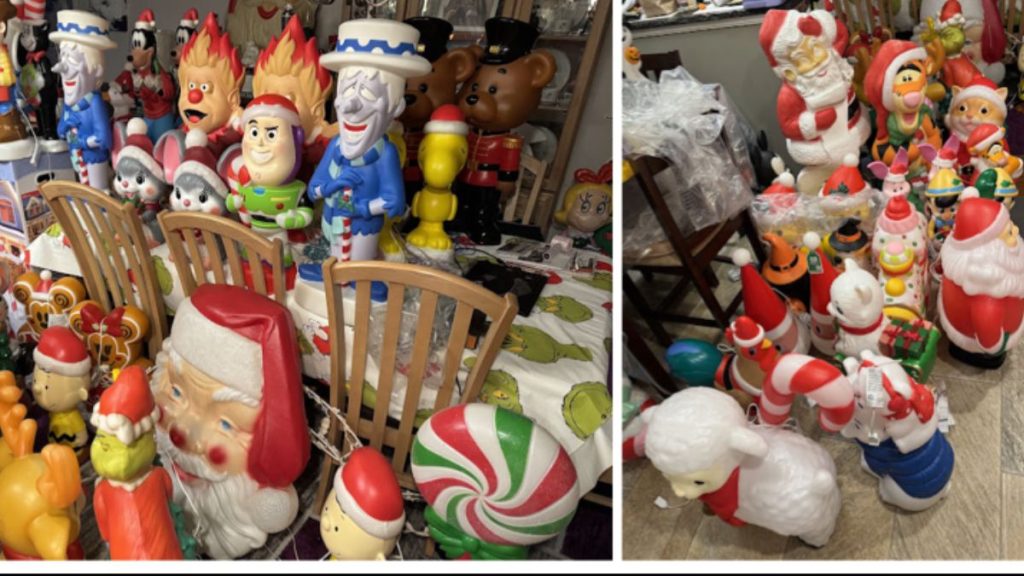
Waiting for Christmas: some of Brandon’s newer blow molds taking over the dining room ahead of the 2026 decorating season.

Brandon’s Advice for New Blow Mold Collectors

So what does someone with several thousand pieces tell the person buying blow mold number one?

First:

You’re not building Brandon’s display next weekend.

And that’s okay.

His advice is to start where collectors have always started:

Yard sales.

Antique stores.

Flea markets.

And yes…

Garbage.

Brandon’s rules for beginning collectors

Brandon: You won’t build a massive display overnight.

It takes time, perseverance, and willingness to get a little dirty!

Oh, yes! You have to be willing to dumpster dive and garbage pick!

Another tip is to save your money.

Start a savings account at birth for this hobby!

Most importantly, have fun.

There are so many dedicated people who make this hobby so enjoyable. Meet fellow blow molders, join the groups online, and share your ideas, displays and finds.

The sense of community in this hobby is truly unmatched.

And then he adds one final piece of advice:

“Don’t yard sale in my neck of the woods—those blow molds are reserved for me!”

Fair warning.

His larger message, though, is community: meet other collectors, join groups, share displays and enjoy the hunt rather than expecting to assemble a massive collection overnight. 


This Is Why I Wrote The Glow That Won’t Go Out

There’s a reason I wanted this interview to publish on October 1—the day The Glow That Won’t Go Out launches.

Look at Brandon’s first snowman again.

It’s not rare because an auction house says it’s rare.

It’s valuable because his grandmother gave it to him.

Look at the old photograph outside Richard’s Way.

A kid staring at someone else’s Christmas display eventually creates one that thousands of other kids will remember.

Look at Brandon and Lori hunting for the Angel Bear.

The object matters.

But the person standing next to you when you find it matters more.

Look at the hospital play area.

Somehow an obsession with illuminated plastic Christmas decorations helped create something for children who may be spending part of their own holiday in a hospital.

And look at the thousands of blow molds covering the Gress property today.

They’re not museum pieces.

They’re outside.

They’re glowing.

They’re doing what they were made to do.

That’s the glow that won’t go out.

Not electricity.

Memory.

Tradition.

Family.

Community.

And a new generation looking through the car window at somebody’s Christmas display thinking:

I want to do that someday.

Brandon was that kid once.

Maybe somewhere in the crowd outside the Gress House this Christmas…

the next Brandon is watching.


Keep the Glow Going

The Glow That Won’t Go Out: The Complete Collector’s Guide to Vintage Holiday Blow Molds by Curtiss Wayne Andrews is now available in e-book, paperback & hardcover (be patient if all those editions don’t show up exactly on Oct 1st!).

The book explores the history, manufacturers, identification, restoration and collecting culture behind vintage holiday blow molds—but more importantly, it tells the stories of the collectors, families and traditions keeping them glowing.

And yes.

Brandon, Lori and that Angel Teddy Bear are in it.

“Dad, I Have a $500 Emergency”: Inside Hope Holubowicz’s Vintage Blow Mold Obsession

She grew up making annual Menards trips with her dad, built a collection of roughly 300 vintage blow molds, and eventually landed on Hoarding for the Holidays. But one legendary Marketplace haul required some creative family financing.

By Curtiss Wayne Andrews

There are emergencies.

Flat tires.

Broken water heaters.

Unexpected medical bills.

The transmission falls out of your car.

And then there are blow mold emergencies.

Hope Holubowicz once encountered the latter.

A Facebook Marketplace listing appeared containing approximately $1,000 worth of vintage blow molds.

There was only one problem.

Hope did not have $1,000.

What she did have were two parents.

So Hope independently contacted each of them and announced that she had a “$500 emergency.”

Mom sent $500.

Dad sent $500.

Problem solved.

At least until Mom and Dad eventually talked to each other.

Welcome to blow mold collecting.

Readers of The Glow That Won’t Go Out may already recognize Hope from my chapter featuring collector stories. Her story stood out to me because beneath all the collecting—and the comedy—is something that comes up again and again in this hobby.

Family.

Hope’s father helped introduce her to blow molds as a child. Years later, that relationship became part of her television appearance.

And somewhere in between came thrift stores, Beco Santas, a Don Featherstone jack-o’-lantern, approximately 300 pieces of glowing plastic…

…and one extremely questionable definition of the word “emergency.”

I had to know more.


Before There Was Marketplace, There Was Menards

When did you start collecting blow molds?

Hope: I would say I have been collecting blow molds for the last 10 years. It is hard to put an exact timeline on it because they had been a big part of my childhood during the early ’90s.

My personal collection started with thrifting.

Growing up, I spent a lot of time as a child going to rummage sales and thrift stores with both my mom and my aunt. Secondhand searching was a way of life for us.

I don’t have any early memories going into “real stores,” as my mom and aunt were always looking for a bargain.

That last sentence explains a lot.

Hope wasn’t introduced to collecting through an online collector group or price guide.

She was raised in the hunt.

Rummage sales.

Thrift stores.

Secondhand shops.

The possibility that something spectacular might be sitting on a shelf for five dollars because nobody else knew what it was.

But blow molds had another family connection.

Her dad.

Each year, Hope remembers going to Menards with him and choosing a new blow mold for the family’s Christmas display.

Those trips left an impression.

So did the glowing decorations themselves.

Years later, when Hope began spotting vintage blow molds while thrifting, something clicked.

She started bringing them home.

And then?

Well…

“It has been absolute, glorious havoc ever since.”


The $500 “Emergency”

Every collector has a story that probably sounds completely reasonable to other collectors and completely insane to everybody else.

This is Hope’s.

A Facebook Marketplace listing appeared in 2023.

The seller had accumulated a large collection.

The asking price was approximately $1,000.

Hope needed it.

Immediately.

There was just that minor funding problem.

So she texted Mom.

“I have a $500 emergency.”

Mom was visiting family in Pennsylvania and Venmoed the money.

Then Hope contacted Dad.

Same emergency.

Another $500.

A thousand dollars later, the blow molds were secured.

Hope repaid both parents within a week.

Then her parents happened to have a conversation.

Dad asked Mom whether she ever found out what Hope’s mysterious $500 emergency had been.

You can probably see where this is going.

The truth emerged.

The emergency was Christmas decorations.

Dad’s response?

“Hope, that is NOT an emergency.”

He then reportedly began explaining the types of situations that actually constitute emergencies.

Which was unnecessary.

Because every serious collector reading this already understands that a once-in-a-lifetime Marketplace blow mold haul clearly falls somewhere between house fire and medical evacuation on the emergency scale.

Sorry, Dad.

I’m siding with Hope.


The $25 Haunted House—and Her Holy Grail

That legendary haul produced one of Hope’s favorite pieces:

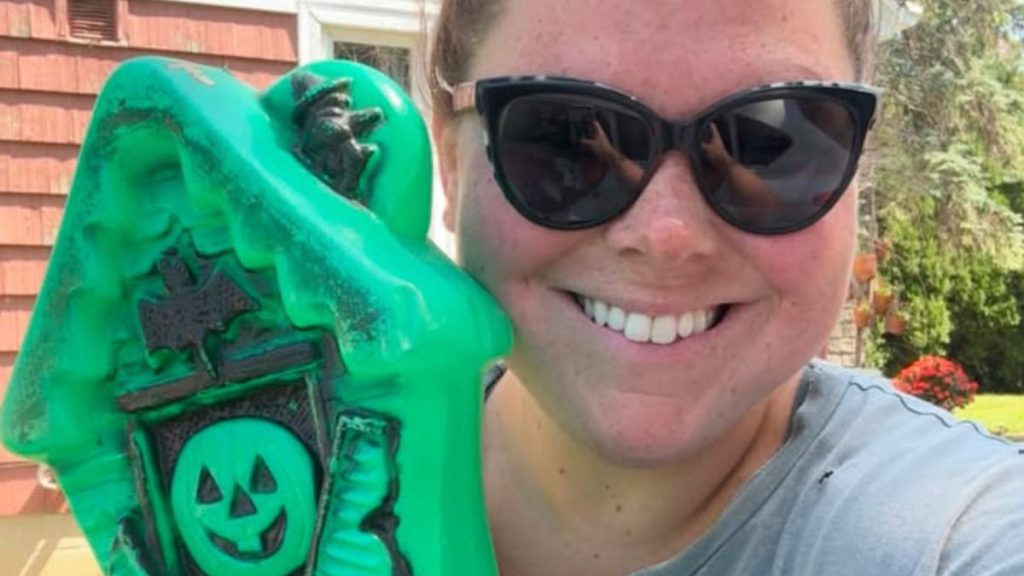
a green Haunted House she got for $25.

Hope's prized green Haunted House blow mold.

But her collection contains other favorites.

Which blow molds stand out the most?

Hope: I think for me my love for my Beco Santas and my Don Featherstone JOL bunch is not so much due to their value but how kitschy they both look.

Like I said in a local news interview:

“I am a 1990s baby living in a 1950s Christmas!”

That’s a pretty fantastic description of the appeal.

Because Hope isn’t merely collecting old Christmas decorations.

She’s curating an aesthetic.

The Beco Santas.

Hope's collection of vintage Beco Santas.

Vintage Halloween.

Mid-century colors.

Old appliances and fixtures.

Christmas decorations that look like they escaped from somebody’s living room decades ago.

Her most expensive blow mold purchase to date was $175 for a Don Featherstone Happy Halloween jack-o’-lantern group.

It’s also what Hope calls her holy grail.

Hope's holy grail find - a Happy Halloween Don Featherstone piece.

And that’s an important distinction.

Expensive doesn’t automatically mean beloved.

Rare doesn’t automatically mean desirable.

The best collection is ultimately a reflection of the person assembling it.

Hope knows exactly what hers is supposed to look like.

Kitschier the better.


Then Instagram Delivered a Very Suspicious Message

By the time Hope had built a substantial collection, she had begun sharing it online.

Then one day a message appeared on Instagram.

Someone claimed to be interested in putting her on television.

Hope’s immediate reaction was reasonable:

I’m being catfished.

How did Hoarding for the Holidays find you?

Hope: I received a message on Instagram from one of the producers or casting directors saying that they loved my collection and personality from watching my saved stories.

At first I thought I was being catfished.

One day after school I was checking my personal email and saw the message. I went into my co-teacher’s classroom and showed her.

We were both thinking, “Yeah right, next comes the question of sending my credit card information.”

But that moment never came.

Instead, Hope went through three rounds of interviews.

Then the network selected her.

And suddenly a woman who describes herself as a typical thirty-something working a typical job—and who admits she has an easier time spending money on old plastic yard ornaments than saving it—was preparing to have her collection filmed for television.


Three Days of Filming—and One Very Important Co-Star

Production lasted three days. Hope said the production crew was the nicest group of people she’s ever met. “They made me feel so at home in my own home going through such a new and different experience of acting!”

Hope and her dad with the production crew of Hoarding for the Holidays, episode #1 "A Real Life Elf."

But Hope’s collection wasn’t the only thing producers found interesting.

They noticed Hope and her father together.

How much of the father-daughter relationship was real?

According to Hope:

All of it.

Hope: Because of the dynamic between my dad and me—he is my best friend and nothing about our on-camera banter was acted—the casting directors wanted our father-daughter story to be a part of the show.

After all, my dad is the one who got me into blow molds back when I was a child.

That makes their scenes considerably better.

Hope and her dad filming for HGTV's Hoarding for the Holidays, episode #1 "A Real Life Elf."

You’re not watching two people manufacture banter for television.

You’re watching a father who helped create a collector…

…now dealing with the consequences.

And apparently there have been consequences.

One involves a Tasmanian Devil.


The Taz Incident

During Hope’s childhood, her father owned a Tasmanian Devil blow mold. Yes, the same one I wrote about here. Small world.

Then, sometime in the early 2000s, somebody stole it from the family’s yard.

Hope says:

“He has never fully recovered from it.”

Having spent enough time talking to blow mold collectors, I believe her.

This is another strange characteristic of these decorations.

People remember them.

You can describe an old blow mold somebody hasn’t seen in thirty years and suddenly they remember exactly where it stood.

Beside the garage.

Under the front window.

Next to the mailbox.

And if somebody stole it?

Apparently the statute of limitations on emotional resentment does not apply.

Dad, if you’re reading this:

I hope Taz finds his way home someday. Or, if you’re longing for a replacement I think they’re going for around $900 these days.


“I Am Not a Hoarder”

There’s one part of the television experience Hope would particularly like to clarify.

The title.

Hoarding for the Holidays.

Hope has a response.

Hope would like the record corrected

Hope: I want to set the record straight—I am in fact not a hoarder but a collector.

And with roughly 300 blow molds, she has certainly committed to the distinction.

Her collection isn’t thrown indiscriminately into a pile.

Hope says her pieces live inside her home, rather than being subjected to outdoor weather.

They’re part collection, part decoration and part lifestyle.

Which leads to one of the strongest differences between Hope and some of the other collectors I’ve interviewed.


New Blow Molds? Hope Has Thoughts.

Some collectors happily mix vintage Empire with brand-new Gemmy.

Hope does not.

What’s your opinion of newer blow molds?

Hope: I don’t own any blow molds that are post-1990s.

Like much else in life—such as my Frigidaire turquoise stove, or my Kohler aqua matching sink and toilet—they don’t make it like they used to!

I find new blow molds cheap.

No offense to anyone who likes ’em!

I am not here to yuk your yum.

And this is why interviewing collectors is more interesting than declaring that there’s one correct way to collect.

Brandon Gress told me he happily mixes old and new and believes we’re living through a blow mold renaissance.

Richard Gierlich has gone so far as to make new blow molds.

Hope?

Give her the old stuff.

That’s collecting.

People develop preferences.

They debate.

They disagree.

And ultimately everybody goes home and plugs in whatever makes them happy.

Hope’s house just happens to stop somewhere around 1999.


How to Find Blow Molds in the Wild

Hope started as a thrifter.

So I wanted to know whether someone can still build a collection that way.

Her answer?

Yes.

But you’re going to have to work harder.

What’s your advice for someone starting today?

Hope: Now they are hard to come by in thrift stores, but every now and then I have some good luck.

The key to thrifting is going regularly, and to your least favorite stores.

That’s where the random unicorn sits waiting to be found—not at your favorite shop.

That might be my favorite collecting advice I’ve heard yet.

Everyone searches the obvious places.

The antique mall known for vintage Christmas?

Already picked.

The trendy thrift store with carefully curated displays?

Everybody checks it.

That slightly depressing thrift shop you don’t particularly enjoy visiting?

That’s where your $8 Beco Santa is hiding.

Go there.


Hope’s Four Rules of Blow Mold Collecting

Hope gave me four pieces of advice.

They’re worth preserving almost exactly as she gave them.

1. Spend decent money on decent-condition pieces. Hope isn’t interested in badly faded or heavily weathered examples, particularly because her approximately 300 blow molds are displayed indoors.

2. Once you buy one, expect to lose sleep over buying your next. There is currently no known cure.

3. Replace questionable old electrical components. Hope replaces aging cords and uses LED bulbs in her collection.

And finally:

4. Understand that blow mold collecting is not for the faint of heart.

Most people won’t understand why you care so much about old plastic Christmas decorations.

Hope thinks that’s part of what makes the community special.

I think she’s right.


A 1990s Kid Living in a 1950s Christmas

There’s something wonderfully circular about Hope’s story.

As a kid, Dad took her to Menards.

They picked out a blow mold.

They brought it home.

They plugged it in.

Years pass.

The kid grows up.

She starts thrifting.

One blow mold comes home.

Then another.

Then approximately 298 more.

Eventually a television producer discovers her collection online and puts Hope and her dad on a television show about people who are completely, hopelessly obsessed with Christmas.

And somewhere in the middle of it all, Hope needs an emergency $1,000.

When I was writing The Glow That Won’t Go Out, stories like Hope’s became as important to me as documenting manufacturers and identifying old molds.

Because objects don’t create traditions by themselves.

People do.

A Beco Santa isn’t nostalgic because it was manufactured decades ago.

It’s nostalgic because somebody remembers it.

A blow mold becomes special when Dad bought it.

Grandma displayed it.

The family drove past it.

Someone rescued it from a thrift store.

Someone else spent twenty years trying to replace the one that was stolen.

The plastic survives.

But people provide the glow.

Hope describes herself as:

“A 1990s baby living in a 1950s Christmas.”

I can’t think of a better way to explain why vintage blow molds are still here.

Every generation borrows a little Christmas from the one before it.

Then adds something of its own.

And passes the glow along.


Meet More of the Collectors in The Glow That Won’t Go Out

Hope Holubowicz and her wonderfully questionable $500 emergency are featured in The Glow That Won’t Go Out: The Complete Collector’s Guide to Vintage Holiday Blow Molds by Curtiss Wayne Andrews.

The book explores the history, manufacturers, identification, restoration and collecting culture behind vintage holiday blow molds—and the amazing people who refuse to let these pieces disappear.

If you grew up staring at a glowing Santa through the back seat window…

this book was written for you.

Thousands of Memories Still Glowing: Inside Nick’s Lifelong Blow Mold Obsession

He bought his first blow molds for $1 each as a kid. Today his collection numbers in the thousands. The Hoarding for the Holidays collector talks restoration, television, auctions and why the old Poloron and Beco pieces still matter.

By Curtiss Wayne Andrews

There was a time when vintage blow molds weren’t vintage.

They weren’t “collectibles,” either.

They were Christmas decorations.

They sat outside houses.

They got rained on.

Snow piled against them.

Kids knocked them over.

Parents shoved them into garages sometime after New Year’s Day, where they waited patiently for another Christmas.

And if you happened upon a few old ones at a flea market?

Apparently, you could buy them for a dollar apiece.

Nick remembers those days.

Very well.

Because that’s essentially how his collection started.

From a $1 Flea-Market Find to Thousands of Blow Molds

While putting together The Glow That Won’t Go Out: The Complete Collector’s Guide to Vintage Holiday Blow Molds, I wanted to capture something that’s difficult to communicate unless you’ve spent time around serious collectors:

This hobby can get completely out of hand.

I mean that affectionately.

One Santa becomes two.

Then you need a snowman.

Then you discover that Empire made six versions of something you thought was one version.

Then somebody mentions Poloron.

Eventually, you’re standing in a building surrounded by several thousand pieces of molded Christmas plastic and explaining that, technically, you don’t have a problem because some of them still need repairs.

Nick understands.

Readers of The Glow That Won’t Go Out may remember him from the section about Hoarding for the Holidays. In the program’s first episode, A Real Life Elf, he appears surrounded by an extraordinary collection of vintage holiday decorations.

There’s also a smaller detail I mentioned in the book that collectors probably appreciated.

Nick wore the hobby.

Literally.

His gray shirt read:

“Plug In Those Vintage Blow Molds and Light Up Your Christmas.”

It’s hard to imagine a more appropriate wardrobe choice when you’re being filmed in the middle of a blow mold collection. Want that shirt or one like it? Click here.

But the brief appearance in my book left me wanting to know more.

How does someone accumulate a collection numbering in the thousands?

What’s it like letting a television crew into that world?

And perhaps most importantly, how do you keep all that aging plastic alive?

So I went back to Nick.

Here’s our conversation.


A Conversation With Nick of Saint Nick’s Display

How did you first get started collecting blow molds?

Nick: I first got started collecting blow molds when I was about six or seven. I was going around to the local flea market and happened to see a vendor selling some for a buck each.

Yes, only one dollar.

At the time I saw them and was amazed by the size of them. I didn’t even realize they lit up until I got them home.

My collection consists of several thousand decorations. Not all are used due to needing repairs, but I try to put out what I can each year.

My favorites have to be anything made by Poloron or Beco—the original OG blow mold companies from the 1960s.

Let’s Stop at “One Dollar” for a Moment

There are younger collectors reading this who may need a minute.

One dollar.

Today, collectors can spend considerable money chasing desirable vintage pieces.

Nick’s childhood introduction to the hobby happened in another universe.

He wasn’t studying sold listings on his phone.

He wasn’t competing against twenty-seven other people who had received the same Marketplace notification.

He was a kid at a flea market who saw some enormous plastic Christmas decorations and thought they looked cool.

Then he brought them home and discovered something even better.

They lit up.

That’s the kind of experience that creates a collector.

And it points to something I kept returning to while writing The Glow That Won’t Go Out.

For many collectors, this isn’t fundamentally about monetary value.

It’s about memory.

A particular Santa can transport someone back to their grandparents’ lawn.

A snowman can look exactly like the one that stood beside the driveway every December.

You aren’t merely collecting plastic.

Sometimes you’re buying your way back into Christmas when you were seven years old.

Nick just happened to start doing it while he actually was seven years old.


When HGTV Comes Calling

Nick’s collection eventually became large enough to attract attention beyond the blow mold community.

He appeared in Hoarding for the Holidays, where viewers got to see both his indoor and outdoor Christmas displays.

But the invitation didn’t initially inspire excitement.

It inspired suspicion.

How did Hoarding for the Holidays discover you?

St. Nick's Display from Hoarding for the Holidays

Nick: I was found for the show Hoarding for the Holidays through my display page on Facebook, Saint Nick’s Display.

They randomly sent me a message one day in the spring, which I originally thought was a spam message and almost ignored.

I can say, having dealt with other shows that were less than stellar to me, I was extremely impressed by HGTV and Exit 4 and all the crew for how professional and kind they all were to me.

It felt like being with friends during the filming.

They were so helpful and even let me tell them how I liked things done.

I couldn’t have been happier with how they filmed us and treated not only me but all my family and friends. They are A-plus people, and I’d work with them again.

Were you happy with the final show?

Nick: I was extremely happy with the final product.

It showed my indoor display and my outdoor display.

And even the mucky places I’d go for Christmas decorations!

That last part matters.

Because every serious collector knows the beautiful display is only half the story.

Nobody photographs the crawlspace.

Nobody makes an Instagram Reel celebrating the moment you climb over fourteen storage totes because you’re convinced the missing light plate is in the box against the back wall.

Nobody sees you standing in mud negotiating over a faded Santa that appears to have spent the previous decade beneath somebody’s porch.

Television usually wants the spectacle.

Nick appreciated that this production captured more of the actual world surrounding the spectacle—and treated the people in it respectfully.


Keeping Thousands of Blow Molds Alive

Having several thousand vintage decorations creates another issue:

Several thousand vintage decorations eventually become several thousand aging vintage decorations.

Paint fades.

Surfaces weather.

Plastic gets damaged.

Parts disappear.

That’s how Nick became interested in restoration.

What got you started restoring blow molds?

Nick: I got into blow mold repairs simply because mine started to peel and get weathered over time.

Having had some of mine for years at that point, they needed a refresh.

I did many different things and ended up finding that airbrushing was the closest I could get them to original.

At first, like all artists, you make mistakes with types of paints and materials. But time helps, and you learn to grow and become better at it.

There’s an important word in that answer:

Artist.

Good restoration isn’t simply covering faded plastic with paint.

You’re trying to preserve the visual character of something manufactured decades ago.

Color.

Opacity.

Edges.

Overspray.

The peculiar look created by mass-production techniques.

Make something too perfect and it can stop looking vintage.

Make the wrong repair and you can create a problem worse than the one you started with.

Light blue painted Santa Claus on train blow mold, vintage.

Which brings us to Nick’s most important restoration advice.


Please Don’t “Fix” It Until You Know How to Fix It

What’s your biggest recommendation for someone considering restoration?

Nick: For those looking to get blow molds restored or fixed, I can only recommend making sure they use the right products and hopefully not DIY it in a way that will entirely ruin the plastic or alter an antique in a way that can never be fixed.

This is worth emphasizing.

Old plastic isn’t a practice canvas.

Before attacking a valuable vintage piece with paint, solvent, adhesive, heat or some restoration hack you saw in a 37-second video, find out what you’re dealing with.

Sometimes the smartest restoration decision is:

Don’t touch it yet.

Research the manufacturer.

Identify the material.

Talk to experienced restorers.

Practice techniques on something expendable.

Determine whether a repair is reversible.

The objective shouldn’t necessarily be to make a 60-year-old blow mold look like it rolled out of the factory yesterday.

The objective is to help it survive.

That’s a recurring theme throughout The Glow That Won’t Go Out:

Preservation beats perfection.

display of airbrushed blow mold Christmas carollers

Then There’s the Jones House Auction

For collectors, online marketplaces have transformed the hunt.

But there’s something an online listing can’t replicate:

Standing in a room full of people who immediately understand why you’re excited about an old piece of glowing plastic.

Nick has been attending the Jones auction for more than a decade.

What is the Jones House Auction experience like?

Nick: I have been going to the Jones auction since its creation over a decade ago.

About the time I was in high school, it first started to be a blow mold auction. It was extremely cheap at the time before the trends happened.

It’s very cool to be so local to that auction. I’m only about 25 minutes away.

I would recommend going if you enjoy the social aspect of being around other like-minded collector people.

That last sentence may explain why physical collector events continue to matter.

You can buy something online.

You can research it online.

You can discuss it online.

But collecting has always had a social component.

Swap meets.

Flea markets.

Auctions.

Estate sales.

Christmas displays.

People leaning over a table saying:

“I’ve been looking for one of these for fifteen years.”

That’s the culture surrounding the objects.

And sometimes that’s more memorable than whatever you brought home.


What Changed?

Nick’s collecting life spans an interesting period in the hobby.

He remembers the $1 flea-market blow mold.

He remembers auctions before prices began climbing.

Now he lives in a world where vintage Christmas has become its own collecting category and previously overlooked decorations can inspire serious competition.

But there’s an irony here.

The increased attention that makes certain pieces harder and more expensive to acquire is also helping ensure they’re preserved.

People are identifying manufacturers.

Documenting variations.

Creating replacement parts.

Learning restoration techniques.

Sharing old catalogs.

Recording histories.

And introducing new collectors to names such as Empire, General Foam, Union Products, Poloron and Beco.

The objects aren’t anonymous lawn decorations anymore.

They’re artifacts of American Christmas.

That’s a large part of why I wrote The Glow That Won’t Go Out.


Several Thousand Reasons the Glow Won’t Go Out

Look again at the photograph of Nick standing in his collection.

Don’t look at him at first.

Look behind him.

Santa.

Snowmen.

Angels.

Reindeer.

Characters.

Rows upon rows of plastic faces.

Every one came from somewhere.

Somebody originally bought each one.

Somebody put it outside.

Some kid saw it glowing through a window.

Eventually it was packed away.

Years passed.

Families moved.

Decorating styles changed.

Somehow, it survived.

And eventually one of those pieces wound up with a collector like Nick.

That’s why the title The Glow That Won’t Go Out means more to me than the literal light inside these decorations.

The glow is the memory attached to them.

Nick bought his first ones when he was six or seven.

All these years later, he’s still restoring them, displaying them, hunting for them and surrounding himself with thousands of them every Christmas.

The collection got considerably larger.

The kid who was amazed to discover those $1 flea-market decorations actually lit up?

I’m not sure he ever completely left.

And maybe that’s the whole point.

Rainbow airbrushed blow mold snowman and painted Santa & snowman blow molds, courtesy of Nick.

Discover More Stories From the Blow Mold Community

Nick and Hoarding for the Holidays are featured in The Glow That Won’t Go Out: The Complete Collector’s Guide to Vintage Holiday Blow Molds by Curtiss Wayne Andrews.

The book explores the manufacturers, history, identification, restoration and collecting culture behind the glowing plastic decorations that became fixtures of the American Christmas landscape.

But just as importantly, it’s about the people who refuse to let that glow disappear.

Why the Santa’s Best Taz Blow Mold Has Become One of the Hottest Finds in Collecting

Every collector has one.

The blow mold you keep hoping will be sitting behind a folding table at an estate sale. The one you search for on Marketplace even though you know perfectly well you searched for it yesterday. The one that makes you slow the car down when you spot a suspiciously familiar plastic silhouette sticking out of somebody’s garage. In my book, The Glow That Won’t Go Out, I highlight collector Brandon’s Indiana Jones-like pursuit of an elusive angel teddy bear blow mold.

Right now, one of those pieces is the Santa’s Best Tasmanian Devil Christmas blow mold.

I recently talked with blow mold collector and dealer Ed (@sickeddie) on Instagram, and when I asked him what collectors are really hunting for these days, his answer caught my attention.

Taz.

According to Ed, the Santa’s Best Tasmanian Devil is one of the most sought-after blow molds right now — and finding a good one is becoming increasingly difficult.

It makes sense.

Because Taz isn’t simply another Christmas blow mold.

He’s a wonderfully strange artifact from the moment when traditional illuminated lawn decorations collided headfirst with 1990s pop culture.

And somehow, it worked.

When Christmas Blow Molds Met the Cartoon Licensing Boom

To understand why a glowing Tasmanian Devil ever ended up standing next to plastic Santas and Nativity sets, you have to go back to the final great era of traditional blow molds.

Santa’s Best arrived in the early 1990s and became one of the recognizable names in holiday décor. Along with companies collectors know well — Empire, General Foam, Union Products and others — Santa’s Best helped keep the molded-plastic Christmas tradition alive as American decorating tastes began changing.

But by the 1990s, there was a problem.

How many different ways could you sell America another Santa?

Manufacturers needed something new.

The answer was sitting inside Saturday morning cartoons, mall stores and seemingly every T-shirt rack in America:

licensed characters.

Warner Bros. characters were everywhere during the 1990s, and few benefited from that explosion more than the Tasmanian Devil.

Taz was perfect for the era.

He was loud. He was ridiculous. He destroyed everything in his path. He looked great on a T-shirt.

His popularity had grown far beyond his original Looney Tunes appearances, aided by television syndication and Taz-Mania, which debuted in 1991.

By the end of the decade, putting Taz on merchandise wasn’t unusual.

Putting him on a giant illuminated plastic Christmas decoration?

That was inspired.

Enter the Santa’s Best Taz Blow Mold

Around 2000, Santa’s Best turned the Tasmanian Devil into something wonderfully absurd: a Christmas lawn decoration.

And not just any lawn decoration.

The large Taz stands roughly 40 inches tall, depending on how he’s measured and positioned, complete with his unmistakable face, Santa-themed styling and removable antlers.

There was also a smaller 18-inch Santa’s Best Taz, giving collectors another version to hunt down.

The large version is the showstopper.

This isn’t Taz politely standing at attention like a choir boy.

It’s Taz.

He looks as if Christmas happened to him rather than the other way around.

That’s part of what makes the piece so appealing today. Traditional blow molds often relied on familiar holiday imagery — Santas, candles, snowmen, angels, reindeer and Nativity figures.

Taz came from another universe entirely.

Put him in a lineup of vintage Christmas blow molds and your eyes immediately go to him.

Why Taz Is So Hard to Find

Here is where the story gets interesting for collectors.

Santa’s Best wasn’t making Taz during the enormous postwar boom in plastic Christmas decorations. He arrived near the end of the classic blow-mold era.

Santa’s Best ceased producing blow molds in 2003.

That means Taz never had decades of continuous production behind him.

Compare that with some classic Santa or snowman designs that were produced in enormous quantities, sometimes through multiple manufacturers and tooling changes.

Taz had a much smaller window.

Then add another problem:

kids loved him.

A traditional plastic candle might get carefully packed away every January. A giant Tasmanian Devil was a character. He was handled. Moved around. Played with. Dragged through garages.

And then there are those antlers.

Collectors searching for a large Taz today frequently encounter examples with missing or damaged accessories. The attachment areas can be vulnerable, and finding one with its original components intact can make a big difference in desirability.

The fact that replacement Taz noses and antlers are manufactured today tells you something about how seriously collectors take restoring these figures.

Nobody starts manufacturing specialty replacement parts for something nobody wants. Are you looking for a blow mold replacement part? If so, blowmolds.com and blowmoldstore.com are reputable places to shop.

The Blow Mold That Captures an Entire Era

There’s another reason I think Taz has become such an interesting collectible.

He represents the moment when two different kinds of nostalgia overlap.

For traditional blow mold collectors, he represents the final years of the classic illuminated plastic yard decoration.

For someone who grew up in the 1980s and 1990s, he represents something completely different.

Looney Tunes shirts.

Warner Bros. stores.

Saturday morning cartoons.

Shopping malls.

Character merchandise.

Christmas catalogs.

Big-box stores stacked with seasonal decorations.

Taz sits right in the middle of all of it.

He’s not quite mid-century Christmas.

He’s not modern Christmas either.

He’s late-20th-century American Christmas preserved in plastic.

And that period is rapidly becoming collectible in its own right.

Then the Inflatable Arrived

Of course, there was another storm brewing on America’s front lawns.

The inflatable.

During the early 2000s, inflatable decorations offered retailers a massive logistical advantage over traditional blow molds.

A four-foot rigid plastic character takes up a lot of shelf space.

Deflate a similarly sized inflatable and you can put it in a box.

That matters when you’re Walmart, Target, Home Depot or any other retailer trying to fit an entire seasonal department into a finite amount of warehouse and shelf space.

The economics changed.

Consumers changed.

And one by one, many of the classic blow molds disappeared.

Santa’s Best ended blow mold production in 2003.

What had seemed like an ordinary mass-market Christmas decoration suddenly had a finite supply.

Twenty-plus years later, collectors are fighting over the survivors.

What Should You Look for When Buying a Taz?

If you stumble across one at an estate sale, flea market or Marketplace pickup, don’t just look at the paint.

Look at the whole piece.

Check the plastic carefully for cracks, particularly around areas where accessories attach. Examine the antlers and nose. Look for repairs. Check whether the original light assembly is present and inspect the cord before attempting to illuminate it.

Paint condition matters, but don’t automatically dismiss a piece with some fading or paint loss.

These were outdoor Christmas decorations.

They lived outside.

Sunlight, freezing temperatures, moisture, garages, attics and twenty-plus Christmas seasons leave evidence.

Personally, I’d rather see an honest survivor with some wear than a heavily altered example masquerading as mint.

And if accessories are missing, restoration may still be possible. An entire cottage industry has developed around keeping vintage blow molds alive, and replacement components are now available for Taz — including noses and reproduction antlers. At blowmoldstore.com you’ll find replacement parts for Taz specifically, among others of course.

That’s another sign that this isn’t merely an old decoration anymore.

It’s a collectible worth saving.

What Is a Santa’s Best Taz Worth?

This is where collectors need to be careful.

Online asking prices are not the same thing as actual market value.

At the time of writing, examples of the smaller Taz can appear in the low hundreds, while sellers sometimes ask considerably more for scarce large examples. Ed showed me an eBay listing for what appears to be a pristine Taz going for almost $900! Condition, size, original accessories, working illumination, paint quality and local availability can all dramatically affect what someone is willing to pay.

The 40-inch Taz is the one I’d be watching especially closely.

A complete example with strong paint, original antlers, nose and working light assembly is a very different collectible from a cracked body missing half its accessories.

So don’t buy based solely on somebody writing RARE!!! in an online listing.

Do your homework.

That’s half the fun anyway.

From Big-Box Novelty to Blow Mold Grail

There is something wonderfully appropriate about Taz becoming a collector favorite.

He wasn’t designed to become an heirloom.

He was seasonal merchandise.

A licensed character molded out of plastic, painted in bright colors, wired with a light bulb and sold to families who wanted something funny on the lawn at Christmas.

Nobody buying one around the turn of the millennium was thinking:

“I should preserve this carefully. Collectors are going to lose their minds over it someday.”

And that’s precisely why pieces like this become collectible.

Most weren’t preserved.

Some cracked.

Some faded.

Some lost their antlers.

Some went into dumpsters when families moved.

Some probably disappeared during Saturday morning garage cleanouts for five bucks apiece.

And a few survived.

Now collectors like Ed are searching for them.

That’s what makes this hobby endlessly fascinating. Sometimes the most interesting piece isn’t the decoration everyone knew would become valuable.

It’s the ridiculous plastic Tasmanian Devil somebody bought for the front yard more than two decades ago.

And somewhere out there, one is probably still sitting in an attic.

Waiting for somebody to figure out what they have.


Want to Learn More About Vintage Blow Molds?

The Glow That Won’t Go Out: The Complete Collector’s Guide to Vintage Holiday Blow Molds explores the manufacturers, history, identification clues, collecting strategies, restoration techniques and stories behind the glowing plastic decorations that once filled American neighborhoods.

From Empire and General Foam to Union Products, Santa’s Best and the pieces collectors are still chasing today, it’s a celebration of a Christmas tradition that nearly disappeared — but never stopped glowing.

The glow isn’t gone. You just have to know where to look.

By Curtiss Wayne Andrews

Don Featherstone: The Man Who Turned Plastic Into American Nostalgia

From the Pink Flamingo to Christmas Santas, Don Featherstone helped create the colorful plastic world collectors are still chasing today.

There is a peculiar moment that happens when a blow mold collector spots an old piece at an estate sale.

You see the plastic first.

Then the shape.

Then the paint.

Then you flip it over.

You’re looking for a manufacturer’s mark, a date, a name—anything that might answer the question every collector asks:

What exactly did I just find?

And there is one name capable of making that discovery considerably more interesting:

Featherstone.

Long before vintage blow molds became prized pieces of holiday nostalgia, before collectors hunted Facebook Marketplace at dawn and drove three hours because somebody listed an old Santa as “plastic Christmas decoration $20,” there was Donald Featherstone.

And before the Santas, witches, ghosts, swans and countless pieces of plastic lawn art associated with his career, there was a bird.

A very pink bird.

THE FLAMINGO THAT CHANGED EVERYTHING

Don Featherstone arrived at Union Products in Leominster, Massachusetts, as a young art-school graduate in the 1950s.

Leominster wasn’t an accidental location. The Massachusetts city had become a center of America’s rapidly expanding plastics industry. Union Products was part of that world, manufacturing colorful decorations intended to transform the increasingly uniform yards of postwar suburbia. 

Featherstone had studied sculpture at the Worcester Art Museum’s school. Suddenly, instead of making fine art for galleries, he was being asked to create animals out of plastic.

It turned out to be the perfect assignment.

His early three-dimensional work for Union included figures and animals, but in 1957 came the assignment that would follow him for the rest of his life:

Make a flamingo.

There was one problem.

Massachusetts wasn’t exactly overflowing with flamingos.

Featherstone found his reference material in National Geographic. Working from photographs, he sculpted the birds in clay—one standing upright and another bending down as though feeding. Steel production molds were then created from the sculptures. 

The result was absurd, elegant and unmistakable.

Two coral-pink birds standing on thin metal legs.

The American lawn would never be quite the same.

https://images.openai.com/static-rsc-4/AgdW-iZKzlMKeZCdEjPJcNapiYuz3KLxmeXec7gjCSuJd-yTZohEkI2XkjYZBaN_X6gvbK2O3WX2MzKtMcaLJPYdLymh0Rl-0aFB3A8foBFEmCm1xCfMWK7NNqiVeq1CoytaTLhdRtgWXdT2sZX_c_uAsUsBKKrITsJk9M8h3jvjfekQMOuPP8Yom-oDdHlO?purpose=fullsize
https://images.openai.com/static-rsc-4/XR5vivzl6cBpRPghYSnp9O0qzUTzA7c0LWbQjgRHEj9YVEwc0C75xdYNrbvPV61uxvGXEbJET82jTZpvMZ6YKg2WYnJiwfqaPnO0f10Pzu3HGt4WLcsKimZnZjyzHmWbrUq9gsPYHEEbm_rmSTRgdk2MliWgNEXASojIRUZYZpvafYXJLRdzSyyd3R9v_BOo?purpose=fullsize
https://images.openai.com/static-rsc-4/aIBvk3fmRgqpnV6yAl9E6VqgR2p7hTP08bRVzqkdM0siBV_0zskEM_p_V4Tyftkt_S9TWBQ1E_mDeZRB3Q4zNzfg_8f33GFN5uKs35yzA0VyybgZenoQBXBwOw-BkYu0fL_L86gAN6-cGU0ZbCJVAnWs3wa7KWxPclCsHTYCQLcg3pjRJjJ5791o1YEKpCAB?purpose=fullsize

TROPICAL GLAMOUR FOR THE SUBURBS

The flamingo arrived at precisely the right moment.

Postwar American suburbs were exploding. Houses could look remarkably similar, and homeowners were looking for inexpensive ways to make their little patch of America feel different.

Featherstone understood that.

He later explained that the flamingo gave an ordinary homeowner a bit of tropical elegance that could instantly distinguish one suburban yard from another. 

It was affordable.

It was colorful.

And absolutely nobody was going to confuse it with the neighbor’s shrubbery.

Millions eventually entered American yards. The flamingo transcended lawn decoration and became a symbol of suburbia, Florida fantasy, kitsch, rebellion and eventually nostalgia. Smithsonian’s National Museum of American History now holds Featherstone flamingos in its collection. 

But collectors interested in holiday blow molds should remember something important:

The flamingo was only the beginning.

FROM FLAMINGOS TO AN ENTIRE PLASTIC UNIVERSE

Featherstone remained with Union Products for more than four decades.

And he kept sculpting.

Union’s catalogs eventually stretched far beyond lawn birds. The company’s output encompassed Christmas, Halloween, Thanksgiving, Valentine’s Day, St. Patrick’s Day and patriotic decorations, along with planters, animals and assorted lawn ornaments. Featherstone’s career ultimately took him from designer to company president before his retirement in 2000. 

That enormous output helped establish the visual vocabulary that vintage-plastic collectors recognize immediately today.

There were Santas.

There were snowmen.

There were holiday figures and Christmas lawn decorations.

There were ducks, geese, swans and other animals.

There were planters, mushrooms and garden figures.

There were Halloween pieces and seasonal characters.

By the late 1990s, Union’s range included more than 200 plastic lawn-art pieces, including Halloween figures and numerous versions of Santa Claus. 

This was plastic designed to make people smile.

And that distinction matters.

THE ARTISTRY COLLECTORS SOMETIMES MISS

Look carefully at a great vintage blow mold.

Ignore the fact that it’s plastic for a moment.

Look at the posture.

The expression.

The folds in Santa’s coat.

The curve of an animal’s neck.

The way a face changes when illuminated from inside.

Someone had to sculpt that.

That’s one reason Featherstone’s background matters. He wasn’t simply an executive approving novelty decorations. He was a trained sculptor working within the limitations—and possibilities—of mass-produced plastic.

The manufacturing process demanded something very different from traditional sculpture.

A form had to be visually readable from a distance.

It had to survive being molded.

It needed enough depth to catch light.

It needed recognizable features without delicate details that manufacturing couldn’t reproduce reliably.

And, once Union moved increasingly into blow molding in the 1970s, many designs had another unusual requirement:

They had to look good with a light bulb glowing inside them. Union initially produced its famous flamingos using molded halves; Smithsonian’s Lemelson Center notes that Union shifted the birds to blow-molding technology in the early 1970s. 

That combination of sculpture, manufacturing and illumination is part of what makes classic blow molds so distinctive.

They weren’t paintings translated into plastic.

They were designed as plastic objects.

SO WHAT ACTUALLY COUNTS AS A “FEATHERSTONE”?

This is where collectors need to be careful.

You’ll occasionally see a marketplace listing that says:

RARE VINTAGE FEATHERSTONE BLOW MOLD!!!

Sometimes that description is useful.

Sometimes it means:

I saw the word Featherstone somewhere on the internet and would now like $375.

The historically accurate distinction is that Union Products was the manufacturer.

Don Featherstone designed an enormous number of products during his decades at Union, but it isn’t safe to assume that every Union Products mold was personally sculpted by him simply because Union made it.

The Journal of Antiques and Collectibles specifically warns collectors about this confusion. 

That’s important when identifying vintage pieces.

Union Products and Don Featherstone are inseparable parts of the same story—but they aren’t interchangeable terms.

THE SIGNATURE THAT COLLECTORS LOOK FOR

Then there’s the signature.

By the 1980s, knockoff flamingos had become common enough that Union needed a way to distinguish the authentic article.

For the flamingo’s 30th anniversary, Featherstone’s signature was incorporated into the production mold.

Suddenly, the artist’s name wasn’t merely part of the history.

It was physically part of the object.

The signature also became a useful dating clue. Smithsonian notes that signed vintage examples were made from the original molds, while historical accounts place the addition of Featherstone’s signature around the flamingo’s 30th anniversary. 

After Featherstone retired, Union removed the signature.

Collectors noticed.

And they weren’t happy.

A boycott campaign followed, objecting to the removal of the creator’s name. The signature ultimately returned. 

Think about how strange—and wonderful—that is.

People were defending the artistic attribution of a plastic lawn flamingo.

But that tells you everything about what Featherstone had become.

He wasn’t merely the guy who designed a lawn ornament anymore.

He was its artist.

WHY ORIGINAL FEATHERSTONE PIECES MATTER TO COLLECTORS

There are plenty of old plastic decorations.

Why do collectors react differently when Featherstone’s name or a desirable Union pedigree enters the conversation?

Because collectors aren’t really collecting plastic.

They’re collecting provenance.

An older Union piece can connect several worlds at once: American plastics manufacturing, postwar suburban culture, mid-century design, seasonal decorating and childhood memory.

A signed Featherstone flamingo adds something else:

a direct connection to the person who created one of America’s most recognizable pieces of popular design.

Age also creates scarcity.

Early flamingos were made differently from later versions. Smithsonian notes that older polystyrene examples could become brittle and crack—particularly where their metal legs entered the body—and could fade badly after years outdoors. Later polyethylene versions were more durable. 

That means surviving early examples aren’t simply old.

They survived exactly the environment they were designed to inhabit.

Sun.

Rain.

Snow.

Garage rafters.

Basements.

Moving trucks.

Kids.

Lawnmowers.

And several decades of homeowners deciding whether that ridiculous pink bird was worth keeping.

For collectors, survival itself becomes part of the story.

CHRISTMAS MAY BE WHERE FEATHERSTONE’S LEGACY GLOWS BRIGHTEST

The flamingo became the celebrity.

But the holiday decorations may be where Featherstone’s influence feels most personal.

A flamingo lived on the lawn.

A Christmas blow mold lived in your childhood.

It stood beside Grandma’s porch.

It guarded the front steps.

It glowed beneath the living-room window.

Maybe it was Santa.

Maybe a snowman.

Maybe a candle, angel or toy soldier.

And when those decorations disappeared from stores, something strange happened.

People began wanting them back.

Not replacements.

The originals.

The scratches didn’t necessarily ruin them.

The faded paint didn’t always make them undesirable.

Sometimes those imperfections made them more powerful.

Because collectors weren’t trying to recreate a department-store display.

They were trying to recreate a feeling.

And Featherstone spent a career helping manufacture that feeling.

WHEN “TACKY” BECOMES AMERICANA

The pink flamingo spent decades being mocked as the ultimate example of bad taste.

Featherstone knew the joke.

He embraced it.

Yet history played a funny trick on everyone.

The disposable plastic lawn ornament became a museum object.

The inexpensive Christmas decoration became collectible.

The stuff people once shoved into garages became the stuff collectors now drive across state lines to find.

In 1996, Featherstone even received the Ig Nobel Prize for Art for the flamingo. 

It’s easy to laugh at that.

But there’s something genuinely significant underneath it.

Featherstone helped democratize decoration.

You didn’t need an expensive sculpture.

You didn’t need a professionally landscaped estate.

You needed a lawn and a few dollars.

And suddenly there could be two flamingos standing outside your ranch house.

Or Santa glowing beside your driveway.

THE END OF UNION—BUT NOT THE END OF THE GLOW

Featherstone retired in 2000 after more than four decades with Union.

Union Products itself eventually closed in 2006. The molds and rights changed hands, and Cado later acquired Union’s assets and continued producing the famous flamingos and other designs. 

Featherstone died in 2015 at age 79. 

But walk through an antique mall in November.

Visit a holiday flea market.

Scroll through a blow mold collector group.

Look at a print ad for the ABC show RJ Decker (a fictional Florida-based PI show).

Drive through an older neighborhood in December.

He’s still there.

Sometimes it’s a flamingo.

Sometimes it’s a Santa.

Sometimes it’s simply the design language of an era when somebody figured out that hollow molded plastic, a little paint and a light bulb could become something people would remember for the rest of their lives.

WHY DON FEATHERSTONE STILL MATTERS

There are designers who make expensive things.

There are artists whose work hangs in museums.

And then there are people who quietly change what ordinary life looks like.

Don Featherstone did that.

He helped turn America’s lawns into canvases.

He helped make molded plastic part of the visual language of the American holiday.

And he proved—perhaps accidentally—that something doesn’t have to be expensive to become meaningful.

That’s why collectors still flip over old plastic decorations looking for names and marks.

That’s why original Union pieces survive.

That’s why people still hunt Featherstone flamingos.

And that’s why a decoration somebody bought for a few dollars decades ago can now feel almost irreplaceable.

Because eventually you’re no longer collecting plastic.

You’re collecting the glow of somewhere you’ve already been.


WANT TO KNOW THE STORIES BEHIND THE BLOW MOLDS?

Don Featherstone and Union Products represent just one chapter in the remarkable history of America’s glowing plastic holiday decorations.

The Glow That Won’t Go Out explores the manufacturers, designers, collectors, forgotten molds and Christmas traditions that turned humble plastic lawn decorations into one of America’s most beloved forms of holiday nostalgia.

From Empire and General Foam to Union Products and beyond, it’s a celebration of the decorations we grew up with—and the collectors making sure they keep glowing.

→ Discover The Glow That Won’t Go Out

From Yard Relic to Retail Revival: How Gemmy Helped Blow Molds Glow Again

Vintage blow molds disappeared from store shelves. Collectors kept the flame alive. Then a new generation discovered that hollow plastic Santas, ghosts and snowmen still had plenty of life left in them.

There was a time when spotting a light-up plastic Santa in somebody’s yard didn’t require explanation.

He was simply Christmas.

The snowman stood beside him. Candles flanked the front door. A choir boy glowed near the shrubs. At Halloween, jack-o’-lanterns and witches took over. They weren’t called “retro décor,” “nostalgia pieces” or even “collectibles.”

They were decorations.

Then something interesting happened.

They disappeared.

And now, walk through the seasonal department at Lowe’s, browse Target or Walmart online, or wander through the holiday merchandise at other major retailers and you’ll see something that would have seemed unlikely 15 years ago:

The blow mold is back.

Not necessarily the blow mold your grandparents bought.

Not necessarily the one collectors are driving three hours to rescue from an estate sale.

But unmistakably its descendant.

And few companies have played a more interesting role in that comeback than Gemmy Industries.

The Blow Mold Never Really Died

To understand today’s revival, you first have to understand what vanished.

The golden-age holiday blow molds produced by companies such as Empire, General Foam, Union Products and others became fixtures of American yards during the second half of the twentieth century.

Their appeal was beautifully simple.

Hollow molded plastic. Painted details. A light inside.

Plug one in after sunset and an ordinary piece of plastic suddenly came alive.

But changing tastes, manufacturing economics and the rise of newer decorating technologies gradually transformed the seasonal aisle. Giant inflatables, LEDs, projections and animated decorations offered retailers entirely new categories of holiday spectacle.

Ironically, one of the companies most responsible for changing that landscape would eventually become an important player in bringing the blow mold aesthetic back.

Enter Gemmy

Gemmy didn’t begin as a blow mold company.

Founded in 1984, its first product line was actually ballpoint pens. The company moved into novelty products and eventually became famous for something that anyone alive around the turn of the millennium probably remembers:

Big Mouth Billy Bass.

Yes.

The singing fish.

In 2001, Gemmy introduced its Airblown inflatable line. Those self-inflating yard decorations fundamentally changed seasonal decorating. Suddenly homeowners could put an enormous Santa, snowman or Halloween monster in the yard and collapse the whole thing into a box afterward.

Gemmy followed with LightShow products, projection technology, animated figures and smart lighting. 

For traditional blow mold collectors, there is a delicious irony here.

The company that helped usher America into the giant-inflatable era would eventually help introduce another generation to molded plastic yard decorations.

The New Blow Mold Arrives

By the 2010s, something had changed culturally.

Nostalgia was becoming a major force in holiday decorating.

People who remembered the Christmas decorations of the 1960s, ’70s, ’80s and ’90s were now homeowners themselves.

Estate-sale hunters were discovering old Empire Santas.

Facebook groups connected collectors.

Photos of enormous vintage displays circulated online.

Shows like The Great Christmas Light Fight popped up and you could see huge collections alive in living color on your 4K flatscreen television.

Suddenly that glowing plastic snowman didn’t look outdated.

It looked wonderful.

Gemmy moved into vintage-inspired blow molds during this period. Collector documentation places its early modern blow mold production in the 2010s, with the line expanding significantly later in the decade. 

And eventually Gemmy began doing something the old manufacturers rarely could:

Combining the visual language of the traditional blow mold with modern licensed pop culture.

The Grinch.

Rudolph.

Mickey and Minnie.

Jack Skellington.

Oogie Boogie.

Frosty.

Star Wars.

Casper.

Suddenly the blow mold wasn’t merely being reproduced.

It was evolving.

Lowe’s and the New Blow Mold Aisle

Walk into Lowe’s during the right part of the holiday season and the influence is obvious.

Gemmy has developed numerous exclusive blow mold offerings for the retailer. Its 2024 Lowe’s Christmas assortment, for example, included 24-inch Santa, snowman, elf, penguin, teddy bear and Nativity figures. 

The following year brought items that would have been almost unimaginable during the Empire era: a four-foot Grinch, Casper holding a jack-o’-lantern, Jack Skellington and Oogie Boogie, and even a Christmas Stormtrooper holding a candy cane. 

Read that last sentence again.

A Stormtrooper Christmas blow mold.

Somewhere, an Empire Plastics Santa just felt a disturbance in the Force.

The 2026 Lowe’s seasonal assortment continues to list modern blow molds, including Gemmy’s Jack Skellington and Oogie Boogie designs alongside other manufacturers’ pieces. 

Meanwhile, Target currently lists Gemmy blow mold-style products ranging from licensed Halloween characters to Frosty the Snowman. Its Frosty, for example, is a 24-inch internally illuminated figure explicitly described as using “classic blow mold construction.” 

And Walmart now maintains entire shopping categories around modern Halloween blow mold décor, including pumpkins, ghosts, mummies, black cats and haunted-house designs. 

This isn’t an obscure collector phenomenon anymore.

The style has returned to mainstream retail.

Vintage vs. New: What’s Actually Different?

This is where collectors occasionally start fighting.

Mention modern blow molds in the wrong Facebook group and you’ll discover that people can become remarkably emotional about illuminated polyethylene.

So let’s settle something.

New blow molds aren’t vintage blow molds.

They aren’t supposed to be.

A genuine decades-old Empire, General Foam or Union piece has characteristics a new retail decoration cannot manufacture on demand.

Age.

Production history.

Regional associations.

Old manufacturing techniques.

Paint wear.

Variations.

Scarcity.

And, most importantly, provenance.

That faded Santa at the estate sale may have spent 35 Christmases standing beside the same family’s driveway.

You can’t injection-mold that history.

The Plastic Tells a Story

Older blow molds can also feel physically different.

Collectors learn to notice plastic thickness, translucency, seams, paint application, light openings, manufacturer markings and even the particular way a figure glows.

That knowledge is enormously useful when identifying an unmarked piece—which is one reason I devote significant attention to those details in The Glow That Won’t Go Out.

Modern production is designed around modern manufacturing, safety requirements, shipping, retail pricing and contemporary lighting.

Many newer figures employ LEDs rather than the simple incandescent lighting associated with older pieces. Gemmy’s current Frosty, for example, uses an energy-efficient internal LED. 

That changes the experience.

Not necessarily for better.

Not necessarily for worse.

Just differently.

The Biggest Difference May Be the Design Philosophy

Vintage manufacturers generally created holiday archetypes.

Santa.

Snowman.

Angel.

Candle.

Toy soldier.

Witch.

Ghost.

Pumpkin.

Carolers.

Nativity figures.

Modern manufacturers still make those—but licensing has radically expanded the vocabulary.

Today’s blow mold can be a traditional Santa standing beside Darth Vader’s employee.

That matters.

Because licensed characters may be one of the best gateways into the hobby.

A 19-year-old Nightmare Before Christmas fan might buy a Jack Skellington blow mold because she loves Jack.

Then she notices an old General Foam ghost at an antique mall.

Then an Empire pumpkin.

Then a Union Products witch.

And suddenly she owns 47 illuminated pieces of plastic and is explaining to her family why the guest bedroom is now called “seasonal storage.”

Congratulations.

A collector has been born.

What About the Blow Molds at Cracker Barrel?

Stores such as Cracker Barrel are interesting because they illustrate another branch of the same nostalgia economy.

The appeal of old-fashioned seasonal décor isn’t limited to exact reproductions of vintage lawn figures. Retailers increasingly sell holiday products designed to evoke the same emotional territory: classic Santas, glowing pumpkins, nostalgic tabletop decorations and retro Christmas imagery.

That’s an important distinction for collectors.

“Vintage-inspired” does not mean vintage.

“Blow mold style” does not necessarily mean traditionally blow molded.

And “looks like Grandma had one” definitely does not mean Grandma actually had one.

If you’re collecting rather than simply decorating, flip it over.

Look for marks.

Look for labels.

Check construction.

Research the manufacturer.

Don’t date an object based solely on its aesthetic.

A decoration manufactured last Tuesday can be extremely convincing after somebody gives it a faux-1957 paint job.

So Are New Blow Molds Collectible?

Absolutely.

But they’re collectible for different reasons.

Some collectors pursue discontinued modern pieces.

Others collect licensed characters.

Some want every variation in a particular Gemmy series.

Retail exclusives can develop their own following.

Certain designs sell quickly and become difficult to find after the season.

The 2025 Gemmy Casper debut, for example, was described by Halloween Daily News as one of that year’s most sought-after new pieces. 

Will today’s $60 blow mold become tomorrow’s $400 treasure?

Maybe.

Maybe not.

And that’s the wrong reason to buy it anyway.

Buy it because when you plug it in, you like what happens next.

That’s how most vintage collections started too.

New Doesn’t Diminish Old

I think collectors sometimes make the mistake of viewing modern reproductions as competition for vintage pieces.

I see the opposite.

Every new blow mold sitting under fluorescent lights at Lowe’s introduces the form to somebody who may never have seen an Empire or General Foam original.

Every new Grinch or Jack Skellington creates another opportunity for someone to discover why collectors get excited about a faded Santa manufactured before they were born.

Gemmy isn’t recreating the original blow mold era.

Nobody can.

That world existed because of a particular combination of American manufacturing, postwar consumer culture, suburban expansion, department stores and the wonderfully excessive holiday decorating tastes of several generations.

But companies such as Gemmy are proving something collectors already knew:

The basic idea still works.

Make a hollow plastic character.

Put a light inside.

Wait until dark.

Watch people smile.

More than half a century later, that’s still the trick.

The Glow Really Won’t Go Out

That’s ultimately why I called my book The Glow That Won’t Go Out.

The story of the blow mold isn’t simply the story of old plastic decorations.

It’s the story of persistence.

Companies disappeared.

Factories closed.

Molds changed hands.

Decorating trends moved on.

Inflatables arrived.

Projectors arrived.

Smart lights arrived.

And yet somewhere along the way, people began rescuing those old Santas from trash piles. Hat tip to Brandon (who you meet in the book).

They hunted down missing bulbs.

They repaired cracked plastic.

They compared base markings.

They drove across state lines for snowmen.

They built online communities.

And eventually retailers noticed.

Now the grandchildren of the original blow mold generation can walk into a big-box store and leave carrying a brand-new glowing plastic figure.

It isn’t 1974 again.

It shouldn’t be.

But when that new snowman lights up beside a weathered Empire Santa that’s been glowing for 50 years, something wonderful happens.

You can see the entire history of the hobby standing together in one yard.

Old glow.

New glow.

Same magic.

And judging by what’s showing up on store shelves again, the glow isn’t going anywhere.


Curtiss Wayne Andrews is the author of The Glow That Won’t Go Out: The Complete Collector’s Guide to Vintage Holiday Blow Molds, exploring the manufacturers, history, identification, restoration and collecting culture behind America’s illuminated holiday icons.