E-BOOK / PAPERBACK & HARDCOVER / AUDIOBOOK OUT NOW!

Before the Blow Mold: The Raylite Angel and the Forgotten Origins of Glowing Plastic Christmas

By Curtiss Wayne Andrews

Collectors love a clean origin story.

We want to know who made the first blow mold, what year it appeared and which company deserves credit for transforming a hollow piece of plastic into a glowing Christmas icon. But manufacturing history is rarely that tidy. The further back we look, the more complicated—and more interesting—the story becomes.

That is especially true of the extraordinary illuminated angel commonly associated with Raylite and Paramount. Often dated to the mid-1940s and sometimes described in collector circles as a 1950s vacuum-formed decoration, it has acquired an almost mythical reputation. For some collectors, it is the “holy grail” of illuminated Christmas figures.

It is also a perfect object through which to examine an important historical question:

What exactly was a “blow mold” before companies such as Union Products, Empire Plastics, Beco and Poloron filled American lawns with glowing Santas, candles, choir children and plastic animals? It’s a subject I wish I would have delved more deeply into inside my book The Glow That Won’t Go Out, but editorial & page count choices had to be made.

The answer requires us to separate the collector’s definition of a blow mold from the manufacturing process that produced one.

“Blow Mold” Has Become a Collector’s Umbrella Term

In today’s collecting community, blow mold is frequently used as shorthand for nearly any vintage hollow-plastic holiday decoration illuminated from within. The phrase evokes a familiar object: a lightweight plastic figure, usually made in two-part tooling, with a visible seam and an opening for a light bulb.

That is understandable collector language, but it is not precise manufacturing language.

Several different processes contributed to the development of illuminated plastic Christmas decorations:

  • Blow molding forms a hollow object by inflating a heated tube or preform of plastic inside a closed mold.
  • Vacuum forming, a type of thermoforming, heats a flat plastic sheet and draws it against a mold using vacuum pressure. It commonly produces a thin shell with a relatively open or flat back.
  • Injection molding forces molten plastic into a closed mold. It was widely used for ornaments, light fixtures, toys, religious figures, candoliers and small decorative components.
  • Compression molding and assembled fabrication were also used for early plastics and electrical novelties.

To a collector viewing the finished decoration from across a room, these objects may belong to the same glowing family. Technically, however, they can have very different manufacturing histories.

That distinction lies at the center of the debate surrounding the Raylite angel.

Blow Molding Began Long Before the Lawn Santa

Blow molding did not originate with Union Products or Empire. Nor was it invented specifically for Christmas decorations.

The fundamental idea came from glassblowing: place a hot, workable material inside a mold and use air pressure to force it against the mold’s interior surface. As manufacturers experimented with early plastics, inventors began adapting similar concepts.

A frequently cited early milestone is an 1881 American patent associated with the Celluloid Novelty Company for forming hollow objects from cellulose material. Later accounts also point to experiments involving cellulose acetate during the 1930s. These early processes helped establish the basic principle, but they were far removed from the efficient polyethylene machinery that eventually produced millions of holiday figures.

The most important transition toward modern commercial plastic blow molding came in the late 1930s. Inventors Enoch Ferngren and William Kopitke developed an early commercial machine for producing hollow plastic containers. Their technology became associated with the Hartford-Empire Company in 1938. The Smithsonian holds an early plastic bottle connected to this pioneering development. 

This history matters because the first commercially significant blow-molded plastic objects were primarily containers, not Christmas decorations.

The process was useful for bottles because it could create a seamless or nearly seamless hollow body with a relatively narrow opening. During the 1940s, however, plastic blow molding remained limited by the available materials, machinery and control systems.

The postwar rise of polyethylene changed everything.

Low-density polyethylene was developed during the 1930s and commercialized around the beginning of World War II. High-density polyethylene and polypropylene entered commercial use during the 1950s. These materials were durable, lightweight, weather resistant, translucent and increasingly economical—exactly the qualities needed for bottles and, eventually, illuminated outdoor figures.

By the time the classic American lawn blow mold emerged, its manufacturing technology had already spent decades developing in the packaging industry.

Before Polyethylene: America’s First Glowing Plastic Christmas Figures

While industrial engineers were improving hollow-container production, Christmas manufacturers were pursuing a different goal: creating small illuminated novelties for the home.

Before the familiar freestanding lawn figures of the 1960s, Christmas decorations included illuminated cardboard houses, metal reflectors, glass ornaments, cellophane scenes, composition figures, molded hard-plastic novelties and translucent plaques.

Many of these were designed for indoor use. They rested on tables, hung on walls, topped trees or served as night lights. Some combined light, music and movement. They were not necessarily blow molded, but they established the visual language later inherited by blow-molded decorations:

  • A translucent plastic figure illuminated from within
  • A concealed electrical cord and lamp
  • Three-dimensional molded facial and clothing details
  • A holiday character presented as a glowing household object
  • A decoration intended to be admired both lighted and unlighted

This is the world in which Raylite Electric Corporation and its Paramount line operated.

Raylite, Paramount and the Illuminated-Novelty Business

Raylite Electric Corporation was a New York manufacturer involved in Christmas lighting and illuminated novelties. Its products appeared under names including Raylite, Paramount, Sterling and Kliptons.

Trademark records show that the Paramount name was being used by Raylite decades before the great lawn-decoration boom. A 1951 federal trademark filing explicitly listed illuminated Christmas products such as miniature churches, musical cathedrals, Rudolph figures, altars, plaques, wise men, angels and musical angels. 

That record is unusually valuable. It documents that illuminated angels were not merely later collector attributions. They were part of Raylite’s recognized commercial product category.

Raylite was also active in the highly competitive Christmas-light business. Historical accounts identify it as the maker of Paramount products and one of the significant American Christmas-light manufacturers of the period. Its 1947 “Kristal Snow” animated candles even became part of a patent dispute with industry giant NOMA. 
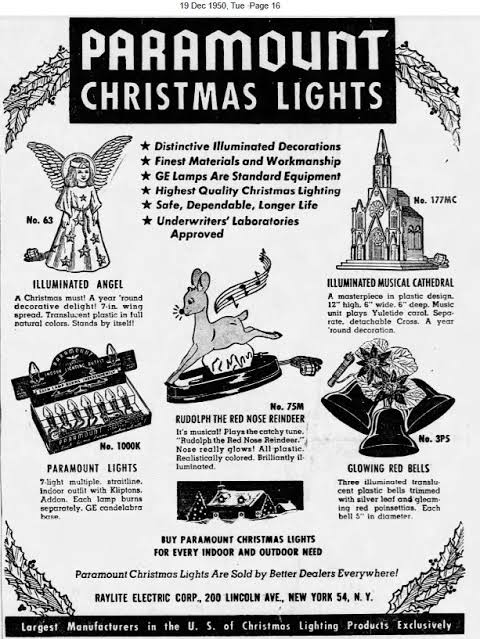
In other words, Raylite was not a minor workshop accidentally producing a plastic angel. It participated in an established market for electrical Christmas spectacle.

The Paramount Musical Angel

The large Paramount musical angel, generally dated to approximately 1946, may be one of the most remarkable surviving objects from this transitional era.

An archival Christmas-light reference describes it as an extremely difficult piece to find. The figure could reportedly be used as a night light, a wall plaque or a Christmas-tree topper. It also incorporated a music box that played “Angels We Have Heard on High.” 

That combination is extraordinary:

  • molded translucent imagery;
  • interior illumination;
  • multiple display configurations;
  • electrical construction; and
  • a mechanical music box.

Rather than a simple decoration, it was a small piece of Christmas theater.

A smaller Paramount No. 63 illuminated angel is also known. Because photographs and marketplace descriptions do not always identify models correctly, collectors should be careful not to treat every Raylite or Paramount angel as the same object.

Likewise, the musical angel should not automatically be called a “1950s blow mold.” The best surviving reference places it around 1946, and the manufacturing process has not yet been conclusively documented in the archival material I have located.

Collectors sometimes describe the angel as vacuum formed, and its plaque-like design makes that interpretation plausible. But plausibility is not proof. Until an original catalog, packaging description, factory document or close physical examination establishes the method, the safest description is:

A circa-1946 Paramount/Raylite illuminated molded-plastic musical angel, often described by collectors as vacuum formed.

Vintage 1950s Paramount Raylite Musical Angel Light

That wording respects both the available evidence and the limits of what we currently know.

Why Early Plastic Is So Often Misidentified

Part of the confusion comes from the vocabulary used to describe old plastics.

“Celluloid” is frequently applied to any thin, yellowed or brittle vintage plastic. Yet historical Christmas-light researchers warn that many decorations identified as celluloid are actually other types of hard plastic. Age, heat from incandescent bulbs and decades of storage can discolor and embrittle several different materials. 

Visual inspection alone may not establish whether an old decoration is cellulose nitrate, cellulose acetate, polystyrene or another resin. Misidentification then spreads from an auction listing to a social-media post and eventually becomes accepted collector lore.

The same thing happens with manufacturing terminology. A hollow-looking decoration becomes a blow mold. A thin decoration becomes vacuum formed. A visible line becomes proof of a two-piece blow mold.

Those clues are useful, but they are not always decisive.

A responsible identification may require examining the back, edge profile, material thickness, trim marks, joints, lamp opening, embossed markings and tool seams. Even then, laboratory material identification or original factory literature may be necessary.

Raylite’s Later Molded-Plastic Patents

Raylite continued developing illuminated molded-plastic decorations into the 1950s.

One especially relevant design patent is Abraham Abramson’s “Illuminable Christmas Plaque,” assigned to Raylite Electric Corporation. It was filed on April 16, 1956, and patented on October 29, 1957. Related Raylite plaque designs appeared during the same period. 

These patents help establish continuity between Raylite’s 1940s illuminated novelties and the plastic plaques of the later 1950s. However, a design patent primarily protects appearance. It should not automatically be read as a technical description of how the object was formed.

What the patents prove is that Raylite remained deeply invested in illuminated molded-plastic seasonal imagery.

That alone makes the company important to blow-mold history—even when a particular Raylite product was not technically blow molded.

When the Familiar Christmas Blow Mold Arrived

The outdoor polyethylene Christmas figure recognizable to modern collectors appears to have emerged during the late 1950s and early 1960s rather than the 1940s.

Beco Products, associated with Bernard Edward Company, was already making plastic decorations during the 1950s. Collector research commonly credits Beco with some of the earliest fully three-dimensional consumer Christmas blow molds, including a Santa-and-sleigh display generally dated to the early or mid-1960s. Period retail evidence places comparable Beco displays in major catalogs by 1966, although the exact “first” remains difficult to prove. 

Union Products had begun operations in 1947 and initially became known for hard-plastic and injection-molded goods. Designer Don Featherstone created the company’s famous pink plastic flamingo in 1957, a key milestone in molded-plastic lawn décor. 

Empire Plastics, whose history is connected to Carolina Enterprises and the Judith Novelty Sales name, also developed injection-molded and blow-molded seasonal products. Empire ultimately became one of the most recognizable names in American illuminated yard decorations.

Poloron produced especially detailed figures during the 1960s and 1970s, including choir figures and animated displays. General Foam Plastics later acquired numerous molds and continued producing familiar designs long after their original manufacturers disappeared.

These companies did not invent the underlying blow-molding process. Their achievement was adapting mature industrial technology to large, affordable, weather-resistant seasonal figures. Each will be given proper coverage on this website in the days ahead.

The Missing Link Was Not One Machine or One Company

There was no single morning when a factory switched on a machine and invented the Christmas blow mold as we know it.

The tradition developed through several overlapping histories:

  1. Glassblowing supplied the basic principle of expanding material inside a mold.
  2. Nineteenth- and early-twentieth-century plastic experiments explored hollow molded forms.
  3. Bottle manufacturers commercialized modern plastic blow molding during the late 1930s and 1940s.
  4. Electrical Christmas companies such as Raylite established a market for illuminated molded-plastic figures and plaques.
  5. Postwar polyethylene made larger, safer and more weather-resistant decorations practical.
  6. Companies including Beco, Union, Empire and Poloron turned those materials and processes into mass-market lawn décor.

The Raylite angel belongs most securely to the fourth chapter.

It may not be the first true Christmas blow mold. It may not be blow molded at all. Yet it represents something historically essential: the desire to transform a molded plastic holiday figure into a glowing presence inside the American home.

That idea predates the classic polyethylene Santa—and helps explain why the Santa was so readily embraced when he finally arrived.

Why the Dispute Is Good for the Hobby

Collectors should not fear disputes over dates, materials or processes. A healthy challenge can move the hobby away from repetition and closer to documented history.

In writing The Glow That Won’t Go Out, I have tried to preserve the stories surrounding these decorations. Preservation, however, also means remaining willing to refine those stories when patents, catalogs, advertisements, packaging or factory records provide stronger evidence.

The most useful approach is to label information honestly:

  • Documented: supported by an original patent, trademark, catalog, advertisement or marked object.
  • Corroborated: supported by multiple reliable secondary sources or surviving examples.
  • Collector attribution: widely repeated but not yet proven by primary documentation.
  • Working theory: a reasonable interpretation that remains open to correction.

Using those distinctions does not diminish the magic. It gives the objects a history strong enough to survive beyond any one book, website or collection.

The Angel’s Place in the Story

The Paramount/Raylite musical angel deserves its “holy grail” reputation because of its rarity, ingenuity and beauty.

Its importance does not depend on proving that it was the first blow mold.

It stands at the threshold between the intimate electric novelties of prewar and immediate-postwar Christmas and the large illuminated plastic figures that eventually conquered the American lawn. It combines religion, domestic light, music, molded plastic and mechanical novelty in one remarkable object.

The angel reminds us that the history of blow molds began before the objects we now call blow molds.

Long before Union’s flamingos, Empire’s Santas or Poloron’s choir children, manufacturers were already trying to make Christmas glow through plastic. The techniques changed. The materials improved. The figures grew larger and moved outdoors.

But the idea was already shining.

—Curtiss Wayne Andrews, author of The Glow That Won’t Go Out

Every Blow Mold Deserves Another Holiday: Inside Tony DePasquale’s Mission to Save Vintage Christmas

The owner of BlowMolds.com has nearly 1,000 blow molds, hundreds of replacement parts—and an ambitious idea for what 3D printing could mean for the future of the hobby.

By Curtiss Wayne Andrews

There is a particular heartbreak known only to blow mold collectors.

You find it.

Maybe it’s buried behind a stack of artificial Christmas trees at an estate sale. Maybe it appears on Facebook Marketplace at 6:14 on a Saturday morning. Maybe you spot it sitting forlornly at the back of an antique mall booth.

It’s old.

It’s beautiful.

It’s exactly what you’ve been looking for.

And it’s missing its nose.

Or an antler.

Or an ear.

Or a candle flame.

Or one of those maddeningly specific little plastic pieces that disappeared sometime during the Reagan administration.

Twenty years ago, that might have been the end of the story.

Today, there’s a good chance Tony DePasquale can help.

The Man Behind BlowMolds.com

When I was researching The Glow That Won’t Go Out: The Complete Collector’s Guide to Vintage Holiday Blow Molds, I wanted the book to be about more than identifying old Empire Santas or determining whether a snowman was made by General Foam.

The bigger story was why these things are still here.

Because that’s what’s remarkable about blow molds.

They’re survivors.

They spent decades outside in December weather. They were dragged into attics, basements and garages every January. They were dropped, faded, cracked, scratched and occasionally subjected to the questionable repair techniques of somebody’s grandfather armed with duct tape and tremendous self-confidence.

Yet collectors keep bringing them back.

That led me to Tony DePasquale of New Brunswick, New Jersey, owner of BlowMolds.com by GNK Collectibles.

I featured Tony and his work in The Glow That Won’t Go Out because he’s part of a fascinating development in the hobby: modern technology is now helping preserve decorations created decades before that technology existed.

At BlowMolds.com, missing pieces can be recreated using 3D printing. The current catalog includes everything from noses, flames and antlers to lantern components, light plates, adapters, windows and other remarkably specific pieces. The company makes clear that these are aftermarket replacements rather than original-manufacturer parts. 

Tony’s philosophy can be reduced to one perfect sentence:

“Every Blow Mold Deserves Another Holiday.”

After featuring his story in the book, I wanted to go back and ask him more.

Not simply about replacement parts.

I wanted to know how someone ends up with around 1,000 blow molds, what he’s learned trying to recreate pieces manufacturers stopped producing decades ago—and whether 3D printing might eventually move from repairing vintage blow molds to actually creating them.

Here’s our conversation.


A Conversation With Tony DePasquale of BlowMolds.com

When did your fascination with blow molds begin? How big is your collection, and do you have any favorites?

Tony DePasquale: My love of Christmas displays goes back to childhood. Christmas was huge in my family: we went caroling, held family parties, and my father played Santa Claus.

I even proposed to my wife, Michelle, on Santa’s lap—with my father playing Santa. Michelle and I have been married for 33 years.

My blow mold collecting really took off when I answered a Craigslist listing for a few vintage pieces. The seller mentioned he had about 30 more in his shed, and I ended up bringing those home too.

Today, I have around 1,000 blow molds.

The Empire train is one of my favorites because I’ve always loved trains.

From 30 Blow Molds to 1,000

There may not be a more authentic blow mold collecting origin story than going to someone’s house for a few decorations and leaving with the contents of the shed.

Collectors understand how this happens.

You start with a Santa.

Then Santa looks lonely.

So you need Mrs. Claus.

Then perhaps a snowman.

Obviously the snowman needs some carolers.

Then you discover Empire made a train.

Several years later, you’re explaining to a perfectly reasonable person why your property now contains three storage buildings filled with illuminated polyethylene.

Thirty becoming 1,000 somehow makes perfect sense.


How did you come to own BlowMolds.com, and what is the store’s primary mission?

Tony: I first connected with GNK Collectibles when I needed replacement fawn ears for my own collection. That led to my helping produce replacement parts, and I eventually bought the business. I now operate BlowMolds.com through GNK Collectibles.

Our mission is summed up by our motto: “Every Blow Mold Deserves Another Holiday.”

A missing nose, ear, light plate, or other small piece shouldn’t mean the end of a decoration someone has loved for decades. We make replacement parts to help people put those pieces back on display.

That mission is evident in the site’s current catalog. Replacement parts span numerous manufacturers and styles, including highly specific components such as TPI reindeer antlers, General Plastics lantern panels and Empire/General Foam sleigh runners. 

And this is where Tony’s work intersects with the larger story I wanted to tell in The Glow That Won’t Go Out.

Preservation doesn’t always mean keeping something 100% original. Sometimes preservation means making it usable again.

A Christmas decoration sitting broken in an attic isn’t preserving much of anything.

Put its nose back on, install a light and place it in the yard?

Now somebody’s kid gets to remember it.

That’s how traditions survive.


Did you have 3D-printing experience before opening the store? What have been the biggest challenges?

Tony: I was already helping produce replacement parts on 3D printers before I bought the business.

The biggest challenge has been learning hundreds of parts and making sure each one fits the right blow mold. There can be differences between pieces that look nearly identical, so I pay close attention to photos, measurements, and customer feedback.

I don’t paint the parts. I print them in different colors of filament to get the color they need.

I also make vinyl stickers and made-to-order holiday signs.

This is an important detail for collectors.

A replacement isn’t necessarily as simple as saying, “I need a reindeer antler.”

Which reindeer?

Which manufacturer?

Which production variation?

How does it attach?

Tony’s current tabletop reindeer listings, for example, distinguish between Union and Poloron versions because their attachment systems differ. 

That’s restoration becoming detective work.


Are parts from certain manufacturers harder to replace than others?

Tony: The difficulty often comes down to the individual part rather than the manufacturer.

Some pieces have unusual shapes, attachment points, or variations between production runs. Photos and measurements help us identify the right version, and sometimes a customer’s feedback helps us refine the fit.

That’s something collectors should remember before ordering any replacement part.

Don’t assume.

Document.

Photograph the mold.

Photograph the attachment point.

Look for markings.

Measure the opening.

The difference between a replacement that works and one that doesn’t can come down to a surprisingly small detail.


Could 3D Printing Eventually Create the Blow Mold Itself?

This was the question I really wanted to ask Tony since about 6 years ago I met with a 3D printing company in Costa Mesa, CA to try and figure out how to make blow mold Christmas ornaments (which Mr. Christmas is now manufacturing and selling at Walmart for just $5.97 a piece).

Replacement noses and antlers are one thing.

But once you can digitally model missing components, an obvious question follows:

How far can this technology go?

Have you considered 3D printing an entire blow mold? Could it work?

Tony: Yes, and I’m working on something along those lines.

I’m interested in recreating smaller vintage pieces and making miniature versions of larger ones.

I’ve spent hours researching who owns the copyrights and trademarks for different designs, including whether some trademarks were ever registered. The history can be complicated, especially with pieces dating back to the 1960s and 1970s, so I’m taking my time with it.

Let’s just say you never know what might be 3D printed next.

Now that is interesting.

We’re watching two eras of plastic manufacturing collide.

The classic blow molds collectors love were products of industrial manufacturing: molds, machinery, production lines and companies capable of manufacturing thousands of decorations.

3D printing changes the economics.

It potentially makes extremely small production runs—and highly specialized replacement components—possible in ways that wouldn’t have made economic sense during the industry’s original era.

That doesn’t mean someone can simply reproduce any vintage design they choose; intellectual-property questions matter, exactly as Tony notes.

But the broader possibility is fascinating:

Could technology developed decades after the golden age of blow molds help keep the aesthetic alive?

We’re already watching the first part of that happen.


Tony’s Advice: Inspect Your Blow Molds Before Christmas

If you’re reading this with a garage full of Christmas plastic, Tony has another recommendation:

Don’t wait until December.

What advice would you give collectors about blow mold maintenance?

Tony: Check your blow molds before the holiday season, while there’s time to find or order anything missing.

Store them carefully, keep track of loose accessories, and avoid forcing a replacement part into place if it doesn’t fit.

Keep them in a dark storage space.

Sunlight is the enemy of blow molds, more so than heat.

If you need help identifying a part, send clear photos of the entire blow mold, the area where the part attaches, and any manufacturer markings.

Measurements of the opening or attachment point are especially helpful.

That’s particularly good advice heading into fall.

Replacement parts aren’t necessarily warehouse items sitting on a shelf waiting to ship. BlowMolds.com says its parts are printed to order, with current typical lead times around 7–10 days and potentially longer waits during busy periods. 

So September and October are much better times to discover Rudolph is missing an antler than December 18.

Tony’s site also publishes specific handling recommendations for 3D-printed parts, including guidance about bulbs, adhesives, drilling, heat and storage. 

Before You Put Up Your Display This Year

Tony’s advice inspired a checklist I’d recommend to any collector:

  1. Inventory your blow molds. Make sure everything you expect to have is actually there.
  2. Check removable parts. Look for noses, antlers, flames, lantern tops, signs and light plates.
  3. Inspect attachment points. Don’t force a replacement into brittle vintage plastic.
  4. Photograph unidentified damage. Get wide shots, close-ups and manufacturer markings.
  5. Take measurements. Especially openings, slots and attachment points.
  6. Test lighting before decorating day. Discovering a problem in the garage beats discovering it on a ladder.
  7. Limit unnecessary sunlight during storage. Tony specifically identifies sunlight as a major enemy.
  8. Order replacements early. Holiday repair season is not the time to discover you need an obscure 40-year-old plastic nose.

And when in doubt?

Ask someone who has approximately 999 more blow molds than a normal person.


This Is Why the Glow Won’t Go Out

When I chose the title The Glow That Won’t Go Out, I wasn’t simply talking about a light bulb inside a piece of molded plastic.

I was talking about persistence.

Companies disappeared.

Factories closed.

Molds were destroyed, sold or forgotten.

Christmas decorating changed.

Inflatables arrived.

LEDs arrived.

Tastes changed.

And still, every November and December, thousands of these old plastic Santas, snowmen, candles, angels, reindeer and Nativity figures emerge from garages and basements and light up again.

Why?

Because people keep caring about them.

Collectors rescue them.

Families inherit them.

Restorers repair them.

And people like Tony DePasquale figure out how to manufacture the tiny missing piece that allows something made half a century ago to survive another Christmas.

Tony’s motto gets the entire philosophy exactly right:

Every blow mold deserves another holiday.

I’d add only one thing.

Every time somebody repairs one and puts it back outside, they’re not merely saving an old decoration.

They’re preserving somebody’s Christmas memory.

And that’s ultimately what The Glow That Won’t Go Out is about.


Meet More of the People Keeping the Glow Alive

Tony DePasquale and the work of BlowMolds.com are featured in The Glow That Won’t Go Out: The Complete Collector’s Guide to Vintage Holiday Blow Molds by Curtiss Wayne Andrews.

The book explores the history, manufacturers, identification, collecting, restoration and enduring appeal of the glowing plastic decorations that became part of the American Christmas landscape—and the collectors helping ensure they don’t disappear.

For replacement parts or help identifying a missing component, visit BlowMolds.com.

Before Amazon, There Was the Wish Book: How Sears Helped Put Blow Molds on America’s Front Lawns

Long before online auctions and Facebook Marketplace, one enormous Christmas catalog helped turn glowing plastic Santas, snowmen and candles into American holiday traditions.

There was a time when Christmas arrived in the mail.

Not in a cardboard box.

Not with a tracking number.

And definitely not in a padded envelope containing something you ordered at 11:47 p.m. because your phone told you there were “ONLY 3 LEFT.”

Christmas arrived as a book.

A very big book.

For generations of American families, the appearance of the Sears Christmas catalog—the legendary Wish Book—meant the holiday season had unofficially begun.

Children went straight for the toys.

Dad found the tools.

Mom looked at clothes, housewares and gifts.

And somewhere among hundreds of pages of merchandise were the things that would eventually become irresistible to another group entirely:

future collectors.

Toy trains.

Barbie dolls.

Slot-car sets.

Bicycles.

Christmas ornaments.

And, of course…

those wonderful illuminated plastic figures that would eventually become known simply as blow molds.

Today, collectors might spend hours searching estate sales, antique malls, Marketplace listings and online auctions for an old Empire Santa or vintage plastic candle.

But decades ago?

You could simply open the Sears catalog.

And that catalog helped change the American Christmas landscape.

Before the Wish Book Was the Wish Book

Sears had been helping Americans shop by mail long before anyone called its Christmas catalog the Wish Book.

The company’s catalog roots date to the late 1880s. By the 1890s, Sears was offering an astonishing range of merchandise by mail, eventually creating what amounted to a department store delivered directly to the customer’s home. 

Christmas merchandise arrived surprisingly early in that story.

The 1896 general catalog offered wax candles for Christmas trees. Christmas cards appeared by 1898. Tree ornaments arrived in 1900, artificial Christmas trees and stockings by 1910, and electric Christmas-tree lights by 1912. 

Then, in 1933, Sears issued its first dedicated Christmas Book.

It was just 87 pages.

Inside were toys and gifts that sound like somebody emptied an antique store onto a catalog page: Lionel trains, a Mickey Mouse watch, a battery-powered toy automobile, fruitcakes, chocolates—and even live singing canaries. 

Yes.

You could apparently order a bird for Christmas.

Amazon still hasn’t topped that.

Customers had already informally referred to Sears catalogs as “Wish Books” or “Books of Wishes,” but Sears officially put Wish Book on its Christmas catalog in 1968. By then, it had become enormous: the 1968 edition ran 605 pages, including 225 pages of toys and 380 pages of adult gifts. 

But the significance of those pages went far beyond shopping.

Sears Didn’t Just Sell Christmas. It Showed America What Christmas Could Look Like.

This is where the story intersects with blow molds.

It’s difficult today to appreciate the cultural power of a national catalog.

There was no Pinterest.

No Instagram.

No Amazon recommendations.

No YouTube video called:

“10 CHRISTMAS YARD DECOR TRENDS YOU NEED IN 1967!!!”

For millions of households, catalogs were discovery engines.

They showed you things you didn’t even know existed.

And when an illuminated plastic Santa, snowman, candle or Nativity figure appeared among the Christmas merchandise, Sears wasn’t merely providing a way to purchase it.

Sears was putting the idea in your head.

Imagine being a child paging through a Christmas catalog in the 1960s.

There’s Santa.

But this Santa is different.

He’s three-dimensional.

He’s colorful.

He lights up.

And apparently he can stand outside your house.

You don’t need to know the term blow molding.

You don’t need to know who manufactured it.

You don’t need to understand polyethylene.

You know only one thing:

WE NEED THAT SANTA.

That is how traditions begin.

The Catalog Was the Original Algorithm

Today, Amazon learns what you like.

Search for one vintage Christmas decoration and suddenly the internet decides:

Excellent. This person would like to see illuminated plastic snowmen until death.

The Sears Wish Book accomplished something remarkably similar without tracking cookies.

You opened the catalog looking for one thing.

Then you discovered another.

A train set led to a slot-car set.

A doll led to a dollhouse.

Christmas lights led to lawn decorations.

And one illuminated Santa could lead to a snowman.

Then candles.

Then a Nativity.

Then a choir boy.

Then another Santa because apparently the first Santa was lonely.

Congratulations.

You have accidentally started a collection.

There’s real collector testimony behind that idea. Collector and writer Carrie Polales Sansing has recalled looking through Sears Wish Books and JCPenney holiday catalogs with her mother in the mid-1960s while deciding which decorations to add to their growing Christmas display. She remembered repeatedly being drawn to the same type of decoration: plastic figures that lit up.

That’s a small memory that explains something much bigger.

Catalogs didn’t merely distribute products.

They created desire, repetition and tradition.

From Product to Family Tradition

Suppose your parents ordered a glowing Santa in 1969.

Every December, Dad brought Santa down from the attic.

You watched him untangle the cord.

Santa went beside the front steps.

Christmas officially began.

1968.

1969.

1970.

1971.

Year after year.

Eventually, Santa wasn’t simply something Sears sold.

He was your family’s Santa.

That’s the emotional transformation at the heart of vintage holiday collecting.

Mass-produced objects become intensely personal.

A plastic decoration that rolled off an assembly line alongside thousands of identical pieces somehow becomes:

the Santa that stood outside Grandma’s house.

the candles that flanked the front door.

the Nativity Dad assembled every December.

the snowman you could see glowing through your bedroom window.

The catalog got the object into the house.

Time turned it into an heirloom.

And Sears Was Doing This With Almost Everything

That’s why the Wish Book matters beyond blow molds.

Look at many of today’s collecting categories and you’ll find fingerprints from the great catalog era.

Lionel trains appeared in the very first 1933 Christmas Book. 

Across subsequent decades, catalogs presented Americans with toys, sporting goods, clothing, appliances, electronics, musical instruments and countless other products. Sears itself later described its catalogs as a kind of historical record of changing American desires and habits, and researchers have used them to trace everything from fashions and home furnishings to sporting equipment. 

That’s exactly why old catalogs have become so valuable to collectors today.

They answer questions.

What year was this sold?

What did it originally cost?

Was this color available?

Was it sold as a set?

What accessories came with it?

What did the manufacturer originally call it?

For a collector, an old catalog isn’t merely nostalgia.

It’s evidence.

The Wish Book Helped Create Tomorrow’s Collectors

There’s another fascinating part of this story.

Children didn’t have purchasing power.

But they had something retailers understood almost as well:

circles.

A child could sit on the living-room carpet with a pen and create a surprisingly sophisticated fourth-quarter procurement strategy.

Circle.

Circle.

Huge circle.

Arrow.

Three stars.

“THIS ONE.”

Parents learned exactly what their children wanted.

And those children remembered.

Decades later, the toys and objects we wanted but couldn’t have often became the things we collected when we finally had disposable income.

The train.

The action figure.

The doll.

The bicycle.

The lunchbox.

The Christmas decoration.

Collecting is often nostalgia with a checking account.

And the Wish Book supplied an enormous amount of the nostalgia.

Why Old Catalog Pages Matter So Much to Blow Mold Collectors

For today’s blow mold collector, vintage catalogs provide something memory can’t always supply:

context.

Finding an old Santa at an estate sale is exciting.

Finding that same Santa pictured in a period catalog?

Now you can see him as shoppers originally saw him.

Maybe he was photographed beside coordinating candles.

Maybe several figures were offered together.

Maybe the catalog reveals an original price.

Maybe the description provides dimensions.

Maybe a tiny detail helps distinguish one production era from another.

That turns a decoration into an artifact.

And that’s one reason old catalogs, advertisements, manufacturer literature and photographs are so important when researching blow mold history.

They’re breadcrumbs.

They help us reconstruct an industry that nobody imagined we’d someday be studying this closely.

Because remember:

These weren’t created as collectibles.

They were Christmas decorations.

People put them outside.

Snow fell on them.

Rain hit them.

Sun faded them.

Children knocked them over.

Dogs investigated them.

Parents shoved them into attics.

Garages baked them every summer.

Extension cords were lost.

Bulbs burned out.

Paint disappeared.

And somehow…

they survived.

The Catalog Era Helped Make Blow Molds National

This may be the Sears Wish Book’s greatest contribution to the story.

A regional store can create a local trend.

A national catalog can create a national visual language.

Families separated by hundreds or thousands of miles could encounter similar holiday merchandise.

The glowing plastic Santa wasn’t limited to one department store window in one town.

Catalog distribution gave products enormous geographic reach.

The same basic style of illuminated holiday figure could become familiar in neighborhoods across America.

And when enough houses displayed them, they stopped looking novel.

They started looking like:

Christmas.

That’s an extraordinary transition.

Plastic became nostalgia.

Manufacturing became tradition.

Commerce became memory.

Sears Wasn’t Alone

Of course, Sears wasn’t the only catalog helping build this world.

JCPenney and Montgomery Ward holiday catalogs also brought merchandise directly into American homes. Collector memories specifically connect Sears and JCPenney catalogs with discovering illuminated plastic Christmas decorations. 

Together, these catalogs functioned almost like annual snapshots of American consumer culture.

Today we scroll.

Then, we turned pages.

And unlike a webpage that disappears when someone redesigns a site, those pages remained tucked inside closets, basements and attics.

Which is why a fifty-year-old catalog can now help identify a fifty-year-old decoration.

Then the Catalog Disappeared

Sears discontinued its famous general “Big Book” catalog in 1993, closing an era of American retail that had begun more than a century earlier. 

The timing almost seems symbolic.

Two years later, Amazon shipped its first book. 

One shopping revolution was ending.

Another was beginning.

Today, finding a blow mold is easier in one sense.

Search.

Click.

Buy.

A collector in California can discover a decoration in Ohio before breakfast.

But something was lost along the way.

The anticipation.

The discovery.

The shared catalog sitting on the coffee table.

The folded corners.

The circled toys.

The handwritten notes.

The page you returned to twenty times because you wanted to make absolutely sure Santa understood.

And That’s Why We Still Care

This is one of the themes running throughout The Glow That Won’t Go Out.

Blow molds aren’t interesting merely because they’re old plastic decorations.

They’re interesting because they sit at the intersection of manufacturing history, retail history, holiday tradition and personal memory.

Companies manufactured them.

Retailers distributed them.

Catalogs introduced them.

Families adopted them.

Children remembered them.

Collectors rescued them.

And now, decades later, we’re trying to piece the story back together.

That old Sears Wish Book in Grandma’s living room probably wasn’t treated like an important historical document.

It was just the Christmas catalog.

That glowing Santa wasn’t an artifact.

It was just the thing Dad plugged in by the front porch.

Nobody knew anyone would care fifty years later.

But we do.

And maybe that’s the real reason these decorations refuse to disappear.

The companies changed.

The catalogs vanished.

The department stores faded.

The original price tags were thrown away.

But somewhere tonight, another collector will plug in an old plastic Santa.

The bulb will flicker on.

The faded red plastic will begin glowing.

And for just a second, Christmas will look exactly the way someone remembers it.

That’s the glow that won’t go out.


KEEP THE GLOW ALIVE

The Glow That Won’t Go Out explores the history, manufacturers, designs, collectors and cultural story behind the vintage holiday blow molds that once illuminated America’s front lawns—and are now being rediscovered by a new generation.

From the golden age of companies such as Empire, General Foam and Union Products to identification, restoration, displaying and the hunt itself, the book tells the story behind decorations that became far more important than anyone expected.

Because sometimes an old piece of plastic isn’t just an old piece of plastic.

Sometimes it’s Christmas at Grandma’s house.