From Leominster’s plastics boom to Don Featherstone, the Pink Flamingo and generations of glowing Santas, snowmen and holiday icons, Union Products helped turn molded plastic into American nostalgia.
By Curtiss Wayne Andrews
If you collect vintage blow molds long enough, certain names stop sounding like manufacturers and start sounding like family names.
General Foam.
Beco.
Poloron.
And then there is Union Products.
For many collectors, finding UNION PRODUCTS — LEOMINSTER, MASS. molded into the bottom of a decoration is enough to make them turn it over for a second look.
There’s a reason.
Union wasn’t merely another company that happened to manufacture plastic Christmas decorations.
It existed in one of the most important places in the history of American plastics. It employed one of the medium’s most famous designers. It produced decorations that ranged from Christmas and Halloween to lawn-and-garden absurdity. And one Union creation escaped the category entirely to become one of the most recognizable objects in American popular culture.
The Pink Flamingo.
But reducing Union Products to the flamingo is a little like reducing Disney to Mickey Mouse.
Technically understandable.
Wildly incomplete.
For readers of The Glow That Won’t Go Out—and collectors trying to understand why Union pieces remain so beloved—it’s worth going back to Leominster and telling the larger story.
Because before plastic Christmas decorations became nostalgic…
plastic itself was the future.
Before Union Products, There Was “Plastic City”
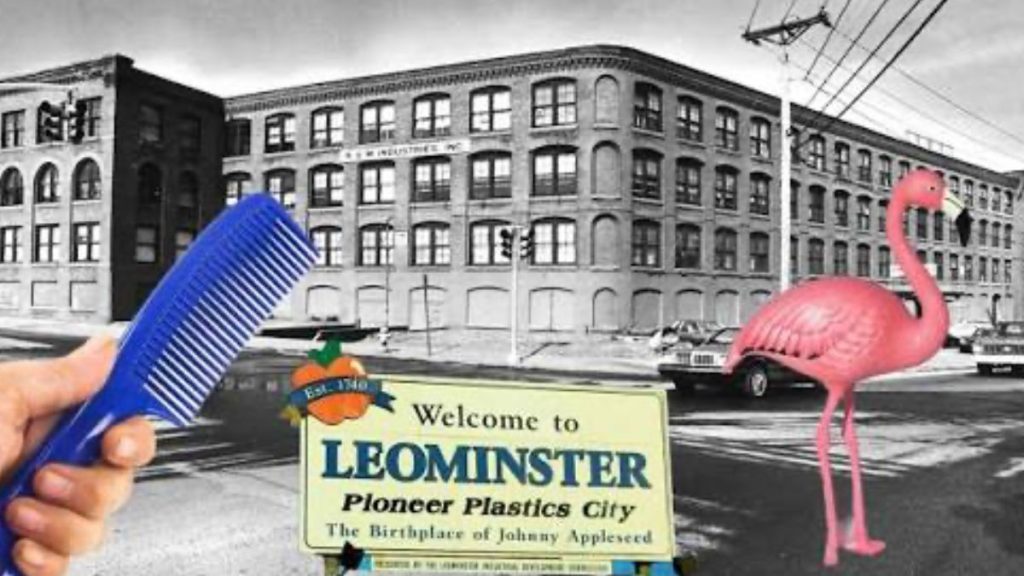
To understand Union, you first have to understand Leominster, Massachusetts.
Union didn’t randomly appear there.
Leominster had already spent generations becoming a manufacturing center. The area was initially famous for comb production, first using natural materials such as horn. The arrival of celluloid transformed the industry, and Leominster increasingly became associated with plastics manufacturing.
By the time Don Featherstone joined Union in 1957, Leominster reportedly had roughly 60 plastics factories employing about 5,500 people—around 80 percent of the city’s workforce.
Think about that.
Today we look at an old plastic Santa and see nostalgia.
Leominster once looked at plastic and saw industry.
Jobs.
Factories.
Innovation.
Injection molding.
New materials.
New ways of mass-producing consumer goods.
This was an ecosystem, and Union Products grew out of it.
Historical accounts generally date the company’s beginning to the mid-1940s; collector references commonly cite 1946, while the Journal of Antiques and Collectibles dates the beginning of operations to 1947. That small discrepancy is worth acknowledging rather than pretending the surviving record is perfectly uniform.
Initially, Union produced hard-plastic injection-molded goods and flat plastic lawn decorations before increasingly embracing three-dimensional molded forms.
And that transition would change everything.
Enter Don Featherstone
If Union Products has a central character, it is Donald Featherstone. I write about him in more detail here.
Featherstone was born in Worcester, Massachusetts, in 1936 and studied art at the Worcester Art Museum School. Soon after finishing school, he took a job at Union.
Imagine that career transition.
You study sculpture and art.
You graduate.
And your professional canvas becomes…
plastic lawn ornaments.
Featherstone later joked about the disconnect himself. But Union needed exactly what an art-school graduate could provide.
The company wanted to move beyond relatively flat lawn decorations and into three-dimensional plastic forms.
That required somebody who could actually sculpt them.
Featherstone’s early assignments included animals. For a duck, he went so far as to obtain a living duck and study it.
Union was essentially combining an old artistic process—observing, drawing and sculpting—with a very modern industrial one.
An artist created the form.
Tooling translated it into a mold.
Plastic manufacturing made it repeatable.
Then thousands of identical sculptures could leave Leominster and land on American lawns.
Fine-art training had met mass-market plastic.
That combination would become Union’s superpower.
And Then Came the Flamingo
In 1957, Featherstone created the object that would forever be attached to his name.
The plastic Pink Flamingo.
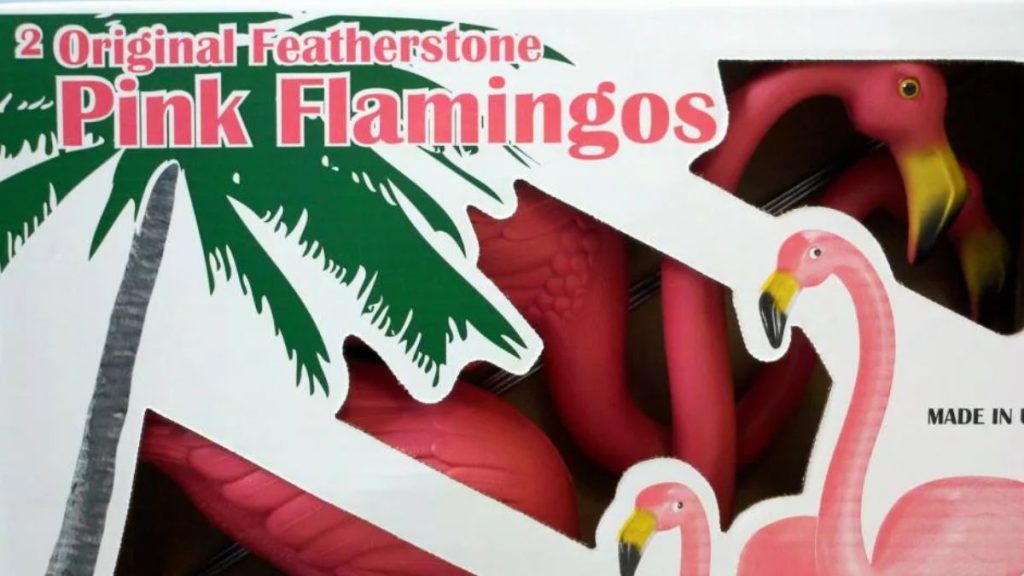
Because finding an actual flamingo wandering around Massachusetts proved somewhat difficult, Featherstone worked from photographs, including imagery published by National Geographic. He sculpted the birds in clay before they were translated into production tooling.
The familiar pair featured two poses:
One upright.
One feeding.
They were unmistakably pink.
They were ridiculous.
They were wonderful.
And America bought them.
Sears carried the flamingos, and contemporary reporting describes early pairs selling for only a few dollars. Millions eventually spread across American lawns.
Something strange had happened.
Union had manufactured a lawn decoration.
America turned it into a cultural symbol.
The Pink Flamingo Became Bigger Than Union
The flamingo eventually came to represent practically everything people loved—or hated—about postwar suburban America.
Artificiality.
Optimism.
Mass production.
Tropical fantasy.
Suburbia.
Kitsch.
Camp.
Bad taste.
Good bad taste.
And eventually nostalgia for all of the above.
The Smithsonian’s National Museum of American History describes Featherstone’s molded-plastic flamingo as evolving from ordinary lawn ornament into one of the best-known icons of American pop-culture kitsch.
That transformation matters to blow mold collectors.
Because the exact same thing eventually happened to the Christmas decorations.
A plastic snowman wasn’t originally manufactured as a collectible.
It was merchandise.
A Santa was something you bought at a store and put beside the front door.
A candle illuminated the porch.
A Nativity went in the yard.
Nobody was putting them into climate-controlled storage because they thought someone would be debating production variations on Facebook fifty years later.
They were inexpensive pieces of popular culture.
Time turned them into artifacts.
Don Featherstone Was Much More Than the Flamingo Guy
This is where Union’s history gets unfairly compressed.
Featherstone didn’t design one bird and spend the next four decades admiring it.
He became extraordinarily prolific.
Published estimates differ depending on what is counted: contemporary sources credit him with more than 600 or 650 designs, while collector literature has placed his output even higher.
By the late 1990s, Union itself reportedly offered more than 200 varieties of plastic yard art, including numerous Santas and other seasonal figures.
And that variety is central to understanding Union.
The company wasn’t simply making Christmas decorations.
Its catalogs encompassed Christmas, Halloween, Thanksgiving, Valentine’s Day, St. Patrick’s Day and Independence Day, along with planters, animals and other lawn-and-garden pieces.
Union was manufacturing a plastic version of the American calendar.
Christmas, Union Style
For today’s blow mold collector, this is where the company becomes especially interesting.
Union’s holiday output included the kinds of forms that now define vintage blow mold collecting:
Santas. Snowmen. Candles. Carolers. Nativity figures. Angels. Soldiers. Elves. Animals. Seasonal characters and yard decorations.
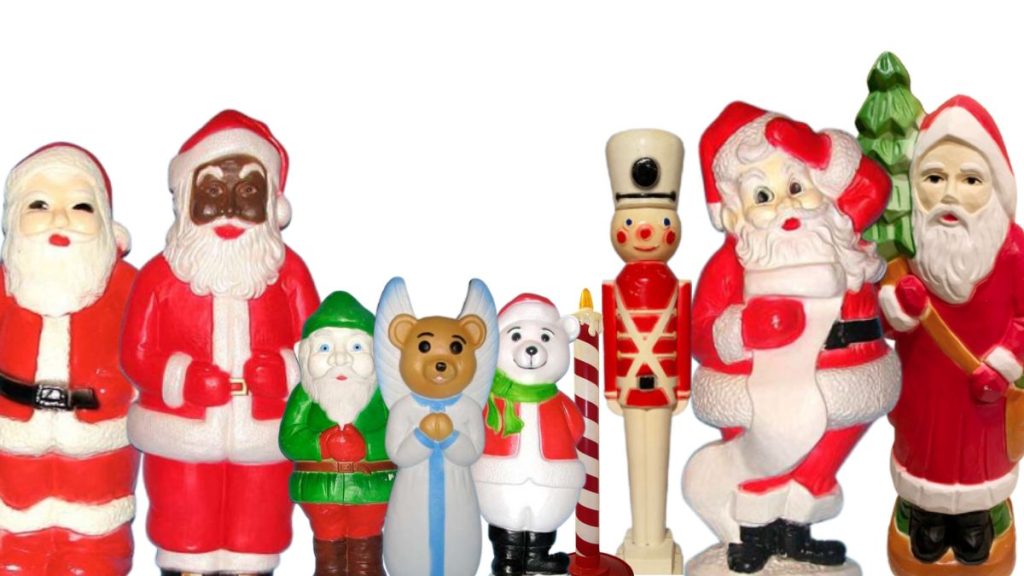
What made many of them memorable wasn’t merely that they illuminated.
It was their personality.
Union’s strongest pieces have faces.
Expressions.
Character.
The sculptural sensibility matters.
Look closely at a good vintage mold and you begin to see that the decoration isn’t simply a hollow plastic shell.
Someone sculpted the folds.
The beard.
The smile.
The buttons.
The eyes.
The posture.
The texture.
That’s why certain molds remain recognizable even when the paint has suffered.
The sculpture is doing much of the work.
And that’s one reason Union remains so respected.
The Christmas Decoration Was Also Industrial Design
It’s easy to romanticize these pieces so much that we forget how they were made.
They were industrial products.
The goal was to manufacture a three-dimensional object efficiently enough that an ordinary family could afford to buy one.
That creates fascinating constraints.
The figure has to look good.
But it also has to release from tooling.
It needs structural integrity.
It needs paint decoration that can be repeated.
If illuminated, light needs to travel through the plastic effectively.
It needs to survive packaging and shipping.
It has to stand properly.
And most importantly:
somebody has to want it badly enough to take it home.
This is where blow molds become a particularly interesting intersection of sculpture, manufacturing and retail design.
Union excelled at that intersection.
Why Union Pieces “Glow” So Well
Collectors often talk about the appearance of vintage blow molds when illuminated.
There isn’t one universal Union formula—materials, thicknesses, paints and manufacturing practices varied across products and eras—but older blow molds can have a visual character that modern collectors immediately recognize.
The light isn’t simply sitting on the surface.
It’s inside the sculpture.
The plastic becomes the diffuser.
Painted details sit over illuminated polyethylene.
A Santa that looks slightly odd in daylight can suddenly become magnificent after dark.
That transformation is the entire magic trick.
It’s also why photographs rarely capture exactly what collectors love about these things.
You have to see a yard full of them glowing.
Halloween Before Halloween Became an Industry
Union’s importance isn’t limited to Christmas. Remember Hope‘s “holy grail” piece – the Featherstone “Happy Halloween” jack o’lantern.
Vintage Halloween blow molds have become a collecting category unto themselves, and Union participated in a much broader seasonal catalog that included Halloween decorations. Collector histories document everything from ordinary seasonal forms to decidedly strange creatures and characters.
And vintage Halloween has something Christmas doesn’t.
Scarcity of historical merchandise.
For decades, Christmas was the giant decorating holiday.
Halloween merchandise existed, of course, but the enormous seasonal retail machine we know today developed later.
That makes surviving vintage Halloween plastics especially appealing.
Pumpkins.
Witches.
Ghosts.
Black cats.
Haunted imagery.
Oddball characters.
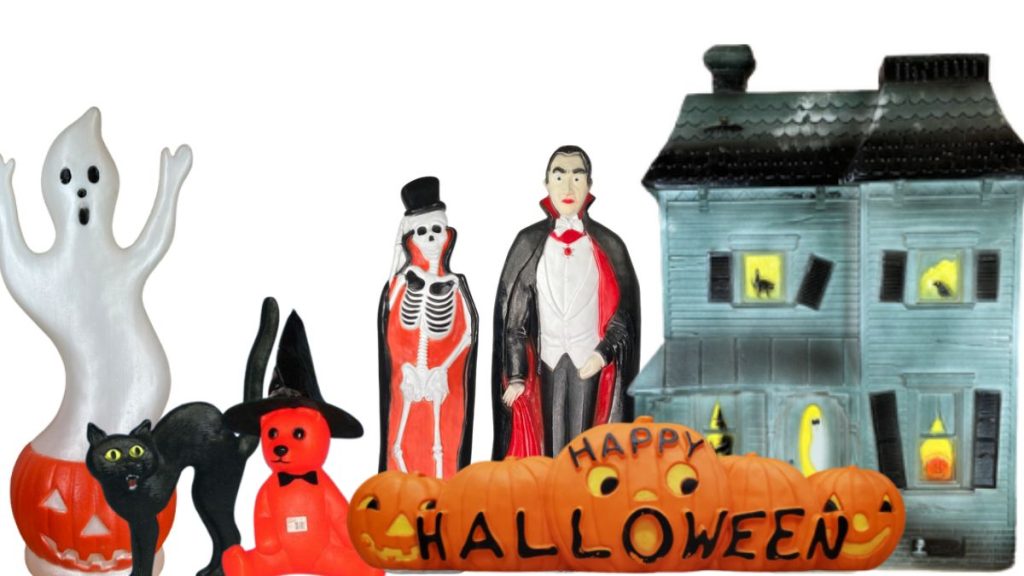
For collectors, the stranger the better.
Union understood strange.
Remember:
this is the company whose greatest contribution to civilization may be putting millions of pink flamingos on people’s lawns.
Not Every “Featherstone” Is a Featherstone
Here’s an important collector distinction.
You’ll sometimes hear people casually refer to Union blow molds as “Featherstones.”
That’s understandable.
But it can be misleading.
Don Featherstone was Union’s extraordinarily important designer and eventually its president and co-owner.
Union Products was the manufacturer.
Not every Union piece should automatically be attributed to Featherstone personally without documentation tying that design to him.
The Journal of Antiques and Collectibles has specifically cautioned collectors about using “Featherstone” as though it were simply another name for all Union molds.
That’s exactly the kind of distinction collectors should preserve.
Manufacturer attribution and designer attribution are not the same thing.
The Signature on the Flamingo’s Rear End
The flamingo offers one of the most entertaining examples of product authentication imaginable.
By the 1980s, knockoffs were everywhere.
So Union needed a way of distinguishing the genuine article.
Around the flamingo’s 30th anniversary, Featherstone’s signature was incorporated into the tooling.
Where?
On the bird.
More specifically…
its rear underside.
Millions of people had bought the flamingo.
Now collectors could flip one over and look for Don’s signature.
It was essentially the plastic lawn-ornament equivalent of an artist signing a canvas.
The signature also became a useful dating clue. Sources generally place signed original Union birds beginning around 1987. The signature was removed after Featherstone’s retirement, prompting enough backlash that the decision became a minor cause célèbre among flamingo enthusiasts.
Imagine designing something so beloved that people protest when your autograph disappears from its plastic butt.
That’s a legacy.
Featherstone Went From Employee to Owner
There’s another part of the Union story I particularly like.
The 21-year-old art-school graduate hired to sculpt plastic animals didn’t remain simply a designer.
Featherstone spent decades with the company.
He rose through its ranks.
And in 1996, Featherstone and two other longtime employees purchased Union Products.
The artist had become an owner.
Eventually he served as president.
Think about the arc:
Art school.
Plastic duck.
Pink flamingo.
Hundreds of designs.
Corporate leadership.
Ownership.
Few people have careers quite like that.
Union Tried to Reinvent Its Greatest Hit
The company didn’t simply freeze the flamingo in 1957.
Union experimented with variations.
There were different colors and special runs.
A Snomingo arrived in the 1990s.
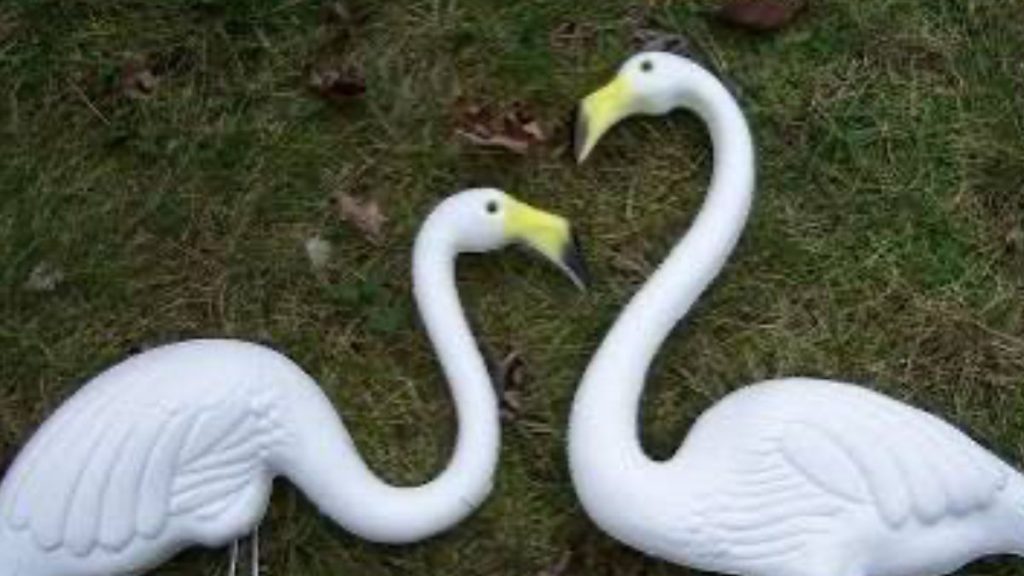
Then came the Realmingo, a larger and more realistic interpretation unveiled in 1998.
Featherstone understood something that today’s blow mold manufacturers are rediscovering:
Nostalgia and novelty can coexist.
Collectors want the familiar.
But they also want something they haven’t seen before.
It’s the same tension running through today’s blow mold revival.
Bring back an old favorite?
People want it.
Create something completely new?
People want that too.
Just don’t mess it up.
Collectors will let you know.
Then the Economics Changed
Union’s story eventually ran into the same forces that reshaped huge portions of American manufacturing.
Competition intensified.
Manufacturing costs changed.
Retail changed.
Imported goods became increasingly significant.
Plastic resin became more expensive.
Energy costs mattered.
And producing bulky, relatively inexpensive plastic lawn decorations in Massachusetts became increasingly difficult economically.
By 2006, Union Products was in trouble.
The company announced that its Leominster operation would close.
Contemporary reports cited rising plastic-resin and electricity costs as well as financial difficulties.
And suddenly the media weren’t merely reporting the closure of a plastics factory.
They were reporting the possible extinction of the Pink Flamingo.
Union ceased production in Leominster in 2006.
An era had ended.
Except Union Didn’t Completely Die
This is where the story gets better.
The tooling survived.
And tooling is everything.
When a manufacturer closes, collectors often assume the product is gone forever.
But if the original molds survive, resurrection remains possible.
After Union’s closure, HMC International acquired rights and tooling and planned renewed flamingo production in New York.
Production later became associated with Cado in nearby Fitchburg, Massachusetts.
Eventually Cado acquired Union Products and its intellectual property/assets, allowing production under the Union name to continue. Cado says the acquisition preserved production of Featherstone’s famous flamingo in the region where it originated.
That makes Union unusual.
The original company closed.
But its identity—and at least part of its manufacturing heritage—survived.
The Flamingos Came Home
There’s something wonderfully appropriate about Cado’s involvement.
Union was born in the Massachusetts plastics ecosystem.
And after a detour through changing ownership, production became rooted again in central Massachusetts.
By 2016, Cado told WBUR it was manufacturing roughly 50,000 to 60,000 pink flamingos annually.
Think about that for a moment.
An object designed by a 21-year-old artist in 1957…
made using a technology that once represented America’s manufacturing future…
mocked for decades as tacky suburban junk…
was still being manufactured nearly sixty years later.
That’s not failure.
That’s immortality in polyethylene.
Why Union Products Remains So Admired
Ask collectors why Union matters and you’ll get different answers.
Some love Featherstone.
Some love the flamingo.
Some collect Santas.
Others want Halloween.
Some are hunting obscure variants.
Some simply remember these pieces from childhood.
But I think Union’s enduring appeal comes down to five things.
First, the sculpting. Many Union pieces have unmistakable personality. They’re decorations rather than merely plastic forms.
Second, variety. Union wasn’t confined to one holiday or one visual language. The company’s catalog became a sprawling universe of lawn and seasonal art.
Third, history. Union is connected to Leominster’s extraordinary plastics-manufacturing heritage.
Fourth, Featherstone. Having a documented artist behind so many mass-market plastic objects gives collectors a human connection that’s often missing from industrial products.
And fifth:
Union made fun things.
That’s easy to underestimate.
Not everything has to be serious. The company created blow molds in the likenesses of The Three Stooges! How can you not love that?
Sometimes you need a glowing Santa.
Sometimes you need a snowman.
Sometimes you need a plastic bird so aggressively pink that your neighbors question your judgment.
Union understood this.
The Difference Between Collectible and Important
There are rare blow molds.
There are expensive blow molds.
There are blow molds collectors desperately want.
But historical importance is a different question.
Union Products matters because its story extends beyond the hobby.
The Smithsonian has preserved Featherstone’s flamingo as an object of American cultural history.
That’s significant.
An inexpensive molded-plastic lawn ornament crossed an invisible line.
It stopped being merely merchandise.
It became Americana.
And that’s ultimately what happened to the best vintage holiday blow molds too.
They became pieces of memory.
Look at the Bottom
This is one reason I tell collectors not to judge an old blow mold only from the front.
Turn it around.
Look underneath.
Search for markings.
Manufacturer names.
Numbers.
Copyright information.
Old electrical openings.
Paint patterns.
Seams.
Construction details.
Because once you know the manufacturers, a random plastic Santa at an estate sale becomes something else.
It becomes a clue.
Union Products. Leominster, Massachusetts.
Now you’re holding a piece connected to one of America’s great plastics-manufacturing cities.
You’re holding something from the same company that gave the world the Pink Flamingo.
You’re holding a survivor from an industry that once employed thousands of people in central Massachusetts.
The decoration hasn’t changed.
Your understanding of it has.
That’s what collecting history does.
The Glow Really Didn’t Go Out
When Union’s Leominster factory closed in 2006, it would have been easy to write the ending there.
Factory closes.
Jobs disappear.
Molds get scattered.
Company becomes a paragraph in manufacturing history.
But that’s not quite what happened.
Collectors kept the pieces.
People kept hunting them.
Featherstone’s work became increasingly celebrated.
The flamingo survived.
Tooling survived.
Production survived.
And the Union name survived.
More importantly, the objects became something their creators probably never anticipated.
Heirlooms.
That plastic snowman Grandma put outside?
Someone wants it.
The Santa your parents bought decades ago?
Someone remembers it.
That weird Halloween figure your neighbor displayed every October?
Someone is searching for one right now.
Union Products manufactured decorations.
Time turned them into memories.
And collectors turned those memories into history.
That’s why Union remains one of the essential names in blow molds.
Not simply because of what the company made.
But because so much of it is still glowing.
Discover More in The Glow That Won’t Go Out
Union Products is only one branch of the much larger story told in The Glow That Won’t Go Out: The Complete Collector’s Guide to Vintage Holiday Blow Molds.
The book explores the history and evolution of blow molding, major manufacturers, identification clues, collecting, restoration and the people keeping this unusual corner of American holiday history alive.
Because the next time you find an old plastic Santa at an estate sale, turn him over.
There may be a story molded into the bottom.