E-BOOK / PAPERBACK & HARDCOVER / AUDIOBOOK OUT NOW!

The Company That Made Plastic Glow: The Complete History of Union Products

From Leominster’s plastics boom to Don Featherstone, the Pink Flamingo and generations of glowing Santas, snowmen and holiday icons, Union Products helped turn molded plastic into American nostalgia.

By Curtiss Wayne Andrews

If you collect vintage blow molds long enough, certain names stop sounding like manufacturers and start sounding like family names.

Empire.

General Foam.

Beco.

Poloron.

And then there is Union Products.

For many collectors, finding UNION PRODUCTS — LEOMINSTER, MASS. molded into the bottom of a decoration is enough to make them turn it over for a second look.

There’s a reason.

Union wasn’t merely another company that happened to manufacture plastic Christmas decorations.

It existed in one of the most important places in the history of American plastics. It employed one of the medium’s most famous designers. It produced decorations that ranged from Christmas and Halloween to lawn-and-garden absurdity. And one Union creation escaped the category entirely to become one of the most recognizable objects in American popular culture.

The Pink Flamingo.

But reducing Union Products to the flamingo is a little like reducing Disney to Mickey Mouse.

Technically understandable.

Wildly incomplete.

For readers of The Glow That Won’t Go Out—and collectors trying to understand why Union pieces remain so beloved—it’s worth going back to Leominster and telling the larger story.

Because before plastic Christmas decorations became nostalgic…

plastic itself was the future.


Before Union Products, There Was “Plastic City”
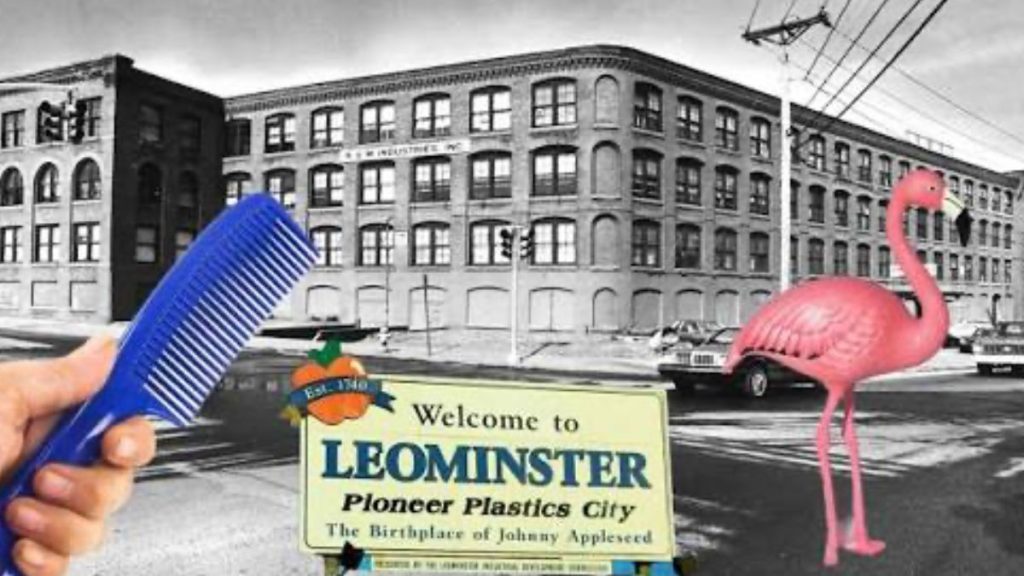
Leominster Massachusetts plastics city, pink flamingo & comb

To understand Union, you first have to understand Leominster, Massachusetts.

Union didn’t randomly appear there.

Leominster had already spent generations becoming a manufacturing center. The area was initially famous for comb production, first using natural materials such as horn. The arrival of celluloid transformed the industry, and Leominster increasingly became associated with plastics manufacturing.

By the time Don Featherstone joined Union in 1957, Leominster reportedly had roughly 60 plastics factories employing about 5,500 people—around 80 percent of the city’s workforce. 

Think about that.

Today we look at an old plastic Santa and see nostalgia.

Leominster once looked at plastic and saw industry.

Jobs.

Factories.

Innovation.

Injection molding.

New materials.

New ways of mass-producing consumer goods.

This was an ecosystem, and Union Products grew out of it.

Historical accounts generally date the company’s beginning to the mid-1940s; collector references commonly cite 1946, while the Journal of Antiques and Collectibles dates the beginning of operations to 1947. That small discrepancy is worth acknowledging rather than pretending the surviving record is perfectly uniform. 

Initially, Union produced hard-plastic injection-molded goods and flat plastic lawn decorations before increasingly embracing three-dimensional molded forms. 

And that transition would change everything.


Enter Don Featherstone

If Union Products has a central character, it is Donald Featherstone. I write about him in more detail here.

Featherstone was born in Worcester, Massachusetts, in 1936 and studied art at the Worcester Art Museum School. Soon after finishing school, he took a job at Union.

Imagine that career transition.

You study sculpture and art.

You graduate.

And your professional canvas becomes…

plastic lawn ornaments.

Featherstone later joked about the disconnect himself. But Union needed exactly what an art-school graduate could provide.

The company wanted to move beyond relatively flat lawn decorations and into three-dimensional plastic forms.

That required somebody who could actually sculpt them.

Featherstone’s early assignments included animals. For a duck, he went so far as to obtain a living duck and study it. 

Union was essentially combining an old artistic process—observing, drawing and sculpting—with a very modern industrial one.

An artist created the form.

Tooling translated it into a mold.

Plastic manufacturing made it repeatable.

Then thousands of identical sculptures could leave Leominster and land on American lawns.

Fine-art training had met mass-market plastic.

That combination would become Union’s superpower.


And Then Came the Flamingo

In 1957, Featherstone created the object that would forever be attached to his name.

The plastic Pink Flamingo.
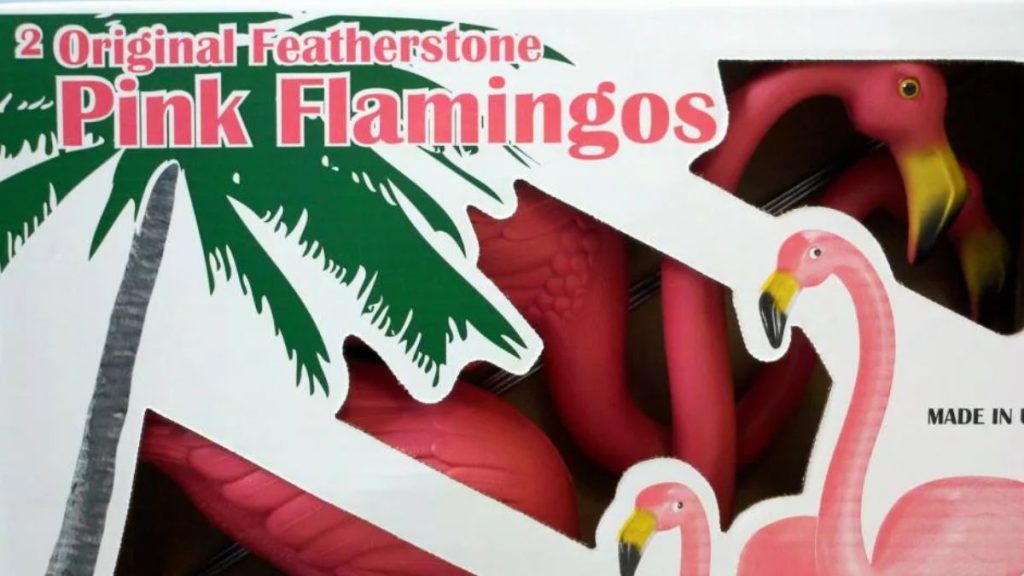
2 Original Featherstone Pink Flamingoes in box

Because finding an actual flamingo wandering around Massachusetts proved somewhat difficult, Featherstone worked from photographs, including imagery published by National Geographic. He sculpted the birds in clay before they were translated into production tooling. 

The familiar pair featured two poses:

One upright.

One feeding.

They were unmistakably pink.

They were ridiculous.

They were wonderful.

And America bought them.

Sears carried the flamingos, and contemporary reporting describes early pairs selling for only a few dollars. Millions eventually spread across American lawns. 

Something strange had happened.

Union had manufactured a lawn decoration.

America turned it into a cultural symbol.


The Pink Flamingo Became Bigger Than Union

The flamingo eventually came to represent practically everything people loved—or hated—about postwar suburban America.

Artificiality.

Optimism.

Mass production.

Tropical fantasy.

Suburbia.

Kitsch.

Camp.

Bad taste.

Good bad taste.

And eventually nostalgia for all of the above.

The Smithsonian’s National Museum of American History describes Featherstone’s molded-plastic flamingo as evolving from ordinary lawn ornament into one of the best-known icons of American pop-culture kitsch. 

That transformation matters to blow mold collectors.

Because the exact same thing eventually happened to the Christmas decorations.

A plastic snowman wasn’t originally manufactured as a collectible.

It was merchandise.

A Santa was something you bought at a store and put beside the front door.

A candle illuminated the porch.

A Nativity went in the yard.

Nobody was putting them into climate-controlled storage because they thought someone would be debating production variations on Facebook fifty years later.

They were inexpensive pieces of popular culture.

Time turned them into artifacts.


Don Featherstone Was Much More Than the Flamingo Guy

This is where Union’s history gets unfairly compressed.

Featherstone didn’t design one bird and spend the next four decades admiring it.

He became extraordinarily prolific.

Published estimates differ depending on what is counted: contemporary sources credit him with more than 600 or 650 designs, while collector literature has placed his output even higher. 

By the late 1990s, Union itself reportedly offered more than 200 varieties of plastic yard art, including numerous Santas and other seasonal figures. 

And that variety is central to understanding Union.

The company wasn’t simply making Christmas decorations.

Its catalogs encompassed Christmas, Halloween, Thanksgiving, Valentine’s Day, St. Patrick’s Day and Independence Day, along with planters, animals and other lawn-and-garden pieces. 

Union was manufacturing a plastic version of the American calendar.


Christmas, Union Style

For today’s blow mold collector, this is where the company becomes especially interesting.

Union’s holiday output included the kinds of forms that now define vintage blow mold collecting:

Santas. Snowmen. Candles. Carolers. Nativity figures. Angels. Soldiers. Elves. Animals. Seasonal characters and yard decorations.

Variety of Union Products blow molds, Santas, elf, angel teddy bear, candle, toy soldier
Images courtesy of blow-molded.com

What made many of them memorable wasn’t merely that they illuminated.

It was their personality.

Union’s strongest pieces have faces.

Expressions.

Character.

The sculptural sensibility matters.

Look closely at a good vintage mold and you begin to see that the decoration isn’t simply a hollow plastic shell.

Someone sculpted the folds.

The beard.

The smile.

The buttons.

The eyes.

The posture.

The texture.

That’s why certain molds remain recognizable even when the paint has suffered.

The sculpture is doing much of the work.

And that’s one reason Union remains so respected.


The Christmas Decoration Was Also Industrial Design

It’s easy to romanticize these pieces so much that we forget how they were made.

They were industrial products.

The goal was to manufacture a three-dimensional object efficiently enough that an ordinary family could afford to buy one.

That creates fascinating constraints.

The figure has to look good.

But it also has to release from tooling.

It needs structural integrity.

It needs paint decoration that can be repeated.

If illuminated, light needs to travel through the plastic effectively.

It needs to survive packaging and shipping.

It has to stand properly.

And most importantly:

somebody has to want it badly enough to take it home.

This is where blow molds become a particularly interesting intersection of sculpture, manufacturing and retail design.

Union excelled at that intersection.


Why Union Pieces “Glow” So Well

Collectors often talk about the appearance of vintage blow molds when illuminated.

There isn’t one universal Union formula—materials, thicknesses, paints and manufacturing practices varied across products and eras—but older blow molds can have a visual character that modern collectors immediately recognize.

The light isn’t simply sitting on the surface.

It’s inside the sculpture.

The plastic becomes the diffuser.

Painted details sit over illuminated polyethylene.

A Santa that looks slightly odd in daylight can suddenly become magnificent after dark.

That transformation is the entire magic trick.

It’s also why photographs rarely capture exactly what collectors love about these things.

You have to see a yard full of them glowing.


Halloween Before Halloween Became an Industry

Union’s importance isn’t limited to Christmas. Remember Hope‘s “holy grail” piece – the Featherstone “Happy Halloween” jack o’lantern.

Vintage Halloween blow molds have become a collecting category unto themselves, and Union participated in a much broader seasonal catalog that included Halloween decorations. Collector histories document everything from ordinary seasonal forms to decidedly strange creatures and characters. 

And vintage Halloween has something Christmas doesn’t.

Scarcity of historical merchandise.

For decades, Christmas was the giant decorating holiday.

Halloween merchandise existed, of course, but the enormous seasonal retail machine we know today developed later.

That makes surviving vintage Halloween plastics especially appealing.

Pumpkins.

Witches.

Ghosts.

Black cats.

Haunted imagery.

Oddball characters.
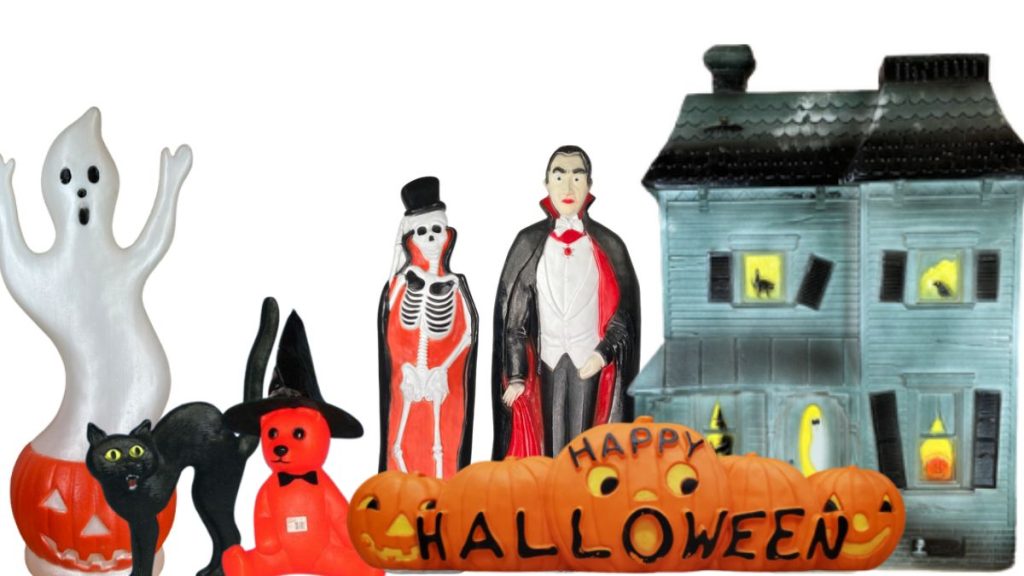
Variety of Union Products Halloween blow molds including ghost, black cat, bear, grim reaper, Bela Lugosi, Happy Halloween jack o'lantern sign & haunted house
Images courtesy of blow-molded.com

For collectors, the stranger the better.

Union understood strange.

Remember:

this is the company whose greatest contribution to civilization may be putting millions of pink flamingos on people’s lawns.


Not Every “Featherstone” Is a Featherstone

Here’s an important collector distinction.

You’ll sometimes hear people casually refer to Union blow molds as “Featherstones.”

That’s understandable.

But it can be misleading.

Don Featherstone was Union’s extraordinarily important designer and eventually its president and co-owner.

Union Products was the manufacturer.

Not every Union piece should automatically be attributed to Featherstone personally without documentation tying that design to him.

The Journal of Antiques and Collectibles has specifically cautioned collectors about using “Featherstone” as though it were simply another name for all Union molds. 

That’s exactly the kind of distinction collectors should preserve.

Manufacturer attribution and designer attribution are not the same thing.


The Signature on the Flamingo’s Rear End

The flamingo offers one of the most entertaining examples of product authentication imaginable.

By the 1980s, knockoffs were everywhere.

So Union needed a way of distinguishing the genuine article.

Around the flamingo’s 30th anniversary, Featherstone’s signature was incorporated into the tooling.

Where?

On the bird.

More specifically…

its rear underside.

Millions of people had bought the flamingo.

Now collectors could flip one over and look for Don’s signature.

It was essentially the plastic lawn-ornament equivalent of an artist signing a canvas.

The signature also became a useful dating clue. Sources generally place signed original Union birds beginning around 1987. The signature was removed after Featherstone’s retirement, prompting enough backlash that the decision became a minor cause célèbre among flamingo enthusiasts. 

Imagine designing something so beloved that people protest when your autograph disappears from its plastic butt.

That’s a legacy.


Featherstone Went From Employee to Owner

There’s another part of the Union story I particularly like.

The 21-year-old art-school graduate hired to sculpt plastic animals didn’t remain simply a designer.

Featherstone spent decades with the company.

He rose through its ranks.

And in 1996, Featherstone and two other longtime employees purchased Union Products. 

The artist had become an owner.

Eventually he served as president.

Think about the arc:

Art school.

Plastic duck.

Pink flamingo.

Hundreds of designs.

Corporate leadership.

Ownership.

Few people have careers quite like that.


Union Tried to Reinvent Its Greatest Hit

The company didn’t simply freeze the flamingo in 1957.

Union experimented with variations.

There were different colors and special runs.

A Snomingo arrived in the 1990s.

Union Products white flamingo blow mold, the Snomingo

Then came the Realmingo, a larger and more realistic interpretation unveiled in 1998. 

Featherstone understood something that today’s blow mold manufacturers are rediscovering:

Nostalgia and novelty can coexist.

Collectors want the familiar.

But they also want something they haven’t seen before.

It’s the same tension running through today’s blow mold revival.

Bring back an old favorite?

People want it.

Create something completely new?

People want that too.

Just don’t mess it up.

Collectors will let you know.


Then the Economics Changed

Union’s story eventually ran into the same forces that reshaped huge portions of American manufacturing.

Competition intensified.

Manufacturing costs changed.

Retail changed.

Imported goods became increasingly significant.

Plastic resin became more expensive.

Energy costs mattered.

And producing bulky, relatively inexpensive plastic lawn decorations in Massachusetts became increasingly difficult economically.

By 2006, Union Products was in trouble.

The company announced that its Leominster operation would close.

Contemporary reports cited rising plastic-resin and electricity costs as well as financial difficulties. 

And suddenly the media weren’t merely reporting the closure of a plastics factory.

They were reporting the possible extinction of the Pink Flamingo.

Union ceased production in Leominster in 2006.

An era had ended.


Except Union Didn’t Completely Die

This is where the story gets better.

The tooling survived.

And tooling is everything.

When a manufacturer closes, collectors often assume the product is gone forever.

But if the original molds survive, resurrection remains possible.

After Union’s closure, HMC International acquired rights and tooling and planned renewed flamingo production in New York. 

Production later became associated with Cado in nearby Fitchburg, Massachusetts.

Eventually Cado acquired Union Products and its intellectual property/assets, allowing production under the Union name to continue. Cado says the acquisition preserved production of Featherstone’s famous flamingo in the region where it originated. 

That makes Union unusual.

The original company closed.

But its identity—and at least part of its manufacturing heritage—survived.


The Flamingos Came Home

There’s something wonderfully appropriate about Cado’s involvement.

Union was born in the Massachusetts plastics ecosystem.

And after a detour through changing ownership, production became rooted again in central Massachusetts.

By 2016, Cado told WBUR it was manufacturing roughly 50,000 to 60,000 pink flamingos annually. 

Think about that for a moment.

An object designed by a 21-year-old artist in 1957…

made using a technology that once represented America’s manufacturing future…

mocked for decades as tacky suburban junk…

was still being manufactured nearly sixty years later.

That’s not failure.

That’s immortality in polyethylene.


Why Union Products Remains So Admired

Ask collectors why Union matters and you’ll get different answers.

Some love Featherstone.

Some love the flamingo.

Some collect Santas.

Others want Halloween.

Some are hunting obscure variants.

Some simply remember these pieces from childhood.

But I think Union’s enduring appeal comes down to five things.

First, the sculpting. Many Union pieces have unmistakable personality. They’re decorations rather than merely plastic forms.

Second, variety. Union wasn’t confined to one holiday or one visual language. The company’s catalog became a sprawling universe of lawn and seasonal art.

Third, history. Union is connected to Leominster’s extraordinary plastics-manufacturing heritage.

Fourth, Featherstone. Having a documented artist behind so many mass-market plastic objects gives collectors a human connection that’s often missing from industrial products.

And fifth:

Union made fun things.

That’s easy to underestimate.

Not everything has to be serious. The company created blow molds in the likenesses of The Three Stooges! How can you not love that?

Sometimes you need a glowing Santa.

Sometimes you need a snowman.

Sometimes you need a plastic bird so aggressively pink that your neighbors question your judgment.

Union understood this.


The Difference Between Collectible and Important

There are rare blow molds.

There are expensive blow molds.

There are blow molds collectors desperately want.

But historical importance is a different question.

Union Products matters because its story extends beyond the hobby.

The Smithsonian has preserved Featherstone’s flamingo as an object of American cultural history. 

That’s significant.

An inexpensive molded-plastic lawn ornament crossed an invisible line.

It stopped being merely merchandise.

It became Americana.

And that’s ultimately what happened to the best vintage holiday blow molds too.

They became pieces of memory.


Look at the Bottom

This is one reason I tell collectors not to judge an old blow mold only from the front.

Turn it around.

Look underneath.

Search for markings.

Manufacturer names.

Numbers.

Copyright information.

Old electrical openings.

Paint patterns.

Seams.

Construction details.

Because once you know the manufacturers, a random plastic Santa at an estate sale becomes something else.

It becomes a clue.

Union Products. Leominster, Massachusetts.

Now you’re holding a piece connected to one of America’s great plastics-manufacturing cities.

You’re holding something from the same company that gave the world the Pink Flamingo.

You’re holding a survivor from an industry that once employed thousands of people in central Massachusetts.

The decoration hasn’t changed.

Your understanding of it has.

That’s what collecting history does.


The Glow Really Didn’t Go Out

When Union’s Leominster factory closed in 2006, it would have been easy to write the ending there.

Factory closes.

Jobs disappear.

Molds get scattered.

Company becomes a paragraph in manufacturing history.

But that’s not quite what happened.

Collectors kept the pieces.

People kept hunting them.

Featherstone’s work became increasingly celebrated.

The flamingo survived.

Tooling survived.

Production survived.

And the Union name survived.

More importantly, the objects became something their creators probably never anticipated.

Heirlooms.

That plastic snowman Grandma put outside?

Someone wants it.

The Santa your parents bought decades ago?

Someone remembers it.

That weird Halloween figure your neighbor displayed every October?

Someone is searching for one right now.

Union Products manufactured decorations.

Time turned them into memories.

And collectors turned those memories into history.

That’s why Union remains one of the essential names in blow molds.

Not simply because of what the company made.

But because so much of it is still glowing.


Discover More in The Glow That Won’t Go Out

Union Products is only one branch of the much larger story told in The Glow That Won’t Go Out: The Complete Collector’s Guide to Vintage Holiday Blow Molds.

The book explores the history and evolution of blow molding, major manufacturers, identification clues, collecting, restoration and the people keeping this unusual corner of American holiday history alive.

Because the next time you find an old plastic Santa at an estate sale, turn him over.

There may be a story molded into the bottom.

From Collector to Creator: How Richard Gierlich Is Trying to Keep the Blow Mold Tradition Alive

His obsession started with his grandparents’ 48-inch Empire Santa. Then Richard Gierlich did something most collectors only dream about: he started making new blow molds.

By Curtiss Wayne Andrews

Most blow mold collectors spend their time looking backward.

We hunt for the Empire Santa that stood on somebody’s porch in 1974.

We search Marketplace for the General Foam snowman we remember from childhood.

We dig through old catalogs, inspect manufacturer markings, compare paint variations and occasionally drive an unreasonable distance because somebody posted three terrible photographs of what might be the piece we’ve been searching for.

Richard Gierlich did all of that.

Then he asked a considerably more complicated question:

What if I made one?

Not repaired one.

Not repainted one.

Not found one forgotten in somebody’s garage.

Actually made a new blow mold.

That question eventually became Richard’s Holiday Shop—and sent a lifelong collector into the decidedly less romantic world of product design, manufacturing, painting, molds, overseas production, freight, warehousing and preorders.

In other words, Richard discovered what happens before the blow mold reaches the lawn.

And his story begins exactly where so many blow mold stories begin.

At his grandparents’ house.


The Santa on the Porch

What first got you interested in blow molds?

Richard Gierlich: I first got interested in blow molds thanks to my grandparents. They had the Empire 48″ Santa that they would set on their porch every year, and as a kid, I always looked forward to seeing him.

My collection is pretty large now. I love both the new and old pieces, so I’m always looking for the newest stuff when it hits stores, but I also love finding that older piece on Marketplace or stumbling across a rare yard sale find.

That’s part of the fun of collecting for me—you never really know what you’re going to find.

That answer could have come from dozens of collectors I spoke with while researching The Glow That Won’t Go Out.

Different decoration.

Same story.

There was one at Grandma’s house.

Or Dad put one beside the driveway.

Or the neighbors had a Santa you could see glowing from the back seat of the family car.

We remember these things because Christmas decorations become landmarks in childhood.

Richard’s landmark was a four-foot Empire Santa.

And unlike many childhood decorations that disappear somewhere along the way, Richard knows exactly where that Santa is today.


The Blow Mold He Was Always Going to Inherit

Do you have a favorite piece?

Richard: Yes! My favorite is the 48″ Empire Santa I mentioned above.

Growing up, I always told my grandparents that I wanted him whenever they decided they no longer wanted him, or when the worst eventually happened.

My dad told me they originally purchased him from Sears when he was a baby, so that Santa has been part of our family for a long time.

When my grandfather passed away and my grandmother was cleaning out the house, she told me to take him home.

He stays inside now, and I love that my kids get to enjoy the same Santa that I grew up with.

Sadly, he did take a tumble inside one year and ended up with a crack in his hat, but I was able to fix him!

This is the part of collecting that price guides can’t measure.

What’s Richard’s Santa worth?

You could search completed sales.

Identify the variation.

Assess condition.

Calculate a market value.

And you’d still get the answer wrong.

Because Richard isn’t merely storing an Empire Santa.

He’s storing Christmas at his grandparents’ house.

Now his own children get to experience the same decoration.

Grandparents.

Son.

Great-grandchildren.

One plastic Santa connecting three generations.

That’s exactly why I called my book The Glow That Won’t Go Out.

Sometimes keeping the glow alive means finding a rare piece.

Sometimes it means repairing a crack in Santa’s hat.


Then Richard Decided to Make Blow Molds Himself

This is where Richard’s story takes an unusual turn.

Collectors routinely say:

“Why doesn’t somebody make this?” Like that Buc-ee blow mold we ranted about here.

Richard decided to find out.

The timing mattered.

General Foam Plastics had been one of the major names in American blow-mold manufacturing, and its products continued into the 2010s; collector documentation, for example, lists several General Foam Christmas-tree designs through 2017. 

When that era ended, Richard saw both a loss and an opportunity.

How did Richard’s Holiday Shop get into making new blow molds?

Richard: I’ve always had a love for the holiday industry.

While General Foam Plastics was still in business, myself and other collectors would always complain about seeing some of the same designs year after year.

So, when they closed, I eventually found a factory in China that was willing to work with me.

I had searched all over the U.S. first, but I couldn’t find anyone who could handle everything I needed, including the design work, painting, and molding.

The first design I came up with was a snowman, and he ended up being shipped to collectors all over the world.

That’s a sentence worth reading again.

A collector designed a snowman—and copies eventually went to collectors around the world.

Richard’s public product-development work also documents concepts including a 24-inch snowman, a companion Snowlady and a large Easter sign, while his more recent reflections describe just how much he learned about manufacturing, packaging, freight, storage, pricing and the difference between people liking an idea and actually purchasing it. 

Suddenly the guy searching yard sales was standing on the other side of the hobby.

He wasn’t asking:

“Who made this?”

He was asking:

“How do we make this?”


Making a Blow Mold Is the Easy Part—Except It Isn’t

There’s a romantic version of product creation that goes something like this:

Have idea.

Draw snowman.

Make snowman.

Sell snowman.

Christmas!

Richard discovered the actual version.

Design.

Engineering.

Molding.

Paint.

Minimum quantities.

Packaging.

Shipping.

Freight.

Warehousing.

Pricing.

Customer expectations.

And somewhere in the middle of all that, you presumably still need to sell the snowman.

Richard has written publicly that one attempted Grand Venture snowman revival taught him an important distinction: collectors may enthusiastically support an idea in principle but have different expectations when it’s time to purchase the finished product. 

That’s something most collectors never see.

We see the finished decoration sitting on a store shelf.

We don’t see the hundreds of decisions required to put it there.

Richard says he has also collaborated with designers Justin and Jerry on future concepts.

Are more Richard’s Holiday Shop designs coming?

Richard: I currently have an Easter sign planned, but due to warehouse and storage issues, I’ve had to pause the business until I can find a new place to operate out of.

While I know the preorder model can be annoying to some people, it’s the way I operate the business.

If I receive enough preorders, the mold goes into production.

If I don’t, everyone is refunded.

It allows me to create unique pieces without ordering a huge quantity and hoping they eventually sell.

That may sound less exciting than discovering a rare Santa at an estate sale.

But it’s part of the modern blow mold story.

The companies of the golden era could manufacture enormous production runs for national retailers.

A small independent creator faces a completely different economic equation.

Richard’s preorder approach effectively asks collectors to help prove demand before committing to a production run.

It’s not simply:

Do collectors want this?

It’s:

Do enough collectors want this enough to actually buy it?

Those are very different questions.

You have to give guys like Richard credit for having the courage and fortitude to really commit to making a product like a blow mold and seeing it to market. Right before COVID, I met with a 3D printer out of Costa Mesa, CA to inquire about the possibility of creating blow mold-style Christmas ornaments. While it was certainly a cool idea and something I was interested in, I couldn’t realistically pull the trigger at that time – not knowing the real manufacturing logistics related to overseas production or the real demand.

You can now buy a blow mold Christmas ornament manufactured by Mr. Christmas at Walmart for $5.97. Oh well.


Why Are Blow Molds Back?

If you’ve been collecting for any length of time, the resurgence is impossible to miss.

Vintage pieces have become desirable collectibles.

New blow molds are appearing in stores.

Long-dormant styles are being reconsidered.

Licensed characters have brought different buyers into the category. See my article about Taz.

And younger collectors are discovering decorations manufactured decades before they were born.

Richard thinks the explanation begins with one word.

Why have blow molds become popular again?

Richard: I think blow molds have become so popular again because of the nostalgia they bring.

For a lot of people, seeing one instantly reminds them of their childhood.

It might be an older collector who remembers their parents putting them out, a younger person who remembers seeing them at their grandparents’ house, or someone who remembers their family driving around looking at Christmas light displays.

I also think the fact that companies are releasing new designs every year has helped bring more people into the hobby.

We’re seeing characters and designs that collectors have wanted for years but that were never made before.

Then you have companies like Mr. Christmas that are actually listening to collectors and bringing back nostalgic pieces.

While those pieces aren’t the originals, they still capture that feeling—especially for people who can’t find or afford an original piece.

It gives another generation the chance to experience them and make their own memories.

There’s an important point there.

Nostalgia doesn’t necessarily require the original object.

Collectors understandably value originals.

But a newly manufactured decoration can become somebody else’s original.

The blow mold a parent buys today might be the one their child desperately searches for thirty years from now.

Tradition has to begin somewhere.


The Great Blow Mold Civil War: Vintage vs. New

Every collecting hobby eventually develops rules nobody actually agreed to.

What’s authentic?

What’s collectible?

What’s worth owning?

Richard has a refreshingly simple answer:

Who cares?

What advice would you give a new collector?

Richard: The biggest advice I can give is just to have fun!

Who cares if you love the new stuff, the old stuff, or both?

A lot of people get into the hobby because they see a new blow mold in a store that catches their attention, and that’s perfectly fine. Other collectors have been around for years and only collect vintage pieces.

One thing I’ve learned from being in the hobby for a long time is that opinions are always going to be strong.

Years ago, collectors complained that we kept seeing the same older designs and wanted something new.

Now that we’re getting new molds and designs every year, you’ll sometimes hear complaints about those too!

You can’t please everyone, and that’s okay.

Don’t let someone else’s opinion about what’s “collectible” determine what you enjoy. If you like it, collect it.

I couldn’t agree more.

A hobby stops being fun remarkably quickly when you’re collecting according to somebody else’s rules.

Want nothing but vintage Empire?

Wonderful.

Love new character molds?

Great.

Want a 1960s Poloron piece standing next to something you bought last Tuesday?

Plug them both in.

Christmas will survive.


Learn the History—But Don’t Turn It Into Homework

Richard does encourage new collectors to learn.

Manufacturers.

Designs.

Production history.

Differences between molds.

Those details add another layer to collecting.

That’s also one of the reasons I wrote The Glow That Won’t Go Out.

Knowing why a decoration looks the way it does, who manufactured it and where it fits into the industry’s history can transform an interesting piece of plastic into something much more meaningful.

But Richard makes another good point.

If researching every manufacturer’s catalog number doesn’t interest you?

That’s okay too.

You don’t need to pass a certification exam before you’re allowed to put a glowing Santa in your yard.


One Thing Every New Collector Should Worry About

There is one area where Richard gets considerably less relaxed.

Online scammers.

What should collectors watch for?

Richard: The biggest thing I would tell people to look out for is scammers.

If you’re buying online and something seems too good to be true, it probably is.

Don’t be afraid to ask questions, request additional pictures, or ask other collectors or group admins for their opinion before sending money.

I also recommend using PayPal Goods and Services when purchasing from someone you don’t know so that you have purchase protection if something goes wrong.

That’s particularly important when you’re hunting rare pieces.

Excitement makes people move quickly.

Scammers know it.

A photograph of a rare blow mold plus an improbably low price plus a seller insisting you need to send money right now should produce skepticism, not adrenaline.

The mold you’ve spent ten years searching for is exactly the one that can make you ignore warning signs.

Don’t.

There will always be another blow mold.


The Collector Who Crossed to the Other Side

The more I thought about Richard’s story, the more I realized why I wanted it included alongside the collector stories surrounding The Glow That Won’t Go Out.

Richard started exactly where many collectors start.

A decoration at his grandparents’ house.

He became a collector.

He learned the manufacturers.

He hunted vintage pieces.

He bought new ones.

And then he crossed an invisible line.

He became part of the process that creates the objects future collectors might someday hunt.

That’s remarkable when you think about it.

Somewhere, a Richard’s Holiday Shop snowman may be standing in a family’s Christmas display right now.

A child sees it every December.

Maybe that child loves it.

Maybe twenty-five years from now that person is scrolling through whatever replaces Facebook Marketplace, desperately trying to find another one.

And perhaps they’ll finally locate it.

They’ll plug it in.

It will glow.

And suddenly they’re eight years old again.

That’s how this works.

Richard inherited the Santa that once stood on his grandparents’ porch.

Now he’s helped create decorations that could become somebody else’s version of that Santa.

The technology changes.

The manufacturers change.

The collectors change.

But the reason these strange illuminated pieces of plastic matter?

That hasn’t changed very much at all.

Richard said it best:

Collect what makes you happy.

Because at the end of the day, that’s what the hobby should be about.

And every once in a while…

someone who loves collecting them decides to make one too.


The Story Continues in The Glow That Won’t Go Out

The Glow That Won’t Go Out: The Complete Collector’s Guide to Vintage Holiday Blow Molds by Curtiss Wayne Andrews explores the manufacturers, history, identification, restoration and collecting culture behind America’s glowing holiday decorations.

It’s also about something larger:

How one generation’s Christmas decorations become the next generation’s memories.

And Richard Gierlich’s journey—from his grandparents’ Empire Santa to creating new blow molds of his own—is a pretty wonderful example of why that glow isn’t going anywhere.

Go to his shop today and look around.

Before Amazon, There Was the Wish Book: How Sears Helped Put Blow Molds on America’s Front Lawns

Long before online auctions and Facebook Marketplace, one enormous Christmas catalog helped turn glowing plastic Santas, snowmen and candles into American holiday traditions.

There was a time when Christmas arrived in the mail.

Not in a cardboard box.

Not with a tracking number.

And definitely not in a padded envelope containing something you ordered at 11:47 p.m. because your phone told you there were “ONLY 3 LEFT.”

Christmas arrived as a book.

A very big book.

For generations of American families, the appearance of the Sears Christmas catalog—the legendary Wish Book—meant the holiday season had unofficially begun.

Children went straight for the toys.

Dad found the tools.

Mom looked at clothes, housewares and gifts.

And somewhere among hundreds of pages of merchandise were the things that would eventually become irresistible to another group entirely:

future collectors.

Toy trains.

Barbie dolls.

Slot-car sets.

Bicycles.

Christmas ornaments.

And, of course…

those wonderful illuminated plastic figures that would eventually become known simply as blow molds.

Today, collectors might spend hours searching estate sales, antique malls, Marketplace listings and online auctions for an old Empire Santa or vintage plastic candle.

But decades ago?

You could simply open the Sears catalog.

And that catalog helped change the American Christmas landscape.

Before the Wish Book Was the Wish Book

Sears had been helping Americans shop by mail long before anyone called its Christmas catalog the Wish Book.

The company’s catalog roots date to the late 1880s. By the 1890s, Sears was offering an astonishing range of merchandise by mail, eventually creating what amounted to a department store delivered directly to the customer’s home. 

Christmas merchandise arrived surprisingly early in that story.

The 1896 general catalog offered wax candles for Christmas trees. Christmas cards appeared by 1898. Tree ornaments arrived in 1900, artificial Christmas trees and stockings by 1910, and electric Christmas-tree lights by 1912. 

Then, in 1933, Sears issued its first dedicated Christmas Book.

It was just 87 pages.

Inside were toys and gifts that sound like somebody emptied an antique store onto a catalog page: Lionel trains, a Mickey Mouse watch, a battery-powered toy automobile, fruitcakes, chocolates—and even live singing canaries. 

Yes.

You could apparently order a bird for Christmas.

Amazon still hasn’t topped that.

Customers had already informally referred to Sears catalogs as “Wish Books” or “Books of Wishes,” but Sears officially put Wish Book on its Christmas catalog in 1968. By then, it had become enormous: the 1968 edition ran 605 pages, including 225 pages of toys and 380 pages of adult gifts. 

But the significance of those pages went far beyond shopping.

Sears Didn’t Just Sell Christmas. It Showed America What Christmas Could Look Like.

This is where the story intersects with blow molds.

It’s difficult today to appreciate the cultural power of a national catalog.

There was no Pinterest.

No Instagram.

No Amazon recommendations.

No YouTube video called:

“10 CHRISTMAS YARD DECOR TRENDS YOU NEED IN 1967!!!”

For millions of households, catalogs were discovery engines.

They showed you things you didn’t even know existed.

And when an illuminated plastic Santa, snowman, candle or Nativity figure appeared among the Christmas merchandise, Sears wasn’t merely providing a way to purchase it.

Sears was putting the idea in your head.

Imagine being a child paging through a Christmas catalog in the 1960s.

There’s Santa.

But this Santa is different.

He’s three-dimensional.

He’s colorful.

He lights up.

And apparently he can stand outside your house.

You don’t need to know the term blow molding.

You don’t need to know who manufactured it.

You don’t need to understand polyethylene.

You know only one thing:

WE NEED THAT SANTA.

That is how traditions begin.

The Catalog Was the Original Algorithm

Today, Amazon learns what you like.

Search for one vintage Christmas decoration and suddenly the internet decides:

Excellent. This person would like to see illuminated plastic snowmen until death.

The Sears Wish Book accomplished something remarkably similar without tracking cookies.

You opened the catalog looking for one thing.

Then you discovered another.

A train set led to a slot-car set.

A doll led to a dollhouse.

Christmas lights led to lawn decorations.

And one illuminated Santa could lead to a snowman.

Then candles.

Then a Nativity.

Then a choir boy.

Then another Santa because apparently the first Santa was lonely.

Congratulations.

You have accidentally started a collection.

There’s real collector testimony behind that idea. Collector and writer Carrie Polales Sansing has recalled looking through Sears Wish Books and JCPenney holiday catalogs with her mother in the mid-1960s while deciding which decorations to add to their growing Christmas display. She remembered repeatedly being drawn to the same type of decoration: plastic figures that lit up.

That’s a small memory that explains something much bigger.

Catalogs didn’t merely distribute products.

They created desire, repetition and tradition.

From Product to Family Tradition

Suppose your parents ordered a glowing Santa in 1969.

Every December, Dad brought Santa down from the attic.

You watched him untangle the cord.

Santa went beside the front steps.

Christmas officially began.

1968.

1969.

1970.

1971.

Year after year.

Eventually, Santa wasn’t simply something Sears sold.

He was your family’s Santa.

That’s the emotional transformation at the heart of vintage holiday collecting.

Mass-produced objects become intensely personal.

A plastic decoration that rolled off an assembly line alongside thousands of identical pieces somehow becomes:

the Santa that stood outside Grandma’s house.

the candles that flanked the front door.

the Nativity Dad assembled every December.

the snowman you could see glowing through your bedroom window.

The catalog got the object into the house.

Time turned it into an heirloom.

And Sears Was Doing This With Almost Everything

That’s why the Wish Book matters beyond blow molds.

Look at many of today’s collecting categories and you’ll find fingerprints from the great catalog era.

Lionel trains appeared in the very first 1933 Christmas Book. 

Across subsequent decades, catalogs presented Americans with toys, sporting goods, clothing, appliances, electronics, musical instruments and countless other products. Sears itself later described its catalogs as a kind of historical record of changing American desires and habits, and researchers have used them to trace everything from fashions and home furnishings to sporting equipment. 

That’s exactly why old catalogs have become so valuable to collectors today.

They answer questions.

What year was this sold?

What did it originally cost?

Was this color available?

Was it sold as a set?

What accessories came with it?

What did the manufacturer originally call it?

For a collector, an old catalog isn’t merely nostalgia.

It’s evidence.

The Wish Book Helped Create Tomorrow’s Collectors

There’s another fascinating part of this story.

Children didn’t have purchasing power.

But they had something retailers understood almost as well:

circles.

A child could sit on the living-room carpet with a pen and create a surprisingly sophisticated fourth-quarter procurement strategy.

Circle.

Circle.

Huge circle.

Arrow.

Three stars.

“THIS ONE.”

Parents learned exactly what their children wanted.

And those children remembered.

Decades later, the toys and objects we wanted but couldn’t have often became the things we collected when we finally had disposable income.

The train.

The action figure.

The doll.

The bicycle.

The lunchbox.

The Christmas decoration.

Collecting is often nostalgia with a checking account.

And the Wish Book supplied an enormous amount of the nostalgia.

Why Old Catalog Pages Matter So Much to Blow Mold Collectors

For today’s blow mold collector, vintage catalogs provide something memory can’t always supply:

context.

Finding an old Santa at an estate sale is exciting.

Finding that same Santa pictured in a period catalog?

Now you can see him as shoppers originally saw him.

Maybe he was photographed beside coordinating candles.

Maybe several figures were offered together.

Maybe the catalog reveals an original price.

Maybe the description provides dimensions.

Maybe a tiny detail helps distinguish one production era from another.

That turns a decoration into an artifact.

And that’s one reason old catalogs, advertisements, manufacturer literature and photographs are so important when researching blow mold history.

They’re breadcrumbs.

They help us reconstruct an industry that nobody imagined we’d someday be studying this closely.

Because remember:

These weren’t created as collectibles.

They were Christmas decorations.

People put them outside.

Snow fell on them.

Rain hit them.

Sun faded them.

Children knocked them over.

Dogs investigated them.

Parents shoved them into attics.

Garages baked them every summer.

Extension cords were lost.

Bulbs burned out.

Paint disappeared.

And somehow…

they survived.

The Catalog Era Helped Make Blow Molds National

This may be the Sears Wish Book’s greatest contribution to the story.

A regional store can create a local trend.

A national catalog can create a national visual language.

Families separated by hundreds or thousands of miles could encounter similar holiday merchandise.

The glowing plastic Santa wasn’t limited to one department store window in one town.

Catalog distribution gave products enormous geographic reach.

The same basic style of illuminated holiday figure could become familiar in neighborhoods across America.

And when enough houses displayed them, they stopped looking novel.

They started looking like:

Christmas.

That’s an extraordinary transition.

Plastic became nostalgia.

Manufacturing became tradition.

Commerce became memory.

Sears Wasn’t Alone

Of course, Sears wasn’t the only catalog helping build this world.

JCPenney and Montgomery Ward holiday catalogs also brought merchandise directly into American homes. Collector memories specifically connect Sears and JCPenney catalogs with discovering illuminated plastic Christmas decorations. 

Together, these catalogs functioned almost like annual snapshots of American consumer culture.

Today we scroll.

Then, we turned pages.

And unlike a webpage that disappears when someone redesigns a site, those pages remained tucked inside closets, basements and attics.

Which is why a fifty-year-old catalog can now help identify a fifty-year-old decoration.

Then the Catalog Disappeared

Sears discontinued its famous general “Big Book” catalog in 1993, closing an era of American retail that had begun more than a century earlier. 

The timing almost seems symbolic.

Two years later, Amazon shipped its first book. 

One shopping revolution was ending.

Another was beginning.

Today, finding a blow mold is easier in one sense.

Search.

Click.

Buy.

A collector in California can discover a decoration in Ohio before breakfast.

But something was lost along the way.

The anticipation.

The discovery.

The shared catalog sitting on the coffee table.

The folded corners.

The circled toys.

The handwritten notes.

The page you returned to twenty times because you wanted to make absolutely sure Santa understood.

And That’s Why We Still Care

This is one of the themes running throughout The Glow That Won’t Go Out.

Blow molds aren’t interesting merely because they’re old plastic decorations.

They’re interesting because they sit at the intersection of manufacturing history, retail history, holiday tradition and personal memory.

Companies manufactured them.

Retailers distributed them.

Catalogs introduced them.

Families adopted them.

Children remembered them.

Collectors rescued them.

And now, decades later, we’re trying to piece the story back together.

That old Sears Wish Book in Grandma’s living room probably wasn’t treated like an important historical document.

It was just the Christmas catalog.

That glowing Santa wasn’t an artifact.

It was just the thing Dad plugged in by the front porch.

Nobody knew anyone would care fifty years later.

But we do.

And maybe that’s the real reason these decorations refuse to disappear.

The companies changed.

The catalogs vanished.

The department stores faded.

The original price tags were thrown away.

But somewhere tonight, another collector will plug in an old plastic Santa.

The bulb will flicker on.

The faded red plastic will begin glowing.

And for just a second, Christmas will look exactly the way someone remembers it.

That’s the glow that won’t go out.


KEEP THE GLOW ALIVE

The Glow That Won’t Go Out explores the history, manufacturers, designs, collectors and cultural story behind the vintage holiday blow molds that once illuminated America’s front lawns—and are now being rediscovered by a new generation.

From the golden age of companies such as Empire, General Foam and Union Products to identification, restoration, displaying and the hunt itself, the book tells the story behind decorations that became far more important than anyone expected.

Because sometimes an old piece of plastic isn’t just an old piece of plastic.

Sometimes it’s Christmas at Grandma’s house.