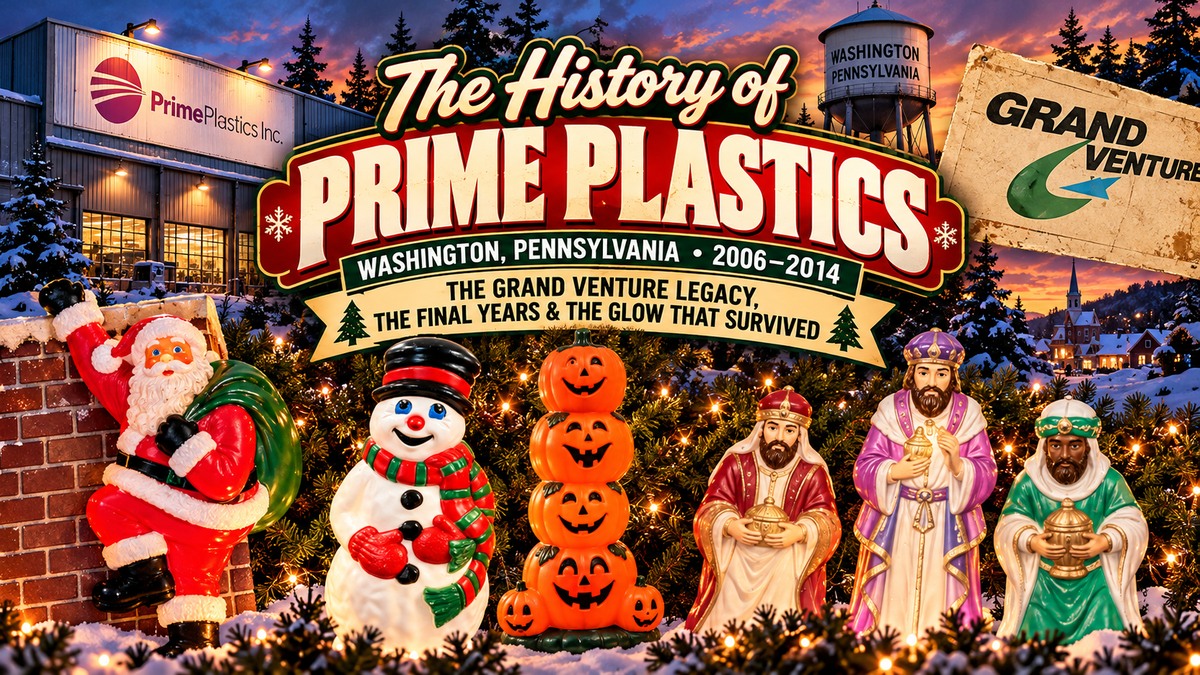
From a Pennsylvania factory and the beloved designs of Grand Venture to bankruptcy, federal investigations and a remarkable second life for its surviving molds, Prime Plastics has one of the most extraordinary stories in vintage holiday decorating history.
By Curtiss Wayne Andrews
There are plenty of stories in the vintage blow mold world about companies that disappeared.
Factories closed. Production moved overseas. Retailers abandoned traditional plastic decorations for inflatable snowmen that looked magnificent when inflated and like enormous discarded trash bags when the power went out.
But the story of Prime Plastics is different.
Much different.
This one has a Pennsylvania factory, some of the most recognizable blow molds of the late 1990s, a company fighting to survive, disputed ownership of manufacturing molds, bankruptcy proceedings, federal investigators and a businessman who eventually pleaded guilty to financial crimes.
And somewhere in the middle of all that?
Santa Claus.
Specifically, a plastic Santa who appears to be climbing up the side of your house.
You couldn’t invent a stranger corporate history for a Christmas decoration manufacturer.
But perhaps the most remarkable part is what happened after Prime Plastics disappeared.
The decorations survived.
The molds resurfaced.
And collectors refused to let some of their favorite characters vanish.
In my book, The Glow That Won’t Go Out, I explore the manufacturers, collectors and unexpected twists that helped turn ordinary plastic lawn decorations into pieces of American history.
Prime Plastics of Washington, Pennsylvania, is one of the clearest examples of why that history is about much more than plastic. The story really deserves its own book or historical doc-series on streaming or cable. Come on, Netflix!
Because this isn’t simply the story of a company that made Christmas decorations.
It’s the story of a company that helped keep a beloved collection of designs alive—and how those designs ultimately outlived the business itself.
Before Prime Plastics, There Was Grand Venture
To understand Prime Plastics, we have to begin with the company whose legacy it inherited.
Grand Venture was founded in Washington, Pennsylvania, in the 1990s. Collector histories identify Gary Anton as its founder, with operations beginning in 1996 or 1997, depending on the source. The company shared its Washington location with Falcon Plastics – responsible for the manufacturing of all of the blow-molded products sold under the Grand Venture name. Falcon was previously MAC Plastics, which produced products for other manufacturers such as Sun Hill Industries & TPI before their 1998 bankruptcy.
Leaving its convoluted history aside, the company manufactured Christmas, Halloween and Easter decorations, along with other molded plastic lawn figures.
Unlike Union Products, whose roots stretched back to the mid-century plastics boom, Grand Venture arrived at a time when blow molds were already a familiar part of American holiday decorating.
Its challenge wasn’t introducing the concept.
It was making people want another one.
And Grand Venture had a talent for creating characters with personality.
Among its most recognizable products were the Climbing Santa, Snowman with Scarf, Drummer Boy, Ghost with Pumpkins and Pumpkin Tower.
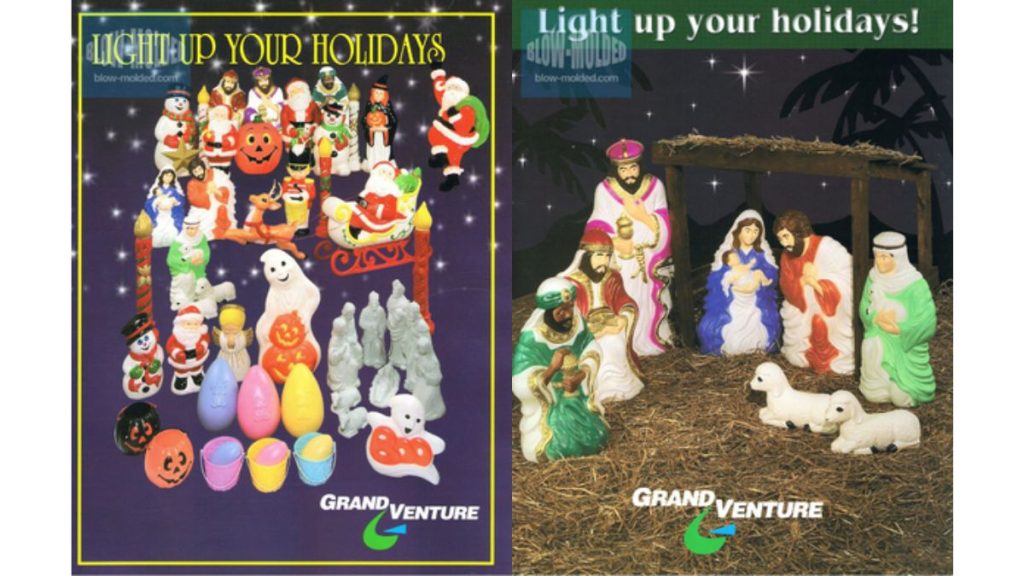
Its catalog also included Nativity figures, witches and other seasonal decorations.
These designs helped give Grand Venture a following that would continue long after its original manufacturing operation ended.
The Grand Venture Connection to Other Manufacturers
The company’s history also illustrates how interconnected the blow mold industry had become.
Collector records indicate that Grand Venture acquired molds and assets from Sun Hill Industries in 2003, adding to its existing manufacturing resources.
Some tooling associated with other manufacturers also entered the picture.
This was increasingly common in the industry.
A company might cease production, but its aluminum molds could remain valuable.
Another manufacturer could purchase them, adapt production and continue selling familiar designs.
The consumer might barely notice the transition.
Collectors, on the other hand, would eventually become fascinated by it.
Because when a design changes manufacturers, everything from the markings to the paint applications can become part of its history.
And that brings us to Prime Plastics.
2005–2008: Prime Plastics Takes Over
Grand Venture ceased operations in 2005.
Prime Plastics subsequently acquired the business or its production assets, preserving a selection of Grand Venture designs.
A 2016 history published by Christmas Lights Creations describes Prime beginning limited production after the acquisition and continuing for approximately eight years.
Another collector history places Prime’s purchase and production of Grand Venture molds in 2008.
The precise acquisition and production chronology therefore isn’t completely consistent across secondary sources.
The important point is that Prime Plastics became a successor producer of Grand Venture’s beloved blow molds.
And that distinction matters.
Prime wasn’t primarily celebrated for inventing an entirely new generation of holiday characters.
Its importance was in keeping existing designs available at a time when the traditional blow mold business was becoming increasingly difficult.
In a sense, Prime was both a manufacturer and a caretaker.
It inherited a collection of characters that already had an audience.
And for several more years, it gave those characters a chance to find new homes.
Washington, Pennsylvania: The Factory Behind Prime Plastics
Unlike many defunct blow mold manufacturers whose precise operating locations can be difficult to establish, Prime Plastics has a documented factory address.
100 Detroit Avenue, Washington, Pennsylvania 15301.
That address appears in federal bankruptcy records and in the official notice announcing the sale of the company’s manufacturing equipment. What’s there now? A multi-tenant commercial & industrial property.
Washington, Pennsylvania, sits southwest of Pittsburgh, in a region with a long industrial tradition – back when manufacturing was actually prominent in the United States.
It’s a fitting setting for a company manufacturing large hollow plastic decorations.
Blow molding requires much more than a creative idea.
A manufacturer needs specialized equipment, production tooling, plastic resin, trained employees, finishing processes, storage and distribution.
And holiday decorations present an additional challenge.
Demand is seasonal.
Retailers want merchandise ready before the decorating season.
A factory may need to manufacture large quantities months before customers begin putting them in their yards.
Then there’s the question of storage.
Anyone who collects blow molds knows that hollow plastic figures have an extraordinary ability to occupy space.
Now imagine manufacturing thousands of them.
The industrial logistics alone are enough to make a collector’s garage look positively organized.
Prime’s Washington facility was where these familiar Grand Venture designs continued their commercial lives.
And for a time, that was something worth celebrating.
The Famous Blow Molds That Defined Prime’s Legacy
Prime Plastics is best understood through the Grand Venture designs it helped preserve.
Not every surviving Grand Venture design can automatically be attributed to a specific Prime production run, and detailed production records remain incomplete.
But several characters are central to the story of the tooling and the later revival of the line.
The Climbing Santa: A Christmas Decoration With Ambition
Few blow molds communicate their purpose as immediately as the Climbing Santa.
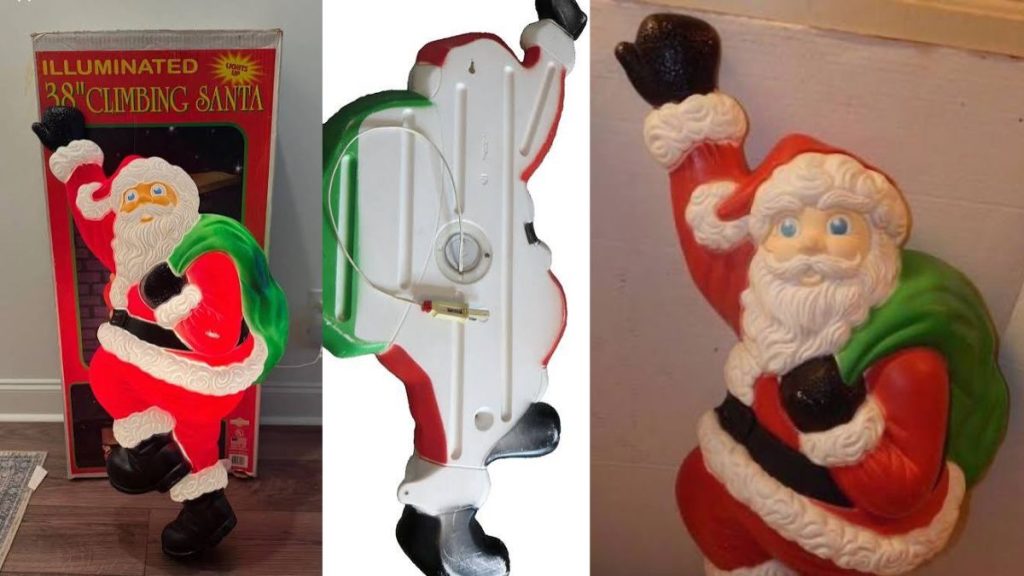
Most Santas stand.
Some wave.
Others carry presents or lanterns.
Grand Venture’s Santa appeared to be climbing.
It transformed the side of a house into part of the Christmas display.
That’s a clever piece of design.
The figure wasn’t simply an ornament.
It suggested an action.
A story.
Santa was arriving.
And that gave the decoration a sense of movement without requiring an electric motor.
The Climbing Santa would later become one of the designs selected for renewed production after Prime’s demise.
Its appeal demonstrates an important principle of successful blow mold design:
Sometimes the most memorable decoration isn’t the largest or most elaborate.
It’s the one with the best idea.
The Snowman With Scarf: Personality in Plastic
The Snowman with Scarf is another Grand Venture favorite. You might remember this specific piece from my conversation with blow mold collector Brandon Gress. Brandon credits this K-mart find as the genesis for his lifelong blow mold fandom.
On paper, it sounds ordinary.
A snowman wearing a scarf.
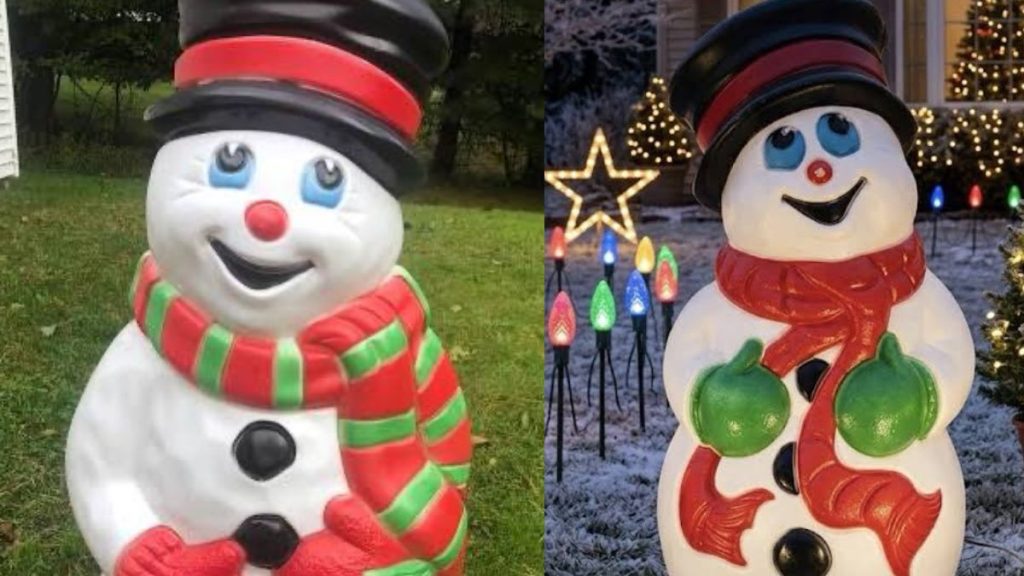
We’ve seen approximately nine million variations of that idea.
But collectors know that no two snowmen are necessarily alike.
The sculpted expression matters.
The proportions matter.
The hat, scarf and pose all contribute to the character.
A particularly successful snowman can become recognizable even without its original paint.
And the Grand Venture Snowman with Scarf developed enough collector appeal to be among the designs revived after the Prime era.
That’s a significant accomplishment for a character whose primary job was standing in the snow and looking cheerful.
The Drummer Boy: A Traditional Christmas Character
The Drummer Boy represents a more traditional side of the Grand Venture catalog.
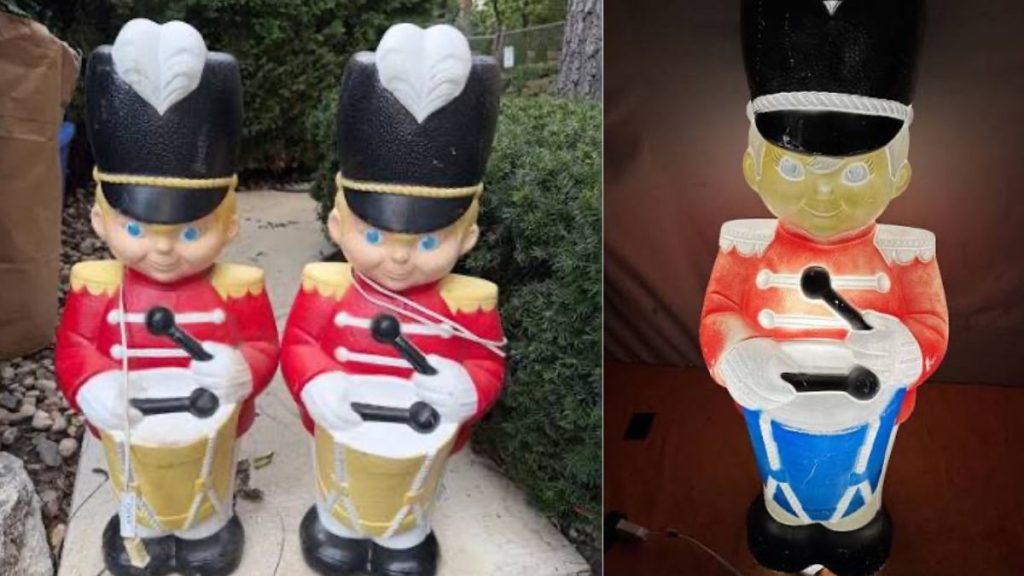
It’s a familiar holiday figure with roots in Christmas storytelling and music.
For a manufacturer, such a character offered a natural complement to Santas, snowmen and Nativity scenes.
For collectors, it offered variety.
A yard display composed entirely of Santas can become a little repetitive.
A drummer boy introduces a different silhouette and a different Christmas association.
It’s a reminder that successful holiday manufacturers didn’t simply produce individual decorations.
They helped customers assemble complete seasonal scenes.
Halloween: Ghosts, Witches and Pumpkin Towers
Grand Venture also developed a memorable Halloween assortment.
Among the better-known designs were the Ghost with Pumpkins, Halloween Witch, Pumpkin Tower and smiling pumpkin figures.
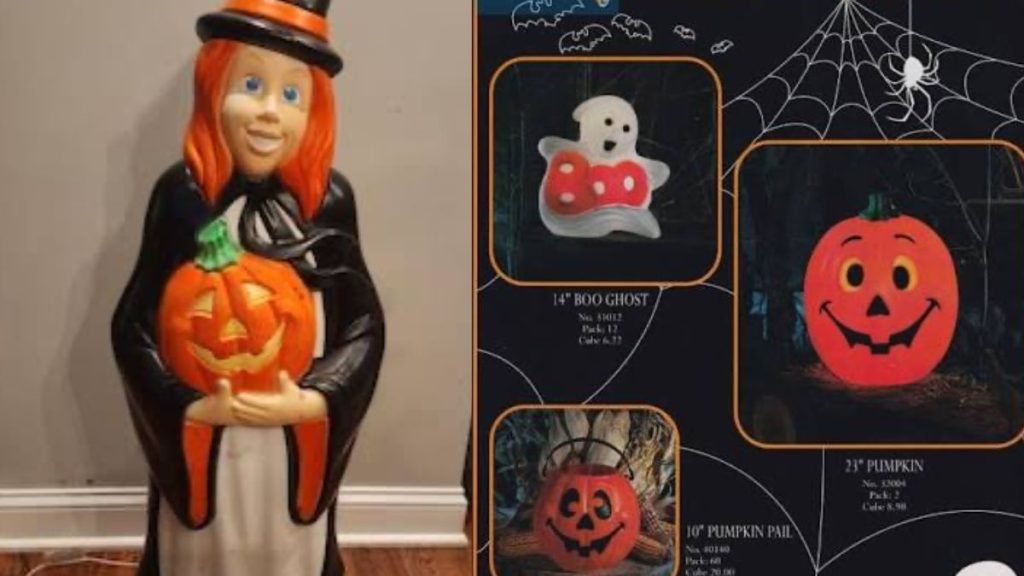
These characters gave collectors an alternative to the increasingly elaborate Halloween decorations arriving from other manufacturers.
The Ghost with Pumpkins combined several familiar Halloween elements into one sculptural composition.
The Pumpkin Tower took a simple seasonal symbol and made it into a larger visual statement.
And the company’s Halloween designs would prove especially important after Prime disappeared.
Some of the original molds eventually returned to production through successor businesses.
It’s another example of a recurring pattern in blow mold history.
The manufacturer dies.
The Halloween decorations refuse to stay buried.
Which, admittedly, is rather appropriate.
The Nativity Set: A Tradition That Survived
Grand Venture’s Nativity figures also became part of the tooling legacy.
Collector histories report that Cado Products later acquired the Grand Venture Nativity tooling and produced several of the figures.
That revival demonstrated that the market for traditional illuminated religious decorations hadn’t entirely disappeared.
For many families, Nativity blow molds aren’t merely decorative merchandise.
They’re part of a Christmas ritual.
The figures are brought out each year.
Placed in familiar positions.
Connected to the same extension cords.
And illuminated in front of the same house.
Over time, the decorations become inseparable from family memories.
That’s why the survival of the molds matters.
The designs can continue creating memories long after their original manufacturer has vanished.
The People Behind Prime Plastics
A manufacturing company is more than its owner.
It’s the people who keep the machinery running, prepare the materials, maintain the molds, assemble the products and get the finished merchandise out the door.
Unfortunately, Prime Plastics’ surviving public history is dominated by its financial collapse.
That makes it easy to overlook the employees who actually made the decorations.
One name central to the company’s corporate story is George Retos Jr., who controlled Prime Plastics and another company called Plastic Power.
Contemporary reporting also identifies Nick Retos, George’s son, as Prime’s chief financial officer during the bankruptcy period.
A later Department of Justice account describes employees being transferred between Prime Plastics and Plastic Power as part of a scheme involving unpaid payroll taxes.
But the public record I’ve reviewed does not provide a reliable roster of Prime’s production workers, supervisors or holiday-decoration designers.
Nor does it establish precisely how many employees worked specifically on blow mold production.
Those are important missing details.
Because whatever happened in the executive offices, people still came to work and manufactured products.
They maintained equipment.
Handled orders.
Prepared shipments.
And helped preserve a line of decorations that collectors still admire.
Their contribution shouldn’t disappear behind the headlines about the company’s owner.
2013: When the Financial Story Overtook the Christmas Story
Here’s where the history takes a decidedly less festive turn.
On February 20, 2013, Prime Plastics filed for Chapter 11 bankruptcy protection in the Western District of Pennsylvania.
The company’s bankruptcy case was numbered 13-20698.
This was not simply a case of a manufacturer struggling against changing Christmas decorating trends.
According to a later account published by SC&H Capital, which was involved in efforts to sell the business, Prime suffered from financial misconduct, unpaid employee withholding taxes and IRS collection actions affecting its accounts and customers.
The firm reported that Prime ultimately lost all but one customer.
That is an extraordinary collapse.
Imagine operating a manufacturing business and reaching a point where almost your entire customer base has disappeared.
The challenge of selling plastic Santas suddenly becomes the least of your problems.
A Buyer Couldn’t Save the Business
Advisers explored selling Prime as an operating company.
SC&H Capital reported interest from potential buyers of the business and its equipment.
But the bankruptcy trustee ultimately decided to shut down operations and release the employees.
Negotiations continued over the assets rather than the ongoing company.
This distinction is important.
A business can be sold with its employees, customer relationships and production operations intact.
Or its equipment can be sold after the business has already ceased functioning.
The second outcome preserves machinery.
It doesn’t necessarily preserve the company—or the jobs.
For Prime Plastics, that distinction became painfully real.
December 2013: The Factory Goes to Auction
On December 12, 2013, a federal bankruptcy court hearing addressed the sale of Prime Plastics’ manufacturing assets.
The official sale notice identified the company’s location at 100 Detroit Avenue and described the property being offered as substantially all of its furniture, fixtures and equipment.
The notice required prospective bidders to provide a deposit of at least $50,000.
For anyone interested in industrial history, this is a sobering moment.
A factory that once manufactured recognizable holiday decorations was being reduced to equipment and assets.
Machines.
Fixtures.
Tools.
Inventory.
The physical remnants of a business.
But the blow mold tooling presented an unusual complication.
Who Actually Owned the Grand Venture Molds?
According to Christmas Lights Creations’ account of the bankruptcy proceedings, Nick Retos claimed ownership of the aluminum molds used to manufacture the Grand Venture decorations.
The retailer reported that the molds were excluded from the auction and remained in his possession.
That account also acknowledged uncertainty surrounding the ownership claim.
I want to emphasize that uncertainty.
A collector history describing a disputed claim isn’t the same thing as a definitive court ruling establishing ownership.
But even with that qualification, the situation illustrates why tooling is so important.
Without the molds, a buyer might acquire blow molding machinery but have no immediate way to produce the familiar Grand Venture characters.
The molds were the designs’ physical connection to the past.
And their fate would determine whether those decorations could ever return.
The Federal Case Against George Retos
Prime’s financial problems eventually became the subject of federal criminal proceedings.
In December 2018, the U.S. Department of Justice announced that George Retos Jr. had pleaded guilty to conspiracy to defraud the IRS and making a false declaration in a bankruptcy proceeding.
According to the Department of Justice, Retos participated in a scheme involving unpaid payroll and employer taxes exceeding $250,000.
The government also described improper expenditures of company funds, including spending at casinos, and a separate unemployment-compensation fraud scheme for which Retos accepted responsibility.
This is a serious part of the story, and it deserves to be described accurately rather than sensationalized.
The federal case involved financial misconduct and the treatment of company funds and obligations.
It did not establish that the Grand Venture blow mold designs themselves were fraudulent or defective.
The decorations weren’t responsible for the business’s collapse.
Nor were the factory employees necessarily responsible for the conduct of management.
And I think that’s an important distinction for anyone writing about the company’s legacy.
A business can have a deeply troubled corporate history while still having manufactured products that people genuinely love. See: Volkswagen, Apple & Nestle among others.
Both things can be true.
2014: The End of Prime Plastics
Prime’s bankruptcy case was converted from Chapter 11 to Chapter 7 on January 9, 2014.
That marks a useful legal endpoint for the company’s attempted reorganization and the transition toward liquidation.
However, the actual shutdown of manufacturing operations occurred during the preceding bankruptcy process, so describing Prime as operating continuously through all of 2014 would be misleading.
For collectors, the practical result was unmistakable.
Prime Plastics was gone.
New production of the familiar Grand Venture designs had stopped.
And the future of the molds was uncertain.
For a brief period, retailers still had unsold inventory.
Christmas Lights Creations reported carrying a limited supply of new Grand Venture Christmas and Halloween decorations during 2013 and 2014.
But once those remaining pieces sold, there was no dependable source of new Prime-produced examples.
That’s when an ordinary retail product begins its transformation into a collectible.
A Santa that could once be ordered from a store suddenly becomes something you have to hunt for.
And the longer production remains dormant, the more interesting surviving examples become.
The Resurrection: Grand Venture Blow Molds Return
Fortunately, the story doesn’t end at the bankruptcy auction.
By 2016, some Grand Venture designs were returning to production.
Christmas Lights Creations announced that a limited selection of Halloween decorations would be available again through successor manufacturing arrangements.
Collector histories also identify Cado Products as a later producer of several Grand Venture designs, including Nativity figures and Halloween characters.
Then, in 2017, Christmas Lights Creations announced the acquisition of three molds: the Climbing Santa, Snowman with Scarf and Smiling Pumpkin.
The Santa and snowman returned to production, with additional color variations following.
Think about what that means.
A manufacturer goes out of business.
Its assets become entangled in bankruptcy.
The original tooling changes hands or remains subject to ownership questions.
And yet, years later, recognizable decorations return.
The business is gone.
The designs are still commercially valuable.
And the collectors who love them get another opportunity to bring them home.
That is one of the most extraordinary aspects of the blow mold industry.
Unlike many consumer products, the original tooling can sometimes give a design an entirely new life.
Why Prime Plastics Still Matters to Collectors
Prime’s reputation among blow mold enthusiasts is inseparable from the Grand Venture designs it continued producing.
Collectors generally admire those designs for their expressive characters, distinctive shapes and their connection to late-1990s and early-2000s holiday decorating.
But Prime also occupies a different place in the hobby’s history.
It represents a period when traditional American blow mold manufacturing was becoming increasingly fragmented.
Companies disappeared.
Tooling moved between owners.
Manufacturing runs became less predictable.
And collectors began realizing that designs they had taken for granted might not always be available.
Prime was part of that transition.
Its brief history demonstrates how vulnerable a beloved product line can become when the company behind it experiences financial or operational trouble.
Yet it also demonstrates the resilience of the designs themselves.
The Climbing Santa didn’t cease being charming because Prime went bankrupt.
The Snowman with Scarf didn’t lose its personality.
The Halloween ghosts and pumpkins didn’t stop making people smile.
And the Nativity figures didn’t stop carrying meaning for the families who displayed them.
The products survived the corporate story.
That’s why collectors continue to care.
How to Identify a Prime Plastics Blow Mold
Here’s an important point for anyone researching or purchasing a decoration from this period.
A Grand Venture design isn’t automatically a Prime Plastics production.
A figure may have originated under Grand Venture, been produced by Prime and later returned through another manufacturer.
That means the sculpt alone may not establish which company manufactured the particular example you’re holding.
Look for manufacturer markings, labels, original packaging and documented production variations.
Examine the light kit, paint treatment and base construction.
Compare your figure with dated photographs, catalogs and reliable collector documentation.
And be cautious about sellers who describe every Grand Venture-style figure as a rare original.
A later production may be just as attractive.
It may even be better suited for regular outdoor display.
But it isn’t necessarily the same collectible as an earlier example.
For collectors, understanding the difference is part of the fun.
For buyers, it can also prevent expensive mistakes.
The Most Important Thing Prime Plastics Left Behind
It’s tempting to remember Prime Plastics entirely through its bankruptcy and the criminal proceedings involving its owner.
Those events are undeniably important.
They help explain why the company disappeared and why its manufacturing assets became so complicated to recover.
But they aren’t the whole story.
Prime also kept a collection of beloved holiday designs available for several more years.
It connected the original Grand Venture era with the later revival of selected molds.
And it became part of a remarkable chain of ownership, manufacturing and preservation that continues to fascinate collectors.
There’s something almost poetic about that.
A business can collapse under the weight of financial problems.
Its equipment can be auctioned.
Its name can disappear.
But a plastic Santa can survive all of it.
He can end up in somebody’s attic.
Then an estate sale.
Then the back seat of a collector’s car.
And eventually, plugged in and glowing against the side of another house.
The company that manufactured him might be long gone.
But Santa is still climbing.
And perhaps that’s the most fitting conclusion to the Prime Plastics story.
Prime Plastics couldn’t survive. But the Christmas characters it helped preserve found a way to keep going.
Which is exactly why I called my book The Glow That Won’t Go Out.
Discover More in The Glow That Won’t Go Out
The story of Prime Plastics is just one chapter in the extraordinary history of America’s vintage holiday blow mold industry.
In The Glow That Won’t Go Out, I explore the companies, manufacturing innovations, collectors and forgotten stories behind the illuminated plastic decorations that became part of our holiday traditions.
From Union Products and Empire to General Foam, Grand Venture and the collectors preserving these pieces today, it’s a celebration of the history behind the glow.
Whether you’re researching a manufacturer, identifying an estate-sale find or remembering the decorations from your childhood, there’s always another story waiting to be discovered.
Discover The Glow That Won’t Go Out on Amazon.
Because these decorations were never just plastic.
They were memories waiting to happen.
And some of them are still climbing toward the roof.