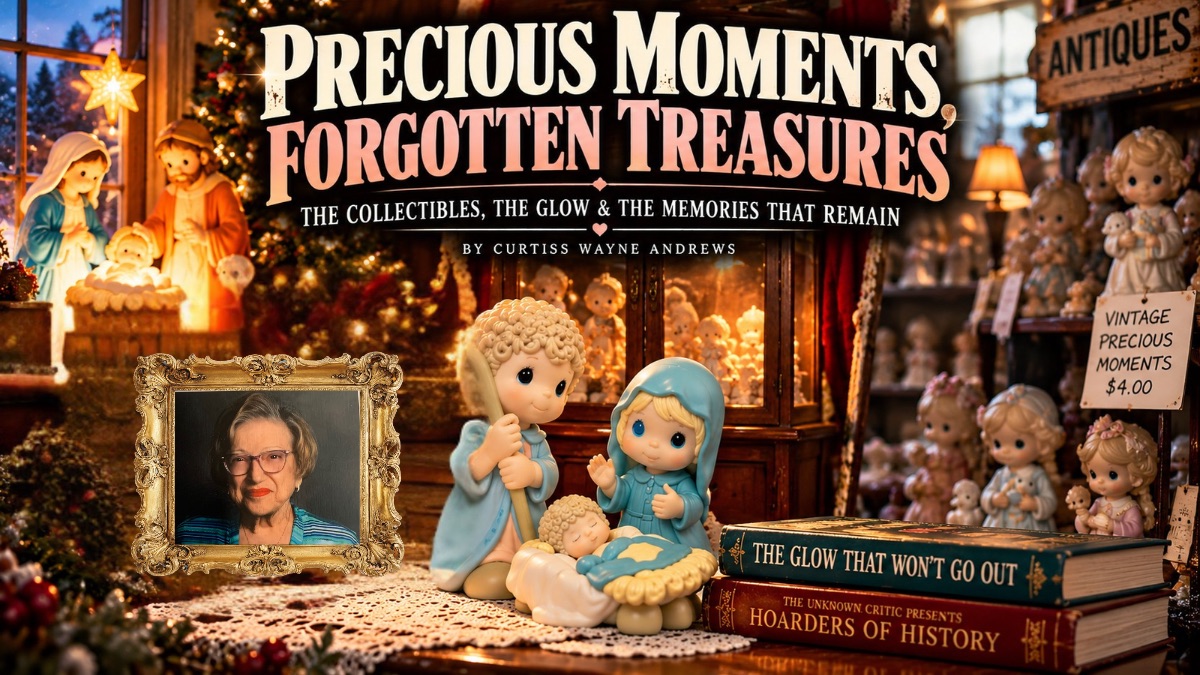
Once treasured in curio cabinets across America, Precious Moments figurines were symbols of love, family and faith. Two years after losing my mother, I’m beginning to understand why those little porcelain children—and their glowing plastic cousins—meant so much.
By Curtiss Wayne Andrews
Walk into almost any antique mall in America today and you’ll eventually find them.
The little porcelain children.
The enormous eyes.
The pastel clothing.
The tiny angels.
The sentimental messages about love, friendship, motherhood and faith.
Precious Moments.
There they sit, often arranged on a dusty shelf somewhere between a commemorative plate from 1987 and a ceramic goose wearing a bonnet.
Five dollars.
Eight dollars.
Three for twenty.
Sometimes still in their original boxes.
Sometimes with their certificates.
Occasionally with a handwritten sign declaring them RARE COLLECTIBLES, which is antique-mall language for PLEASE, SOMEBODY, TAKE THESE HOME.
And every time I see them, I think about my mother.
And my grandmother.
Because there was a time when these little figurines weren’t unwanted secondhand merchandise.
They were important.
They were treasured.
They were gifts carefully chosen for birthdays, anniversaries, Christmases and milestones.
They occupied places of honor in living rooms across America.
And in my family, they were practically royalty.
This October marks two years since my mother passed away.
As I continue researching America’s vintage holiday decorations for The Glow That Won’t Go Out, I keep discovering connections between the plastic Santas and snowmen I love and the other collectibles that filled the homes of my childhood.
One of those connections leads to a manufacturer in Lake Zurich, Illinois, called CobraCo.
And to an unlikely marriage between two very different collecting worlds:
The delicate porcelain figurines of Precious Moments.
And illuminated plastic blow molds.
But before we get to the plastic, we need to remember why those little porcelain children conquered America in the first place.
Before Precious Moments Became Collectibles, They Were Expressions of Faith
The Precious Moments story begins with artist Samuel J. Butcher.
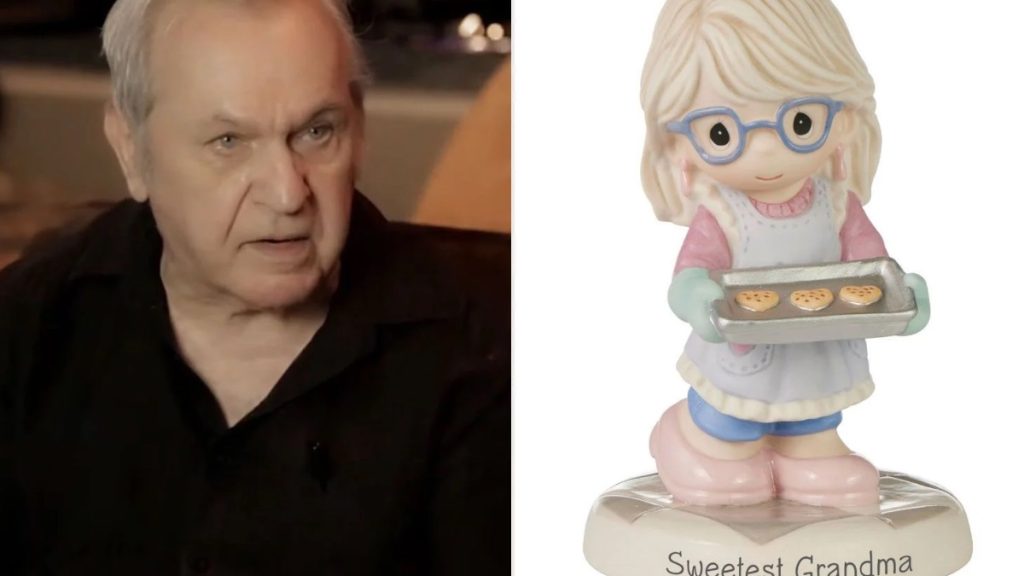
During the early 1970s, Butcher developed illustrations featuring children with distinctive teardrop-shaped eyes.
They were sweet, innocent and unmistakably sentimental.
His artwork drew heavily on his Christian faith and his desire to communicate messages of love, kindness, friendship and devotion.
Working with Bill Biel through a company called Jonathan & David, Butcher began bringing those illustrations to the public through greeting cards and other printed products.
Then came the moment that changed everything.
Enesco executive Eugene Freedman saw the potential to transform Butcher’s artwork into three-dimensional porcelain figurines.
A sculptor named Yasuhei Fujioka helped bring the drawings to life.
In 1978, the original collection of 21 figurines was introduced.
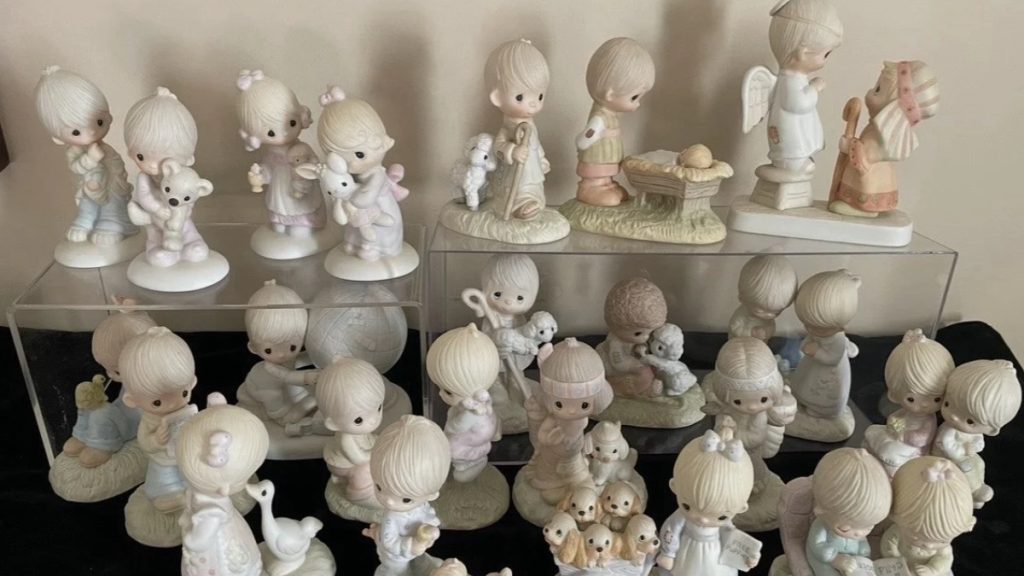
And an American collecting phenomenon was born.
It’s difficult to explain to someone who didn’t live through the 1980s just how thoroughly Precious Moments became part of the American gift-giving landscape.
They weren’t merely decorations.
They were emotional shorthand.
Need a gift for a new mother?
Precious Moments.
A wedding?
Precious Moments.
A baptism?
Precious Moments.
A graduation?
Precious Moments.
Someone you love has just experienced a difficult time?
There was probably a little porcelain angel for that, too.
If Hallmark had somehow figured out how to manufacture feelings out of ceramic material, this was the result.
And Americans loved them.
The 1980s: When a Curio Cabinet Was a Status Symbol
Today, the phrase collectible figurine doesn’t necessarily inspire excitement.
But in the 1980s, it was a serious business.
Department stores and gift shops displayed Precious Moments collections like miniature art galleries.
Collectors joined clubs.
They followed new releases.
They tracked retirement announcements.
They saved original boxes.
They bought pieces to commemorate significant moments in their lives.
The Precious Moments Collectors’ Club, founded in 1981, eventually attracted hundreds of thousands of members.
And for a certain generation, the collection itself became part of a family’s identity.
I know because my mother and grandmother were devoted collectors. They both invested in huge glass curio cabinets in order to properly display their massive Precious Moments collections.
Growing up, I understood that these weren’t ordinary knickknacks.
They were special.
There was something almost ceremonial about them.
You didn’t just toss a Precious Moments figurine onto a shelf next to the television remote.
It deserved a proper place.
Preferably somewhere safe.
Preferably somewhere a child couldn’t knock it over.
And preferably somewhere an adult could admire it while telling you precisely why you weren’t allowed to touch it.
I suspect a considerable percentage of American children learned the meaning of the phrase look with your eyes, not your hands because of Precious Moments.
But here’s what I appreciate now that I didn’t fully understand then.
My mother and grandmother weren’t simply accumulating figurines.
They were collecting expressions of things that mattered to them.
Family.
Faith.
Love.
Childhood.
Celebrations.
The passage of time.
Those little porcelain faces represented an emotional world they recognized.
And they wanted to surround themselves with it.
When Precious Moments Became Bigger Than the Curio Cabinet
By the late 1980s and into the 1990s, Precious Moments had become much more than a porcelain figurine line.
The artwork appeared on ornaments, dolls, greeting cards, home accessories and countless other licensed products.
The brand had become instantly recognizable.
And that recognition created an opportunity.
Why should those beloved teardrop-eyed children remain inside the house?
Why couldn’t they become part of the holiday display outside?
Why couldn’t they glow?
This is where the Precious Moments story intersects with the history of blow molds.
And where a company called CobraCo enters the picture.
CobraCo Manufacturing: The Lake Zurich Connection
CobraCo Manufacturing was associated with Lake Zurich, Illinois, a suburb northwest of Chicago.
The company operated in the broader market for manufactured home and outdoor products like plant stands, hanging baskets, and planters.
Its name is familiar to collectors of certain illuminated Precious Moments decorations, particularly Christmas and Nativity-themed plastic figures attributed to CobraCo.
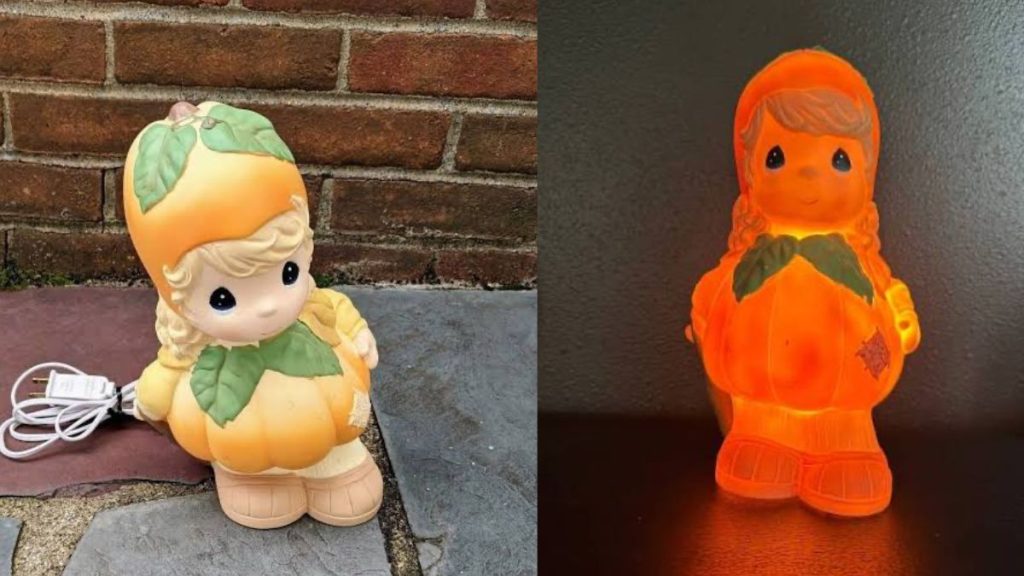
These pieces occupy an interesting corner of blow mold history.
Unlike the more familiar Santas, snowmen and jack-o’-lanterns produced by companies such as Empire, Union Products and General Foam, Precious Moments figures came with an already-established visual identity.
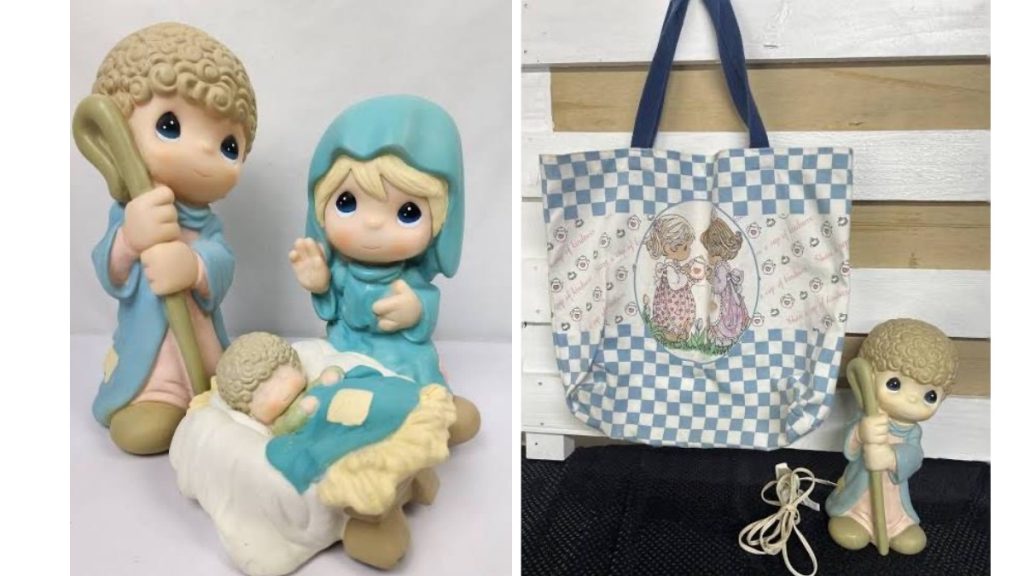
Their characters had to look gentle.
Innocent.
Immediately recognizable.
The appeal wasn’t simply the shape of the figure or the glow of the light inside.
It was the emotional connection people already had with Sam Butcher’s artwork.
And that presented a fascinating challenge.
How do you translate the delicate appearance of a porcelain collectible into a hollow plastic holiday decoration?
The two materials couldn’t be more different.
Porcelain is fragile, detailed and designed for careful indoor display.
Blow-molded plastic is lightweight, hollow and often intended for seasonal decorating.
Yet both can communicate the same feeling.
A sense of warmth.
A little innocence.
A memory of Christmas.
Collectors encounter Precious Moments illuminated plastic Nativity figures today, including representations of Joseph and other traditional Christmas characters.
Some secondary-market examples carry early-2000s dates.
However, a complete original CobraCo product catalog, licensing chronology and verified production history remain difficult to document. That means individual figures should be identified using their actual manufacturer markings, labels and original packaging rather than assuming every Precious Moments plastic decoration came from CobraCo.
That distinction matters to collectors.
Because the story of a decoration isn’t just about what it looks like.
It’s also about who made it, when it was made and how it reached American homes.
And the CobraCo connection is one I’d love to see better documented.
A Different Kind of Christmas Glow
Think about the traditional blow mold Christmas display.
Santa Claus.
A smiling snowman.
A toy soldier.
Maybe a Nativity scene.
Now imagine the familiar Precious Moments interpretation of the Christmas story.
The soft expressions.
The oversized eyes.
The gentle faces.
The childlike innocence.
The artwork that had already become part of millions of American family celebrations was suddenly represented in a format that could illuminate a holiday display.
That’s what makes these pieces so interesting.
They represent the meeting of two powerful traditions.
One was the American love affair with illuminated holiday decorations.
The other was the American love affair with sentimental collectibles.
For someone like my mother, who loved Precious Moments, I can easily understand the appeal.
And for someone like me, who loves blow molds, the connection is equally fascinating.
It’s almost as though two generations of collecting found common ground in a single decoration.
One generation admired the little porcelain figures inside.
Another discovered the larger illuminated figures outside.
Different materials.
Different displays.
The same desire to make the holidays feel special.
What Happened to the Precious Moments Craze?
Here’s where the story becomes bittersweet.
Because if you visit antique stores today, you might reasonably wonder what happened.
How did objects once so beloved become so easy to find?
The answer isn’t that people suddenly stopped caring about their families.
Or that the messages behind Precious Moments became meaningless.
The world changed.
Collecting changed.
Homes changed.
Tastes changed.
And the market changed.
During the collecting boom, Precious Moments figurines were frequently purchased with the expectation that certain pieces might become more desirable over time.
Collectors paid attention to retirements, editions, production marks and original packaging. I remember the Precious Moments nativity set being one of the most sought after pieces in the collection.
But the popularity of a collectible doesn’t guarantee future scarcity.
When enormous numbers of people buy, preserve and carefully store the same products, those products may survive in equally enormous numbers.
Decades later, collections enter the secondary market.
Families downsize.
Collectors pass away.
Children inherit cabinets filled with objects they don’t necessarily want or have room to display.
And suddenly, pieces that once seemed special are competing for attention in antique malls, estate sales and online listings.
Some genuinely rare Precious Moments pieces still attract collectors.
But many common figurines command modest resale prices.
That’s a painful lesson in the difference between sentimental value and market value.
And it’s a subject explored throughout Hoarders of History, where the larger world of collecting raises an uncomfortable question:
What happens when the things one generation treasured become the things the next generation doesn’t know what to do with?
The Cruel Mathematics of Sentimental Value
Let’s say your mother bought a Precious Moments figurine in 1985.
Maybe she received it for Mother’s Day.
Maybe your grandmother gave it to her (my grandmother bequeathed her entire collection to my mother, who already had a massive collection).
Maybe it marked a birthday, an anniversary or the arrival of a child.
For forty years, that figurine sits in her home.
It becomes part of the landscape of your childhood.
You see it every Christmas.
You see it when you visit.
You associate it with the person who owns it.
Then one day, the person is gone.
And you’re left holding a little porcelain figure that an antique dealer might value at six dollars.
Six dollars.
How do you reconcile that?
The object may have almost no commercial value.
But to you, it contains decades of memory.
It represents holidays.
Conversations.
Family gatherings.
The sound of someone’s voice.
A home that no longer exists in quite the same way.
And perhaps that’s the greatest misunderstanding in the entire collecting world.
We assume that the price of an object tells us what it’s worth.
It doesn’t.
Sometimes the most valuable thing in a collection is the piece nobody else wants.
Because nobody else knows its story.
My Mother, My Grandmother, and the Things They Loved
As I write this on the second anniversary of my mother’s passing, I find myself thinking less about the figurines themselves and more about what they represented to her.
My mother and grandmother were part of a generation that took genuine pleasure in collecting beautiful, sentimental things.
Precious Moments belonged to that world.
There was joy in finding a new piece.
Joy in giving one as a gift.
Joy in displaying it.
Joy in knowing that a particular figurine represented a particular moment in life.
I don’t want to romanticize every aspect of the collecting craze.
I’m sure plenty of money was spent on figurines that nobody needed.
I’m sure there were duplicates. Sometimes my father would forget which Precious Moments he got my mother from a previous Christmas or birthday and end up gifting her the same exact one. It happens.
I’m sure there were purchases justified with the timeless collector’s argument:
But this one is going to be retired!
And yes, I’m aware of the irony of making fun of people for collecting too many porcelain figurines while writing a book about people who collect hundreds of illuminated plastic snowmen.
Apparently, collecting runs in the family.
We just changed materials.
But I understand my mother and grandmother better now than I did as a child.
Because collecting isn’t always about the objects.
It’s about creating a world around yourself that reflects the things you love.
For them, Precious Moments represented tenderness, family and faith.
For me, vintage blow molds represent Christmases gone by, childhood memories and the glowing decorations that once filled American neighborhoods.
And maybe those passions aren’t so different after all.
Maybe we’re all trying to preserve something.
Samuel Butcher Understood Something Important
There’s another reason I find the Precious Moments story especially moving.
Sam Butcher didn’t begin with the idea of creating a speculative collectible market.
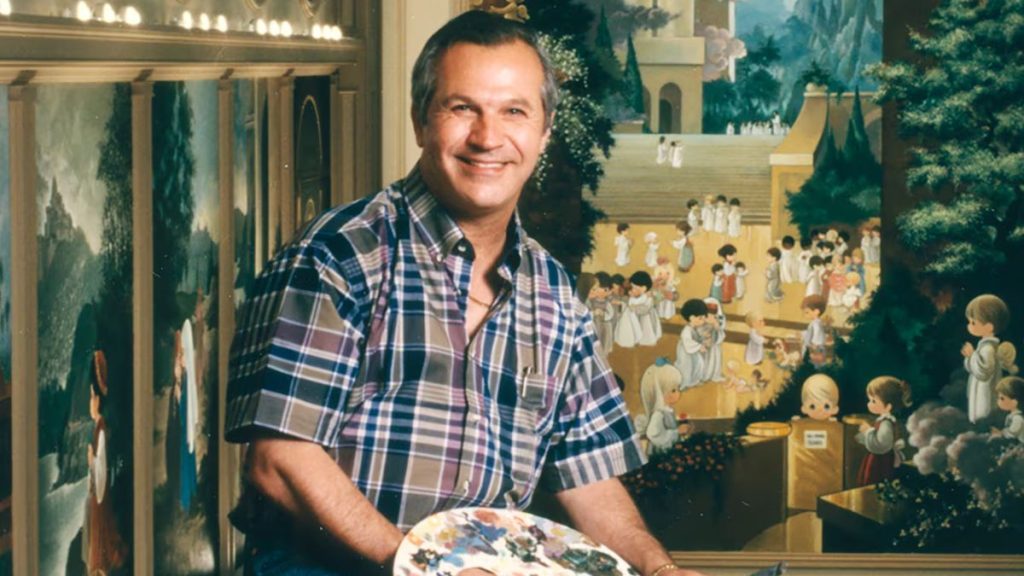
His work grew from personal faith and a desire to communicate love.
Those teardrop-eyed children were intended to express something heartfelt.
The commercial phenomenon came later.
In 1989, Butcher opened the Precious Moments Chapel in Carthage, Missouri. For a family like mine living in Iowa and a mother obsessed with her vast collection, this was a must-do road trip.
It became a physical expression of his artistic and spiritual vision, filled with murals celebrating faith and devotion.
Butcher died in 2024 (ironically, the same year as my mother), leaving behind a remarkable artistic legacy.
And although the collecting market has changed dramatically, the company and its community continue.
In fact, Precious Moments and Enesco announced a renewed licensing partnership in late 2025, reconnecting two names central to the brand’s original success.
It’s a reminder that a collectible’s popularity can rise and fall without erasing the ideas behind it.
The figurines may no longer occupy the same place in American popular culture that they did forty years ago.
But love, kindness, faith and remembrance haven’t gone out of style.
And neither has the need to express those things through gifts.
Why CobraCo’s Precious Moments Blow Molds Deserve to Be Remembered
This is one of the reasons I’ve become so passionate about documenting vintage blow mold manufacturers.
The industry was much bigger than the most famous names.
Yes, Empire, Union Products and General Foam are essential parts of the story.
But there were also smaller, less thoroughly documented product lines, licensing arrangements and companies whose decorations became part of family traditions. These are the ones I find most fascinating to research.
CobraCo’s Precious Moments connection belongs in that broader history.
These figures weren’t necessarily produced in the same quantities as the most familiar holiday decorations.
Their appeal also crossed collecting categories.
A Precious Moments enthusiast might want one because of the characters.
A blow mold collector might want one because of its construction and illumination.
A Nativity collector might want one because of its religious theme.
And someone else might simply remember seeing one at Grandma’s house.
That’s the beauty of these objects.
They can mean different things to different people.
I would especially welcome information from collectors who own CobraCo-marked Precious Moments figures.
Original boxes.
Catalog pages.
Manufacturer labels.
Copyright dates.
Advertising.
Retail packaging.
Any of those details could help preserve a product history that deserves greater attention.
Because someday, if we don’t document these things, the history becomes harder to reconstruct.
And eventually, all that’s left is a mysterious plastic figure sitting on a shelf with a handwritten price tag.
Maybe Nobody Wants Them. But Somebody Still Remembers.
Not long ago, I found myself looking at Precious Moments figurines in an antique store.
There they were.
The familiar faces.
The little angels.
The children holding hearts.
The pastel colors.
The same visual language that once filled my mother’s and grandmother’s homes. The same ones I’d spent years staring at in those giant curio cabinets or looking for at the local gift shops to buy as holiday or birthday gifts for my mom.
And almost nobody was paying attention.
Shoppers walked past.
The figurines sat quietly.
Some were priced so inexpensively that I couldn’t help thinking about what they might have cost when they were new.
But what struck me wasn’t the decline in value.
It was the passage of time.
An entire generation once found enormous meaning in these objects.
They collected them.
Gave them as gifts.
Displayed them proudly.
And built memories around them.
Now many of those collectors are gone.
Their homes have been emptied.
Their collections have been scattered.
And the little porcelain children have become artifacts of another era.
I suppose that’s what happens to almost everything eventually.
Fashion changes.
Tastes evolve.
The objects we treasure become someone else’s curiosities.
But standing there, I didn’t see outdated collectibles.
I saw my mother.
I saw my grandmother.
I saw the world they created around themselves.
And I remembered that there was a time when those little figures made them happy.
That should count for something.
Actually, I think it counts for quite a lot.
The Glow That Doesn’t Go Out
I began writing The Glow That Won’t Go Out because I wanted to preserve the history of vintage illuminated holiday decorations.
The companies.
The designs.
The collectors.
The stories.
But somewhere along the way, I realized that the book was also about something much more personal.
It’s about the things we carry with us.
The objects that reconnect us to people and places we’ve lost.
The decorations that can transport us back to childhood with the flick of a switch.
And the strange, wonderful human instinct to preserve memories by preserving things.
That’s why the story of Precious Moments belongs here.
Because whether it’s a porcelain angel in a curio cabinet or an illuminated plastic Nativity figure in the front yard, the impulse is the same.
We surround ourselves with reminders of what matters.
And sometimes, long after the people who bought those objects are gone, the objects remain.
Waiting for someone to recognize them.
Waiting for someone to remember.
Two years after losing my mother, I find myself thinking about the phrase Precious Moments differently.
Not as a brand.
Not as a collecting craze.
Not as a line of figurines that once dominated American gift shops.
But as a description of the things I wish I could have back.
One more conversation.
One more holiday.
One more ordinary afternoon that I didn’t realize would someday become extraordinary in my memory.
I can’t have those moments back.
But I can remember them.
And maybe that’s why I keep writing about old decorations and forgotten collectibles.
Because beneath the plastic, porcelain and cardboard boxes, there’s something worth saving.
The people who loved them.
And the precious moments they left behind.
Two Books. One Fascination With the Things We Keep.
In The Glow That Won’t Go Out, I explore the history of vintage blow molds and the collectors preserving America’s illuminated holiday traditions.
And in Hoarders of History, readers can explore the larger world of collecting—the objects we accumulate, the stories we attach to them and the complicated question of what happens when collections outlive their owners.
One book is about the glow of holiday decorations.
The other is about the enduring fascination with things from the past.
Both remind us that the real value of a collection isn’t always found on a price tag.
Explore Hoarders of History: https://www.amazon.com/dp/B0FCYYCS9Z
Explore The Glow That Won’t Go Out: https://www.amazon.com/dp/B0HKGJKFC8
Dedicated to my mother, on the second anniversary of her passing, and to my grandmother—two women who taught me, long before I understood it, that the things we collect are often reminders of the people and moments we love.