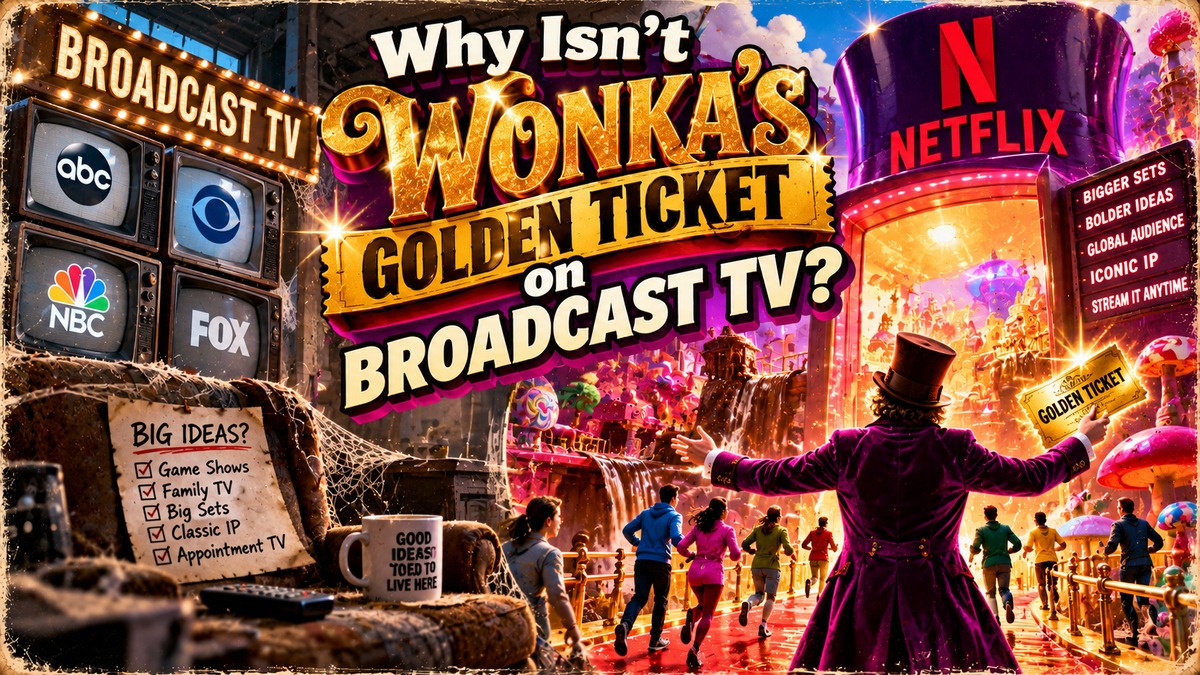
Netflix built a giant chocolate factory, resurrected Wonkavision and created the kind of big, ridiculous, family-friendly reality show network television used to own. So why does watching it feel like another nail in traditional TV’s coffin?
I was watching Wonka’s The Golden Ticket on Netflix when something strange happened.
Not the chocolate river.
Not the Oompa Loompas.
Not the contestants being asked to make important life decisions while standing next to a 14-foot gumball machine.
I had a more disturbing thought.
Why the hell isn’t this on broadcast television?
Seriously.
Look at this show.
It’s Willy Wonka.
It’s a competition.
It’s family-friendly.
It has celebrities.
It has enormous sets.
It has games.
It has eliminations.
It has nostalgia.
It has contestants crying.
It has contestants forming alliances.
It has contestants saying things like:
“I didn’t come here to make friends.”
You’re standing next to an edible mushroom, Chad.
Calm down.
This is exactly the kind of giant, colorful, broad-appeal reality spectacle that television networks spent 50 years putting on television.
And yet here I am.
Watching it on Netflix.
Which leads me to an uncomfortable conclusion:
Streaming isn’t just stealing television’s audience anymore.
Streaming is stealing television’s job.
WELCOME TO THE CHOCOLATE FACTORY
The premise of Wonka’s The Golden Ticket is wonderfully ridiculous.
Twelve Golden Ticket winners each bring a partner into Wonka’s Chocolate Factory, where they’re subjected to physical challenges, strategy games, temptations and various tests of character.
Basically:
Survivor, if Jeff Probst owned a confectionery company and had unresolved childhood issues.
The prize is advertised as a “lifetime supply of money.”
Which sounds like something Wonka would invent until you read the fine print.
It’s $3 million.
Paid as $100,000 a year for 30 years.
So apparently Willy Wonka has become a financial planner.
“Congratulations, Charlie! You’ve inherited the factory!”
“Wonderful!”
“Unfortunately, it’s an annuity.”
“Oh.”
The contestants live inside this enormous Wonka environment and compete in challenges inspired by the original story and the beloved 1971 film.
There’s the Chocolate Room.
The Wonkatania.
The Great Glass Elevator.
Golden eggs.
Gobstoppers.
Lickable wallpaper.
Even Wonkavision.
The production reportedly built an enormous multi-studio factory complex in Australia specifically for the series.
This isn’t twelve people standing behind podiums at Television City.
They built Wonka World.
And visually?
It’s impressive.
Really impressive.
Which brings me back to my question.
WHY ISN’T THIS ON TELEVISION?
Yes, yes.
Technically Netflix is television now.
I understand.
Please don’t email me.
You know what I mean.
I’m talking about:
ABC.
CBS.
NBC.
Fox.
Or one of the dozens of traditional cable networks currently broadcasting some variation of:
“People Who Renovate Cabins While Possibly Dating.”
Wonka’s The Golden Ticket feels like a broadcast-network concept.
Big recognizable IP.
Broad family appeal.
Competition format.
Celebrity appearances.
Weekly watercooler potential.
Built-in nostalgia.
Merchandising opportunities.
Easy promotion.
You could put this thing behind an NFL game and half the country would accidentally watch it.
Instead?
Netflix.
Again.
AND THE SHOW ISN’T EVEN THAT GOOD
Here’s the funniest part.
I don’t think Wonka’s The Golden Ticket is some masterpiece.
Far from it.
Critics have been beating this thing like it stole Fizzy Lifting Drinks.
The challenges sometimes feel overcomplicated.
The strategy occasionally swallows the whimsy.
There are moments when the show seems less interested in Wonka’s magical world than in turning it into:
CANDY SURVIVOR: OUTWIT, OUTPLAY, OUTDIABETES.
And then there’s the AI recreation of Gene Wilder’s voice.
Oh boy.
The production received permission from Wilder’s widow and clearly treated the process seriously.
I understand what they’re attempting.
But there is something profoundly unsettling about hearing an approximation of Gene Wilder’s Wonka floating through a reality competition decades after Wilder died.
It’s less:
“Come with me and you’ll be in a world of pure imagination…”
and more:
“Your Alexa has become sentient and would like you to enter the Chocolate Room.”
I kept expecting:
“Augustus, you’ve been eliminated.”
“Also, your Amazon package has arrived.”
BUT THEN THE FACTORY SAVES IT
Here’s the frustrating part.
Every time I started rolling my eyes…
I’d look at the set.
Good Lord.
Netflix didn’t build a game-show set.
It built an environment. I wanted to be there. Hell, it could be a theme park attraction and I’d pay Disney prices to visit.
The production team constructed an enormous Chocolate Factory across multiple studios in Australia’s Gold Coast.
There are practical illusions.
Working machinery.
A chocolate river.
Edible scenery.
A Wonkavator.
A Wonkatania.
Miles of decorative material.
Thousands of gallons of various substances that somebody apparently had to explain to an accountant.
Imagine that meeting.
ACCOUNTANT: Why do you need 27,000 gallons of fake chocolate?
PRODUCER: River.
ACCOUNTANT: Of course. Approved.
This is where the show becomes fascinating even when the game itself isn’t.
Because Netflix spent money making it look like an event.
REMEMBER WHEN NETWORK TELEVISION DID THAT?
That’s the part that bothers me.
Traditional television used to specialize in events.
Networks wanted you to feel that something was happening.
Tonight.
At 8.
And if you didn’t watch it?
Everyone at work would talk about it tomorrow and you’d sit there pretending you understood.
“Oh yeah. That ending was crazy.”
You hadn’t seen it.
But you weren’t going to admit that to Linda in Accounting.
Game shows were events.
Reality finales were events.
Miniseries were events.
Made-for-TV movies were events.
Sweeps were events.
Even ridiculous celebrity specials felt like events.
Networks understood that their biggest advantage was scale.
They could put something in front of tens of millions of people simultaneously.
And somewhere along the way…
They stopped acting like that was an advantage.
WELCOME BACK TO CHANNELMANIA
This is exactly the kind of insanity I explore in Channelmania.
Television spent decades creating more channels.
Then more cable networks.
Then more niche networks.
Then digital channels.
Then streaming services.
Then streaming services inside other streaming services.
Then FAST channels.
Then bundles containing the streaming services that were created to replace the bundles.
We’ve basically reinvented cable television while insisting we defeated cable television.
Congratulations, everyone.
We made cable.
Again.
But there’s a deeper problem.
Traditional television became so obsessed with managing decline that it sometimes forgot to create reasons not to decline.
Cut costs.
Reduce episodes.
Share programming.
Run repeats.
Fill hours cheaply.
Move expensive programming elsewhere.
Protect margins.
Manage erosion.
Then everybody gathers for the quarterly earnings call and wonders:
“Why are viewers leaving?”
Maybe because Netflix just built Willy Wonka’s Chocolate Factory while Channel 47 is airing Episode 11 of Storage Shed Deputies.
NETFLIX IS BECOMING THE NETWORK
Think about Netflix’s evolution.
Originally, Netflix was where you went to watch other people’s television.
Then Netflix started making prestige television.
Then movies.
Then reality shows.
Then competition series.
Then documentaries.
Then stand-up comedy.
Then live events.
Then sports.
Then wrestling.
Then children’s programming.
Then game shows.
And now it’s building giant family entertainment spectacles based on recognizable intellectual property.
At what point do we stop calling Netflix “the streamer”?
This isn’t some scrappy technology company sneaking around Hollywood anymore.
Netflix is increasingly behaving like the network television networks forgot how to be.
Except instead of three hours of primetime…
Netflix owns the entire day.
THE WONKA IRONY IS DELICIOUS
Here’s where this gets particularly strange.
Netflix owns the Roald Dahl Story Company.
So it isn’t merely borrowing Wonka for one random reality show.
It’s building an ecosystem.
Netflix has already adapted Dahl properties and has more coming.
Wonka isn’t just a movie character.
He’s IP.
And streaming understands IP.
Maybe better than television currently does.
The goal isn’t simply:
MAKE SHOW.
It’s:
MAKE SHOW.
BUILD WORLD.
CREATE FRANCHISE.
SELL PRODUCTS.
MAKE ANIMATED MOVIE.
CREATE EXPERIENCES.
KEEP PEOPLE INSIDE ECOSYSTEM.
That used to be the kind of vertically integrated corporate thinking that made television executives salivate.
Now Netflix is doing it while traditional media companies are trying to figure out whether two declining cable channels can share a programming department.
AND HERE’S THE REALLY EMBARRASSING PART
The Golden Ticket contains something called:
WONKAVISION.
Wonkavision!
The fictional technology from Willy Wonka & the Chocolate Factory that sends objects through television.
And where can you watch the modern version of Wonkavision?
Not primarily on traditional television.
On Netflix.
You cannot make this up.
Mike Teavee spent 1971 obsessed with television.
Fifty-five years later, television lost him to streaming.
That’s not irony.
That’s an industry obituary written by an Oompa Loompa.
THE STREAMERS HAVE THE CONFIDENCE NOW
This may be the biggest difference.
Netflix behaves like it expects people to show up.
Traditional television increasingly behaves like it’s afraid they won’t.
Those are very different creative positions.
One says:
“Build the chocolate factory.”
The other says:
“Can we do the chocolate factory in one room?”
One says:
“Let’s make it visually enormous.”
The other says:
“Could we use the set from another show?”
One says:
“Let’s turn recognizable IP into a global reality competition.”
The other says:
“Do we have another celebrity singing format?”
or “How about another police or medical procedural set in a city we haven’t exploited yet.” 9-1-1 Topeka, here we come.
This isn’t universally true, obviously.
Broadcast television still produces major shows.
Cable still produces excellent television.
Traditional media companies remain enormously powerful.
But the direction of travel is impossible to ignore.
Streaming used to compete with television by offering convenience.
Now it’s competing on ambition.
That’s much more dangerous.
AND PEOPLE WATCHED
Here’s another problem for anyone hoping to dismiss The Golden Ticket as streaming excess.
People watched the thing.
Despite terrible reviews, the show reportedly attracted about 4.6 million views during its first week and reached No. 2 on Netflix’s English-language television chart.
That’s fascinating.
The critics essentially said:
BAD EGG.
The audience said:
Okay, but what’s behind that door?
Which proves something television executives used to understand instinctively.
Sometimes audiences don’t need perfection.
They need a reason to look.
Wonka gives them a reason.
The factory gives them a reason.
The Golden Ticket gives them a reason.
The spectacle gives them a reason.
Familiarity gets you through the door.
Execution determines whether you stay.
THAT’S WHAT LINEAR TV IS LOSING
The crisis facing traditional television isn’t simply:
“People prefer streaming.”
That’s too easy.
People prefer interesting things.
They prefer convenient things.
They prefer things that feel worth their time.
And increasingly the streamers have stopped merely offering a better delivery mechanism.
They’re offering the programming that once would have defined network television.
Big competition shows.
Live sports.
Wrestling. Yes, it’s still popular.
Reality franchises.
Event programming.
Family entertainment.
Prestige dramas.
Movies.
Stand-up.
Documentaries.
International hits.
Children’s programming.
Traditional television’s response cannot simply be:
“But we’re free with an antenna!”
That’s not a strategy.
That’s a fun fact.
GOLDEN TICKET COULD HAVE BEEN APPOINTMENT TELEVISION
Imagine this show airing once a week.
A major network.
Sunday night.
Families watching together.
Promotion during football.
Golden Tickets hidden around the country.
Contestants appearing on morning shows.
Eliminations discussed the next day.
Kids arguing about their favorites.
A finale promoted for weeks.
That’s not some radical concept.
That’s…
television.
Old-fashioned, broad-audience, unapologetically populist television.
And maybe The Golden Ticket wouldn’t have worked.
Maybe viewers would have rejected it.
Maybe critics still would’ve fired it directly into the chocolate river.
But at least it would have been a swing.
Television needs swings.
Not everything can be programmed by spreadsheet.
THE GREAT CHANNELMANIA REVERSAL
For years, the assumption was that streaming would become more like television.
Ads.
Live programming.
Sports.
Weekly releases.
Bundles.
Lower-cost tiers.
And that’s happening.
But television is also becoming more like the worst version of streaming.
Smaller audiences.
Fragmented programming.
Confusing distribution.
Content moving between platforms.
Shows disappearing.
Brands losing identity.
Viewers unsure where anything lives.
It’s the strangest possible outcome.
Streaming stole television’s weaknesses…
then started stealing its strengths.
Netflix now has advertising.
Traditional television now has nobody watching the commercials.
Fantastic trade.
MAYBE THE GOLDEN TICKET ISN’T THE SHOW
Maybe the real Golden Ticket is the idea itself.
A giant piece of familiar intellectual property.
A broad family audience.
A competition format.
Spectacle.
Nostalgia.
Games.
Celebrities.
A massive physical production.
A premise you can explain in seven seconds.
“People compete inside Willy Wonka’s Chocolate Factory.”
That’s a television executive’s dream.
Or at least it used to be.
And that’s why I find Wonka’s The Golden Ticket more interesting than I find it good.
The show itself?
Messy.
Overproduced.
Sometimes clever.
Sometimes exhausting.
Occasionally magical.
Occasionally like somebody trapped Survivor, Squid Game and Candy Land inside the same elevator and pressed every button.
But as an industry artifact?
It’s fascinating.
Because it represents the moment streaming stopped saying:
“Watch television differently.”
and started saying:
“WE’LL MAKE THE TELEVISION TOO.”
SO WHY ISN’T WONKA ON BROADCAST TV?
Because the television business changed.
Because ownership changed.
Because audiences changed.
Because economics changed.
Because Netflix owns Roald Dahl’s story company and has every reason to turn those characters into global streaming franchises.
All true.
All rational.
All very corporate.
But sit back and actually watch The Golden Ticket for a minute.
Look at that enormous factory.
Look at the contestants.
Look at the celebrity game-show hosts.
Look at the challenges.
Look at the nostalgia.
Look at the family-friendly premise.
Then tell me this wouldn’t have fit perfectly on a broadcast network 15 years ago.
That’s the point.
Streaming didn’t just steal the future.
It’s starting to steal television’s past too.
The game show.
The reality competition.
The family event.
The big Sunday-night spectacle.
The watercooler show.
The familiar IP.
The thing everybody knows.
The thing everybody can watch.
The thing television used to be exceptionally good at making.
And perhaps that’s the most Channelmania thing imaginable.
We created hundreds of channels because we wanted infinite choice.
Then streaming arrived and gave us infinite choice.
Now the streamers are discovering something the old networks knew all along:
Sometimes people don’t want infinite choice.
Sometimes they just want somebody to build a giant chocolate factory and say:
“Watch this.”
Traditional television should probably be paying attention.
Preferably before Netflix finds the Golden Ticket to the rest of its audience.
— The Unknown Critic