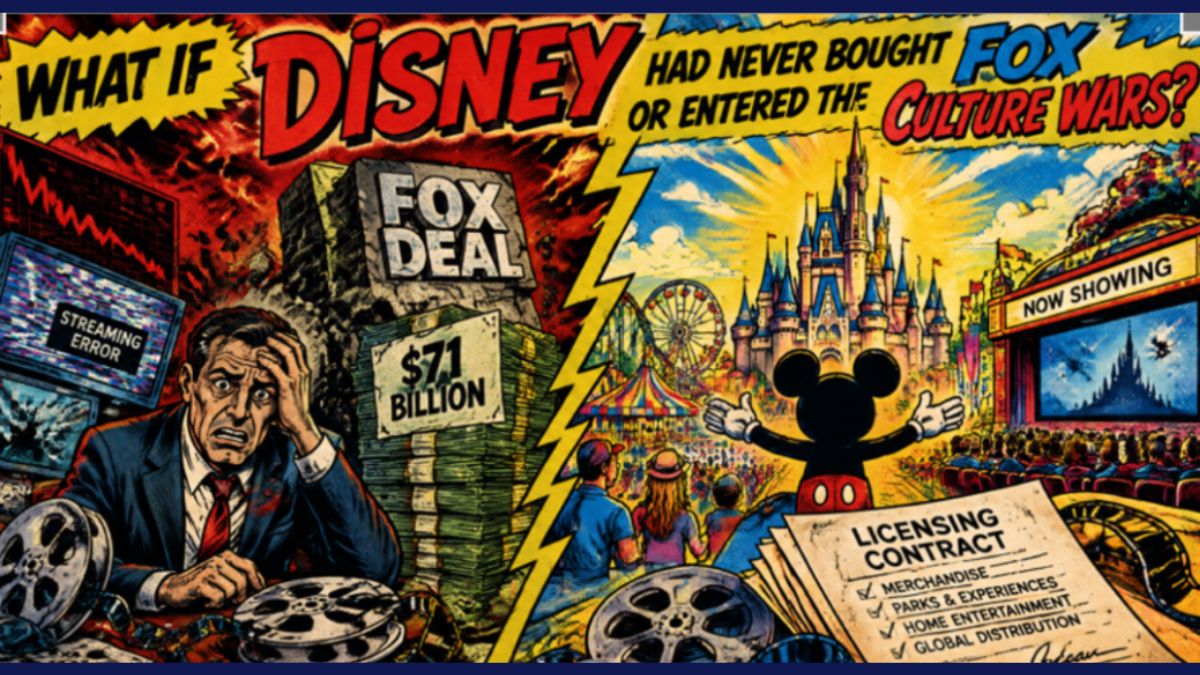
In an alternate universe, Mickey Mouse keeps his mouth shut, Bob Iger keeps $71 billion off the shopping list, and Netflix continues paying Disney for the privilege of entertaining its subscribers. Could the House of Mouse have been better off?
I used to love Marvel’s What If…? comic books.
For those who didn’t grow up spending their allowance at comic book stores, the premise was wonderfully simple. Take a familiar Marvel storyline, change one seemingly insignificant decision, and watch the entire universe go haywire. What if Spider-Man had joined the Fantastic Four? What if Captain America hadn’t disappeared during World War II? What if somebody at Marvel had finally told Tony Stark that putting a nuclear reactor in his chest probably wasn’t the healthiest long-term lifestyle choice?
Okay, I made that last one up. But you get the idea.
Those comics were irresistible because they understood something Hollywood executives frequently forget: sometimes the most interesting story isn’t what happened. It’s what could have happened if somebody had made a different decision.
Which brings me to the Walt Disney Company, a corporation that has spent much of the past decade behaving like a Marvel character who acquires every Infinity Stone, discovers that possessing unlimited power is surprisingly expensive, and then wonders why half the universe is angry with him.
I’ve been thinking about a particularly fascinating alternate timeline.
What if Disney never purchased most of 21st Century Fox? What if it largely stayed out of America’s political food fights? And what if, instead of trying to defeat Netflix at its own game, Disney continued doing what it had done spectacularly well for decades: creating entertainment that other companies were willing to pay enormous amounts of money to distribute?
I’m not suggesting that Disney would have escaped every problem facing Hollywood. Cable television was already declining, moviegoing habits were changing, and the pandemic was waiting around the corner to introduce its own brand of corporate misery.
But I suspect Disney might be in a much better position today. Possibly a much better position.
So indulge me for a few minutes as we travel to an alternate universe where Mickey Mouse never bought the Fox, Disney never became a recurring guest on cable-news shouting matches, and the streaming wars played out rather differently.
Cue the dramatic comic-book narration.
Issue #1: What If Bob Iger Had Walked Away From the Fox Deal?
Our story begins in 2017.
Disney was riding high. Marvel Studios had transformed comic-book movies into a seemingly unstoppable box-office machine. Pixar remained one of the most respected animation brands in the world. Lucasfilm had brought Star Wars into the Disney family, and the company’s theme parks continued attracting enormous crowds.
Bob Iger had already accomplished something remarkable by acquiring Pixar, Marvel, and Lucasfilm. These weren’t merely purchases of movie studios. They were acquisitions of creative engines that could produce films, merchandise, attractions, and television programming for generations.
It was an extraordinary run.

Then came Fox.
Disney originally agreed to purchase a large portion of 21st Century Fox for approximately $52.4 billion in stock. Comcast entered the picture with a competing offer, and suddenly Disney found itself in a bidding war that ultimately pushed the announced transaction value to $71.3 billion.
Seventy-one billion dollars.
For perspective, that’s the kind of money that makes even Dr. Evil lower his pinky and ask somebody to check the calculator.
Disney wasn’t simply buying another movie studio. The deal included the 20th Century Fox film and television operations, FX, National Geographic, international television assets, and Fox’s stake in Hulu, among other properties. The transaction also involved debt and required significant divestitures, bringing Disney’s estimated net acquisition cost to roughly $57 billion after asset sales.
The logic wasn’t completely crazy. Disney wanted a larger content library, international distribution capabilities, and greater scale for its coming streaming business. It also gained valuable franchises, including Avatar, The Simpsons, and the Fox-controlled Marvel characters.
But here’s where our alternate universe branches away.
Imagine Iger looking at Comcast’s escalating bid and saying, “You know what? Let them have it.”
No dramatic press conference. No last-minute financial gymnastics. No enormous acquisition that would reshape Disney’s balance sheet just before a global pandemic.
Disney keeps its existing powerhouse franchises and retains far more financial flexibility. And the Fox assets? They end up somewhere else.
Maybe Comcast gets them. Maybe the properties are divided among different buyers. Perhaps some studios remain independent longer than anyone expects.
The exact outcome is impossible to predict, but the most important consequence is obvious: Disney doesn’t spend tens of billions of dollars acquiring another massive entertainment operation at the very moment the traditional television business is beginning to deteriorate.
Think about the opportunities that money could have represented.
Disney could have invested more aggressively in its parks, strengthened its existing film studios, reduced debt, repurchased shares, or simply maintained a substantial financial cushion for whatever catastrophe came next.
And as we know, a rather substantial catastrophe arrived in 2020.
The pandemic shut down theme parks, disrupted film releases, and hammered businesses that depended on people leaving their homes. Disney survived, of course, but imagine facing that crisis without the financial obligations and integration challenges associated with the Fox acquisition.
That’s an alternate history worth considering.
Of course, Disney would have sacrificed some valuable properties. Avatar alone has remained a formidable theatrical franchise, while FX and Hulu brought considerable strategic value. Fox’s Marvel characters also created possibilities that comic-book fans had wanted to see for years.
But was acquiring all of that worth the price?
There’s a difference between buying something valuable and paying too much for it. Anybody who’s ever attended an estate auction and gotten carried away bidding on a vintage jukebox understands the distinction.
The jukebox may be terrific. You still have to explain why you spent twice what you intended.
Issue #2: What If Disney Had Remained Hollywood’s Most Powerful Arms Dealer?
This is where the alternate universe gets especially interesting.
Before Disney decided it needed to own the entire streaming experience, it enjoyed an enviable position in the entertainment business. It controlled some of the most desirable intellectual property on the planet, and other companies were willing to pay handsomely for access.
Netflix wanted Disney movies. Cable networks wanted Disney programming. Television distributors wanted ESPN. International broadcasters wanted the company’s films and shows.
Disney owned the ammunition. Everybody else needed to buy it.
In December 2012, Netflix and Disney announced a major licensing agreement that would bring new Disney theatrical releases to Netflix during the exclusive U.S. subscription television window beginning with the studio’s 2016 releases.
The arrangement included films from Disney Animation, Pixar, Marvel, and other Disney labels.
Think about the beauty of that business model.
Netflix had to attract subscribers, maintain its technology, develop its recommendation systems, handle customer service, and convince people not to cancel their subscriptions. Disney could produce a hit movie, enjoy its theatrical revenue, and then collect licensing fees when the film moved to its next distribution window.
The risks weren’t identical, of course. Disney still had enormous production and marketing expenses. But it didn’t need to shoulder the entire cost of building a global subscription platform to monetize its films.
Then Disney decided it wanted to become Netflix.
And suddenly the company that had been selling ammunition to the combatants decided it needed to enter the battlefield itself.
Now, to be fair, Disney had legitimate reasons for making that decision. Traditional television subscriptions were declining, consumers were shifting toward on-demand viewing, and Netflix was becoming powerful enough to influence the economics of Hollywood itself.
Remaining dependent on outside distributors carried risks. Netflix could demand better terms, prioritize its own productions, or eventually decide it no longer needed Disney’s content.
But there’s a reasonable argument that Disney overcorrected.
Instead of operating a relatively modest branded streaming service while continuing to license much of its content elsewhere, Disney went all-in on direct-to-consumer distribution. It spent heavily on technology, international expansion, marketing, and original programming, while sacrificing some of the licensing revenue it might otherwise have collected.
And once every major media company began launching a competing service, the economics became increasingly ugly.
Consumers weren’t going to subscribe to every platform forever. Content costs remained enormous. Customer acquisition was expensive, and subscribers could cancel with a few taps on their phones.
The industry had successfully reinvented cable television, except now customers had to remember twelve different passwords.
Congratulations, everybody.
Imagine instead a Disney that maintained a carefully curated streaming offering for its most loyal fans but continued licensing significant portions of its film and television library to Netflix, Amazon, broadcasters, and other distributors.
Disney wouldn’t need to win the streaming wars. It could make money regardless of who won. And maybe Disney wouldn’t be crawling back to Netflix in 2026.
That’s the kind of position most companies would kill to occupy.
Issue #3: What If the Streaming Wars Had Been Somebody Else’s Problem?
Let’s talk about the financial damage.
During Disney’s early streaming expansion, its direct-to-consumer operations accumulated enormous losses. A 2024 presentation from activist investor Trian Partners estimated that Disney’s cumulative streaming losses had exceeded $14 billion through fiscal 2023.
That’s not a typo.
Fourteen billion dollars in cumulative losses, using Trian’s analysis of Disney’s reported figures.
And that doesn’t include the full financial cost of purchasing Fox or taking complete ownership of Hulu.
To put that into perspective, Disney could have financed an astonishing amount of new theme-park development with the money consumed by its streaming ambitions. It could have invested in attractions, expanded resorts, or funded theatrical films without requiring every new release to justify its existence as part of an ever-growing subscription-content machine.
Instead, Disney spent years chasing subscriber growth.
Remember when streaming executives loved announcing subscriber totals?
Every quarterly earnings report seemed to resemble a telethon, with companies proudly revealing how many millions of people had signed up. Whether those subscribers were generating attractive profits was sometimes treated as an inconvenient detail to be discussed later.
Disney wasn’t alone in this madness. Warner Bros., Paramount, NBCUniversal, and practically every other major entertainment company became convinced that the future belonged to whoever could accumulate the largest collection of streaming subscribers.
It was like watching a room full of casino gamblers convince themselves that the next spin would finally pay for the previous twenty.
Eventually, Wall Street remembered that businesses are supposed to make money.
And here’s where I have to give Disney credit: its streaming operation has improved substantially.
By fiscal 2025, Disney reported approximately $1.33 billion in annual direct-to-consumer operating income, compared with just $143 million the previous year. Its Disney+ and Hulu services had grown into a substantial global business.
So the streaming strategy hasn’t been an unqualified disaster. Far from it.
But the What If…? question remains.
Could Disney have earned more money over the same period by licensing its content, avoiding much of the infrastructure spending, and letting competing streaming companies fight over its programming?
We can’t know the answer without access to an alternate universe’s financial statements.
I suspect the answer might be yes. And I suspect Disney’s executives would have slept considerably better along the way.
Issue #4: What If Mickey Mouse Had Stayed Out of Politics?
Now we arrive at the chapter that’s guaranteed to make somebody angry.
Which, ironically, is precisely the problem.
Disney spent generations cultivating an image as a company that belonged to everybody. Families across the political spectrum visited its theme parks, watched its movies, and purchased merchandise featuring characters that had become part of American popular culture.
Walt Disney himself had political opinions, of course. The company has never existed in some magical vacuum where politics couldn’t reach it, and its films have often reflected the values and social attitudes of their times.
But there was a difference between having a corporate identity and becoming a central character in a national political confrontation.
That distinction became painfully obvious in 2022.
Florida passed legislation restricting certain classroom instruction about sexual orientation and gender identity, a measure that supporters described as protecting parental rights and critics condemned as discriminatory toward LGBTQ people.
Disney initially faced criticism from employees and advocates who believed the company wasn’t doing enough to oppose the legislation. After Disney publicly criticized the law, Florida Governor Ron DeSantis and Republican lawmakers targeted the company’s longstanding special-governance arrangements surrounding Walt Disney World.
The resulting fight involved lawsuits, political retaliation allegations, corporate statements, and enough cable-news commentary to power a small city.
By March 2024, Disney and the Florida oversight district reached a settlement resolving a major portion of the dispute.
What an extraordinary waste of corporate attention.
Here’s the alternate-universe question: what if Disney had never allowed itself to become such a prominent participant in that particular political battle?
Perhaps it could have addressed employee concerns privately, advocated through established business channels, or developed a more consistent policy about when the company would speak publicly on controversial legislation.
Maybe it could have explained its position without becoming the centerpiece of a national confrontation. And perhaps it could have avoided spending years as a political punching bag.
Now, before anybody starts sharpening their pitchforks, staying out of politics isn’t as simple as telling a corporation to keep quiet. Disney has employees, customers, and creative partners who hold strong views, and some issues directly affect them. Silence can alienate people just as surely as speaking out can.
There’s also a legitimate question about whether corporations have a responsibility to defend principles they claim to support.
Those arguments deserve serious consideration.
But from a business perspective, Disney found itself in an especially difficult position because its products depend on broad emotional appeal. When your core business involves convincing families to spend thousands of dollars visiting a theme park, voluntarily becoming a symbol in America’s culture wars introduces a risk that most entertainment companies would prefer to avoid.
Some consumers accused Disney of becoming too politically progressive. Others criticized the company for responding too slowly or inconsistently to issues affecting employees and marginalized communities.
The company managed to disappoint people on both sides.
That’s quite an accomplishment.
The financial consequences are harder to establish. Disney’s political controversies generated enormous publicity, but that doesn’t mean we can calculate how much revenue the company lost because of them. Theme-park attendance, movie performance, and consumer spending are influenced by many factors.
Still, I can’t help wondering whether the Disney brand would be healthier today if fewer Americans associated it with political arguments.
The alternate-universe Mickey Mouse doesn’t endorse anybody’s position.
He sells mouse ears.
And people from every political persuasion keep buying them.
Issue #5: What If Disney Had Stopped Trying to Own Everything?
One of the strangest developments in modern Hollywood is the assumption that every successful entertainment company must become a vertically integrated empire.
Make the movie. Own the studio. Own the streaming service. Control the customer relationship. Operate the advertising technology. Collect the subscriber data.
Then spend the next five years figuring out why the whole operation costs so much.
Disney’s earlier acquisition strategy was brilliant partly because the businesses complemented one another so well.
Pixar strengthened Disney’s animation pipeline. Marvel supplied an enormous collection of characters and stories. Lucasfilm brought Star Wars and Indiana Jones into the family.
Each acquisition gave Disney recognizable creative properties that could be exploited across theaters, television, merchandise, publishing, and theme parks.
Fox was different.
It brought valuable franchises, but it also brought substantial legacy television operations and complicated international businesses at a time when traditional media economics were deteriorating.
Disney wasn’t simply buying another collection of characters. It was buying additional exposure to an industry undergoing a painful transformation.
And here’s the irony: the more content Disney acquired, the more content it needed to produce and distribute to justify its streaming ambitions.
A company that once benefited from carefully managing theatrical releases and home-entertainment windows became increasingly dependent on maintaining a constant supply of programming for its platforms.
That creates an entirely different set of incentives.
Instead of asking whether a particular movie deserves to exist, executives can find themselves asking whether a franchise needs another series to keep subscribers engaged.
We’ve all seen what happens when entertainment companies begin treating recognizable characters as endlessly renewable industrial resources.
Marvel fans once counted the days until the next major theatrical release. Eventually, keeping up with the Marvel Cinematic Universe began to resemble homework.
There were films, streaming series, spin-offs, character introductions, multiverse explanations, and enough interconnected storylines to make the average viewer consider enrolling in an online certification course.
I say this as someone who genuinely loves Marvel.
Sometimes I miss the days when I could watch a superhero movie without wondering whether I’d failed to complete the prerequisite television assignments.
Would a Disney without Fox and a smaller streaming operation have produced fewer Marvel projects? Possibly.
Would those projects have been better?
Not necessarily, but I suspect a little scarcity might have helped.
Entertainment franchises can lose their magic when audiences begin treating new installments as obligations rather than events.
And Disney, of all companies, should understand the value of making something feel special.
Issue #6: What If Disney Had Put the Theme Parks First?
Here’s another thought.
What if Disney had treated its theme parks and resorts as the center of its growth strategy rather than one piece of a sprawling entertainment empire?
I’m not suggesting the company should have abandoned movies or television. Those businesses provide the stories and characters that make Disney’s parks distinctive.
But the parks offer something Netflix can’t easily replicate.
You can’t download Space Mountain.
You can’t stream a ride on Pirates of the Caribbean and pretend it’s the same experience as sitting in the boat.
And no matter how sophisticated virtual reality becomes, I doubt it will completely replace the experience of walking down Main Street, U.S.A., on a warm evening with the castle glowing in the distance.
Disney’s parks and experiences business has remained one of its strongest financial performers. In fiscal 2025, the company’s broader Experiences segment generated substantial operating income, helping support Disney while its media businesses adjusted to changing consumer habits.
Imagine what Disney might have done with a portion of the capital it devoted to the Fox acquisition and streaming expansion.
More attractions. Faster refurbishment cycles. New resort experiences. Perhaps additional investment in international parks.
Of course, building theme parks isn’t cheap, and the pandemic demonstrated that physical attractions carry risks of their own. Parks also face capacity constraints, labor expenses, and consumer resistance to rising prices.
But Disney already possessed a tremendous competitive advantage in that business.
Its parks aren’t simply collections of rides. They’re destinations built around decades of storytelling, emotional attachment, and family traditions.
I sometimes wonder whether Disney executives became so fascinated with becoming a technology-driven media company that they underestimated the value of the business Walt Disney himself had helped pioneer.
There’s a certain absurdity in spending billions trying to compete with Netflix when you already own Cinderella Castle.
Netflix would probably trade a few of its less successful original series for one of those.
Issue #7: What If Disney Had Kept Its Old Magic Without Becoming an Old-Fashioned Company?
Now comes the difficult part of our alternate-universe story.
Because I can already hear the objections.
Without Disney+, wouldn’t the company have been dangerously dependent on Netflix and other distributors? Without Fox, wouldn’t Disney have lacked the content library necessary to compete internationally? And without publicly addressing political controversies, wouldn’t it have alienated employees and audiences who expected more from the company?
All fair questions.
There’s a reason Bob Iger pursued the strategy he did. Netflix was disrupting traditional television, cable subscriptions were falling, and Disney needed to establish a direct relationship with viewers before its old distribution partners became less valuable.
The Fox acquisition also delivered real benefits, including Hulu’s larger ownership stake, international operations, and franchises that Disney continues to monetize.
And Disney’s streaming business has finally become profitable on an operating basis.
The alternate universe isn’t automatically better simply because it avoids expensive decisions.
Perhaps Disney would have watched Netflix become an even more powerful gatekeeper, leaving studios dependent on a handful of distributors that could dictate licensing terms. Maybe a competing company would have acquired Fox and used its content to challenge Disney’s position in theaters and television.
It’s also possible that Disney would have eventually launched a substantial streaming service anyway, just several years later and under less favorable conditions.
Those possibilities matter.
But here’s why I keep returning to this particular What If…? scenario.
Disney didn’t have to choose between doing absolutely nothing and betting so heavily on owning the entire distribution chain.
There was a middle ground.
It could have maintained a premium branded streaming service without trying to become a full-scale replacement for cable television. It could have continued licensing selected films and television programs to outside distributors while retaining exclusive access to certain franchises.
It could have resisted the Fox bidding war, preserved more financial flexibility, and concentrated on the businesses where it already possessed extraordinary advantages.
And perhaps most importantly, it could have developed a more disciplined approach to public political controversies, one that respected employees and customers without turning the company’s identity into a recurring national argument.
Would that strategy have produced more revenue?
Maybe not.
Would it have produced better profits, lower financial risk, and a less exhausted brand?
That’s where I’d put my money.
The Final Page: What If the Best Disney Was the Disney We Already Had?
There’s a reason I still remember those old Marvel What If…? comics.
The endings weren’t always happy.
Sometimes the alternate universe turned out to be considerably worse than the familiar one. Spider-Man made a different decision, Captain America took another path, and suddenly the entire world was in danger because somebody had changed one tiny piece of history.
That’s what made the stories interesting.
They reminded us that every decision carries consequences, including consequences nobody could reasonably predict at the time.
Disney’s decision to acquire Fox and invest heavily in streaming wasn’t made by executives who woke up one morning and decided to set billions of dollars on fire. They saw a rapidly changing industry and made enormous bets on what they believed its future would look like.
Some of those bets are beginning to pay off. Others remain open to debate.
But imagine the alternate version of Disney we’re leaving behind as this comic book reaches its final page.
It’s 2026.
Disney still owns Pixar, Marvel, Lucasfilm, ABC, ESPN, and its extraordinary theme parks. It never spends $71.3 billion winning a bidding war for Fox. Its balance sheet is potentially stronger, and its executives have more room to maneuver when the pandemic arrives.
Netflix and other distributors continue paying substantial licensing fees for Disney entertainment. Disney operates a more selective streaming service but doesn’t feel compelled to match every competitor’s spending or programming volume.
Marvel releases feel like major events again rather than another assignment on an increasingly crowded viewing calendar.
And Mickey Mouse?
He’s still welcoming visitors to the Magic Kingdom without appearing quite so frequently in arguments about American politics.
Disney is still a giant corporation with expensive parks, demanding shareholders, occasional box-office disappointments, and all the ordinary problems that come with running a global entertainment business.
But perhaps it isn’t trying to be quite so many things at once.
Perhaps it’s a little more focused. A little less controversial. And possibly a lot more profitable.
I can’t prove that alternate Disney would have been worth more than the one we have today. Nobody can. We’d need to know what the company earned from licensing, what it saved in capital spending, what it lost by giving up Fox’s franchises, and how competitors responded to every decision along the way.
But after watching Hollywood spend the better part of a decade chasing streaming subscribers, absorbing competitors, and arguing with its own customers, I can’t shake the feeling that Disney may have complicated a business that was already working remarkably well.
The company once had the most desirable entertainment properties in the world and a long line of distributors willing to pay for them.
It decided that wasn’t enough.
Maybe it was.
And somewhere in the multiverse, there’s a version of Bob Iger who walked away from the Fox deal, kept licensing movies to Netflix, and never had to explain to shareholders why the streaming business was losing billions.
I’d love to read that comic book.
WHAT IF… DISNEY HAD JUST KEPT MAKING MAGIC?
The End?
Not in this universe.