Before Alexa, smart homes and Wi-Fi-enabled refrigerators, America fell in love with a lamp you could turn on by slapping it.
There was a time when Americans were so easily impressed by technology that we collectively lost our minds over a lamp.
Not a lamp that could talk, change colors to match your emotional state or synchronize with a Taylor Swift concert. Just a regular household lamp that performed one extraordinary trick: You could touch it, and it would turn on.
Touch it again, and it got brighter. Another touch made it brighter still. One more tap, and the whole thing went dark. No twisting a knob, no pulling a chain, no fumbling around beneath a lampshade trying to locate a switch. You simply reached over and gave the thing a little pat.
Ladies and gentlemen, welcome to the future.
I remember seeing touch lamps in the 1980s and thinking they were about the coolest things ever invented. Forget the Space Shuttle. Forget personal computers. Somebody had finally eliminated the exhausting physical burden of reaching beneath a lampshade and turning a little knob. What a time to be alive.
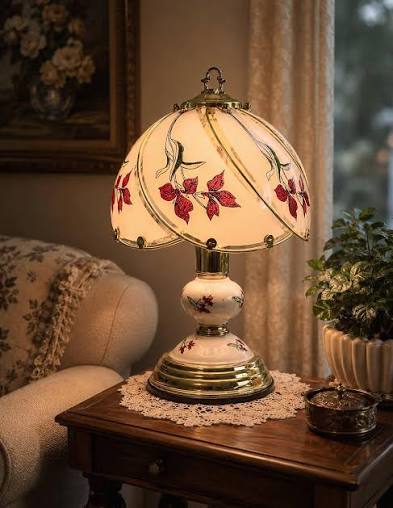
These miraculous devices eventually appeared in bedrooms, living rooms and the homes of grandparents who otherwise showed absolutely no interest in modern technology. A woman who wouldn’t trust a microwave oven to reheat her coffee would happily demonstrate her touch lamp to every visitor who walked through the door.
“Watch this,” she’d say, tapping the base. The light came on. Another tap made it brighter. By the third tap, you were expected to react as though you’d just witnessed the moon landing.
And you know what? We did.
Looking back, I think the humble touch lamp tells us quite a bit about how Americans became obsessed with buying things that solve problems we never realized we had. It also helps explain why we’re now living in houses filled with appliances that require Wi-Fi passwords.
BEFORE THE TOUCH LAMP, AMERICANS ENDURED UNSPEAKABLE HARDSHIP
To appreciate the touch lamp, you have to understand the primitive conditions under which Americans lived before its arrival.
Turning on a lamp required physical effort. You had to reach toward the fixture, locate a switch and manipulate it with your fingers. Sometimes the switch was a small rotating knob. Other times, it was a pull chain. In especially challenging situations, you had to stand up.
I’m amazed we survived.
For decades, the electric lamp had been a perfectly satisfactory household appliance. You plugged it into the wall, flipped a switch and enjoyed the miracle of artificial illumination. Thomas Edison and his contemporaries had spent years developing practical electric lighting, and generations of engineers had improved the technology. By the middle of the twentieth century, the average American could illuminate an entire room without setting anything on fire.
Most of the time.
But apparently, somebody looked at this extraordinary achievement and thought, “You know what would make this better? If we could turn it on by touching the base.”
And so began another chapter in America’s never-ending quest to make ordinary household objects slightly more complicated.
THE TOUCH LAMP WAS OLDER THAN YOU THINK
Here’s something that surprised me: The touch lamp wasn’t actually invented in the 1980s. Not even close.
The idea had been around since at least the early 1950s, when Aladdin Industries, a company with a long history of making lamps, began experimenting with lighting fixtures that responded to human touch.
Yes, Aladdin. Apparently, the company decided that rubbing a magic lamp and making a genie appear was too ambitious, so it settled for turning on a 60-watt light bulb.
Between 1953 and 1956, Aladdin produced a series of lamps equipped with what it called Magic Touch technology. These weren’t merely laboratory curiosities. They were actual products, and according to research published by Aladdin lamp collectors, the company manufactured an estimated 10,000 across its various designs.

They weren’t cheap, either. Contemporary wholesale prices ranged from $19.95 to $24.95, which was a substantial amount of money in the 1950s, particularly for something that performed the same basic function as a lamp with a conventional switch.
The technology had some serious engineering behind it. Fred Schumann, associated with Vanderbilt University’s electrical engineering department, developed touch-responsive circuitry for Aladdin. His patent application, filed in 1956, resulted in U.S. Patent 2,896,131 in July 1959.
General Electric was also exploring similar technology. In a 1958 issue of General Electric Review, engineer Leon H. Cutler discussed the company’s Touchtron control system, including the difficulties engineers faced in making touch-sensitive switching reliable and affordable.
Those early circuits could be bulky, expensive and temperamental. They also offered a genuine benefit to people with limited mobility, who might have difficulty reaching or operating a conventional switch. That was a legitimate advantage, even if the technology would eventually become better known as a novelty.
The problem was that the technology cost too much and was too complicated for most households. So the touch lamp largely waited for electronics to catch up.
Then came the 1980s, and America was ready to touch absolutely everything.
THE 1980s: WHEN THE TOUCH LAMP BECAME A HOUSEHOLD CELEBRITY
By the early 1980s, advances in solid-state electronics had made touch-sensitive lighting considerably more practical. Manufacturers developed circuits that could fit inside ordinary lamp bases or small adapters, and patents filed during that period show how engineers were refining the technology for everyday use.
The concept was no longer restricted to expensive specialty fixtures. Now you could put the technology into almost anything, and manufacturers wasted little time doing exactly that.
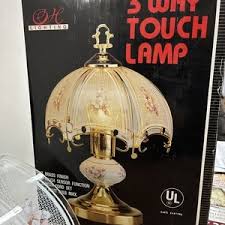
There were brass touch lamps, ceramic touch lamps and bedside lamps with elaborate glass shades. Some looked like something you’d find in a Victorian sitting room. Others resembled the lighting fixtures in a budget motel that had recently discovered the concept of luxury.
One particularly memorable style featured a shiny brass-colored base supporting a decorative glass shade, often adorned with flowers or other patterns that suggested the designer had recently visited a very enthusiastic craft fair.
They were everywhere. Or at least they seemed to be.
You’d see them in furniture stores, department stores, gift catalogs and television advertisements. They were especially popular as bedroom lamps, where the ability to turn on a light without fumbling around for a switch actually made sense.
But practicality wasn’t what made them exciting. The novelty was the attraction, and people absolutely loved demonstrating them.
You could visit somebody’s house and find yourself subjected to a full presentation about the lamp sitting on their nightstand. Your host would invite you to touch the base, then encourage you to touch it again. By the fourth tap, you’d completed an entire demonstration of the lamp’s technological capabilities.
There was usually a moment of silence afterward, as though everyone needed a few seconds to process what had just occurred.
I remember thinking this was astonishing. Today, I realize we were essentially applauding a lamp for having a different kind of switch.
HOW DID THE THING ACTUALLY WORK?
The technology behind most familiar touch lamps is surprisingly clever.
Your body has electrical properties, including capacitance, which is the ability to store a small electrical charge. A touch-sensitive lamp uses electronic circuitry to detect a change when your body contacts a conductive part of the fixture. That change tells the lamp to switch states.
In many models, the sequence runs through low, medium and high brightness before returning to off. No mechanical switch needs to move, and there’s no hidden button being pressed. The lamp senses your touch and responds accordingly.
That’s genuinely impressive engineering, especially considering how inexpensive these devices eventually became.
Of course, the technology wasn’t always perfect. Some lamps could behave strangely because of electrical interference or other environmental conditions. Depending on the design, a touch lamp might occasionally activate unexpectedly or fail to respond properly.
Nothing makes you question the supernatural quite like a bedroom lamp turning itself on at two in the morning.
Was it faulty circuitry? Was it a ghost? Was Grandma trying to tell us something from the other side? Personally, I’d have checked the wiring before calling a paranormal investigator, although I suppose that wouldn’t have made for a very exciting episode of Unsolved Mysteries.
WE DIDN’T BUY TOUCH LAMPS BECAUSE WE NEEDED THEM
This is where the story gets interesting.
The touch lamp represents a particular kind of consumer product that Americans have been buying for decades: the ordinary household object redesigned around one feature that makes it feel futuristic.
The original product works fine. The upgraded version does essentially the same thing, but now it does that thing in a way that makes your friends say, “Oh, that’s neat.”
And suddenly, you’ve got a business.
The touch lamp didn’t provide dramatically better lighting. It didn’t eliminate the need for electricity or make light bulbs last forever. It simply changed the way you turned the light on, and for a lot of consumers, that was enough to make the product interesting.
I don’t say this as a criticism of the people who bought them. I wanted one myself even though both my parents and my grandparents both had sets.
The appeal was understandable. Touch lamps were fun, reasonably affordable as the technology matured, and just different enough to make an ordinary bedroom feel a little more modern. If you had one on your nightstand, you were living in the future, even if the rest of your bedroom featured wood paneling and a clock radio with numbers that flipped over mechanically.
The trouble starts when manufacturers realize they can sell us the same basic product repeatedly by changing the way we interact with it.
Which brings us to the present day.
And, boy, have we gotten good at that.
THE TOUCH LAMP WAS THE GRANDFATHER OF THE SMART HOME
Fast-forward to today, when we have smart light bulbs that connect to Wi-Fi, change colors, respond to voice commands and operate according to schedules programmed through smartphone apps.
You can tell a digital assistant to turn on the bedroom light without leaving your chair. You can make your living room glow purple, set your lights to imitate a sunset or program the whole house to look occupied while you’re on vacation.
It’s impressive technology, and some of those features are genuinely useful.
It can also be completely ridiculous.
Imagine explaining this progression to somebody in 1985.
“In the future, you won’t have to touch your lamp.”
“Really? How does it work?”
“You’ll talk to it.”
“Talk to the lamp?”
“Well, technically, you’ll talk to a computer that communicates with the lamp over a wireless network.”
“Why?”
“So the light comes on.”
“Couldn’t I just touch it?”
“That’s not the point.”
And there you have the entire modern consumer electronics industry in one conversation.
We’ve spent decades developing increasingly elaborate ways to accomplish something that was already fairly easy. The old touch lamp needed electricity and a working circuit. A modern smart bulb may depend on an app, a wireless connection, compatible hardware and software that the manufacturer hasn’t decided to abandon.
If your internet connection goes down, some smart lighting systems can still function locally. Others lose features or become considerably less convenient. And if the company behind your smart home gadget goes out of business, you might discover that your expensive piece of hardware is suddenly much less intelligent than the box promised.
The touch lamp never asked you to update its firmware. It never required you to create an account, and it certainly never sent you an email announcing changes to its privacy policy.
You slapped the base. The light came on.
End of transaction.
WE’VE TURNED EVERY HOUSEHOLD APPLIANCE INTO A COMPUTER
The touch lamp’s legacy extends far beyond lighting. Look around a modern home and you’ll find technology embedded in products that once functioned perfectly well without it.
Refrigerators now come with enormous touchscreens. Washing machines offer Wi-Fi connectivity. Coffee makers can be programmed from your phone, and some ovens can apparently receive software updates while you’re trying to make dinner.
Some of these features are genuinely useful. Remote monitoring, accessibility controls and energy-management tools can make everyday life easier. But sometimes I wonder whether we’re improving the products or simply creating more things that can break.
My refrigerator has one primary responsibility: Keep the food cold.
I don’t need it to display family photographs, suggest recipes or inform me that we’re running low on milk. I’ve managed to identify a milk shortage for most of my adult life by opening the refrigerator and looking at the carton. It’s a fairly reliable system, and it doesn’t require a monthly subscription.
Yet appliance manufacturers keep finding new ways to make ordinary products appear more sophisticated, largely because sophistication sells. Or at least the appearance of sophistication does.
A refrigerator with a touchscreen looks more advanced than one without it, even if both keep your leftover pizza at exactly the same temperature. The touchscreen might offer genuinely useful features, but it’s also a highly visible reminder that you’ve purchased something modern.
That’s the touch lamp principle. Take a familiar object, add an unusual interface, and convince people they’re looking at the future.
The only difference is that today’s version might cost an extra $800 and require a software update before breakfast.
THE INFOMERCIAL INDUSTRY UNDERSTOOD THIS PERFECTLY
If the touch lamp had a spiritual home, it was the world of late-night television advertising.
This was an industry built around identifying tiny inconveniences and treating them like national emergencies. Remember the commercials where somebody struggled to perform an incredibly ordinary task? In my book Flopocalpyse Now, I go into this in detail (probably too much).
A woman couldn’t open a jar. A man somehow destroyed his kitchen while attempting to slice a tomato. An elderly gentleman tried to put on his socks and appeared to be fighting for his life.
Then a cheerful announcer would introduce a revolutionary product that solved the problem.
Only $19.95! But wait, there was more!
The touch lamp fit that philosophy beautifully, even though it had a more substantial engineering history than many novelty products. Ordinary lamps required switches, touch lamps didn’t, and somebody had figured out how to turn that minor convenience into a selling point.
Once consumers accepted that a small improvement justified purchasing an entirely new product, manufacturers had plenty of opportunities to repeat the formula.
Automatic soap dispensers. Motion-activated trash cans. Electric wine openers. Bluetooth-connected bathroom scales.
I’m not saying these products are useless. Some are quite handy, and I’ll admit that a trash can that opens automatically can be convenient when your hands are full.
I’m saying we’ve reached a point where almost any small physical movement can be reclassified as an inconvenience requiring electronic intervention.
Apparently, touching the lid of a trash can has become an unacceptable burden on the American household.
I suppose the next logical step is a garbage can that uses artificial intelligence to determine whether your banana peel is emotionally prepared for disposal. Give it time. Somebody’s probably working on it.
THE REAL BUSINESS IS CONVINCING US THAT LAST YEAR’S VERSION IS OBSOLETE
Here’s the biggest difference between the touch lamp era and modern consumer culture.
Back in the 1980s, the touch lamp was sold as a novelty. It was a fun alternative to something you already owned, and nobody seriously suggested that your conventional lamp had become obsolete because it required a switch.
Today, companies are much better at convincing us that the older version of a perfectly functional product is somehow inadequate.
Your phone still works? Wonderful. But the new one has a better camera.
Your television looks great? Sure. But this year’s model has a slightly brighter screen and an artificial intelligence processor that apparently understands your viewing habits better than your spouse.
Your electric toothbrush cleans your teeth? That’s adorable. The new model connects to an app and provides personalized brushing feedback.
I don’t know about you, but I’ve never finished brushing my teeth and thought, “I wish I had more performance data.”
Yet companies have become extraordinarily skilled at turning incremental improvements into reasons for another purchase. Part of that comes from genuine technological progress. Cameras really have improved, modern appliances can use less energy, and accessibility features can make an enormous difference for people who need them.
But the marketing often goes well beyond the practical benefits. It sells the feeling of being current, of owning the newest thing, of not being the person whose living room still contains technology from the previous decade.
The touch lamp offered a little taste of that feeling. It let you demonstrate that your household had embraced the future, even if your idea of cutting-edge entertainment was watching The Love Boat on a 19-inch Zenith.
Now we chase that same feeling through product launches, upgrade cycles and devices that become outdated long before they stop working.
Somewhere, a perfectly functional television is sitting in a landfill because its owner wanted slightly better black levels.
WE’VE ALSO FORGOTTEN HOW TO APPRECIATE A SIMPLE TRICK
There’s another reason I remember the touch lamp so fondly.
It was fun, and not everything has to justify its existence through productivity or measurable improvement.
Sometimes a gadget can simply make you smile. The first time you touched one of those lamps and watched it illuminate, you experienced a tiny moment of wonder.
You didn’t need a tutorial. You didn’t need to download anything, and you certainly didn’t have to watch a 14-minute YouTube video explaining which settings to enable.
You touched it, it worked, and you wanted to do it again.
That simplicity is part of what made so many older consumer inventions memorable.
The Clapper, introduced in the mid-1980s, let you control appliances by clapping your hands. It was another product that turned a basic household action into a small performance, and television commercials made sure everybody understood just how thrilling that could be.
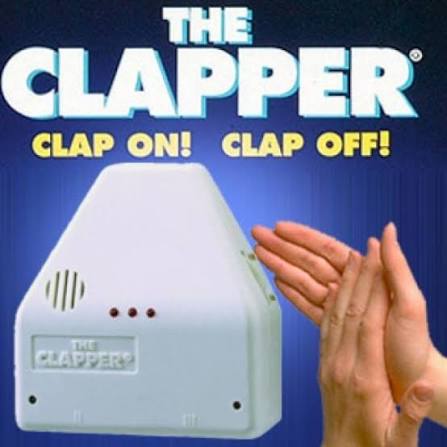
You didn’t just turn on a lamp. You demonstrated your lamp.
And if you owned both a touch lamp and a Clapper, your home was practically the headquarters of NASA.
The entertainment came from seeing technology do something unexpected. Modern devices can perform vastly more complicated tasks, but they often demand much more attention in return.
They need charging, configuring, pairing or troubleshooting. Sometimes I think the most impressive feature a company could introduce in 2026 would be a device that works immediately after you take it out of the box.
No setup. No account. No six-digit verification code.
Just plug it in.
Revolutionary.
MAYBE THE TOUCH LAMP HAD IT RIGHT ALL ALONG
I recently found myself thinking about those old touch lamps and wondering why something so simple made such a lasting impression.
Part of it is nostalgia, obviously. Anything associated with the 1980s now benefits from the warm glow of childhood memories, even if the original product was a questionable piece of furniture featuring a brass-colored base and a glass shade decorated with roses.
But there’s something else.
The touch lamp offered a clever feature without demanding much from its owner. It didn’t try to become the center of your household, collect information about your habits or establish an ongoing relationship with the manufacturer.
You bought it, brought it home, plugged it in and enjoyed the novelty. If you got tired of touching it, you could still use it as a lamp.
That’s a pretty good arrangement.
Compare that with today’s growing collection of connected products, where a manufacturer can change the software, discontinue support or remove features long after you’ve paid for the hardware.
The touch lamp never threatened to stop working because its parent company had decided to concentrate on a new subscription-based lighting platform.
It just sat there, waiting to be touched.
There’s something comforting about that, particularly when you consider how much of our modern technology now depends on companies continuing to support products they’ve already sold us.
ONE LAST TAP FOR THE FUTURE
I’m not suggesting we abandon modern technology and return to the days of rotary telephones, VHS tracking adjustments and television sets that weighed more than a Buick.
I like modern conveniences. I appreciate being able to control the thermostat from my phone, and I enjoy having thousands of songs available without maintaining a small warehouse of compact discs.
And I certainly wouldn’t trade modern medical technology for anything from 1985.
But I do think the touch lamp offers a useful little lesson about consumer culture. We have a habit of confusing novelty with progress, and manufacturers have become very good at encouraging that confusion.
Sometimes the distinction doesn’t matter. A product can be enjoyable simply because it’s different. Other times, we spend hundreds of dollars replacing things that already work because somebody has convinced us the new version represents a major technological breakthrough.
The touch lamp was a charming example of that impulse. Today’s smart home is the same idea with a larger budget and considerably more passwords.
And if I ever come across one of those gloriously tacky brass touch lamps at a thrift store, I might just buy it.
I’ll put it on my nightstand, plug it in and touch the base. The light will come on, and another touch will make it brighter. For a few seconds, I’ll be right back in the 1980s, marveling at a piece of technology that made a perfectly ordinary household task feel like something out of The Jetsons.
Then I’ll turn it off.
Assuming I can remember how many times I’m supposed to touch the damn thing.
— The Unknown Critic
LOOKING FOR A TOUCH LAMP?
After all this talk about touch lamps, you might be tempted to track one down for yourself. And why not? Nothing says sophisticated home décor quite like a brass-colored lamp that responds to being slapped.
But before you start digging through thrift stores or your grandmother’s attic, there’s another option. Check out Treasures, Trinkets, and Triumphs! It might just satisfy your appetite for a little old-fashioned consumer nostalgia without requiring you to rearrange your nightstand.
And unlike an actual touch lamp, you won’t have to tap it four times to turn it off.
Although, knowing Amazon, they’ll probably recommend a smart bulb to go with it.