E-BOOK / PAPERBACK & HARDCOVER / AUDIOBOOK OUT NOW!

The Glow That Won’t Go Out: Inside Brandon Gress’s Life With Thousands of Blow Molds

From a childhood K-Mart snowman to Hoarding for the Holidays, thousands of blow molds, a legendary Christmas display—and one unforgettable Angel Teddy Bear hunt

By Curtiss Wayne Andrews

Today, I officially release a book about blow molds.

But here’s the thing.

The Glow That Won’t Go Out was never really supposed to be a book about plastic.

Yes, it’s filled with blow molds.

Santas. Snowmen. Reindeer. Candles. Nativity figures. Empire. General Foam. Union Products. Poloron. Beco. The manufacturers, the markings, the history, the hunt, the restoration and all the wonderfully obsessive details collectors care about.

But somewhere along the way, while researching and writing the book, something became obvious:

The interesting part isn’t simply what survived.

It’s why people refuse to let it disappear.

And I’m not sure anyone illustrates that better than Brandon Gress.

Readers of The Glow That Won’t Go Out already meet Brandon in the book through my look at Episode 3 of Hoarding for the Holidays, appropriately titled “Let It Blow (Mold).”

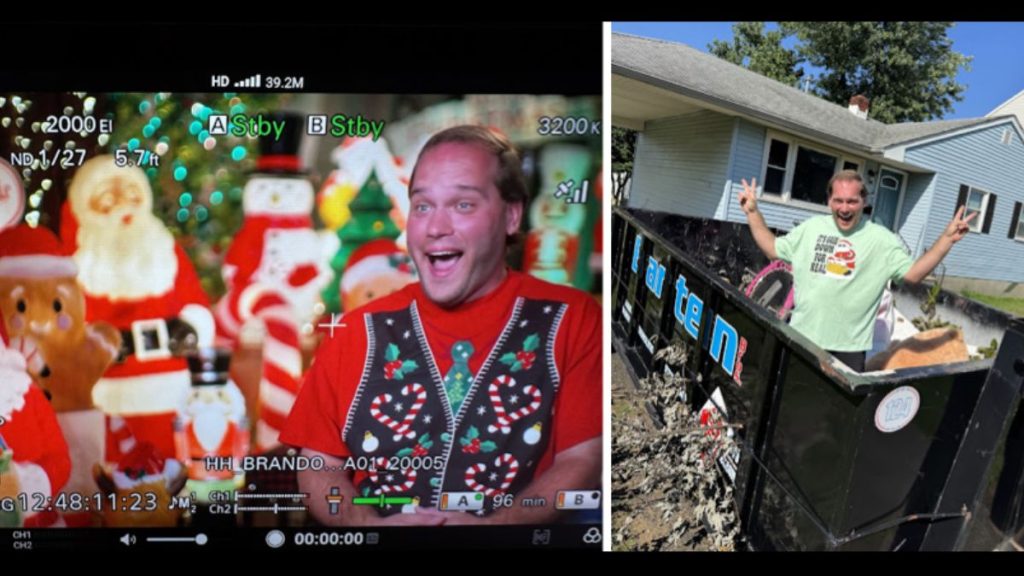
In the episode, Brandon and his mother, Lori, hunt for vintage Christmas decorations, go dumpster diving, laugh at themselves, and pursue a particularly elusive Angel Teddy Bear blow mold.

There’s even a wonderfully perfect ending to that particular story.

After finally finding the Angel Bear he had been hunting…

Brandon discovered another one he already owned buried in his storage shed two days later.

Collectors, I assume, require no explanation whatsoever.

But the television episode only scratches the surface.

Brandon’s relationship with blow molds began long before television cameras showed up. His collection now extends well into the thousands, and his family’s Christmas display has become an annual tradition for thousands of visitors.

It has also raised thousands of dollars for a children’s hospital.

So for the launch of The Glow That Won’t Go Out, I wanted to go back to Brandon.

I wanted to hear the story behind the story.

And appropriately enough, it begins with a snowman.


The $20 Snowman That Started Everything

When did you first get started collecting blow molds?

Brandon Gress: Blow molds have always been a part of my life.

Growing up in the early 2000s, you couldn’t pass a neighbor’s house without at least one holiday blow mold in their yard. Better yet—you couldn’t walk into any big-box store that did not sell blow molds.

I still have vivid memories of seeing blow molds in my local K-Mart and Walmart. And I still kick myself for not getting some of the pieces as a child!

My love for blow molds came from merely being exposed to them.

There were two houses by me that shaped my love for them. A home in Holmdel, New Jersey, on Richard’s Way, was the first time I remember being enamored by these pieces of plastic.

Another home right around the corner from me became my all-time favorite. “The house behind Toys R Us” became my inspiration for years.

The owner of this house, a fellow blow molder and exceptional friend, Tom, has become one of my closest friends in the hobby.

Making my mom and family members drive me by these houses became obsessive—and still is part of my holiday tradition.
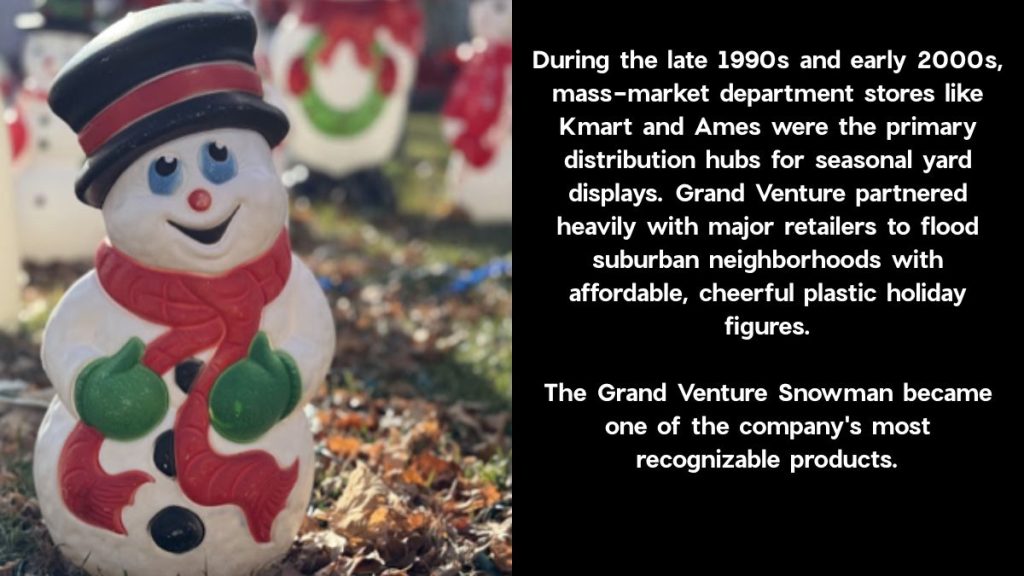
Brandon Gress's childhood Grand Venture snowman blow mold from K-Mart
The one that started it all: Brandon’s Grand Venture snowman from K-Mart, a childhood gift from his grandmother.

Then came the piece that changed everything.

Brandon: For me, it was a small Grand Venture snowman from K-Mart.

Like any other five-year-old—ha!—I became obsessed with these plastic light-up pieces because of a snowman my grandmother bought me from the box store.

This blow mold, which would become a staple in my bedroom Christmas display—that every child has, of course!—is still used in my displays outside.

The tattered, faded K-Mart tag still clings to the backside of the piece as a reminder of simpler times and the catalyst for my lifelong blow mold obsession of well over a couple thousand molds.

That snowman is one of my favorite things in Brandon’s story.

Because it’s easy to look at a collection numbering in the thousands and assume collecting is about accumulation.

But there’s the original snowman.

Still there.

Still displayed.

Still wearing its battered K-Mart tag.

That’s what collecting is really about.


The Houses That Created a Collector

Richard's Way Christmas display in Holmdel New Jersey that inspired Brandon Gress
Richard’s Way in Holmdel, New Jersey—the Christmas display Brandon credits with helping ignite his fascination with blow molds.
Brandon Gress and his cousins visiting the Richard's Way Christmas display around 2004
Brandon and his three cousins at the Richard’s Way Christmas display, circa 2004.

Look at that photograph and then look at Brandon’s display today.

There’s your origin story.

A kid gets driven past a spectacular Christmas house.

He stares at the lights and glowing plastic figures.

He asks to go back.

And back.

And back.

Eventually he starts building his own version.

This is how traditions propagate.

Not through instruction manuals.

Through wonder.

Christmas blow mold display known by Brandon Gress as the House Behind Toys R Us
The “House Behind Toys R Us,” another childhood inspiration—and the home of Tom, who would eventually become one of Brandon’s closest friends in the hobby.

Brandon’s tastes today run all over the blow mold world, although he admits a particular affection for cartoon-character molds and Empire Santas.

Choosing a single favorite, he says, would be like choosing a favorite child.

And as an elementary-school teacher?

He knows better.

His collection now extends well beyond a couple thousand molds, and some of his European auction purchases have cost thousands of dollars. 

Brandon’s justification?

There are worse things to spend money on.

Every collector just nodded.


Then Television Called

If you watched Hoarding for the Holidays, you might assume Brandon’s collection was discovered specifically for that program.

Actually, television already knew the Gress family.

Their displays have appeared on ABC’s The Great Christmas Light Fight, Hallmark Channel’s Ready, Set, Glow, AOL’s All Is Bright and HGTV’s Hoarding for the Holidays. According to Brandon, his family never applied for any of them; casting producers approached them. 

How did Hoarding for the Holidays happen?

Brandon: I was contacted by a casting producer explaining they were looking for “passionate Christmas enthusiasts who were crazy about collecting.”

Needless to say, we fit that bill!

We agreed to film with them and the rest is history.

On three excruciatingly hot August afternoons, we donned our Christmas best and played like it was the holidays.

We filmed all around town—anywhere from my own yard to antique stores—and even dumpsters.

We had a BLAST filming for this show.
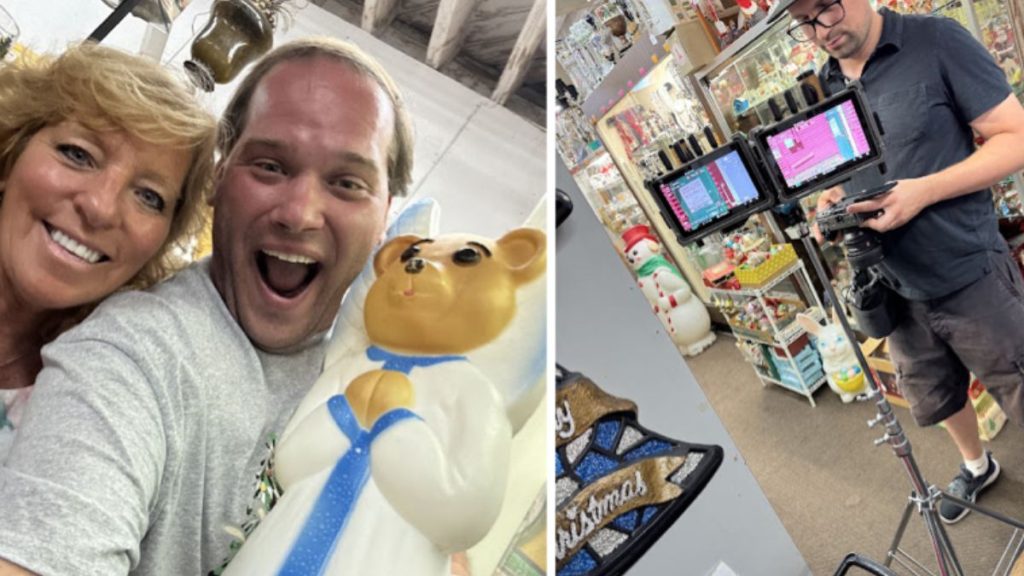
Brandon Gress filming Hoarding for the Holidays with vintage blow molds
Behind the scenes of Hoarding for the Holidays: the Angel Teddy Bear hunt, filming the episode—and yes, dumpster diving.

But there was one complication.

Brandon didn’t know the show’s title until filming had finished.

And then he saw the word:

Hoarding.

He wasn’t thrilled.

He worried that a genuine collecting passion might be presented as something exploitative or pathological. After talking with the production team, however, he was reassured that the title was tongue-in-cheek. When Brandon finally saw the finished episode, he says he was exceptionally proud of it and felt it captured just how hardcore holiday collectors can be. 

That matters.

Because the best part of Brandon’s segment isn’t the size of the collection.

It’s the relationship at the center of it.


A Mother, a Son and a Completely Reasonable Dumpster Dive

One of my favorite elements of Episode 3—and something I wrote about in The Glow That Won’t Go Out—is Brandon’s relationship with his mother, Lori.

She doesn’t merely tolerate the hobby.

She’s in it.

When Brandon finds a goose blow mold at the thrift store, puts a wig on it and deadpans “add to cart,” Lori laughs.

When he decides discarded Christmas plastic might be waiting in neighborhood trash?

Mom drives.

There’s something important buried underneath the comedy.

Collecting can be generational.

A parent decorates.

A child remembers.

The child grows up.

Eventually those same decorations become something worth preserving because they’re attached to a person, a place and a particular December. A lot of this reminded me of my own mother who passed in 2024 and her extensive strawberry & Precious Moments collections, detailed in the book I co-authored, Hoarders of History.

That’s how a piece of molded plastic becomes an heirloom.


The Great Angel Teddy Bear Hunt

And then there’s the bear.

Every serious collector has one.

The piece that somehow keeps escaping.

The one you search for at antique stores, flea markets, auctions, Marketplace and every other place collectors congregate.

Brandon’s white whale was the Angel Teddy Bear blow mold.

Brandon Gress filming Hoarding for the Holidays with vintage blow molds
Mission accomplished: Brandon and Lori with the elusive Angel Teddy Bear during filming for Hoarding for the Holidays.

The episode turns the search into a miniature Christmas adventure. It reminded me of American Pickers but with Brandon and Lori playing the parts of Mike & Frank, but sweeter!

And eventually, Brandon gets it.

The elusive Angel Teddy Bear appears at a thrift store in Red Bank, not far from home.

Victory.

Celebration.

Embrace the bear.

Roll credits.

Except blow mold collecting had one more joke to tell.

Two days later, Brandon found the Angel Teddy Bear he already owned buried in his crowded storage shed.

That may be the single most blow-mold-collector ending ever filmed.

When your collection reaches several thousand pieces, apparently you can become your own estate sale.


When a Christmas Display Becomes Something Bigger

This is where Brandon’s story changes.

Because the Gress House Holiday Light Spectacular isn’t merely a place to put the collection.

It has become part of the community.

Tell me about the display.

Brandon: My Christmas display—without sounding too cliché—has become a staple in my community.

“The Gress House Holiday Light Spectacular,” as it has become famously known on all social media platforms, started when I was very young.

I always decorated outside, but now it is next level.

I started doing it simply because it made me happy.

While it still makes me happy, it has so much more meaning now.

For one, it has become a holiday tradition for THOUSANDS of visitors annually.

Gress House Holiday Light Spectacular Christmas display with vintage blow molds
The Gress House Holiday Light Spectacular—a childhood passion that grew into an annual community tradition.
Gress House Holiday Light Spectacular Christmas display with vintage blow molds
The Gress House display in 2025, packed with illuminated blow molds and Christmas lights.

Then Brandon told me something that changes how you see those photographs.

Around 2013, the family began using the display to support a Children’s Miracle Network-affiliated hospital in New Jersey. Brandon says the display has raised thousands of dollars through the years. In 2023, the family’s contributions were recognized as part of a hospital expansion with a dedicated Post Office Play Area, chosen because of its natural connection to Christmas and letters to Santa. 

Post Office Play Area supported by Gress House Holiday Light Spectacular fundraising
The Post Office Play Area supported by the Gress family’s holiday-display fundraising—a reminder that a Christmas decorating obsession can become something much bigger.

Brandon summed it up better than I could:

“It is truly crazy to think that some lights and pieces of plastic can bring so many people together.”

That’s the sentence.

That’s the entire book.


Vintage Empire Meets Brand-New Gemmy

I also wanted Brandon’s opinion on one of the livelier debates in blow mold collecting:

Old versus new.

His answer?

Why choose?

What’s your take on the newer generation of blow molds?

Brandon: I am in no way a blow mold purist.

In fact, my display is filled with new and old. A 1970s Santa sits alongside Gemmy counterparts from a few years ago.

It is all about your decorating style.

While some complain about the new blow molds coming out—how they flood the market and “just don’t make them like they used to!”—I feel quite the contrary.

I think Gemmy introducing these blow molds has been great for collectors.

I think we are in the blow mold renaissance.

That’s an interesting perspective, particularly from someone with such an enormous vintage collection.

Brandon argues that newer molds give younger collectors an affordable entry point while licensed characters can attract people who may never have gone hunting for a vintage Empire Santa. His own displays freely mix old and new.  I write more about the old vs new debate here.

And then comes my favorite detail.

When Brandon was in fourth grade, he wrote to Gemmy for a persuasive-writing assignment asking the company to make the Miser Brothers.

Nearly twenty years later?

They’re available as holiday decorations.

Teacher-approved persuasive writing, apparently.
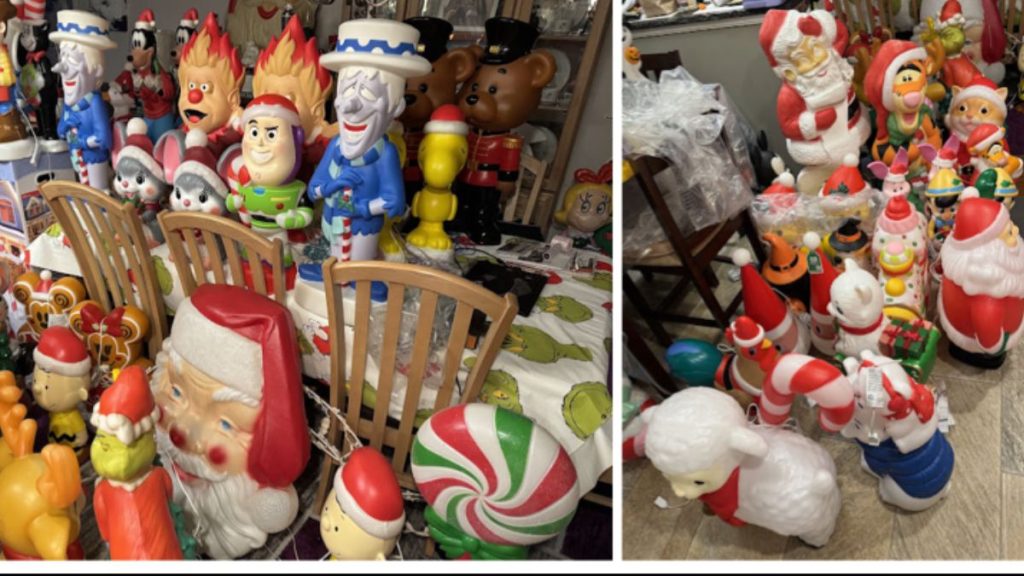
New Gemmy Christmas blow molds in Brandon Gress's collection for the 2026 season
Waiting for Christmas: some of Brandon’s newer blow molds taking over the dining room ahead of the 2026 decorating season.

Brandon’s Advice for New Blow Mold Collectors

So what does someone with several thousand pieces tell the person buying blow mold number one?

First:

You’re not building Brandon’s display next weekend.

And that’s okay.

His advice is to start where collectors have always started:

Yard sales.

Antique stores.

Flea markets.

And yes…

Garbage.

Brandon’s rules for beginning collectors

Brandon: You won’t build a massive display overnight.

It takes time, perseverance, and willingness to get a little dirty!

Oh, yes! You have to be willing to dumpster dive and garbage pick!

Another tip is to save your money.

Start a savings account at birth for this hobby!

Most importantly, have fun.

There are so many dedicated people who make this hobby so enjoyable. Meet fellow blow molders, join the groups online, and share your ideas, displays and finds.

The sense of community in this hobby is truly unmatched.

And then he adds one final piece of advice:

“Don’t yard sale in my neck of the woods—those blow molds are reserved for me!”

Fair warning.

His larger message, though, is community: meet other collectors, join groups, share displays and enjoy the hunt rather than expecting to assemble a massive collection overnight. 


This Is Why I Wrote The Glow That Won’t Go Out

There’s a reason I wanted this interview to publish on October 1—the day The Glow That Won’t Go Out launches.

Look at Brandon’s first snowman again.

It’s not rare because an auction house says it’s rare.

It’s valuable because his grandmother gave it to him.

Look at the old photograph outside Richard’s Way.

A kid staring at someone else’s Christmas display eventually creates one that thousands of other kids will remember.

Look at Brandon and Lori hunting for the Angel Bear.

The object matters.

But the person standing next to you when you find it matters more.

Look at the hospital play area.

Somehow an obsession with illuminated plastic Christmas decorations helped create something for children who may be spending part of their own holiday in a hospital.

And look at the thousands of blow molds covering the Gress property today.

They’re not museum pieces.

They’re outside.

They’re glowing.

They’re doing what they were made to do.

That’s the glow that won’t go out.

Not electricity.

Memory.

Tradition.

Family.

Community.

And a new generation looking through the car window at somebody’s Christmas display thinking:

I want to do that someday.

Brandon was that kid once.

Maybe somewhere in the crowd outside the Gress House this Christmas…

the next Brandon is watching.


Keep the Glow Going

The Glow That Won’t Go Out: The Complete Collector’s Guide to Vintage Holiday Blow Molds by Curtiss Wayne Andrews is now available in e-book, paperback & hardcover (be patient if all those editions don’t show up exactly on Oct 1st!).

The book explores the history, manufacturers, identification, restoration and collecting culture behind vintage holiday blow molds—but more importantly, it tells the stories of the collectors, families and traditions keeping them glowing.

And yes.

Brandon, Lori and that Angel Teddy Bear are in it.
“Dad, I Have a $500 Emergency”: Inside Hope Holubowicz’s Vintage Blow Mold Obsession

She grew up making annual Menards trips with her dad, built a collection of roughly 300 vintage blow molds, and eventually landed on Hoarding for the Holidays. But one legendary Marketplace haul required some creative family financing.

By Curtiss Wayne Andrews

There are emergencies.

Flat tires.

Broken water heaters.

Unexpected medical bills.

The transmission falls out of your car.

And then there are blow mold emergencies.

Hope Holubowicz once encountered the latter.

A Facebook Marketplace listing appeared containing approximately $1,000 worth of vintage blow molds.

There was only one problem.

Hope did not have $1,000.

What she did have were two parents.

So Hope independently contacted each of them and announced that she had a “$500 emergency.”

Mom sent $500.

Dad sent $500.

Problem solved.

At least until Mom and Dad eventually talked to each other.

Welcome to blow mold collecting.

Readers of The Glow That Won’t Go Out may already recognize Hope from my chapter featuring collector stories. Her story stood out to me because beneath all the collecting—and the comedy—is something that comes up again and again in this hobby.

Family.

Hope’s father helped introduce her to blow molds as a child. Years later, that relationship became part of her television appearance.

And somewhere in between came thrift stores, Beco Santas, a Don Featherstone jack-o’-lantern, approximately 300 pieces of glowing plastic…

…and one extremely questionable definition of the word “emergency.”

I had to know more.


Before There Was Marketplace, There Was Menards

When did you start collecting blow molds?

Hope: I would say I have been collecting blow molds for the last 10 years. It is hard to put an exact timeline on it because they had been a big part of my childhood during the early ’90s.

My personal collection started with thrifting.

Growing up, I spent a lot of time as a child going to rummage sales and thrift stores with both my mom and my aunt. Secondhand searching was a way of life for us.

I don’t have any early memories going into “real stores,” as my mom and aunt were always looking for a bargain.

That last sentence explains a lot.

Hope wasn’t introduced to collecting through an online collector group or price guide.

She was raised in the hunt.

Rummage sales.

Thrift stores.

Secondhand shops.

The possibility that something spectacular might be sitting on a shelf for five dollars because nobody else knew what it was.

But blow molds had another family connection.

Her dad.

Each year, Hope remembers going to Menards with him and choosing a new blow mold for the family’s Christmas display.

Those trips left an impression.

So did the glowing decorations themselves.

Years later, when Hope began spotting vintage blow molds while thrifting, something clicked.

She started bringing them home.

And then?

Well…

“It has been absolute, glorious havoc ever since.”


The $500 “Emergency”

Every collector has a story that probably sounds completely reasonable to other collectors and completely insane to everybody else.

This is Hope’s.

A Facebook Marketplace listing appeared in 2023.

The seller had accumulated a large collection.

The asking price was approximately $1,000.

Hope needed it.

Immediately.

There was just that minor funding problem.

So she texted Mom.

“I have a $500 emergency.”

Mom was visiting family in Pennsylvania and Venmoed the money.

Then Hope contacted Dad.

Same emergency.

Another $500.

A thousand dollars later, the blow molds were secured.

Hope repaid both parents within a week.

Then her parents happened to have a conversation.

Dad asked Mom whether she ever found out what Hope’s mysterious $500 emergency had been.

You can probably see where this is going.

The truth emerged.

The emergency was Christmas decorations.

Dad’s response?

“Hope, that is NOT an emergency.”

He then reportedly began explaining the types of situations that actually constitute emergencies.

Which was unnecessary.

Because every serious collector reading this already understands that a once-in-a-lifetime Marketplace blow mold haul clearly falls somewhere between house fire and medical evacuation on the emergency scale.

Sorry, Dad.

I’m siding with Hope.


The $25 Haunted House—and Her Holy Grail

That legendary haul produced one of Hope’s favorite pieces:

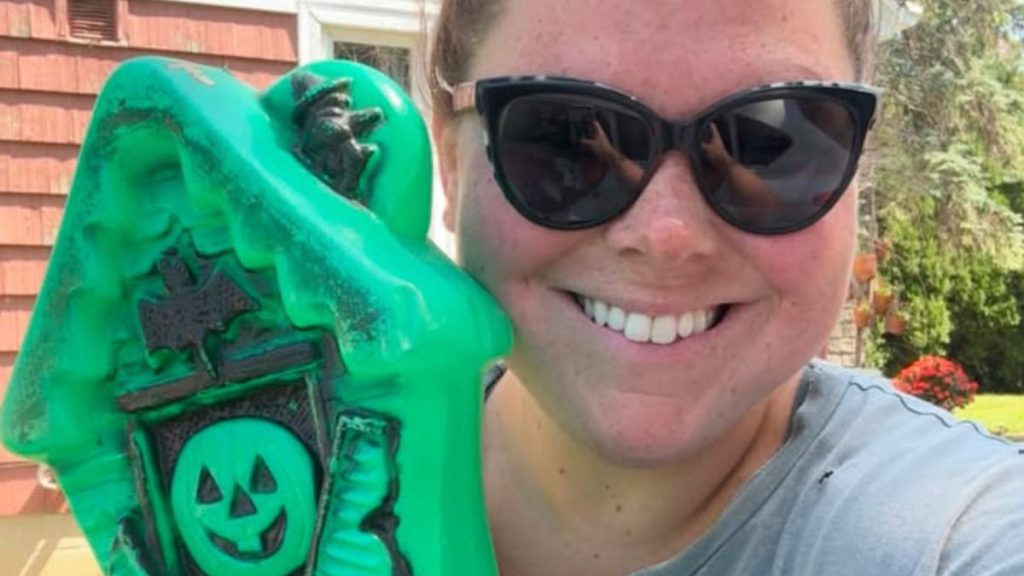
a green Haunted House she got for $25.

Hope's prized green Haunted House blow mold.

But her collection contains other favorites.

Which blow molds stand out the most?

Hope: I think for me my love for my Beco Santas and my Don Featherstone JOL bunch is not so much due to their value but how kitschy they both look.

Like I said in a local news interview:

“I am a 1990s baby living in a 1950s Christmas!”

That’s a pretty fantastic description of the appeal.

Because Hope isn’t merely collecting old Christmas decorations.

She’s curating an aesthetic.

The Beco Santas.

Hope's collection of vintage Beco Santas.

Vintage Halloween.

Mid-century colors.

Old appliances and fixtures.

Christmas decorations that look like they escaped from somebody’s living room decades ago.

Her most expensive blow mold purchase to date was $175 for a Don Featherstone Happy Halloween jack-o’-lantern group.

It’s also what Hope calls her holy grail.

Hope's holy grail find - a Happy Halloween Don Featherstone piece.

And that’s an important distinction.

Expensive doesn’t automatically mean beloved.

Rare doesn’t automatically mean desirable.

The best collection is ultimately a reflection of the person assembling it.

Hope knows exactly what hers is supposed to look like.

Kitschier the better.


Then Instagram Delivered a Very Suspicious Message

By the time Hope had built a substantial collection, she had begun sharing it online.

Then one day a message appeared on Instagram.

Someone claimed to be interested in putting her on television.

Hope’s immediate reaction was reasonable:

I’m being catfished.

How did Hoarding for the Holidays find you?

Hope: I received a message on Instagram from one of the producers or casting directors saying that they loved my collection and personality from watching my saved stories.

At first I thought I was being catfished.

One day after school I was checking my personal email and saw the message. I went into my co-teacher’s classroom and showed her.

We were both thinking, “Yeah right, next comes the question of sending my credit card information.”

But that moment never came.

Instead, Hope went through three rounds of interviews.

Then the network selected her.

And suddenly a woman who describes herself as a typical thirty-something working a typical job—and who admits she has an easier time spending money on old plastic yard ornaments than saving it—was preparing to have her collection filmed for television.


Three Days of Filming—and One Very Important Co-Star

Production lasted three days. Hope said the production crew was the nicest group of people she’s ever met. “They made me feel so at home in my own home going through such a new and different experience of acting!”

Hope and her dad with the production crew of Hoarding for the Holidays, episode #1 "A Real Life Elf."

But Hope’s collection wasn’t the only thing producers found interesting.

They noticed Hope and her father together.

How much of the father-daughter relationship was real?

According to Hope:

All of it.

Hope: Because of the dynamic between my dad and me—he is my best friend and nothing about our on-camera banter was acted—the casting directors wanted our father-daughter story to be a part of the show.

After all, my dad is the one who got me into blow molds back when I was a child.

That makes their scenes considerably better.

Hope and her dad filming for HGTV's Hoarding for the Holidays, episode #1 "A Real Life Elf."

You’re not watching two people manufacture banter for television.

You’re watching a father who helped create a collector…

…now dealing with the consequences.

And apparently there have been consequences.

One involves a Tasmanian Devil.


The Taz Incident

During Hope’s childhood, her father owned a Tasmanian Devil blow mold. Yes, the same one I wrote about here. Small world.

Then, sometime in the early 2000s, somebody stole it from the family’s yard.

Hope says:

“He has never fully recovered from it.”

Having spent enough time talking to blow mold collectors, I believe her.

This is another strange characteristic of these decorations.

People remember them.

You can describe an old blow mold somebody hasn’t seen in thirty years and suddenly they remember exactly where it stood.

Beside the garage.

Under the front window.

Next to the mailbox.

And if somebody stole it?

Apparently the statute of limitations on emotional resentment does not apply.

Dad, if you’re reading this:

I hope Taz finds his way home someday. Or, if you’re longing for a replacement I think they’re going for around $900 these days.


“I Am Not a Hoarder”

There’s one part of the television experience Hope would particularly like to clarify.

The title.

Hoarding for the Holidays.

Hope has a response.

Hope would like the record corrected

Hope: I want to set the record straight—I am in fact not a hoarder but a collector.

And with roughly 300 blow molds, she has certainly committed to the distinction.

Her collection isn’t thrown indiscriminately into a pile.

Hope says her pieces live inside her home, rather than being subjected to outdoor weather.

They’re part collection, part decoration and part lifestyle.

Which leads to one of the strongest differences between Hope and some of the other collectors I’ve interviewed.


New Blow Molds? Hope Has Thoughts.

Some collectors happily mix vintage Empire with brand-new Gemmy.

Hope does not.

What’s your opinion of newer blow molds?

Hope: I don’t own any blow molds that are post-1990s.

Like much else in life—such as my Frigidaire turquoise stove, or my Kohler aqua matching sink and toilet—they don’t make it like they used to!

I find new blow molds cheap.

No offense to anyone who likes ’em!

I am not here to yuk your yum.

And this is why interviewing collectors is more interesting than declaring that there’s one correct way to collect.

Brandon Gress told me he happily mixes old and new and believes we’re living through a blow mold renaissance.

Richard Gierlich has gone so far as to make new blow molds.

Hope?

Give her the old stuff.

That’s collecting.

People develop preferences.

They debate.

They disagree.

And ultimately everybody goes home and plugs in whatever makes them happy.

Hope’s house just happens to stop somewhere around 1999.


How to Find Blow Molds in the Wild

Hope started as a thrifter.

So I wanted to know whether someone can still build a collection that way.

Her answer?

Yes.

But you’re going to have to work harder.

What’s your advice for someone starting today?

Hope: Now they are hard to come by in thrift stores, but every now and then I have some good luck.

The key to thrifting is going regularly, and to your least favorite stores.

That’s where the random unicorn sits waiting to be found—not at your favorite shop.

That might be my favorite collecting advice I’ve heard yet.

Everyone searches the obvious places.

The antique mall known for vintage Christmas?

Already picked.

The trendy thrift store with carefully curated displays?

Everybody checks it.

That slightly depressing thrift shop you don’t particularly enjoy visiting?

That’s where your $8 Beco Santa is hiding.

Go there.


Hope’s Four Rules of Blow Mold Collecting

Hope gave me four pieces of advice.

They’re worth preserving almost exactly as she gave them.

1. Spend decent money on decent-condition pieces. Hope isn’t interested in badly faded or heavily weathered examples, particularly because her approximately 300 blow molds are displayed indoors.

2. Once you buy one, expect to lose sleep over buying your next. There is currently no known cure.

3. Replace questionable old electrical components. Hope replaces aging cords and uses LED bulbs in her collection.

And finally:

4. Understand that blow mold collecting is not for the faint of heart.

Most people won’t understand why you care so much about old plastic Christmas decorations.

Hope thinks that’s part of what makes the community special.

I think she’s right.


A 1990s Kid Living in a 1950s Christmas

There’s something wonderfully circular about Hope’s story.

As a kid, Dad took her to Menards.

They picked out a blow mold.

They brought it home.

They plugged it in.

Years pass.

The kid grows up.

She starts thrifting.

One blow mold comes home.

Then another.

Then approximately 298 more.

Eventually a television producer discovers her collection online and puts Hope and her dad on a television show about people who are completely, hopelessly obsessed with Christmas.

And somewhere in the middle of it all, Hope needs an emergency $1,000.

When I was writing The Glow That Won’t Go Out, stories like Hope’s became as important to me as documenting manufacturers and identifying old molds.

Because objects don’t create traditions by themselves.

People do.

A Beco Santa isn’t nostalgic because it was manufactured decades ago.

It’s nostalgic because somebody remembers it.

A blow mold becomes special when Dad bought it.

Grandma displayed it.

The family drove past it.

Someone rescued it from a thrift store.

Someone else spent twenty years trying to replace the one that was stolen.

The plastic survives.

But people provide the glow.

Hope describes herself as:

“A 1990s baby living in a 1950s Christmas.”

I can’t think of a better way to explain why vintage blow molds are still here.

Every generation borrows a little Christmas from the one before it.

Then adds something of its own.

And passes the glow along.


Meet More of the Collectors in The Glow That Won’t Go Out

Hope Holubowicz and her wonderfully questionable $500 emergency are featured in The Glow That Won’t Go Out: The Complete Collector’s Guide to Vintage Holiday Blow Molds by Curtiss Wayne Andrews.

The book explores the history, manufacturers, identification, restoration and collecting culture behind vintage holiday blow molds—and the amazing people who refuse to let these pieces disappear.

If you grew up staring at a glowing Santa through the back seat window…

this book was written for you.

Thousands of Memories Still Glowing: Inside Nick’s Lifelong Blow Mold Obsession

He bought his first blow molds for $1 each as a kid. Today his collection numbers in the thousands. The Hoarding for the Holidays collector talks restoration, television, auctions and why the old Poloron and Beco pieces still matter.

By Curtiss Wayne Andrews

There was a time when vintage blow molds weren’t vintage.

They weren’t “collectibles,” either.

They were Christmas decorations.

They sat outside houses.

They got rained on.

Snow piled against them.

Kids knocked them over.

Parents shoved them into garages sometime after New Year’s Day, where they waited patiently for another Christmas.

And if you happened upon a few old ones at a flea market?

Apparently, you could buy them for a dollar apiece.

Nick remembers those days.

Very well.

Because that’s essentially how his collection started.

From a $1 Flea-Market Find to Thousands of Blow Molds

While putting together The Glow That Won’t Go Out: The Complete Collector’s Guide to Vintage Holiday Blow Molds, I wanted to capture something that’s difficult to communicate unless you’ve spent time around serious collectors:

This hobby can get completely out of hand.

I mean that affectionately.

One Santa becomes two.

Then you need a snowman.

Then you discover that Empire made six versions of something you thought was one version.

Then somebody mentions Poloron.

Eventually, you’re standing in a building surrounded by several thousand pieces of molded Christmas plastic and explaining that, technically, you don’t have a problem because some of them still need repairs.

Nick understands.

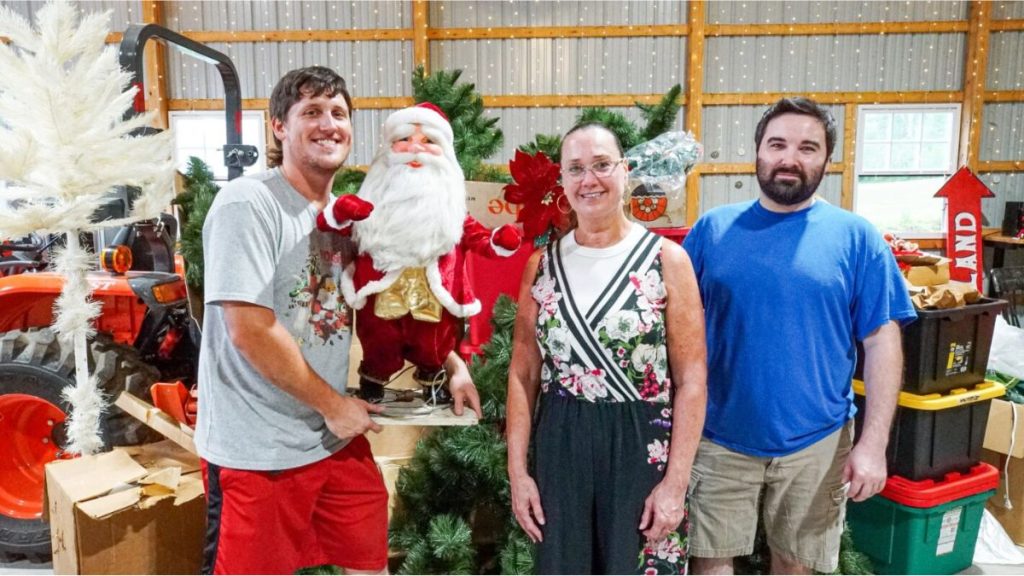
Readers of The Glow That Won’t Go Out may remember him from the section about Hoarding for the Holidays. In the program’s first episode, A Real Life Elf, he appears surrounded by an extraordinary collection of vintage holiday decorations.

There’s also a smaller detail I mentioned in the book that collectors probably appreciated.

Nick wore the hobby.

Literally.

His gray shirt read:

“Plug In Those Vintage Blow Molds and Light Up Your Christmas.”

It’s hard to imagine a more appropriate wardrobe choice when you’re being filmed in the middle of a blow mold collection. Want that shirt or one like it? Click here.

But the brief appearance in my book left me wanting to know more.

How does someone accumulate a collection numbering in the thousands?

What’s it like letting a television crew into that world?

And perhaps most importantly, how do you keep all that aging plastic alive?

So I went back to Nick.

Here’s our conversation.


A Conversation With Nick of Saint Nick’s Display

How did you first get started collecting blow molds?

Nick: I first got started collecting blow molds when I was about six or seven. I was going around to the local flea market and happened to see a vendor selling some for a buck each.

Yes, only one dollar.

At the time I saw them and was amazed by the size of them. I didn’t even realize they lit up until I got them home.

My collection consists of several thousand decorations. Not all are used due to needing repairs, but I try to put out what I can each year.

My favorites have to be anything made by Poloron or Beco—the original OG blow mold companies from the 1960s.

Let’s Stop at “One Dollar” for a Moment

There are younger collectors reading this who may need a minute.

One dollar.

Today, collectors can spend considerable money chasing desirable vintage pieces.

Nick’s childhood introduction to the hobby happened in another universe.

He wasn’t studying sold listings on his phone.

He wasn’t competing against twenty-seven other people who had received the same Marketplace notification.

He was a kid at a flea market who saw some enormous plastic Christmas decorations and thought they looked cool.

Then he brought them home and discovered something even better.

They lit up.

That’s the kind of experience that creates a collector.

And it points to something I kept returning to while writing The Glow That Won’t Go Out.

For many collectors, this isn’t fundamentally about monetary value.

It’s about memory.

A particular Santa can transport someone back to their grandparents’ lawn.

A snowman can look exactly like the one that stood beside the driveway every December.

You aren’t merely collecting plastic.

Sometimes you’re buying your way back into Christmas when you were seven years old.

Nick just happened to start doing it while he actually was seven years old.


When HGTV Comes Calling

Nick’s collection eventually became large enough to attract attention beyond the blow mold community.

He appeared in Hoarding for the Holidays, where viewers got to see both his indoor and outdoor Christmas displays.

But the invitation didn’t initially inspire excitement.

It inspired suspicion.

How did Hoarding for the Holidays discover you?

St. Nick's Display from Hoarding for the Holidays

Nick: I was found for the show Hoarding for the Holidays through my display page on Facebook, Saint Nick’s Display.

They randomly sent me a message one day in the spring, which I originally thought was a spam message and almost ignored.

I can say, having dealt with other shows that were less than stellar to me, I was extremely impressed by HGTV and Exit 4 and all the crew for how professional and kind they all were to me.

It felt like being with friends during the filming.

They were so helpful and even let me tell them how I liked things done.

I couldn’t have been happier with how they filmed us and treated not only me but all my family and friends. They are A-plus people, and I’d work with them again.

Were you happy with the final show?

Nick: I was extremely happy with the final product.

It showed my indoor display and my outdoor display.

And even the mucky places I’d go for Christmas decorations!

That last part matters.

Because every serious collector knows the beautiful display is only half the story.

Nobody photographs the crawlspace.

Nobody makes an Instagram Reel celebrating the moment you climb over fourteen storage totes because you’re convinced the missing light plate is in the box against the back wall.

Nobody sees you standing in mud negotiating over a faded Santa that appears to have spent the previous decade beneath somebody’s porch.

Television usually wants the spectacle.

Nick appreciated that this production captured more of the actual world surrounding the spectacle—and treated the people in it respectfully.


Keeping Thousands of Blow Molds Alive

Having several thousand vintage decorations creates another issue:

Several thousand vintage decorations eventually become several thousand aging vintage decorations.

Paint fades.

Surfaces weather.

Plastic gets damaged.

Parts disappear.

That’s how Nick became interested in restoration.

What got you started restoring blow molds?

Nick: I got into blow mold repairs simply because mine started to peel and get weathered over time.

Having had some of mine for years at that point, they needed a refresh.

I did many different things and ended up finding that airbrushing was the closest I could get them to original.

At first, like all artists, you make mistakes with types of paints and materials. But time helps, and you learn to grow and become better at it.

There’s an important word in that answer:

Artist.

Good restoration isn’t simply covering faded plastic with paint.

You’re trying to preserve the visual character of something manufactured decades ago.

Color.

Opacity.

Edges.

Overspray.

The peculiar look created by mass-production techniques.

Make something too perfect and it can stop looking vintage.

Make the wrong repair and you can create a problem worse than the one you started with.

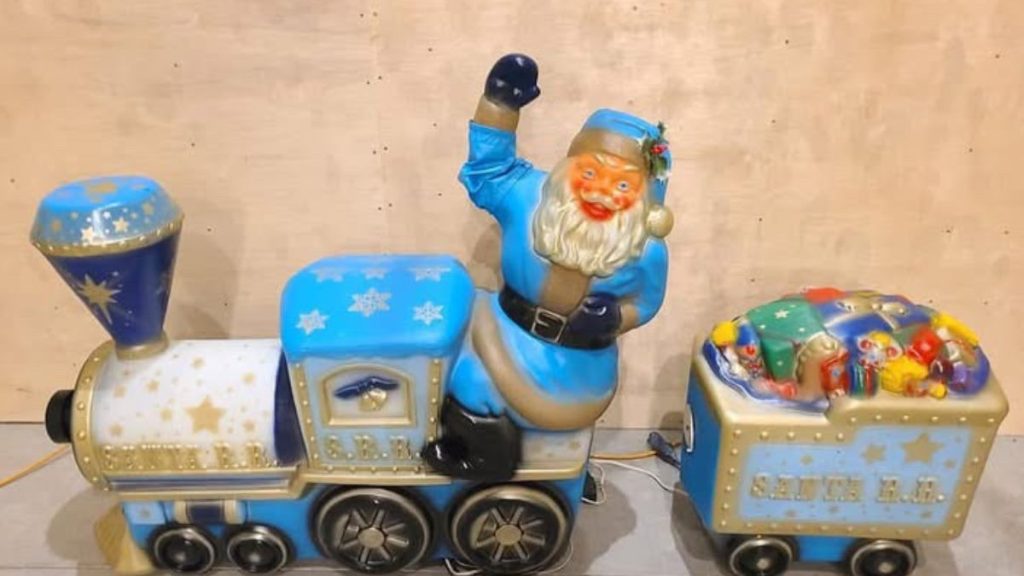
Light blue painted Santa Claus on train blow mold, vintage.

Which brings us to Nick’s most important restoration advice.


Please Don’t “Fix” It Until You Know How to Fix It

What’s your biggest recommendation for someone considering restoration?

Nick: For those looking to get blow molds restored or fixed, I can only recommend making sure they use the right products and hopefully not DIY it in a way that will entirely ruin the plastic or alter an antique in a way that can never be fixed.

This is worth emphasizing.

Old plastic isn’t a practice canvas.

Before attacking a valuable vintage piece with paint, solvent, adhesive, heat or some restoration hack you saw in a 37-second video, find out what you’re dealing with.

Sometimes the smartest restoration decision is:

Don’t touch it yet.

Research the manufacturer.

Identify the material.

Talk to experienced restorers.

Practice techniques on something expendable.

Determine whether a repair is reversible.

The objective shouldn’t necessarily be to make a 60-year-old blow mold look like it rolled out of the factory yesterday.

The objective is to help it survive.

That’s a recurring theme throughout The Glow That Won’t Go Out:

Preservation beats perfection.

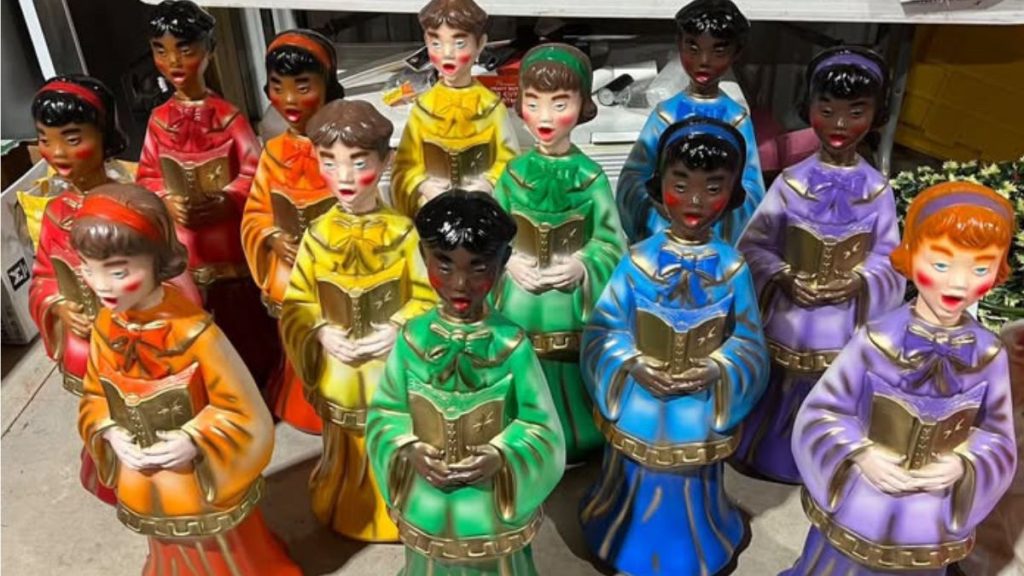
display of airbrushed blow mold Christmas carollers

Then There’s the Jones House Auction

For collectors, online marketplaces have transformed the hunt.

But there’s something an online listing can’t replicate:

Standing in a room full of people who immediately understand why you’re excited about an old piece of glowing plastic.

Nick has been attending the Jones auction for more than a decade.

What is the Jones House Auction experience like?

Nick: I have been going to the Jones auction since its creation over a decade ago.

About the time I was in high school, it first started to be a blow mold auction. It was extremely cheap at the time before the trends happened.

It’s very cool to be so local to that auction. I’m only about 25 minutes away.

I would recommend going if you enjoy the social aspect of being around other like-minded collector people.

That last sentence may explain why physical collector events continue to matter.

You can buy something online.

You can research it online.

You can discuss it online.

But collecting has always had a social component.

Swap meets.

Flea markets.

Auctions.

Estate sales.

Christmas displays.

People leaning over a table saying:

“I’ve been looking for one of these for fifteen years.”

That’s the culture surrounding the objects.

And sometimes that’s more memorable than whatever you brought home.


What Changed?

Nick’s collecting life spans an interesting period in the hobby.

He remembers the $1 flea-market blow mold.

He remembers auctions before prices began climbing.

Now he lives in a world where vintage Christmas has become its own collecting category and previously overlooked decorations can inspire serious competition.

But there’s an irony here.

The increased attention that makes certain pieces harder and more expensive to acquire is also helping ensure they’re preserved.

People are identifying manufacturers.

Documenting variations.

Creating replacement parts.

Learning restoration techniques.

Sharing old catalogs.

Recording histories.

And introducing new collectors to names such as Empire, General Foam, Union Products, Poloron and Beco.

The objects aren’t anonymous lawn decorations anymore.

They’re artifacts of American Christmas.

That’s a large part of why I wrote The Glow That Won’t Go Out.


Several Thousand Reasons the Glow Won’t Go Out

Look again at the photograph of Nick standing in his collection.

Don’t look at him at first.

Look behind him.

Santa.

Snowmen.

Angels.

Reindeer.

Characters.

Rows upon rows of plastic faces.

Every one came from somewhere.

Somebody originally bought each one.

Somebody put it outside.

Some kid saw it glowing through a window.

Eventually it was packed away.

Years passed.

Families moved.

Decorating styles changed.

Somehow, it survived.

And eventually one of those pieces wound up with a collector like Nick.

That’s why the title The Glow That Won’t Go Out means more to me than the literal light inside these decorations.

The glow is the memory attached to them.

Nick bought his first ones when he was six or seven.

All these years later, he’s still restoring them, displaying them, hunting for them and surrounding himself with thousands of them every Christmas.

The collection got considerably larger.

The kid who was amazed to discover those $1 flea-market decorations actually lit up?

I’m not sure he ever completely left.

And maybe that’s the whole point.

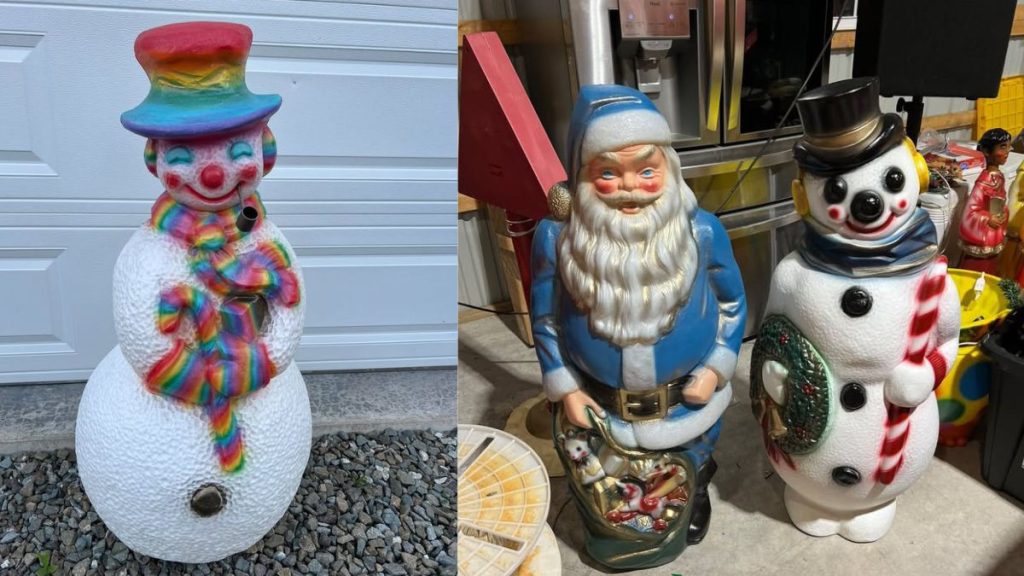
Rainbow airbrushed blow mold snowman and painted Santa & snowman blow molds, courtesy of Nick.

Discover More Stories From the Blow Mold Community

Nick and Hoarding for the Holidays are featured in The Glow That Won’t Go Out: The Complete Collector’s Guide to Vintage Holiday Blow Molds by Curtiss Wayne Andrews.

The book explores the manufacturers, history, identification, restoration and collecting culture behind the glowing plastic decorations that became fixtures of the American Christmas landscape.

But just as importantly, it’s about the people who refuse to let that glow disappear.