By Curtiss Wayne Andrews, author of The Glow That Won’t Go Out
There are certain objects that don’t simply remind you of childhood.
They switch childhood back on.
For me, vintage blow molds do that.
Put an old plastic Santa on a dark lawn, plug in that slightly questionable cord, wait for the bulb inside to warm up, and suddenly you’re not looking at a piece of molded plastic anymore.
You’re looking at Christmas.
And if you grew up in America during the second half of the twentieth century, there’s a pretty good chance that some of those glowing figures came from one company:
Empire.
Collectors know the name.
You’ll see it stamped into the backs and bases of Santas, snowmen, candles, Nativity figures and Halloween decorations that still turn up at estate sales, flea markets and in garages across America.
But Empire deserves to be remembered for something bigger than the name stamped into the plastic. And yes, I even designed a t-shirt honoring its roots.
For decades, the company helped define what an American holiday looked like.
The Beginning of an Empire
The corporate history can get confusing because the names Empire, Empire Plastics, Empire Industries, Empire of Carolina, Carolina Enterprises and Judith Novelty Sales all appear in different chapters of the story.
But the holiday-decorating lineage collectors associate with Empire reaches back to the 1950s in Tarboro, North Carolina.
Early seasonal pieces were marketed through Judith Novelty Sales, associated with Carolina Enterprises and what would become the Empire operation.
And Empire wasn’t simply a Christmas-decoration company.
This was American plastics manufacturing during its postwar boom.
The company’s output included toys, ride-ons, garden products and novelty items alongside the hollow plastic figures collectors obsess over today.
Plastic was becoming the wonder material of American consumer culture.
And blow molding offered manufacturers a particularly magical trick.
A relatively large object could be produced as a hollow shell, making it durable enough for the yard, light enough to carry and — most importantly for us — translucent enough to illuminate from within.
Empire understood the possibilities.
When Plastic Became Christmas
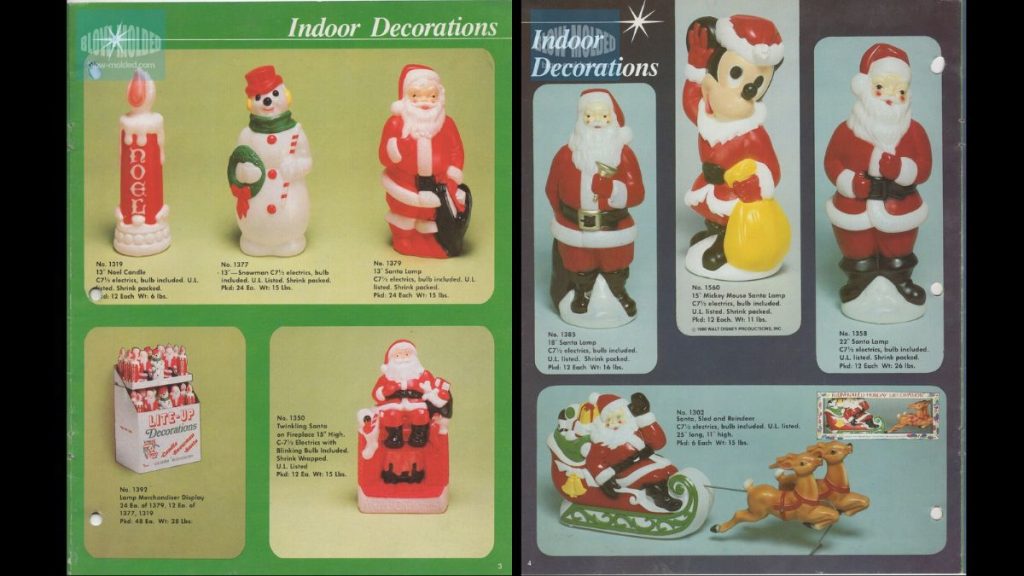
Look at the classic Empire catalog and you begin to understand the company’s influence.
Santas.
Snowmen.
Toy soldiers.
Candles.
Elves.
Choir figures.
Nativity pieces.
These weren’t subtle decorations.
That was the point.
They were big. Bright. Cheerful. Colorful. And when somebody put a light inside one on a December night, it became something completely different.
A plastic figure suddenly had a soul.
That’s the strange magic of the blow mold.
During daylight, you can see every scuff, faded patch of paint and imperfection.
At night?
Turn the bulb on and all is forgiven.
Empire became extraordinarily good at that transformation.
The Empire Nativity
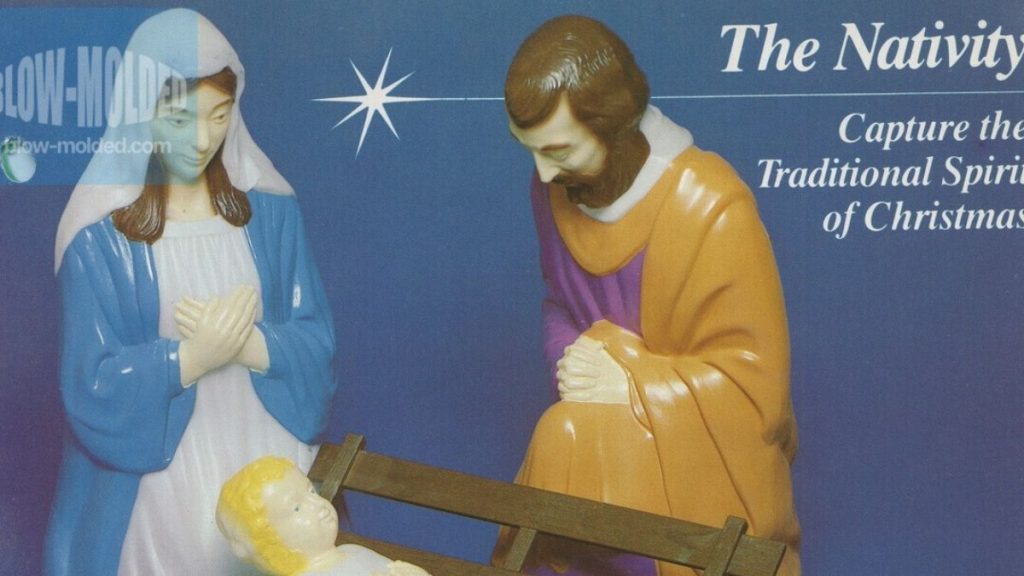
If I had to choose one product family that demonstrates the company’s lasting impact, the Empire Nativity would be near the top.
Mary.
Joseph.
Baby Jesus.
The shepherd.
Sheep.
Wise Men.
Camel.
Donkey.
Ox.
Over time, the collection grew into the kind of large illuminated Nativity display that became a fixture of American Christmas decorating.
These weren’t decorations you placed on a mantel.
They could occupy a yard.
Families assembled them beneath homemade stables. Churches displayed them outside. People added pieces over time until a small Holy Family became an entire illuminated scene.
And that’s where blow molds become something more interesting than collectibles.
They became traditions.
A child might see the same Mary and Joseph pulled out of the garage every December for 15 years.
Eventually that child grew up.
Then one day, decades later, he spots that exact Joseph at an estate sale.
Suddenly it’s not plastic anymore.
It’s memory.
Empire Didn’t Just Create — It Preserved
There’s another important chapter in Empire’s history.
The American blow-mold industry was never static.
Companies disappeared. Tooling changed hands. Aluminum molds survived the companies that originally owned them.
Empire became part of that chain of preservation.
Designs associated with manufacturers such as Poloron and its successors eventually found their way into Empire’s catalog. Pieces originally conceived in an earlier era could therefore survive into another generation.
One wonderful example is the classic Drummer Boy.
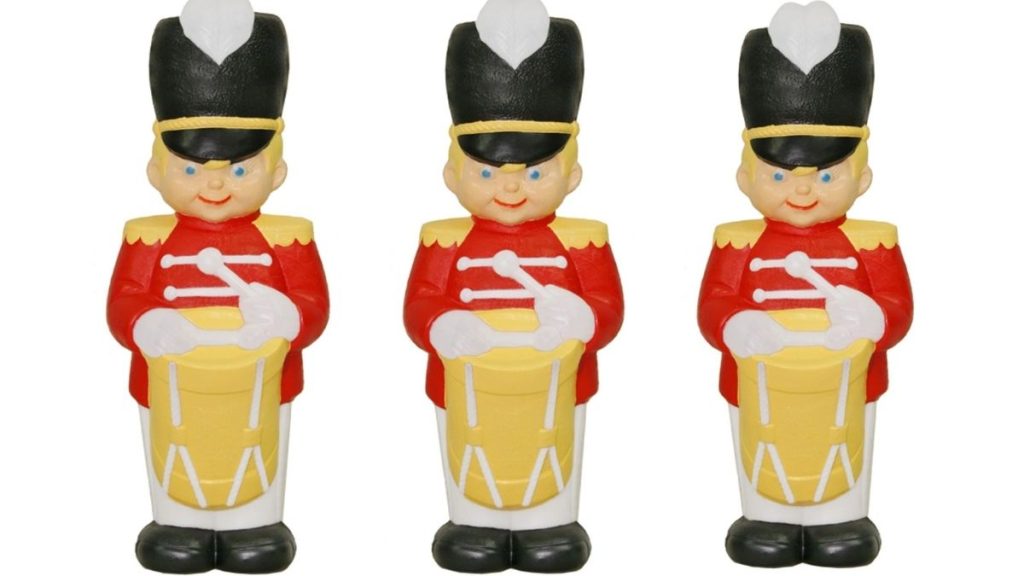
Its lineage stretches through multiple manufacturers. Empire produced a version during the 1990s, and after Empire’s seasonal business changed hands, the design continued under General Foam.
That’s one of the fascinating things about collecting blow molds.
Sometimes you’re not simply tracing a decoration.
You’re tracing a mold.
The company name can change while the character survives.
And Then There Were the Characters
Empire wasn’t afraid of pop culture, either.
During the 1970s, the company produced Christmas-themed Disney characters, including versions of Mickey Mouse, Minnie Mouse, Donald Duck and Goofy.
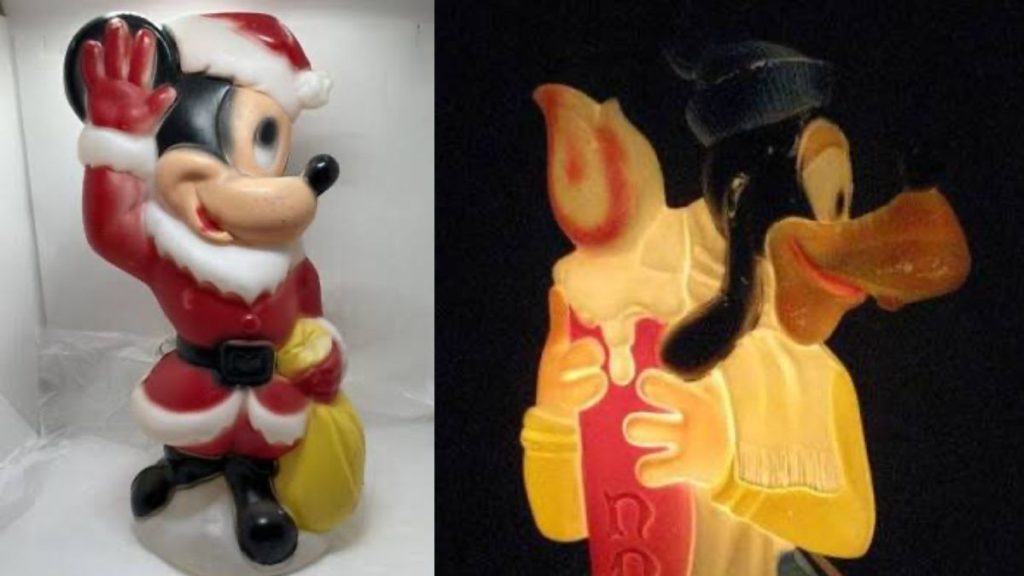
Think about how wonderfully strange that is.
Traditional Christmas iconography lived alongside cartoon characters, toy soldiers and giant candles — all made from glowing molded plastic.
But that eclectic quality was part of the appeal.
The American front yard was becoming its own holiday stage.
And Empire supplied the cast.
Halloween Gets the Empire Treatment
Christmas may dominate the popular memory of blow molds, but Halloween collectors know Empire had plenty to say once October arrived.
Jack-o’-lanterns.
Ghosts.
Scarecrows.
Black cats.
Witches.
Seasonal characters that looked completely different once illuminated against a dark porch.
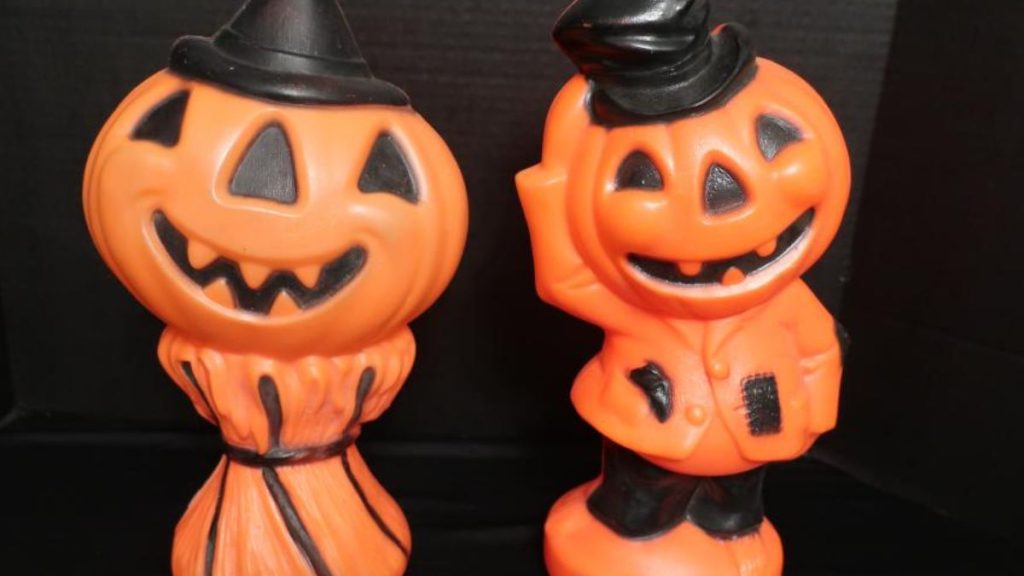
By the 1990s, Empire was still creating memorable Halloween pieces. The company’s Jack the Scarecrow, for example, appeared during that decade and has since developed the kind of nostalgic following that turns an ordinary yard decoration into a sought-after collectible.
That is another reason Empire matters.
Its history wasn’t frozen in 1965.
The company kept participating in American seasonal decorating for decades.
The Company Behind the Blow Molds Was Much Bigger
Collectors sometimes understandably reduce Empire to the glowing figures.
But the company was a significant toy manufacturer as well.
Empire’s world eventually included ride-on toys and recognizable consumer brands. It acquired rights to the famous Big Wheel, and later its toy operations encompassed brands including Buddy L. What kid in the 1980’s didn’t have one of these??
That larger business helps explain the scale behind the holiday decorations.
Empire wasn’t a tiny workshop producing a few hundred Santas for specialty stores.
This was industrial American manufacturing.
The Tarboro operation became enormous, with a manufacturing complex eventually encompassing roughly 1.2 million square feet.
Millions of plastic products passed through that manufacturing ecosystem.
And among them were the Santas and snowmen now sitting in our garages.
The End of Empire
Like many great American manufacturing stories, Empire’s ending is complicated.
Corporate restructuring, acquisitions, financial pressure and increasing competition transformed the business during the 1990s. The whole story should really be an HBO Max series, shouldn’t it?
By 2000, the Tarboro manufacturing era was coming to an end.
In May of that year, Empire entered into an agreement with General Foam Plastics involving its Tarboro facility and substantial portions of its seasonal manufacturing operation.
General Foam acquired the holiday product assets and continued producing many designs associated with the Empire legacy.
Later that year, Empire of Carolina filed for Chapter 11 bankruptcy protection.
By 2001, substantially all of the remaining toy operations had also been sold.
The Empire that had helped fill American yards with plastic Christmas characters was effectively gone.
But here’s the funny thing about blow molds.
Companies can disappear.
Their products refuse to.
Why Empire Is Still Everywhere
Drive around older American neighborhoods in December and you’ll occasionally see one.
Maybe it’s a Santa whose red paint has faded almost pink.
Maybe it’s a snowman with scratches across his stomach.
Maybe Mary has spent 30 winters standing next to Joseph.
The owner might not even know they’re Empire pieces.
They simply know that these decorations belonged to Mom and Dad.
Or Grandma.
Or they’ve been in the family “forever.”
That might be Empire’s greatest achievement.
The company manufactured mass-produced plastic objects that somehow became family heirlooms.
Think about the contradiction in that.
Plastic was supposed to be cheap.
Disposable.
Modern.
Replaceable.
Instead, people are restoring these things.
They’re searching flea markets for them.
They’re repairing cracked plastic.
They’re replacing missing light kits.
They’re researching paint variations and manufacturing marks.
They’re driving hundreds of miles to buy a Santa somebody else was about to throw away.
And they’re passing them down.
The Imperfections Are Part of It
I’ve spent a lot of time thinking about why vintage blow molds have such an emotional pull.
I don’t think perfection has anything to do with it.
Actually, I think it’s the opposite.
An old Empire piece often shows its life.
The paint is thin around the nose.
There’s a scratch down one side.
The plastic has yellowed slightly.
Someone drilled a hole where they probably shouldn’t have.
The light kit isn’t original.
Maybe there’s a name written on the bottom in permanent marker from a garage sale 30 years ago.
Every flaw is evidence that the thing survived.
And when you illuminate it again?
It still works.
It still glows.
More Than a Manufacturer
That’s why Empire belongs in the conversation whenever we talk about the history of American blow molds.
Companies like Empire, Union Products, General Foam, Beco and Poloron weren’t simply manufacturing seasonal decorations.
They created a visual language.
The glowing Santa beside the driveway.
The plastic candle near the front steps.
The snowman standing in the yard.
The Nativity glowing beneath a plywood stable.
These images became part of the American holiday landscape.
Empire helped put them there.
The Glow Didn’t Go Out
Today, collectors know what previous generations often didn’t.
Those old decorations matter.
Not because every Empire blow mold is rare.
Many aren’t.
Empire produced and distributed enormous numbers of them, which is precisely why so many people remember them.
Their importance isn’t necessarily scarcity.
It’s reach.
Empire put glowing plastic Christmas memories into neighborhoods all across America.
And more than two decades after the original company disappeared, collectors are still plugging those memories back in.
That’s a pretty remarkable legacy for something that started as a hollow piece of plastic.
Maybe that’s why I keep coming back to these things.
Factories close.
Companies disappear.
Catalogs get thrown away.
People move.
Families change.
But somewhere tonight, somebody will find an old Empire Santa in an attic, wipe the dust from his face, put a bulb inside him and watch him glow again.
And for a moment, everything that disappeared with him comes back.
That’s the glow that won’t go out.
Curtiss Wayne Andrews is the author of The Glow That Won’t Go Out, a collector’s guide exploring the history, manufacturers, personalities and enduring appeal of vintage holiday blow molds.