A mysterious Santa, a Reddit clue, Harold Gale—and why collectors will crawl through an antique mall looking for something money can’t really buy
By Curtiss Wayne Andrews
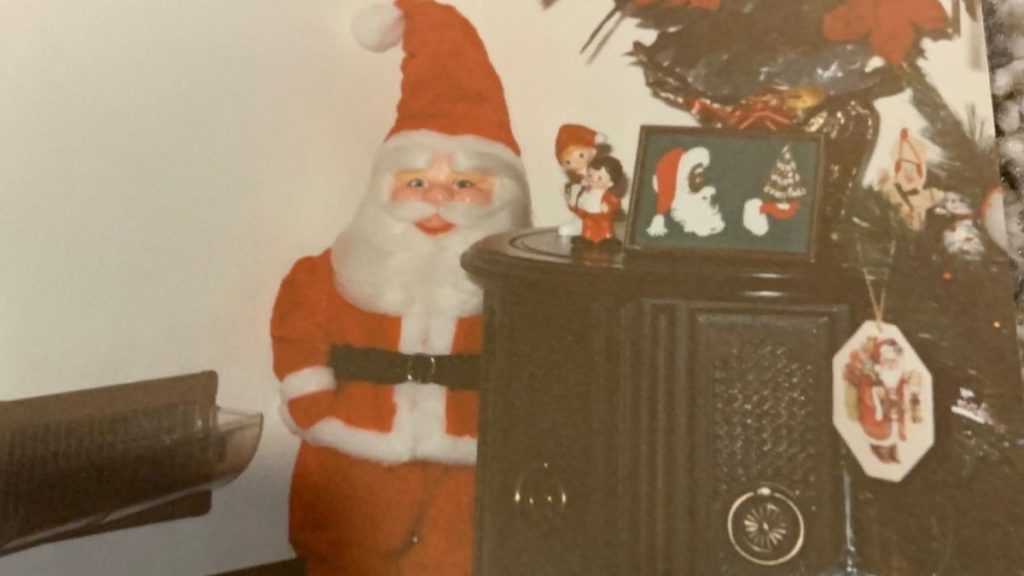
Somewhere out there is my Santa.
At least, that’s what I choose to believe.
He may be standing in an antique mall in Iowa with a $795 price tag hanging from his wrist.
He may be in somebody’s attic underneath a box labeled XMAS STUFF — DON’T THROW AWAY, which virtually guarantees their children will eventually throw it away.
He may be sitting in a barn.
He may have been destroyed decades ago.
Or—and this is the scenario I prefer—he is currently waiting for me in the back corner of an estate sale while a shaft of sunlight shines dramatically through a window and John Williams music begins playing.
Because I have apparently turned finding my grandparents’ Christmas decoration into Raiders of the Lost Ark.
And I’m completely fine with that.
The Santa at My Grandparents’ House
At the end of my book The Glow That Won’t Go Out, I put out a request to readers.
Help me find this Santa.
My grandparents lived in Nevada, Iowa, and sometime in the 1980s they had the approximately four-foot Santa you see in the photograph accompanying this article.
He wasn’t a blow mold.
But in my memory, he occupied the same universe.
Christmas decorations weren’t “holiday décor” when you’re a kid. You didn’t care who manufactured them, what year they were produced or whether they still had their original tags.
They simply appeared.
One day Grandma and Grandpa’s house looked normal.
Then Christmas happened.
Santa was there.
And because children possess the archival instincts of drunken raccoons, I did not think to turn him upside down and record the manufacturer’s information for a book I would write approximately four decades later.
This has proven inconvenient.
Then Reddit Gave Me a Name
Recently, someone looking at the photograph suggested a possibility:
Harold Gale.
And down the rabbit hole I went.
If you’re unfamiliar with Harold Gale, welcome to one of those glorious corners of collecting where you suddenly realize an object you’ve seen your entire life has an entire history hiding behind it.
Harold Gale wasn’t merely some guy manufacturing Santa dolls.
He helped create the Christmas America once saw through department-store windows.
Harold and Viola’s Santa Workshop
The story begins around 1946, when Harold Gale and his wife, Viola, began making Santa figures at home in Kansas City.
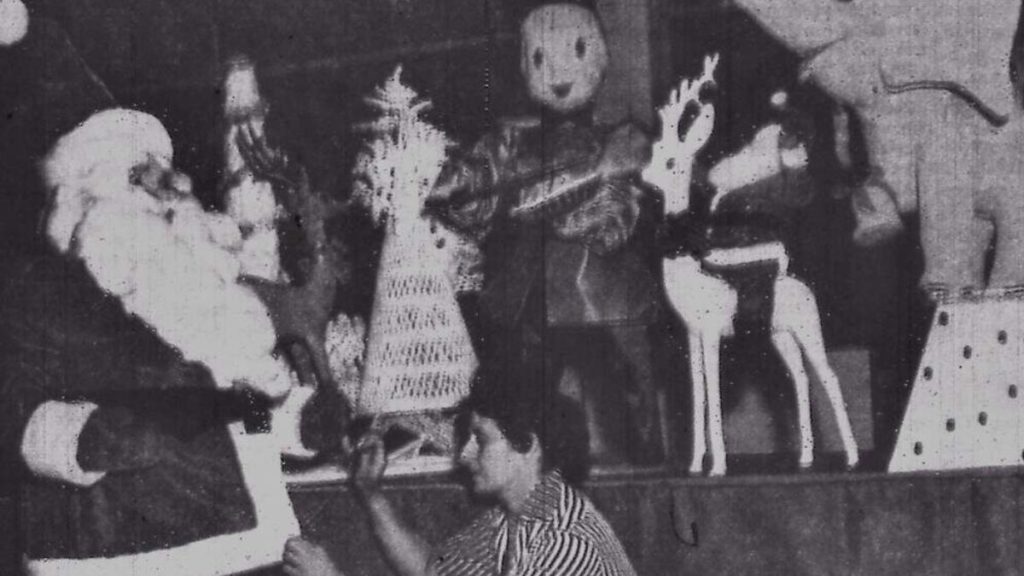
Harold had worked in department-store display, and the couple recognized a market for convincing Santa figures that retailers could use in their Christmas windows and displays. Early accounts describe them working nights and weekends, constructing figures using wire frames, fabric costumes and carefully finished faces.
This wasn’t “launch a startup” in the modern sense.
There was no venture-capital pitch.
No app.
No podcast called Disrupting Santa.
They made Santas.
With their hands.
The Gales reportedly put about $3,000 of their savings into the venture. As demand increased, their homegrown operation expanded until they had a roughly 3,000-square-foot factory employing dozens of workers.
Think about that.
A husband and wife making Christmas figures after their children went to bed eventually created a factory devoted to manufacturing Santa Claus.
That may be the most American business story ever told.
These Weren’t Just Santas. They Were Performers.
Gale’s larger creations were designed for retail display.
Some were animated.
Some waved.
Some moved.
Some emerged from chimneys.
There were elves, Mrs. Claus figures and other characters.
And these things had presence.
We’re talking about an era when department-store Christmas windows were events. Before you could order 400 LED lights from your phone while sitting on the toilet, retailers had to make you physically stop walking down the sidewalk.
A moving six-foot Santa could accomplish that.
Surviving large Gale displays demonstrate just how substantial these creations could be. Collectors have documented examples approaching six feet tall, while other authenticated animated models were considerably smaller.
Eventually the Santas came home.
In 1957, Gale introduced a roughly 15-inch Santa aimed at ordinary consumers rather than commercial display departments. Those smaller figures—with some versions sporting wonderfully period white belts and white boots—became enormously popular. By 1960, accounts say the company had produced more than 100,000 Santas.
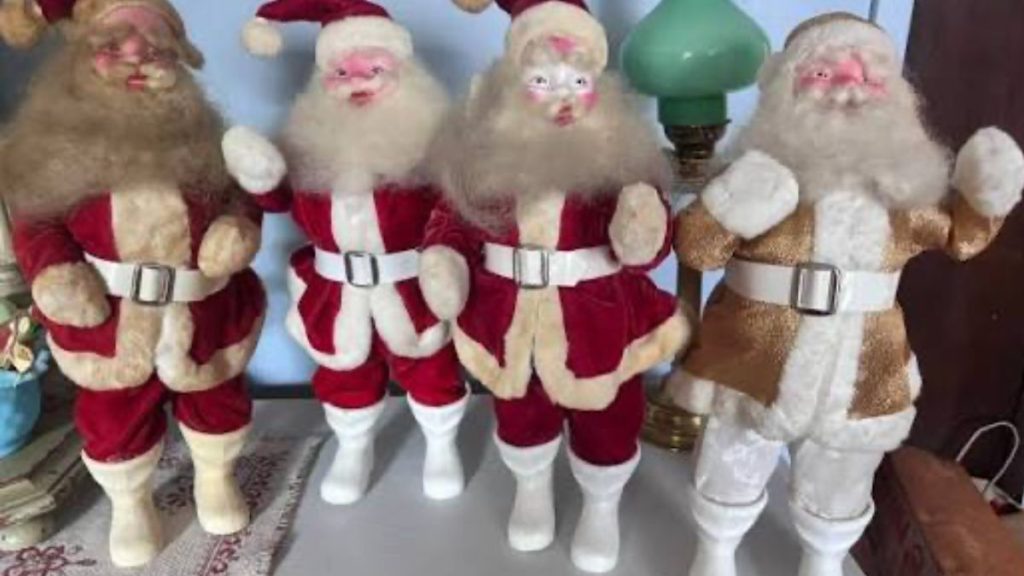
There were different clothes.
Different colors.
Different faces.
Promotional versions.
And enough variations that today you can lose an entire evening comparing Santa Claus’s footwear on the Internet.
Ask me how I know.
The Faces Matter
One of the charms of Gale Santas is that many don’t have the sterile perfection of modern mass-produced decorations.
They have faces.
Expressions.
Personality.
Harold Gale’s daughter, Susan Gale Laird, later recalled that an artist known as Mrs. Ewing painted many of the faces, while Viola Gale developed clothing patterns and supervised seamstresses. She even remembered separating lamb’s wool for Santa beards while visiting the shop.
That’s the detail that gets me.
Lamb’s wool.
Hand-painted cheeks.
Sewn costumes.
These were commercial products, certainly.
But human hands were all over them.
That’s why two old Santas standing beside each other can somehow feel like two different guys.
One looks jolly.
One looks tired.
One looks like he knows exactly what you did in 1973 and has chosen not to involve the authorities.
So…Is My Santa a Harold Gale?
Here comes the frustrating part.
I don’t know.
And I’m not going to turn a tantalizing possibility into a fact simply because it makes a better story.
Gale absolutely produced large Santas for commercial displays, and collectors recognize recurring construction methods, facial styles, costumes and other characteristics. Large examples survive today.
But my evidence is currently one family photograph.
That’s not enough.
Looking closely at our Santa, I see details that make the suggestion intriguing, but I also see enough differences from readily documented Gale examples that I want much stronger evidence before declaring victory.
So the case remains open.
Which, unfortunately for everyone who knows me, means I now have another thing to hunt for.
Welcome to the Disease
This is where my Santa hunt intersects perfectly with blow-mold collecting.
Collectors understand what happens next.
You walk into an antique store supposedly looking for nothing.
That’s your first lie.
You tell your spouse:
“I’m just going to look around.”
Second lie.
Then you see something red approximately 70 feet away.
Your pulse changes.
You begin moving toward it while pretending you’re not moving toward it because another person is standing nearby and that person is now competition.
Is that Santa?
Wrong boots.
Keep moving.
Next booth.
Plastic snowman.
Empire?
Turn it around.
No marking.
Interesting seam.
Could be.
Take picture.
Google.
Walk twelve feet.
Another Santa.
Too small.
Next aisle.
Suddenly you have been inside the antique mall for two hours and are carrying a ceramic squirrel you had absolutely no intention of buying.
This is collecting.
Why Do We Do This?
I’ve thought about that question a lot while writing The Glow That Won’t Go Out. I thought about it a lot while contributing to Hoarders of History – 100 Timeless Collections That Reflect Who We Are, but I think about it even more now.
Why do adults become obsessed with finding old plastic Santas, discontinued ornaments, department-store displays, toys, signs, advertising pieces and decorations?
Because logically, it’s ridiculous.
We can buy a new Santa.
There are thousands of them.
Amazon will deliver one tomorrow.
That’s not the point.
We’re not looking for a Santa.
We’re looking for the Santa.
That’s an entirely different transaction.
The Indiana Jones Theory of Collecting
The best collecting adventures have three ingredients:
The artifact.
The mystery.
The story.
Indiana Jones doesn’t become excited because an object would look nice on a shelf.
He wants to know where it came from.
Who touched it?
Where did it disappear?
How did it survive?
And can he get to it before the Nazis?
Hopefully your local antique mall contains fewer Nazis.
But otherwise, the principle holds.
A vintage object becomes compelling when its history transforms it from a thing into an artifact.
That’s why I co-wrote Treasures, Trinkets, and Triumphs! The Unknown Critic’s Dusty Adventure Through America’s Top 100 Antique Shops.
Collecting isn’t really about accumulating possessions.
The great stories are about the hunt.
The flea market where you spotted something under a table.
The estate sale you almost didn’t attend.
The dusty antique shop where you found the object you’d been searching for for twenty years.
The seller who told you where it came from.
The thing you bought for $8 that turned out to be worth $800.
And, occasionally, the thing you paid $800 for that turned out to be worth $8.
We don’t discuss those.
The Value Nobody Can Put in a Price Guide
Suppose tomorrow somebody conclusively identifies my grandparents’ Santa.
Then suppose I find an identical example for sale.
What’s it worth?
$200?
$500?
$1,000?
To somebody else, maybe.
To me?
That’s where collecting economics falls apart.
Because I’m not purchasing four feet of old Christmas decoration.
I’m buying access to a room that doesn’t exist anymore.
My grandparents’ house.
Nevada, Iowa.
Christmas in the 1980s.
The furniture.
The decorations.
The television.
The smell of my Grandma’s perfect non-lumpy mashed potatoes with gravy.
The people who were there.
That Santa is a key.
That’s why nostalgia collectibles can generate emotions wildly disproportionate to their material value.
The object survived after the moment didn’t.
Harold Gale Understood Something
Harold and Viola Gale probably couldn’t have imagined people discussing their Santas online eighty years later.
Harold sold the business in the early 1970s and retired to California, according to his daughter’s later recollection. He died in 1982. The company continued after his departure and ultimately ceased production in 1988.
But the Santas survived.
They’re in collections.
Antique malls.
Estate sales.
Auctions.
Basements.
Christmas displays.
Some are battered.
Some have replacement beards.
Some no longer move.
Some have stains.
Some are missing pieces.
And people still want them.
One recent 2026 auction, for example, sold a Harold Gale Santa for $76, while specialty dealers currently ask considerably more for certain examples; rarity, size, condition, age and provenance can make the market highly variable.
But again:
Price isn’t the interesting part.
Survival is.
Somewhere Out There…
So my search continues.
Maybe the Santa in my grandparents’ photograph is Harold Gale.
Maybe someone reading this will recognize the face.
Maybe it’s another manufacturer entirely.
Maybe somebody has an old catalog showing the exact model.
Maybe someone in Iowa will email me:
“You’re not going to believe what’s been in my mother’s basement for 35 years.”
Those are the five greatest words in collecting.
Well, after:
“I don’t know what it’s worth.”
Because every collector secretly believes the next antique shop could contain the thing.
That’s why we pull over for flea markets.
That’s why we scan estate-sale photographs at midnight.
That’s why we dig through boxes.
That’s why we turn blow molds around looking for manufacturer’s marks.
That’s why a photograph of a Santa from forty years ago can send a grown man into the history of an obscure Kansas City Christmas-decoration company.
We’re searching for objects.
But we’re really searching for stories.
And every once in a while, if we’re incredibly lucky, we find a piece of our own.
So if you recognize this Santa…
Indiana Jones here is still looking.
Curtiss Wayne Andrews is the author of The Glow That Won’t Go Out, which explores the history, personalities and collecting culture surrounding vintage holiday blow molds, and Treasures, Trinkets, and Triumphs! The Unknown Critic’s Dusty Adventure Through America’s Top 100 Antique Shops.