He bought his first blow molds for $1 each as a kid. Today his collection numbers in the thousands. The Hoarding for the Holidays collector talks restoration, television, auctions and why the old Poloron and Beco pieces still matter.
By Curtiss Wayne Andrews
There was a time when vintage blow molds weren’t vintage.
They weren’t “collectibles,” either.
They were Christmas decorations.
They sat outside houses.
They got rained on.
Snow piled against them.
Kids knocked them over.
Parents shoved them into garages sometime after New Year’s Day, where they waited patiently for another Christmas.
And if you happened upon a few old ones at a flea market?
Apparently, you could buy them for a dollar apiece.
Nick remembers those days.
Very well.
Because that’s essentially how his collection started.
From a $1 Flea-Market Find to Thousands of Blow Molds
While putting together The Glow That Won’t Go Out: The Complete Collector’s Guide to Vintage Holiday Blow Molds, I wanted to capture something that’s difficult to communicate unless you’ve spent time around serious collectors:
This hobby can get completely out of hand.
I mean that affectionately.
One Santa becomes two.
Then you need a snowman.
Then you discover that Empire made six versions of something you thought was one version.
Then somebody mentions Poloron.
Eventually, you’re standing in a building surrounded by several thousand pieces of molded Christmas plastic and explaining that, technically, you don’t have a problem because some of them still need repairs.
Nick understands.
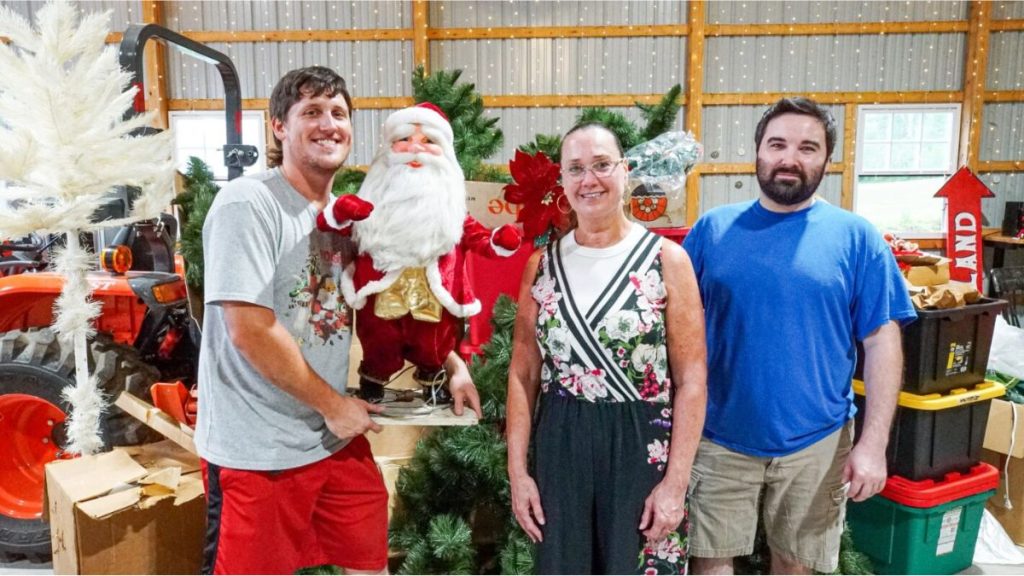
Readers of The Glow That Won’t Go Out may remember him from the section about Hoarding for the Holidays. In the program’s first episode, A Real Life Elf, he appears surrounded by an extraordinary collection of vintage holiday decorations.
There’s also a smaller detail I mentioned in the book that collectors probably appreciated.
Nick wore the hobby.
Literally.
His gray shirt read:
“Plug In Those Vintage Blow Molds and Light Up Your Christmas.”
It’s hard to imagine a more appropriate wardrobe choice when you’re being filmed in the middle of a blow mold collection. Want that shirt or one like it? Click here.
But the brief appearance in my book left me wanting to know more.
How does someone accumulate a collection numbering in the thousands?
What’s it like letting a television crew into that world?
And perhaps most importantly, how do you keep all that aging plastic alive?
So I went back to Nick.
Here’s our conversation.
A Conversation With Nick of Saint Nick’s Display
How did you first get started collecting blow molds?
Nick: I first got started collecting blow molds when I was about six or seven. I was going around to the local flea market and happened to see a vendor selling some for a buck each.
Yes, only one dollar.
At the time I saw them and was amazed by the size of them. I didn’t even realize they lit up until I got them home.
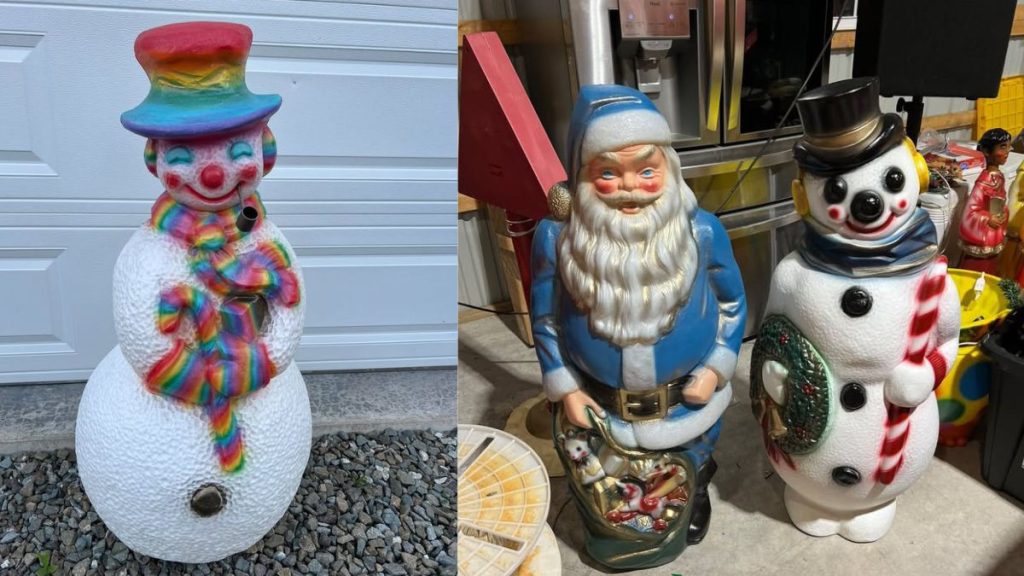
My collection consists of several thousand decorations. Not all are used due to needing repairs, but I try to put out what I can each year.
My favorites have to be anything made by Poloron or Beco—the original OG blow mold companies from the 1960s.
Let’s Stop at “One Dollar” for a Moment
There are younger collectors reading this who may need a minute.
One dollar.
Today, collectors can spend considerable money chasing desirable vintage pieces.
Nick’s childhood introduction to the hobby happened in another universe.
He wasn’t studying sold listings on his phone.
He wasn’t competing against twenty-seven other people who had received the same Marketplace notification.
He was a kid at a flea market who saw some enormous plastic Christmas decorations and thought they looked cool.
Then he brought them home and discovered something even better.
They lit up.
That’s the kind of experience that creates a collector.
And it points to something I kept returning to while writing The Glow That Won’t Go Out.
For many collectors, this isn’t fundamentally about monetary value.
It’s about memory.
A particular Santa can transport someone back to their grandparents’ lawn.
A snowman can look exactly like the one that stood beside the driveway every December.
You aren’t merely collecting plastic.
Sometimes you’re buying your way back into Christmas when you were seven years old.
Nick just happened to start doing it while he actually was seven years old.
When HGTV Comes Calling
Nick’s collection eventually became large enough to attract attention beyond the blow mold community.
He appeared in Hoarding for the Holidays, where viewers got to see both his indoor and outdoor Christmas displays.
But the invitation didn’t initially inspire excitement.
It inspired suspicion.
How did Hoarding for the Holidays discover you?
Nick: I was found for the show Hoarding for the Holidays through my display page on Facebook, Saint Nick’s Display.
They randomly sent me a message one day in the spring, which I originally thought was a spam message and almost ignored.
I can say, having dealt with other shows that were less than stellar to me, I was extremely impressed by HGTV and Exit 4 and all the crew for how professional and kind they all were to me.
It felt like being with friends during the filming.
They were so helpful and even let me tell them how I liked things done.
I couldn’t have been happier with how they filmed us and treated not only me but all my family and friends. They are A-plus people, and I’d work with them again.
Were you happy with the final show?
Nick: I was extremely happy with the final product.
It showed my indoor display and my outdoor display.
And even the mucky places I’d go for Christmas decorations!
That last part matters.
Because every serious collector knows the beautiful display is only half the story.
Nobody photographs the crawlspace.
Nobody makes an Instagram Reel celebrating the moment you climb over fourteen storage totes because you’re convinced the missing light plate is in the box against the back wall.
Nobody sees you standing in mud negotiating over a faded Santa that appears to have spent the previous decade beneath somebody’s porch.
Television usually wants the spectacle.
Nick appreciated that this production captured more of the actual world surrounding the spectacle—and treated the people in it respectfully.
Keeping Thousands of Blow Molds Alive
Having several thousand vintage decorations creates another issue:
Several thousand vintage decorations eventually become several thousand aging vintage decorations.
Paint fades.
Surfaces weather.
Plastic gets damaged.
Parts disappear.
That’s how Nick became interested in restoration.
What got you started restoring blow molds?
Nick: I got into blow mold repairs simply because mine started to peel and get weathered over time.
Having had some of mine for years at that point, they needed a refresh.
I did many different things and ended up finding that airbrushing was the closest I could get them to original.
At first, like all artists, you make mistakes with types of paints and materials. But time helps, and you learn to grow and become better at it.
There’s an important word in that answer:
Artist.
Good restoration isn’t simply covering faded plastic with paint.
You’re trying to preserve the visual character of something manufactured decades ago.
Color.
Opacity.
Edges.
Overspray.
The peculiar look created by mass-production techniques.
Make something too perfect and it can stop looking vintage.
Make the wrong repair and you can create a problem worse than the one you started with.

Which brings us to Nick’s most important restoration advice.
Please Don’t “Fix” It Until You Know How to Fix It
What’s your biggest recommendation for someone considering restoration?
Nick: For those looking to get blow molds restored or fixed, I can only recommend making sure they use the right products and hopefully not DIY it in a way that will entirely ruin the plastic or alter an antique in a way that can never be fixed.
This is worth emphasizing.
Old plastic isn’t a practice canvas.
Before attacking a valuable vintage piece with paint, solvent, adhesive, heat or some restoration hack you saw in a 37-second video, find out what you’re dealing with.
Sometimes the smartest restoration decision is:
Don’t touch it yet.
Research the manufacturer.
Identify the material.
Talk to experienced restorers.
Practice techniques on something expendable.
Determine whether a repair is reversible.
The objective shouldn’t necessarily be to make a 60-year-old blow mold look like it rolled out of the factory yesterday.
The objective is to help it survive.
That’s a recurring theme throughout The Glow That Won’t Go Out:
Preservation beats perfection.

Then There’s the Jones House Auction
For collectors, online marketplaces have transformed the hunt.
But there’s something an online listing can’t replicate:
Standing in a room full of people who immediately understand why you’re excited about an old piece of glowing plastic.
Nick has been attending the Jones auction for more than a decade.
What is the Jones House Auction experience like?
Nick: I have been going to the Jones auction since its creation over a decade ago.
About the time I was in high school, it first started to be a blow mold auction. It was extremely cheap at the time before the trends happened.
It’s very cool to be so local to that auction. I’m only about 25 minutes away.
I would recommend going if you enjoy the social aspect of being around other like-minded collector people.
That last sentence may explain why physical collector events continue to matter.
You can buy something online.
You can research it online.
You can discuss it online.
But collecting has always had a social component.
Swap meets.
Flea markets.
Auctions.
Estate sales.
Christmas displays.
People leaning over a table saying:
“I’ve been looking for one of these for fifteen years.”
That’s the culture surrounding the objects.
And sometimes that’s more memorable than whatever you brought home.
What Changed?
Nick’s collecting life spans an interesting period in the hobby.
He remembers the $1 flea-market blow mold.
He remembers auctions before prices began climbing.
Now he lives in a world where vintage Christmas has become its own collecting category and previously overlooked decorations can inspire serious competition.
But there’s an irony here.
The increased attention that makes certain pieces harder and more expensive to acquire is also helping ensure they’re preserved.
People are identifying manufacturers.
Documenting variations.
Creating replacement parts.
Learning restoration techniques.
Sharing old catalogs.
Recording histories.
And introducing new collectors to names such as Empire, General Foam, Union Products, Poloron and Beco.
The objects aren’t anonymous lawn decorations anymore.
They’re artifacts of American Christmas.
That’s a large part of why I wrote The Glow That Won’t Go Out.
Several Thousand Reasons the Glow Won’t Go Out
Look again at the photograph of Nick standing in his collection.
Don’t look at him at first.
Look behind him.
Santa.
Snowmen.
Angels.
Reindeer.
Characters.
Rows upon rows of plastic faces.
Every one came from somewhere.
Somebody originally bought each one.
Somebody put it outside.
Some kid saw it glowing through a window.
Eventually it was packed away.
Years passed.
Families moved.
Decorating styles changed.
Somehow, it survived.
And eventually one of those pieces wound up with a collector like Nick.
That’s why the title The Glow That Won’t Go Out means more to me than the literal light inside these decorations.
The glow is the memory attached to them.
Nick bought his first ones when he was six or seven.
All these years later, he’s still restoring them, displaying them, hunting for them and surrounding himself with thousands of them every Christmas.
The collection got considerably larger.
The kid who was amazed to discover those $1 flea-market decorations actually lit up?
I’m not sure he ever completely left.
And maybe that’s the whole point.
Discover More Stories From the Blow Mold Community
Nick and Hoarding for the Holidays are featured in The Glow That Won’t Go Out: The Complete Collector’s Guide to Vintage Holiday Blow Molds by Curtiss Wayne Andrews.
The book explores the manufacturers, history, identification, restoration and collecting culture behind the glowing plastic decorations that became fixtures of the American Christmas landscape.
But just as importantly, it’s about the people who refuse to let that glow disappear.