What started with two friends, $300 and some replacement light cords has grown into a small business built around vintage Christmas, hard-to-find blow molds—and the eternal problem of where to store all this plastic.
By Curtiss Wayne Andrews
There comes a point in almost every serious blow mold collector’s life when a troubling realization sets in:
You need parts.
Maybe you found the perfect vintage Santa at a yard sale.
The paint is good.
The plastic isn’t cracked.
The price was right.
You bring him home, turn him around and discover that the electrical components appear to have last been inspected during the Carter administration.
Or maybe there’s no cord at all.
Or the backing plate is missing.
Or the clips are gone.
Suddenly your great $20 find has become a restoration project.
That’s part of the world Thomas and his longtime friend stepped into when they started The Blow Mold Boys in Massapequa Park, New York.
But Thomas isn’t merely selling parts.
He’s a collector himself.
And like so many people I’ve interviewed while writing The Glow That Won’t Go Out, his story begins long before there was a business.
It begins with Dad.
It Started in Dad’s Yard
What first got you interested in blow molds?
Thomas: I got interested when I was a little kid. My dad used to put out blow molds, and I ended up developing a love for them.
As I got older, I started buying new pieces for my dad’s house. When I eventually moved, I took them with me.
Today, Thomas estimates his collection has grown to more than 100 pieces, spread across Christmas, Halloween and a smaller number of Easter blow molds.
Sound familiar?
It should.
One of the most consistent things I’ve discovered while talking to collectors is that the obsession rarely starts with the collector.
It starts with somebody else.
Dad put them outside.
Grandma had a Santa.
The neighbors had a snowman.
The family drove around looking at Christmas displays.
Eventually the child who stared at those glowing figures grows up, gets a house…
…and realizes he can buy them himself.
This is how trouble starts.
Old School Wins
Thomas owns newer pieces, but ask him where his heart is and there’s not much hesitation.
Vintage.
Do you have favorite pieces?
Thomas: I like the old-school ones because they were made better. The paint jobs were better on them and lasted longer.
Some of my favorite pieces are the Victorian Dickens Christmas Carolers. I wish they had come out with more in that style.
I also have the four elves, which are really cool.
The Victorian-style carolers make sense as favorites.
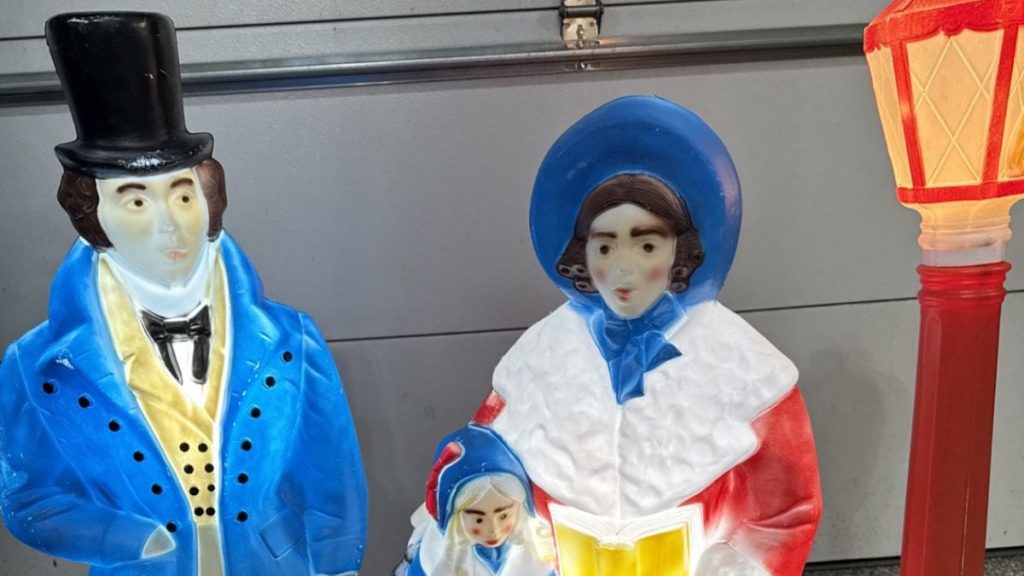
They don’t simply look like Christmas decorations.
They look like Christmas itself—the idealized version we’ve collectively inherited from greeting cards, department-store windows and old holiday movies.
Thomas has plenty of more common molds too.
But that’s another thing collectors learn eventually:
Common doesn’t mean bad.
The Santa everybody’s seen a hundred times might be exactly the Santa somebody remembers from childhood.
Rarity can make something expensive.
It doesn’t necessarily make it meaningful.
Two Friends, $150 Each—and a Bunch of Light Cords
Then came the business.
Not with investors.
Not with a warehouse.
Not with some elaborate five-year entrepreneurial plan.
It started with Thomas asking his friend for help sourcing a light cord.
How did The Blow Mold Boys begin?
Thomas: The shop started about three years ago, in 2023.
We started out selling single C7 light cords.
The first year we didn’t sell many of them, and we thought it was a bust.
Then the next year, the C7 singles sold out.
That’s when things got interesting.
Thomas and his friend had each put approximately $150 into the venture.
Three hundred dollars total. Sounds like a winning Shark Tank pitch.
The first year wasn’t particularly encouraging.
Then customers showed up.
The partners reinvested what they made, purchasing additional cords and expanding into other products.
And Thomas found another way to feed the business:
buying and reselling blow molds.
Thomas: As we were doing that, I was buying blow molds and flipping them for more money to help with the business, which we still do today.
The Blow Mold Boys originated basically because I asked my friend to help me get light cords. I knew he was more savvy with that, and he did it.
We both started with $150 each.
We don’t take much of our profit for ourselves because we keep buying more products.
That’s a wonderfully unglamorous small-business origin story.
“Hey, can you help me get some light cords?”
Three years later, you’re running a blow mold business.
Selling the Stuff That Keeps the Old Stuff Glowing
Light cords were the beginning.
Today, The Blow Mold Boys carry a considerably broader selection of replacement electrical and mounting components.
Thomas lists:
C7 single light cords, C7 double light cords, E26 large-bulb light cord kits, backing plates, plastic and metal butterfly clips, C7 vampire sockets, male and female vampire plugs, and SPT-1 wire.
This might not sound as exciting as finding a rare Poloron at an estate sale.
But it’s an important part of keeping vintage blow molds alive.
A decoration manufactured decades ago can survive beautifully while its electrical hardware does not.
Plastic lasts.
Parts disappear.
Cords deteriorate.
Sockets fail.
Backing plates get lost.
And that’s how a perfectly good blow mold ends up sitting unlit in a garage.
It’s one of the themes I kept encountering while writing The Glow That Won’t Go Out.
Preservation isn’t always glamorous.
Sometimes saving Christmas means replacing a cord.
What Actually Sells?
Thomas gets to see another side of collecting that individual collectors don’t necessarily see:
what people are actually buying.
What kinds of blow molds are consistently popular?
Thomas: A lot of the more popular pieces I sell are the soldiers, Santas and snowmen.
People also like the hard-to-find ones.
There’s just one problem with those.
Thomas: Usually when I get those, I keep them.
And there it is.
The fundamental flaw in opening a business that sells the exact things you personally collect.
Imagine running a bakery while being incapable of selling any particularly good cake.
Thomas buys blow molds partly to resell.
Then something unusual appears.
He looks at it.
The business owner says:
Sell it.
The collector says:
Absolutely not.
Guess which one wins?
The Haunted House That Never Made It to the Customer
Thomas gave me a perfect example.
What’s the best part of running the shop?
Thomas: The best part about running my shop is that me and my buddy have been best friends for years.
We like to bring vintage Christmas back to people’s houses.
And the best part is the hunt for the blow molds.
You’re always on the hunt for pieces that you never thought you could find—or something you didn’t want to pay that high price for. Hello, HGTV or A&E – here’s your next holiday reality show.
One business purchase included a Halloween haunted-house blow mold.
Presumably, the rational plan was:
Buy collection.
Separate inventory.
Price haunted house.
Sell haunted house.
Make profit.
Instead:
Thomas kept the haunted house.
And apparently this wasn’t an isolated incident.
Thomas: Usually when I get it, I keep it for my own collection. For example, the Halloween haunted house I picked up in a lot for our business, but I ended up keeping it for myself—as I have with many other ones too.
I just can’t keep them all.
This is why accountants should probably never allow blow mold collectors to classify inventory.
What Should You Charge for a Vintage Blow Mold?
If Thomas sees the buying and selling side regularly, I wanted to know whether he had a formula for pricing.
The answer is refreshingly simple.
There isn’t one.
What’s your advice to somebody selling a blow mold?
Thomas: There’s no real advice I can give to someone trying to sell their blow molds because every year people want different ones.
One year I can sell soldiers like crazy. Other years I have trouble.
You’ve got to find what people like and price it not too high, not too low.
That’s an important lesson for anyone who looks at a price online and assumes:
That’s what mine is worth.
Not necessarily.
Collector markets move.
Demand changes.
Condition matters.
Location matters.
Season matters.
And most importantly:
An asking price is not automatically a selling price.
The hottest item this Christmas might sit unsold next year.
Thomas sees soldiers, Santas and snowmen move consistently, but even those categories fluctuate.
So if you’re selling?
Research comparable pieces.
Look at condition.
Pay attention to what people are actually purchasing.
And price it where another human being might realistically want to buy it.
The Thrill of the Hunt Is Still the Best Part
For all the practical aspects of running The Blow Mold Boys—cords, clips, sockets, inventory and pricing—the thing Thomas enjoys most isn’t especially complicated.
Finding stuff.
That’s the addiction underneath the entire hobby.
You don’t know what’s at the next yard sale.
You don’t know what somebody is about to list online.
You don’t know what’s hiding in the back of a garage.
You don’t know whether the lot you’re buying for resale contains something you’ve been hunting for yourself for ten years.
Thomas said it perfectly:
“You’re always on the hunt for pieces that you never thought you could find.”
Anyone can order something that’s readily available.
The unforgettable finds are the ones you weren’t expecting.
The haunted house buried in a lot.
The Santa priced incorrectly at an estate sale.
The decoration you’ve refused to pay collector prices for suddenly sitting in front of you for twenty bucks.
That’s why collectors keep looking even after they have 100 pieces.
Or 300.
Or 1,000.
You’re never searching only for another blow mold.
You’re searching for the find.
From Dad’s Yard to The Blow Mold Boys
There’s something appropriately circular about Thomas’s story.
His dad put blow molds outside.
Thomas fell in love with them.
As he got older, he bought new pieces for Dad’s display.
Eventually those pieces followed Thomas when he moved.
The collection grew.
Then a need for replacement lighting turned into a conversation with a friend.
Two buddies each put in $150.
They tried selling C7 cords.
It didn’t work particularly well.
Until it did.
Then they reinvested.
Added products.
Bought blow molds.
Sold blow molds.
Kept too many blow molds.
And somewhere along the way, The Blow Mold Boys became a business.
Not because somebody looked at market research and identified a lucrative opportunity in illuminated polyethylene Christmas decorations.
Because two friends liked this stuff.
That’s how some of the best niche businesses begin.
There’s Just One Problem
Thomas has more than 100 blow molds.
He buys additional blow molds for the business.
Sometimes he sells them.
Sometimes he accidentally becomes emotionally attached to the inventory and moves it into his personal collection.
So what is the hardest part of simultaneously operating The Blow Mold Boys and being a collector?
Thomas asks the question every serious blow mold collector eventually confronts:
“Where do you store it?”
There it is.
The final boss of blow mold collecting.
Not price.
Not rarity.
Not faded paint.
Square footage.
A ceramic Christmas ornament can fit in a box.
A blow mold Santa is basically another person living in your house.
Snowmen don’t nest.
Soldiers don’t fold.
Haunted houses stubbornly remain the size of haunted houses.
Eventually every collector looks around and realizes they no longer own a garage.
They own a blow mold storage facility that happens to have a garage door.
And yet Thomas keeps hunting.
Of course he does.
Because somewhere out there is another piece he never expected to find.
Keeping the Glow Alive—One Cord at a Time
I’ve spent a lot of time thinking about why the people surrounding this hobby became such an important part of The Glow That Won’t Go Out.
Thomas represents another piece of that ecosystem.
There are the collectors who save these decorations.
The restorers who repair them.
The historians who document them.
The manufacturers creating new ones.
The people running displays.
And there are small businesses supplying the decidedly unromantic parts that allow an old decoration to light up again. Guys like Thomas. Guys like Tony DePasquale at blowmolds.com.
A vintage Santa without a functioning light is still a Santa.
But plug in a new cord…
Put him outside…
Wait until dark…
And suddenly somebody driving past sees exactly what Thomas saw when he was a kid looking at his father’s display.
That’s how this keeps going.
One collector becomes another.
One Christmas becomes the next.
And one old piece of plastic gets another December to glow.
Maybe Thomas and his buddy aren’t simply selling cords after all.
They’re selling another Christmas.
Meet the People Keeping the Glow Alive
Thomas and The Blow Mold Boys of Massapequa Park, New York, are part of a growing community of collectors, sellers, restorers and enthusiasts keeping vintage holiday blow molds in circulation.
The Glow That Won’t Go Out: The Complete Collector’s Guide to Vintage Holiday Blow Molds by Curtiss Wayne Andrews explores the manufacturers, history, identification, restoration and collecting culture behind these glowing pieces of American holiday history.
Because finding the blow mold is only half the story.
You’ve still got to plug the thing in.