E-BOOK / PAPERBACK & HARDCOVER / AUDIOBOOK OUT NOW!

Why the Santa’s Best Taz Blow Mold Has Become One of the Hottest Finds in Collecting

Every collector has one.

The blow mold you keep hoping will be sitting behind a folding table at an estate sale. The one you search for on Marketplace even though you know perfectly well you searched for it yesterday. The one that makes you slow the car down when you spot a suspiciously familiar plastic silhouette sticking out of somebody’s garage. In my book, The Glow That Won’t Go Out, I highlight collector Brandon’s Indiana Jones-like pursuit of an elusive angel teddy bear blow mold.

Right now, one of those pieces is the Santa’s Best Tasmanian Devil Christmas blow mold.

I recently talked with blow mold collector and dealer Ed (@sickeddie) on Instagram, and when I asked him what collectors are really hunting for these days, his answer caught my attention.

Taz.

According to Ed, the Santa’s Best Tasmanian Devil is one of the most sought-after blow molds right now — and finding a good one is becoming increasingly difficult.

It makes sense.

Because Taz isn’t simply another Christmas blow mold.

He’s a wonderfully strange artifact from the moment when traditional illuminated lawn decorations collided headfirst with 1990s pop culture.

And somehow, it worked.

When Christmas Blow Molds Met the Cartoon Licensing Boom

To understand why a glowing Tasmanian Devil ever ended up standing next to plastic Santas and Nativity sets, you have to go back to the final great era of traditional blow molds.

Santa’s Best arrived in the early 1990s and became one of the recognizable names in holiday décor. Along with companies collectors know well — Empire, General Foam, Union Products and others — Santa’s Best helped keep the molded-plastic Christmas tradition alive as American decorating tastes began changing.

But by the 1990s, there was a problem.

How many different ways could you sell America another Santa?

Manufacturers needed something new.

The answer was sitting inside Saturday morning cartoons, mall stores and seemingly every T-shirt rack in America:

licensed characters.

Warner Bros. characters were everywhere during the 1990s, and few benefited from that explosion more than the Tasmanian Devil.

Taz was perfect for the era.

He was loud. He was ridiculous. He destroyed everything in his path. He looked great on a T-shirt.

His popularity had grown far beyond his original Looney Tunes appearances, aided by television syndication and Taz-Mania, which debuted in 1991.

By the end of the decade, putting Taz on merchandise wasn’t unusual.

Putting him on a giant illuminated plastic Christmas decoration?

That was inspired.

Enter the Santa’s Best Taz Blow Mold

Around 2000, Santa’s Best turned the Tasmanian Devil into something wonderfully absurd: a Christmas lawn decoration.

And not just any lawn decoration.

The large Taz stands roughly 40 inches tall, depending on how he’s measured and positioned, complete with his unmistakable face, Santa-themed styling and removable antlers.

There was also a smaller 18-inch Santa’s Best Taz, giving collectors another version to hunt down.

The large version is the showstopper.

This isn’t Taz politely standing at attention like a choir boy.

It’s Taz.

He looks as if Christmas happened to him rather than the other way around.

That’s part of what makes the piece so appealing today. Traditional blow molds often relied on familiar holiday imagery — Santas, candles, snowmen, angels, reindeer and Nativity figures.

Taz came from another universe entirely.

Put him in a lineup of vintage Christmas blow molds and your eyes immediately go to him.

Why Taz Is So Hard to Find

Here is where the story gets interesting for collectors.

Santa’s Best wasn’t making Taz during the enormous postwar boom in plastic Christmas decorations. He arrived near the end of the classic blow-mold era.

Santa’s Best ceased producing blow molds in 2003.

That means Taz never had decades of continuous production behind him.

Compare that with some classic Santa or snowman designs that were produced in enormous quantities, sometimes through multiple manufacturers and tooling changes.

Taz had a much smaller window.

Then add another problem:

kids loved him.

A traditional plastic candle might get carefully packed away every January. A giant Tasmanian Devil was a character. He was handled. Moved around. Played with. Dragged through garages.

And then there are those antlers.

Collectors searching for a large Taz today frequently encounter examples with missing or damaged accessories. The attachment areas can be vulnerable, and finding one with its original components intact can make a big difference in desirability.

The fact that replacement Taz noses and antlers are manufactured today tells you something about how seriously collectors take restoring these figures.

Nobody starts manufacturing specialty replacement parts for something nobody wants. Are you looking for a blow mold replacement part? If so, blowmolds.com and blowmoldstore.com are reputable places to shop.

The Blow Mold That Captures an Entire Era

There’s another reason I think Taz has become such an interesting collectible.

He represents the moment when two different kinds of nostalgia overlap.

For traditional blow mold collectors, he represents the final years of the classic illuminated plastic yard decoration.

For someone who grew up in the 1980s and 1990s, he represents something completely different.

Looney Tunes shirts.

Warner Bros. stores.

Saturday morning cartoons.

Shopping malls.

Character merchandise.

Christmas catalogs.

Big-box stores stacked with seasonal decorations.

Taz sits right in the middle of all of it.

He’s not quite mid-century Christmas.

He’s not modern Christmas either.

He’s late-20th-century American Christmas preserved in plastic.

And that period is rapidly becoming collectible in its own right.

Then the Inflatable Arrived

Of course, there was another storm brewing on America’s front lawns.

The inflatable.

During the early 2000s, inflatable decorations offered retailers a massive logistical advantage over traditional blow molds.

A four-foot rigid plastic character takes up a lot of shelf space.

Deflate a similarly sized inflatable and you can put it in a box.

That matters when you’re Walmart, Target, Home Depot or any other retailer trying to fit an entire seasonal department into a finite amount of warehouse and shelf space.

The economics changed.

Consumers changed.

And one by one, many of the classic blow molds disappeared.

Santa’s Best ended blow mold production in 2003.

What had seemed like an ordinary mass-market Christmas decoration suddenly had a finite supply.

Twenty-plus years later, collectors are fighting over the survivors.

What Should You Look for When Buying a Taz?

If you stumble across one at an estate sale, flea market or Marketplace pickup, don’t just look at the paint.

Look at the whole piece.

Check the plastic carefully for cracks, particularly around areas where accessories attach. Examine the antlers and nose. Look for repairs. Check whether the original light assembly is present and inspect the cord before attempting to illuminate it.

Paint condition matters, but don’t automatically dismiss a piece with some fading or paint loss.

These were outdoor Christmas decorations.

They lived outside.

Sunlight, freezing temperatures, moisture, garages, attics and twenty-plus Christmas seasons leave evidence.

Personally, I’d rather see an honest survivor with some wear than a heavily altered example masquerading as mint.

And if accessories are missing, restoration may still be possible. An entire cottage industry has developed around keeping vintage blow molds alive, and replacement components are now available for Taz — including noses and reproduction antlers. At blowmoldstore.com you’ll find replacement parts for Taz specifically, among others of course.

That’s another sign that this isn’t merely an old decoration anymore.

It’s a collectible worth saving.

What Is a Santa’s Best Taz Worth?

This is where collectors need to be careful.

Online asking prices are not the same thing as actual market value.

At the time of writing, examples of the smaller Taz can appear in the low hundreds, while sellers sometimes ask considerably more for scarce large examples. Ed showed me an eBay listing for what appears to be a pristine Taz going for almost $900! Condition, size, original accessories, working illumination, paint quality and local availability can all dramatically affect what someone is willing to pay.

The 40-inch Taz is the one I’d be watching especially closely.

A complete example with strong paint, original antlers, nose and working light assembly is a very different collectible from a cracked body missing half its accessories.

So don’t buy based solely on somebody writing RARE!!! in an online listing.

Do your homework.

That’s half the fun anyway.

From Big-Box Novelty to Blow Mold Grail

There is something wonderfully appropriate about Taz becoming a collector favorite.

He wasn’t designed to become an heirloom.

He was seasonal merchandise.

A licensed character molded out of plastic, painted in bright colors, wired with a light bulb and sold to families who wanted something funny on the lawn at Christmas.

Nobody buying one around the turn of the millennium was thinking:

“I should preserve this carefully. Collectors are going to lose their minds over it someday.”

And that’s precisely why pieces like this become collectible.

Most weren’t preserved.

Some cracked.

Some faded.

Some lost their antlers.

Some went into dumpsters when families moved.

Some probably disappeared during Saturday morning garage cleanouts for five bucks apiece.

And a few survived.

Now collectors like Ed are searching for them.

That’s what makes this hobby endlessly fascinating. Sometimes the most interesting piece isn’t the decoration everyone knew would become valuable.

It’s the ridiculous plastic Tasmanian Devil somebody bought for the front yard more than two decades ago.

And somewhere out there, one is probably still sitting in an attic.

Waiting for somebody to figure out what they have.


Want to Learn More About Vintage Blow Molds?

The Glow That Won’t Go Out: The Complete Collector’s Guide to Vintage Holiday Blow Molds explores the manufacturers, history, identification clues, collecting strategies, restoration techniques and stories behind the glowing plastic decorations that once filled American neighborhoods.

From Empire and General Foam to Union Products, Santa’s Best and the pieces collectors are still chasing today, it’s a celebration of a Christmas tradition that nearly disappeared — but never stopped glowing.

The glow isn’t gone. You just have to know where to look.

By Curtiss Wayne Andrews

Don Featherstone: The Man Who Turned Plastic Into American Nostalgia

From the Pink Flamingo to Christmas Santas, Don Featherstone helped create the colorful plastic world collectors are still chasing today.

There is a peculiar moment that happens when a blow mold collector spots an old piece at an estate sale.

You see the plastic first.

Then the shape.

Then the paint.

Then you flip it over.

You’re looking for a manufacturer’s mark, a date, a name—anything that might answer the question every collector asks:

What exactly did I just find?

And there is one name capable of making that discovery considerably more interesting:

Featherstone.

Long before vintage blow molds became prized pieces of holiday nostalgia, before collectors hunted Facebook Marketplace at dawn and drove three hours because somebody listed an old Santa as “plastic Christmas decoration $20,” there was Donald Featherstone.

And before the Santas, witches, ghosts, swans and countless pieces of plastic lawn art associated with his career, there was a bird.

A very pink bird.

THE FLAMINGO THAT CHANGED EVERYTHING

Don Featherstone arrived at Union Products in Leominster, Massachusetts, as a young art-school graduate in the 1950s.

Leominster wasn’t an accidental location. The Massachusetts city had become a center of America’s rapidly expanding plastics industry. Union Products was part of that world, manufacturing colorful decorations intended to transform the increasingly uniform yards of postwar suburbia. 

Featherstone had studied sculpture at the Worcester Art Museum’s school. Suddenly, instead of making fine art for galleries, he was being asked to create animals out of plastic.

It turned out to be the perfect assignment.

His early three-dimensional work for Union included figures and animals, but in 1957 came the assignment that would follow him for the rest of his life:

Make a flamingo.

There was one problem.

Massachusetts wasn’t exactly overflowing with flamingos.

Featherstone found his reference material in National Geographic. Working from photographs, he sculpted the birds in clay—one standing upright and another bending down as though feeding. Steel production molds were then created from the sculptures. 

The result was absurd, elegant and unmistakable.

Two coral-pink birds standing on thin metal legs.

The American lawn would never be quite the same.

https://images.openai.com/static-rsc-4/AgdW-iZKzlMKeZCdEjPJcNapiYuz3KLxmeXec7gjCSuJd-yTZohEkI2XkjYZBaN_X6gvbK2O3WX2MzKtMcaLJPYdLymh0Rl-0aFB3A8foBFEmCm1xCfMWK7NNqiVeq1CoytaTLhdRtgWXdT2sZX_c_uAsUsBKKrITsJk9M8h3jvjfekQMOuPP8Yom-oDdHlO?purpose=fullsize
https://images.openai.com/static-rsc-4/XR5vivzl6cBpRPghYSnp9O0qzUTzA7c0LWbQjgRHEj9YVEwc0C75xdYNrbvPV61uxvGXEbJET82jTZpvMZ6YKg2WYnJiwfqaPnO0f10Pzu3HGt4WLcsKimZnZjyzHmWbrUq9gsPYHEEbm_rmSTRgdk2MliWgNEXASojIRUZYZpvafYXJLRdzSyyd3R9v_BOo?purpose=fullsize
https://images.openai.com/static-rsc-4/aIBvk3fmRgqpnV6yAl9E6VqgR2p7hTP08bRVzqkdM0siBV_0zskEM_p_V4Tyftkt_S9TWBQ1E_mDeZRB3Q4zNzfg_8f33GFN5uKs35yzA0VyybgZenoQBXBwOw-BkYu0fL_L86gAN6-cGU0ZbCJVAnWs3wa7KWxPclCsHTYCQLcg3pjRJjJ5791o1YEKpCAB?purpose=fullsize

TROPICAL GLAMOUR FOR THE SUBURBS

The flamingo arrived at precisely the right moment.

Postwar American suburbs were exploding. Houses could look remarkably similar, and homeowners were looking for inexpensive ways to make their little patch of America feel different.

Featherstone understood that.

He later explained that the flamingo gave an ordinary homeowner a bit of tropical elegance that could instantly distinguish one suburban yard from another. 

It was affordable.

It was colorful.

And absolutely nobody was going to confuse it with the neighbor’s shrubbery.

Millions eventually entered American yards. The flamingo transcended lawn decoration and became a symbol of suburbia, Florida fantasy, kitsch, rebellion and eventually nostalgia. Smithsonian’s National Museum of American History now holds Featherstone flamingos in its collection. 

But collectors interested in holiday blow molds should remember something important:

The flamingo was only the beginning.

FROM FLAMINGOS TO AN ENTIRE PLASTIC UNIVERSE

Featherstone remained with Union Products for more than four decades.

And he kept sculpting.

Union’s catalogs eventually stretched far beyond lawn birds. The company’s output encompassed Christmas, Halloween, Thanksgiving, Valentine’s Day, St. Patrick’s Day and patriotic decorations, along with planters, animals and assorted lawn ornaments. Featherstone’s career ultimately took him from designer to company president before his retirement in 2000. 

That enormous output helped establish the visual vocabulary that vintage-plastic collectors recognize immediately today.

There were Santas.

There were snowmen.

There were holiday figures and Christmas lawn decorations.

There were ducks, geese, swans and other animals.

There were planters, mushrooms and garden figures.

There were Halloween pieces and seasonal characters.

By the late 1990s, Union’s range included more than 200 plastic lawn-art pieces, including Halloween figures and numerous versions of Santa Claus. 

This was plastic designed to make people smile.

And that distinction matters.

THE ARTISTRY COLLECTORS SOMETIMES MISS

Look carefully at a great vintage blow mold.

Ignore the fact that it’s plastic for a moment.

Look at the posture.

The expression.

The folds in Santa’s coat.

The curve of an animal’s neck.

The way a face changes when illuminated from inside.

Someone had to sculpt that.

That’s one reason Featherstone’s background matters. He wasn’t simply an executive approving novelty decorations. He was a trained sculptor working within the limitations—and possibilities—of mass-produced plastic.

The manufacturing process demanded something very different from traditional sculpture.

A form had to be visually readable from a distance.

It had to survive being molded.

It needed enough depth to catch light.

It needed recognizable features without delicate details that manufacturing couldn’t reproduce reliably.

And, once Union moved increasingly into blow molding in the 1970s, many designs had another unusual requirement:

They had to look good with a light bulb glowing inside them. Union initially produced its famous flamingos using molded halves; Smithsonian’s Lemelson Center notes that Union shifted the birds to blow-molding technology in the early 1970s. 

That combination of sculpture, manufacturing and illumination is part of what makes classic blow molds so distinctive.

They weren’t paintings translated into plastic.

They were designed as plastic objects.

SO WHAT ACTUALLY COUNTS AS A “FEATHERSTONE”?

This is where collectors need to be careful.

You’ll occasionally see a marketplace listing that says:

RARE VINTAGE FEATHERSTONE BLOW MOLD!!!

Sometimes that description is useful.

Sometimes it means:

I saw the word Featherstone somewhere on the internet and would now like $375.

The historically accurate distinction is that Union Products was the manufacturer.

Don Featherstone designed an enormous number of products during his decades at Union, but it isn’t safe to assume that every Union Products mold was personally sculpted by him simply because Union made it.

The Journal of Antiques and Collectibles specifically warns collectors about this confusion. 

That’s important when identifying vintage pieces.

Union Products and Don Featherstone are inseparable parts of the same story—but they aren’t interchangeable terms.

THE SIGNATURE THAT COLLECTORS LOOK FOR

Then there’s the signature.

By the 1980s, knockoff flamingos had become common enough that Union needed a way to distinguish the authentic article.

For the flamingo’s 30th anniversary, Featherstone’s signature was incorporated into the production mold.

Suddenly, the artist’s name wasn’t merely part of the history.

It was physically part of the object.

The signature also became a useful dating clue. Smithsonian notes that signed vintage examples were made from the original molds, while historical accounts place the addition of Featherstone’s signature around the flamingo’s 30th anniversary. 

After Featherstone retired, Union removed the signature.

Collectors noticed.

And they weren’t happy.

A boycott campaign followed, objecting to the removal of the creator’s name. The signature ultimately returned. 

Think about how strange—and wonderful—that is.

People were defending the artistic attribution of a plastic lawn flamingo.

But that tells you everything about what Featherstone had become.

He wasn’t merely the guy who designed a lawn ornament anymore.

He was its artist.

WHY ORIGINAL FEATHERSTONE PIECES MATTER TO COLLECTORS

There are plenty of old plastic decorations.

Why do collectors react differently when Featherstone’s name or a desirable Union pedigree enters the conversation?

Because collectors aren’t really collecting plastic.

They’re collecting provenance.

An older Union piece can connect several worlds at once: American plastics manufacturing, postwar suburban culture, mid-century design, seasonal decorating and childhood memory.

A signed Featherstone flamingo adds something else:

a direct connection to the person who created one of America’s most recognizable pieces of popular design.

Age also creates scarcity.

Early flamingos were made differently from later versions. Smithsonian notes that older polystyrene examples could become brittle and crack—particularly where their metal legs entered the body—and could fade badly after years outdoors. Later polyethylene versions were more durable. 

That means surviving early examples aren’t simply old.

They survived exactly the environment they were designed to inhabit.

Sun.

Rain.

Snow.

Garage rafters.

Basements.

Moving trucks.

Kids.

Lawnmowers.

And several decades of homeowners deciding whether that ridiculous pink bird was worth keeping.

For collectors, survival itself becomes part of the story.

CHRISTMAS MAY BE WHERE FEATHERSTONE’S LEGACY GLOWS BRIGHTEST

The flamingo became the celebrity.

But the holiday decorations may be where Featherstone’s influence feels most personal.

A flamingo lived on the lawn.

A Christmas blow mold lived in your childhood.

It stood beside Grandma’s porch.

It guarded the front steps.

It glowed beneath the living-room window.

Maybe it was Santa.

Maybe a snowman.

Maybe a candle, angel or toy soldier.

And when those decorations disappeared from stores, something strange happened.

People began wanting them back.

Not replacements.

The originals.

The scratches didn’t necessarily ruin them.

The faded paint didn’t always make them undesirable.

Sometimes those imperfections made them more powerful.

Because collectors weren’t trying to recreate a department-store display.

They were trying to recreate a feeling.

And Featherstone spent a career helping manufacture that feeling.

WHEN “TACKY” BECOMES AMERICANA

The pink flamingo spent decades being mocked as the ultimate example of bad taste.

Featherstone knew the joke.

He embraced it.

Yet history played a funny trick on everyone.

The disposable plastic lawn ornament became a museum object.

The inexpensive Christmas decoration became collectible.

The stuff people once shoved into garages became the stuff collectors now drive across state lines to find.

In 1996, Featherstone even received the Ig Nobel Prize for Art for the flamingo. 

It’s easy to laugh at that.

But there’s something genuinely significant underneath it.

Featherstone helped democratize decoration.

You didn’t need an expensive sculpture.

You didn’t need a professionally landscaped estate.

You needed a lawn and a few dollars.

And suddenly there could be two flamingos standing outside your ranch house.

Or Santa glowing beside your driveway.

THE END OF UNION—BUT NOT THE END OF THE GLOW

Featherstone retired in 2000 after more than four decades with Union.

Union Products itself eventually closed in 2006. The molds and rights changed hands, and Cado later acquired Union’s assets and continued producing the famous flamingos and other designs. 

Featherstone died in 2015 at age 79. 

But walk through an antique mall in November.

Visit a holiday flea market.

Scroll through a blow mold collector group.

Look at a print ad for the ABC show RJ Decker (a fictional Florida-based PI show).

Drive through an older neighborhood in December.

He’s still there.

Sometimes it’s a flamingo.

Sometimes it’s a Santa.

Sometimes it’s simply the design language of an era when somebody figured out that hollow molded plastic, a little paint and a light bulb could become something people would remember for the rest of their lives.

WHY DON FEATHERSTONE STILL MATTERS

There are designers who make expensive things.

There are artists whose work hangs in museums.

And then there are people who quietly change what ordinary life looks like.

Don Featherstone did that.

He helped turn America’s lawns into canvases.

He helped make molded plastic part of the visual language of the American holiday.

And he proved—perhaps accidentally—that something doesn’t have to be expensive to become meaningful.

That’s why collectors still flip over old plastic decorations looking for names and marks.

That’s why original Union pieces survive.

That’s why people still hunt Featherstone flamingos.

And that’s why a decoration somebody bought for a few dollars decades ago can now feel almost irreplaceable.

Because eventually you’re no longer collecting plastic.

You’re collecting the glow of somewhere you’ve already been.


WANT TO KNOW THE STORIES BEHIND THE BLOW MOLDS?

Don Featherstone and Union Products represent just one chapter in the remarkable history of America’s glowing plastic holiday decorations.

The Glow That Won’t Go Out explores the manufacturers, designers, collectors, forgotten molds and Christmas traditions that turned humble plastic lawn decorations into one of America’s most beloved forms of holiday nostalgia.

From Empire and General Foam to Union Products and beyond, it’s a celebration of the decorations we grew up with—and the collectors making sure they keep glowing.

→ Discover The Glow That Won’t Go Out

From Yard Relic to Retail Revival: How Gemmy Helped Blow Molds Glow Again

Vintage blow molds disappeared from store shelves. Collectors kept the flame alive. Then a new generation discovered that hollow plastic Santas, ghosts and snowmen still had plenty of life left in them.

There was a time when spotting a light-up plastic Santa in somebody’s yard didn’t require explanation.

He was simply Christmas.

The snowman stood beside him. Candles flanked the front door. A choir boy glowed near the shrubs. At Halloween, jack-o’-lanterns and witches took over. They weren’t called “retro décor,” “nostalgia pieces” or even “collectibles.”

They were decorations.

Then something interesting happened.

They disappeared.

And now, walk through the seasonal department at Lowe’s, browse Target or Walmart online, or wander through the holiday merchandise at other major retailers and you’ll see something that would have seemed unlikely 15 years ago:

The blow mold is back.

Not necessarily the blow mold your grandparents bought.

Not necessarily the one collectors are driving three hours to rescue from an estate sale.

But unmistakably its descendant.

And few companies have played a more interesting role in that comeback than Gemmy Industries.

The Blow Mold Never Really Died

To understand today’s revival, you first have to understand what vanished.

The golden-age holiday blow molds produced by companies such as Empire, General Foam, Union Products and others became fixtures of American yards during the second half of the twentieth century.

Their appeal was beautifully simple.

Hollow molded plastic. Painted details. A light inside.

Plug one in after sunset and an ordinary piece of plastic suddenly came alive.

But changing tastes, manufacturing economics and the rise of newer decorating technologies gradually transformed the seasonal aisle. Giant inflatables, LEDs, projections and animated decorations offered retailers entirely new categories of holiday spectacle.

Ironically, one of the companies most responsible for changing that landscape would eventually become an important player in bringing the blow mold aesthetic back.

Enter Gemmy

Gemmy didn’t begin as a blow mold company.

Founded in 1984, its first product line was actually ballpoint pens. The company moved into novelty products and eventually became famous for something that anyone alive around the turn of the millennium probably remembers:

Big Mouth Billy Bass.

Yes.

The singing fish.

In 2001, Gemmy introduced its Airblown inflatable line. Those self-inflating yard decorations fundamentally changed seasonal decorating. Suddenly homeowners could put an enormous Santa, snowman or Halloween monster in the yard and collapse the whole thing into a box afterward.

Gemmy followed with LightShow products, projection technology, animated figures and smart lighting. 

For traditional blow mold collectors, there is a delicious irony here.

The company that helped usher America into the giant-inflatable era would eventually help introduce another generation to molded plastic yard decorations.

The New Blow Mold Arrives

By the 2010s, something had changed culturally.

Nostalgia was becoming a major force in holiday decorating.

People who remembered the Christmas decorations of the 1960s, ’70s, ’80s and ’90s were now homeowners themselves.

Estate-sale hunters were discovering old Empire Santas.

Facebook groups connected collectors.

Photos of enormous vintage displays circulated online.

Shows like The Great Christmas Light Fight popped up and you could see huge collections alive in living color on your 4K flatscreen television.

Suddenly that glowing plastic snowman didn’t look outdated.

It looked wonderful.

Gemmy moved into vintage-inspired blow molds during this period. Collector documentation places its early modern blow mold production in the 2010s, with the line expanding significantly later in the decade. 

And eventually Gemmy began doing something the old manufacturers rarely could:

Combining the visual language of the traditional blow mold with modern licensed pop culture.

The Grinch.

Rudolph.

Mickey and Minnie.

Jack Skellington.

Oogie Boogie.

Frosty.

Star Wars.

Casper.

Suddenly the blow mold wasn’t merely being reproduced.

It was evolving.

Lowe’s and the New Blow Mold Aisle

Walk into Lowe’s during the right part of the holiday season and the influence is obvious.

Gemmy has developed numerous exclusive blow mold offerings for the retailer. Its 2024 Lowe’s Christmas assortment, for example, included 24-inch Santa, snowman, elf, penguin, teddy bear and Nativity figures. 

The following year brought items that would have been almost unimaginable during the Empire era: a four-foot Grinch, Casper holding a jack-o’-lantern, Jack Skellington and Oogie Boogie, and even a Christmas Stormtrooper holding a candy cane. 

Read that last sentence again.

A Stormtrooper Christmas blow mold.

Somewhere, an Empire Plastics Santa just felt a disturbance in the Force.

The 2026 Lowe’s seasonal assortment continues to list modern blow molds, including Gemmy’s Jack Skellington and Oogie Boogie designs alongside other manufacturers’ pieces. 

Meanwhile, Target currently lists Gemmy blow mold-style products ranging from licensed Halloween characters to Frosty the Snowman. Its Frosty, for example, is a 24-inch internally illuminated figure explicitly described as using “classic blow mold construction.” 

And Walmart now maintains entire shopping categories around modern Halloween blow mold décor, including pumpkins, ghosts, mummies, black cats and haunted-house designs. 

This isn’t an obscure collector phenomenon anymore.

The style has returned to mainstream retail.

Vintage vs. New: What’s Actually Different?

This is where collectors occasionally start fighting.

Mention modern blow molds in the wrong Facebook group and you’ll discover that people can become remarkably emotional about illuminated polyethylene.

So let’s settle something.

New blow molds aren’t vintage blow molds.

They aren’t supposed to be.

A genuine decades-old Empire, General Foam or Union piece has characteristics a new retail decoration cannot manufacture on demand.

Age.

Production history.

Regional associations.

Old manufacturing techniques.

Paint wear.

Variations.

Scarcity.

And, most importantly, provenance.

That faded Santa at the estate sale may have spent 35 Christmases standing beside the same family’s driveway.

You can’t injection-mold that history.

The Plastic Tells a Story

Older blow molds can also feel physically different.

Collectors learn to notice plastic thickness, translucency, seams, paint application, light openings, manufacturer markings and even the particular way a figure glows.

That knowledge is enormously useful when identifying an unmarked piece—which is one reason I devote significant attention to those details in The Glow That Won’t Go Out.

Modern production is designed around modern manufacturing, safety requirements, shipping, retail pricing and contemporary lighting.

Many newer figures employ LEDs rather than the simple incandescent lighting associated with older pieces. Gemmy’s current Frosty, for example, uses an energy-efficient internal LED. 

That changes the experience.

Not necessarily for better.

Not necessarily for worse.

Just differently.

The Biggest Difference May Be the Design Philosophy

Vintage manufacturers generally created holiday archetypes.

Santa.

Snowman.

Angel.

Candle.

Toy soldier.

Witch.

Ghost.

Pumpkin.

Carolers.

Nativity figures.

Modern manufacturers still make those—but licensing has radically expanded the vocabulary.

Today’s blow mold can be a traditional Santa standing beside Darth Vader’s employee.

That matters.

Because licensed characters may be one of the best gateways into the hobby.

A 19-year-old Nightmare Before Christmas fan might buy a Jack Skellington blow mold because she loves Jack.

Then she notices an old General Foam ghost at an antique mall.

Then an Empire pumpkin.

Then a Union Products witch.

And suddenly she owns 47 illuminated pieces of plastic and is explaining to her family why the guest bedroom is now called “seasonal storage.”

Congratulations.

A collector has been born.

What About the Blow Molds at Cracker Barrel?

Stores such as Cracker Barrel are interesting because they illustrate another branch of the same nostalgia economy.

The appeal of old-fashioned seasonal décor isn’t limited to exact reproductions of vintage lawn figures. Retailers increasingly sell holiday products designed to evoke the same emotional territory: classic Santas, glowing pumpkins, nostalgic tabletop decorations and retro Christmas imagery.

That’s an important distinction for collectors.

“Vintage-inspired” does not mean vintage.

“Blow mold style” does not necessarily mean traditionally blow molded.

And “looks like Grandma had one” definitely does not mean Grandma actually had one.

If you’re collecting rather than simply decorating, flip it over.

Look for marks.

Look for labels.

Check construction.

Research the manufacturer.

Don’t date an object based solely on its aesthetic.

A decoration manufactured last Tuesday can be extremely convincing after somebody gives it a faux-1957 paint job.

So Are New Blow Molds Collectible?

Absolutely.

But they’re collectible for different reasons.

Some collectors pursue discontinued modern pieces.

Others collect licensed characters.

Some want every variation in a particular Gemmy series.

Retail exclusives can develop their own following.

Certain designs sell quickly and become difficult to find after the season.

The 2025 Gemmy Casper debut, for example, was described by Halloween Daily News as one of that year’s most sought-after new pieces. 

Will today’s $60 blow mold become tomorrow’s $400 treasure?

Maybe.

Maybe not.

And that’s the wrong reason to buy it anyway.

Buy it because when you plug it in, you like what happens next.

That’s how most vintage collections started too.

New Doesn’t Diminish Old

I think collectors sometimes make the mistake of viewing modern reproductions as competition for vintage pieces.

I see the opposite.

Every new blow mold sitting under fluorescent lights at Lowe’s introduces the form to somebody who may never have seen an Empire or General Foam original.

Every new Grinch or Jack Skellington creates another opportunity for someone to discover why collectors get excited about a faded Santa manufactured before they were born.

Gemmy isn’t recreating the original blow mold era.

Nobody can.

That world existed because of a particular combination of American manufacturing, postwar consumer culture, suburban expansion, department stores and the wonderfully excessive holiday decorating tastes of several generations.

But companies such as Gemmy are proving something collectors already knew:

The basic idea still works.

Make a hollow plastic character.

Put a light inside.

Wait until dark.

Watch people smile.

More than half a century later, that’s still the trick.

The Glow Really Won’t Go Out

That’s ultimately why I called my book The Glow That Won’t Go Out.

The story of the blow mold isn’t simply the story of old plastic decorations.

It’s the story of persistence.

Companies disappeared.

Factories closed.

Molds changed hands.

Decorating trends moved on.

Inflatables arrived.

Projectors arrived.

Smart lights arrived.

And yet somewhere along the way, people began rescuing those old Santas from trash piles. Hat tip to Brandon (who you meet in the book).

They hunted down missing bulbs.

They repaired cracked plastic.

They compared base markings.

They drove across state lines for snowmen.

They built online communities.

And eventually retailers noticed.

Now the grandchildren of the original blow mold generation can walk into a big-box store and leave carrying a brand-new glowing plastic figure.

It isn’t 1974 again.

It shouldn’t be.

But when that new snowman lights up beside a weathered Empire Santa that’s been glowing for 50 years, something wonderful happens.

You can see the entire history of the hobby standing together in one yard.

Old glow.

New glow.

Same magic.

And judging by what’s showing up on store shelves again, the glow isn’t going anywhere.


Curtiss Wayne Andrews is the author of The Glow That Won’t Go Out: The Complete Collector’s Guide to Vintage Holiday Blow Molds, exploring the manufacturers, history, identification, restoration and collecting culture behind America’s illuminated holiday icons.

Blow Mold Collector Spotlight: Meet Cole Walker

For longtime collector and Blow-Molded contributor Cole Walker, the appeal of vintage blow molds comes down to something collectors everywhere understand: the designs, the memories, and that unmistakable glow.

One of the unexpected joys of writing The Glow That Won’t Go Out: The Complete Collector’s Guide to Vintage Holiday Blow Molds was getting to know the people who have kept this hobby alive.

Collectors don’t simply accumulate plastic Christmas decorations. They preserve them, restore them, research their histories, hunt for elusive examples, and—most importantly—continue putting them out year after year.

Along the way, I’ve discovered an incredibly welcoming community of people eager to share their knowledge and enthusiasm for the hobby.

That’s how I met collector Cole Walker.

Our paths crossed through the online blow mold community while I was researching the book and trying to connect with the people behind Blow-Molded, one of the most extensive online resources devoted to documenting vintage blow molds and their manufacturers.

Cole has been collecting blow molds for approximately 25 years and has contributed to Blow-Molded since 2023. He also generously offered feedback during the development of The Glow That Won’t Go Out.

I asked Cole about his collection, the manufacturers that fascinate him, the differences between vintage and modern blow molds, and what advice he would give someone just entering the hobby.

How long have you been collecting blow molds, and what got you started?

Cole Walker: I’ve been collecting for around 25 years now. I’ve always enjoyed driving around town and seeing everyone’s displays for the holidays. Blow molds in particular have always fascinated me with their unique designs, nostalgic glow, and varieties.

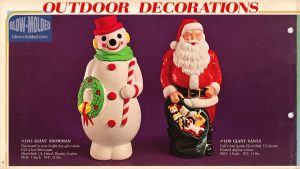
snowman and Santa vintage blow molds

How many blow molds are currently in your collection? Any favorites that stand out?

Cole: I have around 40 blow molds in my collection currently. My favorites are the TPI Nativity and the General Foam “Chilly Willy” Penguin.

You’re also a contributor to Blow-Molded. How did that come about?

Cole: I have been helping out with the Blow-Molded website since 2023. I had been helping the website’s current operator with various amounts of information and photographs for several years before he invited me on as an editor.

Since then, I’ve been helping keep the site updated and accurate with various edits on a weekly basis.

What fascinates you most about the history of blow molds and the factories that produced them?

Cole: The most interesting thing to me is how innovative some of the manufacturers were. Many of them were introducing unique features to up their game, such as Day-Glo paint, animation, and even motion-activated music boxes.

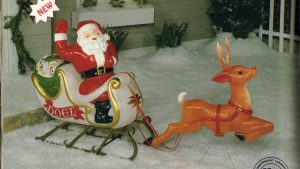
santa and reindeer vintage blow mold

Was there one manufacturer that particularly stood out?

Cole: One manufacturer that stood out the most would have to be Empire, who happened to try all three of those features.

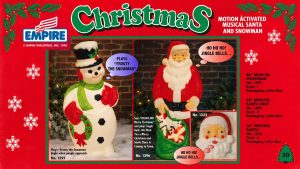
Starting in the 1970s, they introduced Day-Glo paint on many of their molds, followed by an animated sleigh with a waving Santa in the early 1990s, followed by a talking/musical motion-activated Santa a few years later.

What’s your take on today’s new blow molds compared with vintage blow molds from the 1960s and ’70s?

Cole: While many new designs are being made each year, the majority are coming from Chinese manufacturers with poor-quality paint that doesn’t last well outside.

I believe vintage collecting remains popular because they were made in the U.S. and Canada by many well-known companies, there are many desirable pieces, and the quality was made to last much longer on them.

Newer items are much easier to find, cheaper quality, and made in far greater quantities. Therefore, the demand isn’t always there compared to vintage pieces.

Why do you think vintage blow mold collecting continues to resonate with people?

There’s an interesting idea running through Cole’s answers: scarcity alone doesn’t explain the appeal.

Vintage blow molds came from an era when manufacturers such as Empire, General Foam and TPI were developing distinctive characters and experimenting with different manufacturing techniques, paints and features. Decades later, those differences give collectors something to discover.

One Santa isn’t necessarily the same as another Santa.

Manufacturer, mold variation, age, paint, condition and production history can transform an ordinary-looking holiday decoration into something much more interesting to a collector.

vintage snowman & santa blow molds

And then there is the emotional component.

For many people, seeing one illuminated on a lawn isn’t simply seeing a piece of molded plastic. It’s seeing Christmas at their grandparents’ house. It’s riding through the neighborhood looking at decorations as a kid. It’s pulling the same Santa out of storage that appeared every December when they were growing up.

The glow is part of the memory.

What advice would you give someone just getting started collecting vintage blow molds?

Cole: My advice for newbies would be to check thrift stores, yard sales, and antique stores for vintage pieces.

Certain pieces were made for much longer than others, thus affecting their availability, so it’s a good idea to keep that in mind when searching for what you want.

Prices fluctuate all the time, so ultimately the value of a blow mold boils down to three factors: condition, availability, and how much you’re willing to pay for an item.

The Hunt Is Part of the Fun

That last point may be some of the best advice a new collector can receive.

There isn’t a universal price guide capable of telling you exactly what every vintage blow mold is “worth.” Condition matters. Rarity matters. Regional availability matters. And ultimately, the value of a piece depends upon what another collector is willing to pay for it.

But there’s another lesson in Cole’s story.

You don’t need hundreds of blow molds to be a serious collector.

A collection of 40 carefully chosen pieces can carry decades of memories, research and stories. Whether you’re searching for a specific Empire Santa, an unusual General Foam piece, a TPI Nativity—or simply the same glowing decoration you remember from childhood—the hunt is part of what keeps the hobby interesting.

Collectors like Cole are also helping preserve something that could easily have disappeared. Every photograph documented, manufacturer identified, production variation recorded and old decoration saved from the landfill adds another small piece to the history of the hobby.

And that’s precisely the history I wanted to celebrate in The Glow That Won’t Go Out.

—Curtiss Wayne Andrews

Keep the Glow Going

The Glow That Won’t Go Out: The Complete Collector’s Guide to Vintage Holiday Blow Molds explores the manufacturers, history, collecting, identification, restoration and enduring appeal of the illuminated holiday decorations that refused to disappear.

Available October 1, 2026.