E-BOOK / PAPERBACK & HARDCOVER / AUDIOBOOK OUT NOW!

The Hunt Never Ends: Inside The Blow Mold Boys of Massapequa Park

What started with two friends, $300 and some replacement light cords has grown into a small business built around vintage Christmas, hard-to-find blow molds—and the eternal problem of where to store all this plastic.

By Curtiss Wayne Andrews

There comes a point in almost every serious blow mold collector’s life when a troubling realization sets in:

You need parts.

Maybe you found the perfect vintage Santa at a yard sale.

The paint is good.

The plastic isn’t cracked.

The price was right.

You bring him home, turn him around and discover that the electrical components appear to have last been inspected during the Carter administration.

Or maybe there’s no cord at all.

Or the backing plate is missing.

Or the clips are gone.

Suddenly your great $20 find has become a restoration project.

That’s part of the world Thomas and his longtime friend stepped into when they started The Blow Mold Boys in Massapequa Park, New York.

But Thomas isn’t merely selling parts.

He’s a collector himself.

And like so many people I’ve interviewed while writing The Glow That Won’t Go Out, his story begins long before there was a business.

It begins with Dad.


It Started in Dad’s Yard

What first got you interested in blow molds?

Thomas: I got interested when I was a little kid. My dad used to put out blow molds, and I ended up developing a love for them.

As I got older, I started buying new pieces for my dad’s house. When I eventually moved, I took them with me.

Today, Thomas estimates his collection has grown to more than 100 pieces, spread across Christmas, Halloween and a smaller number of Easter blow molds.

Sound familiar?

It should.

One of the most consistent things I’ve discovered while talking to collectors is that the obsession rarely starts with the collector.

It starts with somebody else.

Dad put them outside.

Grandma had a Santa.

The neighbors had a snowman.

The family drove around looking at Christmas displays.

Eventually the child who stared at those glowing figures grows up, gets a house…

…and realizes he can buy them himself.

This is how trouble starts.


Old School Wins

Thomas owns newer pieces, but ask him where his heart is and there’s not much hesitation.

Vintage.

Do you have favorite pieces?

Thomas: I like the old-school ones because they were made better. The paint jobs were better on them and lasted longer.

Some of my favorite pieces are the Victorian Dickens Christmas Carolers. I wish they had come out with more in that style.

I also have the four elves, which are really cool.

The Victorian-style carolers make sense as favorites.
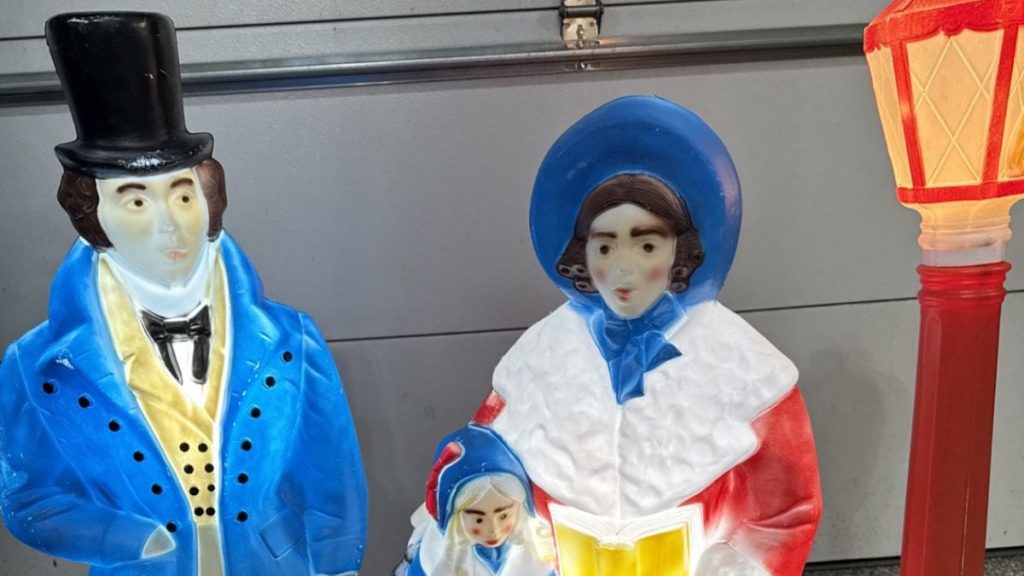
vintage Victorian-style blow mold Carolers

They don’t simply look like Christmas decorations.

They look like Christmas itself—the idealized version we’ve collectively inherited from greeting cards, department-store windows and old holiday movies.

Thomas has plenty of more common molds too.

But that’s another thing collectors learn eventually:

Common doesn’t mean bad.

The Santa everybody’s seen a hundred times might be exactly the Santa somebody remembers from childhood.

Rarity can make something expensive.

It doesn’t necessarily make it meaningful.


Two Friends, $150 Each—and a Bunch of Light Cords

Then came the business.

Not with investors.

Not with a warehouse.

Not with some elaborate five-year entrepreneurial plan.

It started with Thomas asking his friend for help sourcing a light cord.

How did The Blow Mold Boys begin?

Thomas: The shop started about three years ago, in 2023.

We started out selling single C7 light cords.

The first year we didn’t sell many of them, and we thought it was a bust.

Then the next year, the C7 singles sold out.

That’s when things got interesting.

Thomas and his friend had each put approximately $150 into the venture.

Three hundred dollars total. Sounds like a winning Shark Tank pitch.

The first year wasn’t particularly encouraging.

Then customers showed up.

The partners reinvested what they made, purchasing additional cords and expanding into other products.

And Thomas found another way to feed the business:

buying and reselling blow molds.

Thomas: As we were doing that, I was buying blow molds and flipping them for more money to help with the business, which we still do today.

The Blow Mold Boys originated basically because I asked my friend to help me get light cords. I knew he was more savvy with that, and he did it.

We both started with $150 each.

We don’t take much of our profit for ourselves because we keep buying more products.

That’s a wonderfully unglamorous small-business origin story.

“Hey, can you help me get some light cords?”

Three years later, you’re running a blow mold business.


Selling the Stuff That Keeps the Old Stuff Glowing

Light cords were the beginning.

Today, The Blow Mold Boys carry a considerably broader selection of replacement electrical and mounting components.

Thomas lists:

C7 single light cords, C7 double light cords, E26 large-bulb light cord kits, backing plates, plastic and metal butterfly clips, C7 vampire sockets, male and female vampire plugs, and SPT-1 wire.

This might not sound as exciting as finding a rare Poloron at an estate sale.

But it’s an important part of keeping vintage blow molds alive.

A decoration manufactured decades ago can survive beautifully while its electrical hardware does not.

Plastic lasts.

Parts disappear.

Cords deteriorate.

Sockets fail.

Backing plates get lost.

And that’s how a perfectly good blow mold ends up sitting unlit in a garage.

It’s one of the themes I kept encountering while writing The Glow That Won’t Go Out.

Preservation isn’t always glamorous.

Sometimes saving Christmas means replacing a cord.


What Actually Sells?

Thomas gets to see another side of collecting that individual collectors don’t necessarily see:

what people are actually buying.

What kinds of blow molds are consistently popular?

Thomas: A lot of the more popular pieces I sell are the soldiers, Santas and snowmen.

People also like the hard-to-find ones.

There’s just one problem with those.

Thomas: Usually when I get those, I keep them.

And there it is.

The fundamental flaw in opening a business that sells the exact things you personally collect.

Imagine running a bakery while being incapable of selling any particularly good cake.

Thomas buys blow molds partly to resell.

Then something unusual appears.

He looks at it.

The business owner says:

Sell it.

The collector says:

Absolutely not.

Guess which one wins?


The Haunted House That Never Made It to the Customer

Thomas gave me a perfect example.

What’s the best part of running the shop?

Thomas: The best part about running my shop is that me and my buddy have been best friends for years.

We like to bring vintage Christmas back to people’s houses.

And the best part is the hunt for the blow molds.

You’re always on the hunt for pieces that you never thought you could find—or something you didn’t want to pay that high price for. Hello, HGTV or A&E – here’s your next holiday reality show.

One business purchase included a Halloween haunted-house blow mold.

Presumably, the rational plan was:

Buy collection.

Separate inventory.

Price haunted house.

Sell haunted house.

Make profit.

Instead:

Thomas kept the haunted house.

And apparently this wasn’t an isolated incident.

Thomas: Usually when I get it, I keep it for my own collection. For example, the Halloween haunted house I picked up in a lot for our business, but I ended up keeping it for myself—as I have with many other ones too.

I just can’t keep them all.

This is why accountants should probably never allow blow mold collectors to classify inventory.


What Should You Charge for a Vintage Blow Mold?

If Thomas sees the buying and selling side regularly, I wanted to know whether he had a formula for pricing.

The answer is refreshingly simple.

There isn’t one.

What’s your advice to somebody selling a blow mold?

Thomas: There’s no real advice I can give to someone trying to sell their blow molds because every year people want different ones.

One year I can sell soldiers like crazy. Other years I have trouble.

You’ve got to find what people like and price it not too high, not too low.

That’s an important lesson for anyone who looks at a price online and assumes:

That’s what mine is worth.

Not necessarily.

Collector markets move.

Demand changes.

Condition matters.

Location matters.

Season matters.

And most importantly:

An asking price is not automatically a selling price.

The hottest item this Christmas might sit unsold next year.

Thomas sees soldiers, Santas and snowmen move consistently, but even those categories fluctuate.

So if you’re selling?

Research comparable pieces.

Look at condition.

Pay attention to what people are actually purchasing.

And price it where another human being might realistically want to buy it.


The Thrill of the Hunt Is Still the Best Part

For all the practical aspects of running The Blow Mold Boys—cords, clips, sockets, inventory and pricing—the thing Thomas enjoys most isn’t especially complicated.

Finding stuff.

That’s the addiction underneath the entire hobby.

You don’t know what’s at the next yard sale.

You don’t know what somebody is about to list online.

You don’t know what’s hiding in the back of a garage.

You don’t know whether the lot you’re buying for resale contains something you’ve been hunting for yourself for ten years.

Thomas said it perfectly:

“You’re always on the hunt for pieces that you never thought you could find.”

Anyone can order something that’s readily available.

The unforgettable finds are the ones you weren’t expecting.

The haunted house buried in a lot.

The Santa priced incorrectly at an estate sale.

The decoration you’ve refused to pay collector prices for suddenly sitting in front of you for twenty bucks.

That’s why collectors keep looking even after they have 100 pieces.

Or 300.

Or 1,000.

You’re never searching only for another blow mold.

You’re searching for the find.


From Dad’s Yard to The Blow Mold Boys

There’s something appropriately circular about Thomas’s story.

His dad put blow molds outside.

Thomas fell in love with them.

As he got older, he bought new pieces for Dad’s display.

Eventually those pieces followed Thomas when he moved.

The collection grew.

Then a need for replacement lighting turned into a conversation with a friend.

Two buddies each put in $150.

They tried selling C7 cords.

It didn’t work particularly well.

Until it did.

Then they reinvested.

Added products.

Bought blow molds.

Sold blow molds.

Kept too many blow molds.

And somewhere along the way, The Blow Mold Boys became a business.

Not because somebody looked at market research and identified a lucrative opportunity in illuminated polyethylene Christmas decorations.

Because two friends liked this stuff.

That’s how some of the best niche businesses begin.


There’s Just One Problem

Thomas has more than 100 blow molds.

He buys additional blow molds for the business.

Sometimes he sells them.

Sometimes he accidentally becomes emotionally attached to the inventory and moves it into his personal collection.

So what is the hardest part of simultaneously operating The Blow Mold Boys and being a collector?

Thomas asks the question every serious blow mold collector eventually confronts:

“Where do you store it?”

There it is.

The final boss of blow mold collecting.

Not price.

Not rarity.

Not faded paint.

Square footage.

A ceramic Christmas ornament can fit in a box.

A blow mold Santa is basically another person living in your house.

Snowmen don’t nest.

Soldiers don’t fold.

Haunted houses stubbornly remain the size of haunted houses.

Eventually every collector looks around and realizes they no longer own a garage.

They own a blow mold storage facility that happens to have a garage door.

And yet Thomas keeps hunting.

Of course he does.

Because somewhere out there is another piece he never expected to find.


Keeping the Glow Alive—One Cord at a Time

I’ve spent a lot of time thinking about why the people surrounding this hobby became such an important part of The Glow That Won’t Go Out.

Thomas represents another piece of that ecosystem.

There are the collectors who save these decorations.

The restorers who repair them.

The historians who document them.

The manufacturers creating new ones.

The people running displays.

And there are small businesses supplying the decidedly unromantic parts that allow an old decoration to light up again. Guys like Thomas. Guys like Tony DePasquale at blowmolds.com.

A vintage Santa without a functioning light is still a Santa.

But plug in a new cord…

Put him outside…

Wait until dark…

And suddenly somebody driving past sees exactly what Thomas saw when he was a kid looking at his father’s display.

That’s how this keeps going.

One collector becomes another.

One Christmas becomes the next.

And one old piece of plastic gets another December to glow.

Maybe Thomas and his buddy aren’t simply selling cords after all.

They’re selling another Christmas.


Meet the People Keeping the Glow Alive

Thomas and The Blow Mold Boys of Massapequa Park, New York, are part of a growing community of collectors, sellers, restorers and enthusiasts keeping vintage holiday blow molds in circulation.

The Glow That Won’t Go Out: The Complete Collector’s Guide to Vintage Holiday Blow Molds by Curtiss Wayne Andrews explores the manufacturers, history, identification, restoration and collecting culture behind these glowing pieces of American holiday history.

Because finding the blow mold is only half the story.

You’ve still got to plug the thing in.
Thousands of Memories Still Glowing: Inside Nick’s Lifelong Blow Mold Obsession

He bought his first blow molds for $1 each as a kid. Today his collection numbers in the thousands. The Hoarding for the Holidays collector talks restoration, television, auctions and why the old Poloron and Beco pieces still matter.

By Curtiss Wayne Andrews

There was a time when vintage blow molds weren’t vintage.

They weren’t “collectibles,” either.

They were Christmas decorations.

They sat outside houses.

They got rained on.

Snow piled against them.

Kids knocked them over.

Parents shoved them into garages sometime after New Year’s Day, where they waited patiently for another Christmas.

And if you happened upon a few old ones at a flea market?

Apparently, you could buy them for a dollar apiece.

Nick remembers those days.

Very well.

Because that’s essentially how his collection started.

From a $1 Flea-Market Find to Thousands of Blow Molds

While putting together The Glow That Won’t Go Out: The Complete Collector’s Guide to Vintage Holiday Blow Molds, I wanted to capture something that’s difficult to communicate unless you’ve spent time around serious collectors:

This hobby can get completely out of hand.

I mean that affectionately.

One Santa becomes two.

Then you need a snowman.

Then you discover that Empire made six versions of something you thought was one version.

Then somebody mentions Poloron.

Eventually, you’re standing in a building surrounded by several thousand pieces of molded Christmas plastic and explaining that, technically, you don’t have a problem because some of them still need repairs.

Nick understands.

Readers of The Glow That Won’t Go Out may remember him from the section about Hoarding for the Holidays. In the program’s first episode, A Real Life Elf, he appears surrounded by an extraordinary collection of vintage holiday decorations.

There’s also a smaller detail I mentioned in the book that collectors probably appreciated.

Nick wore the hobby.

Literally.

His gray shirt read:

“Plug In Those Vintage Blow Molds and Light Up Your Christmas.”

It’s hard to imagine a more appropriate wardrobe choice when you’re being filmed in the middle of a blow mold collection. Want that shirt or one like it? Click here.

But the brief appearance in my book left me wanting to know more.

How does someone accumulate a collection numbering in the thousands?

What’s it like letting a television crew into that world?

And perhaps most importantly, how do you keep all that aging plastic alive?

So I went back to Nick.

Here’s our conversation.


A Conversation With Nick of Saint Nick’s Display

How did you first get started collecting blow molds?

Nick: I first got started collecting blow molds when I was about six or seven. I was going around to the local flea market and happened to see a vendor selling some for a buck each.

Yes, only one dollar.

At the time I saw them and was amazed by the size of them. I didn’t even realize they lit up until I got them home.

My collection consists of several thousand decorations. Not all are used due to needing repairs, but I try to put out what I can each year.

My favorites have to be anything made by Poloron or Beco—the original OG blow mold companies from the 1960s.

Let’s Stop at “One Dollar” for a Moment

There are younger collectors reading this who may need a minute.

One dollar.

Today, collectors can spend considerable money chasing desirable vintage pieces.

Nick’s childhood introduction to the hobby happened in another universe.

He wasn’t studying sold listings on his phone.

He wasn’t competing against twenty-seven other people who had received the same Marketplace notification.

He was a kid at a flea market who saw some enormous plastic Christmas decorations and thought they looked cool.

Then he brought them home and discovered something even better.

They lit up.

That’s the kind of experience that creates a collector.

And it points to something I kept returning to while writing The Glow That Won’t Go Out.

For many collectors, this isn’t fundamentally about monetary value.

It’s about memory.

A particular Santa can transport someone back to their grandparents’ lawn.

A snowman can look exactly like the one that stood beside the driveway every December.

You aren’t merely collecting plastic.

Sometimes you’re buying your way back into Christmas when you were seven years old.

Nick just happened to start doing it while he actually was seven years old.


When HGTV Comes Calling

Nick’s collection eventually became large enough to attract attention beyond the blow mold community.

He appeared in Hoarding for the Holidays, where viewers got to see both his indoor and outdoor Christmas displays.

But the invitation didn’t initially inspire excitement.

It inspired suspicion.

How did Hoarding for the Holidays discover you?

St. Nick's Display from Hoarding for the Holidays

Nick: I was found for the show Hoarding for the Holidays through my display page on Facebook, Saint Nick’s Display.

They randomly sent me a message one day in the spring, which I originally thought was a spam message and almost ignored.

I can say, having dealt with other shows that were less than stellar to me, I was extremely impressed by HGTV and Exit 4 and all the crew for how professional and kind they all were to me.

It felt like being with friends during the filming.

They were so helpful and even let me tell them how I liked things done.

I couldn’t have been happier with how they filmed us and treated not only me but all my family and friends. They are A-plus people, and I’d work with them again.

Were you happy with the final show?

Nick: I was extremely happy with the final product.

It showed my indoor display and my outdoor display.

And even the mucky places I’d go for Christmas decorations!

That last part matters.

Because every serious collector knows the beautiful display is only half the story.

Nobody photographs the crawlspace.

Nobody makes an Instagram Reel celebrating the moment you climb over fourteen storage totes because you’re convinced the missing light plate is in the box against the back wall.

Nobody sees you standing in mud negotiating over a faded Santa that appears to have spent the previous decade beneath somebody’s porch.

Television usually wants the spectacle.

Nick appreciated that this production captured more of the actual world surrounding the spectacle—and treated the people in it respectfully.


Keeping Thousands of Blow Molds Alive

Having several thousand vintage decorations creates another issue:

Several thousand vintage decorations eventually become several thousand aging vintage decorations.

Paint fades.

Surfaces weather.

Plastic gets damaged.

Parts disappear.

That’s how Nick became interested in restoration.

What got you started restoring blow molds?

Nick: I got into blow mold repairs simply because mine started to peel and get weathered over time.

Having had some of mine for years at that point, they needed a refresh.

I did many different things and ended up finding that airbrushing was the closest I could get them to original.

At first, like all artists, you make mistakes with types of paints and materials. But time helps, and you learn to grow and become better at it.

There’s an important word in that answer:

Artist.

Good restoration isn’t simply covering faded plastic with paint.

You’re trying to preserve the visual character of something manufactured decades ago.

Color.

Opacity.

Edges.

Overspray.

The peculiar look created by mass-production techniques.

Make something too perfect and it can stop looking vintage.

Make the wrong repair and you can create a problem worse than the one you started with.

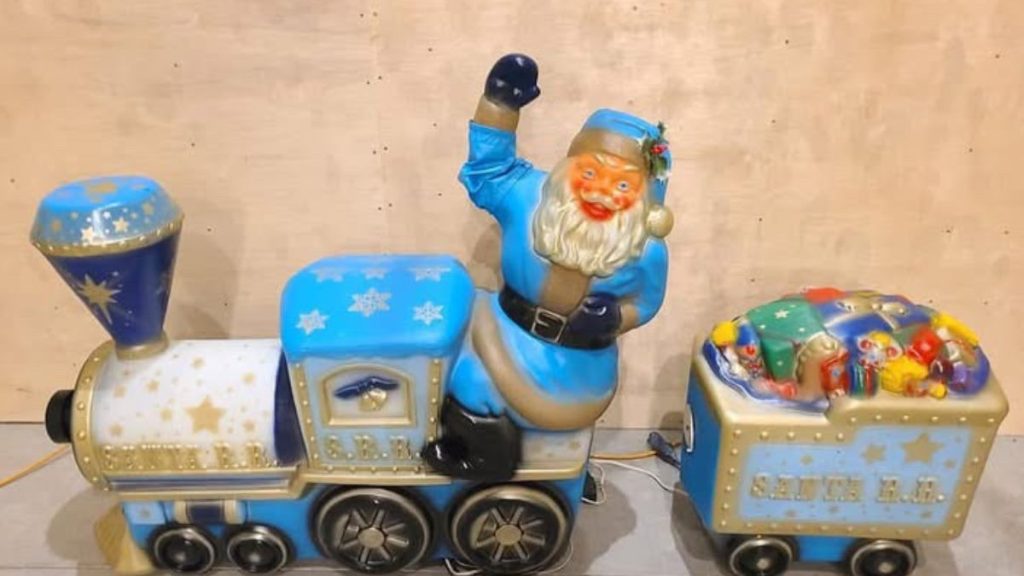
Light blue painted Santa Claus on train blow mold, vintage.

Which brings us to Nick’s most important restoration advice.


Please Don’t “Fix” It Until You Know How to Fix It

What’s your biggest recommendation for someone considering restoration?

Nick: For those looking to get blow molds restored or fixed, I can only recommend making sure they use the right products and hopefully not DIY it in a way that will entirely ruin the plastic or alter an antique in a way that can never be fixed.

This is worth emphasizing.

Old plastic isn’t a practice canvas.

Before attacking a valuable vintage piece with paint, solvent, adhesive, heat or some restoration hack you saw in a 37-second video, find out what you’re dealing with.

Sometimes the smartest restoration decision is:

Don’t touch it yet.

Research the manufacturer.

Identify the material.

Talk to experienced restorers.

Practice techniques on something expendable.

Determine whether a repair is reversible.

The objective shouldn’t necessarily be to make a 60-year-old blow mold look like it rolled out of the factory yesterday.

The objective is to help it survive.

That’s a recurring theme throughout The Glow That Won’t Go Out:

Preservation beats perfection.

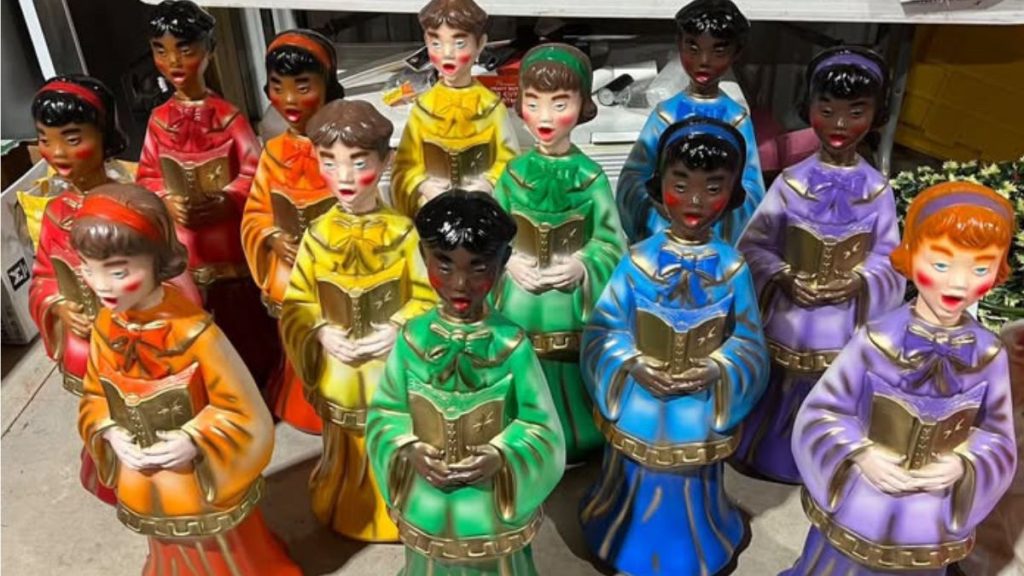
display of airbrushed blow mold Christmas carollers

Then There’s the Jones House Auction

For collectors, online marketplaces have transformed the hunt.

But there’s something an online listing can’t replicate:

Standing in a room full of people who immediately understand why you’re excited about an old piece of glowing plastic.

Nick has been attending the Jones auction for more than a decade.

What is the Jones House Auction experience like?

Nick: I have been going to the Jones auction since its creation over a decade ago.

About the time I was in high school, it first started to be a blow mold auction. It was extremely cheap at the time before the trends happened.

It’s very cool to be so local to that auction. I’m only about 25 minutes away.

I would recommend going if you enjoy the social aspect of being around other like-minded collector people.

That last sentence may explain why physical collector events continue to matter.

You can buy something online.

You can research it online.

You can discuss it online.

But collecting has always had a social component.

Swap meets.

Flea markets.

Auctions.

Estate sales.

Christmas displays.

People leaning over a table saying:

“I’ve been looking for one of these for fifteen years.”

That’s the culture surrounding the objects.

And sometimes that’s more memorable than whatever you brought home.


What Changed?

Nick’s collecting life spans an interesting period in the hobby.

He remembers the $1 flea-market blow mold.

He remembers auctions before prices began climbing.

Now he lives in a world where vintage Christmas has become its own collecting category and previously overlooked decorations can inspire serious competition.

But there’s an irony here.

The increased attention that makes certain pieces harder and more expensive to acquire is also helping ensure they’re preserved.

People are identifying manufacturers.

Documenting variations.

Creating replacement parts.

Learning restoration techniques.

Sharing old catalogs.

Recording histories.

And introducing new collectors to names such as Empire, General Foam, Union Products, Poloron and Beco.

The objects aren’t anonymous lawn decorations anymore.

They’re artifacts of American Christmas.

That’s a large part of why I wrote The Glow That Won’t Go Out.


Several Thousand Reasons the Glow Won’t Go Out

Look again at the photograph of Nick standing in his collection.

Don’t look at him at first.

Look behind him.

Santa.

Snowmen.

Angels.

Reindeer.

Characters.

Rows upon rows of plastic faces.

Every one came from somewhere.

Somebody originally bought each one.

Somebody put it outside.

Some kid saw it glowing through a window.

Eventually it was packed away.

Years passed.

Families moved.

Decorating styles changed.

Somehow, it survived.

And eventually one of those pieces wound up with a collector like Nick.

That’s why the title The Glow That Won’t Go Out means more to me than the literal light inside these decorations.

The glow is the memory attached to them.

Nick bought his first ones when he was six or seven.

All these years later, he’s still restoring them, displaying them, hunting for them and surrounding himself with thousands of them every Christmas.

The collection got considerably larger.

The kid who was amazed to discover those $1 flea-market decorations actually lit up?

I’m not sure he ever completely left.

And maybe that’s the whole point.

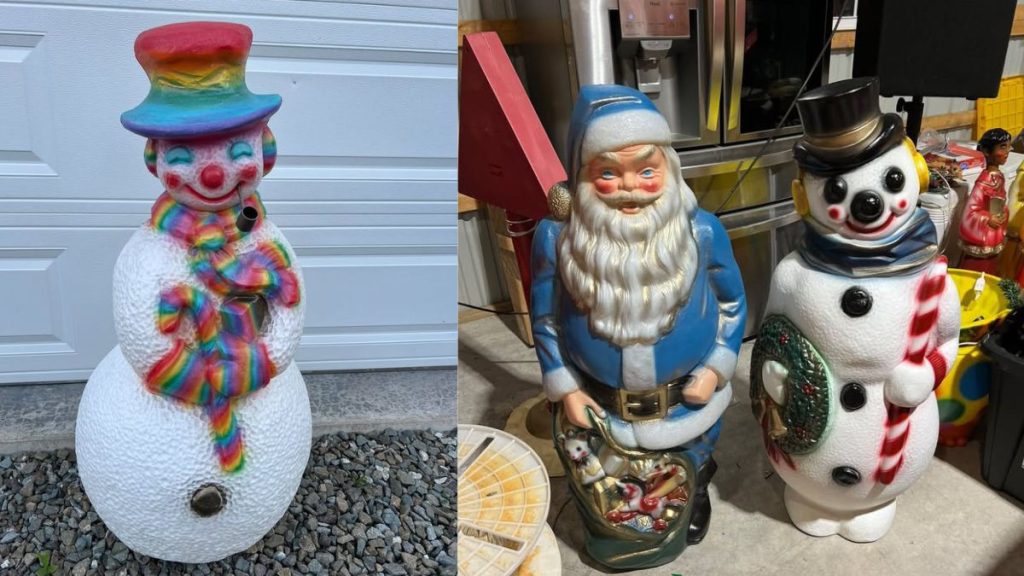
Rainbow airbrushed blow mold snowman and painted Santa & snowman blow molds, courtesy of Nick.

Discover More Stories From the Blow Mold Community

Nick and Hoarding for the Holidays are featured in The Glow That Won’t Go Out: The Complete Collector’s Guide to Vintage Holiday Blow Molds by Curtiss Wayne Andrews.

The book explores the manufacturers, history, identification, restoration and collecting culture behind the glowing plastic decorations that became fixtures of the American Christmas landscape.

But just as importantly, it’s about the people who refuse to let that glow disappear.

Every Blow Mold Deserves Another Holiday: Inside Tony DePasquale’s Mission to Save Vintage Christmas

The owner of BlowMolds.com has nearly 1,000 blow molds, hundreds of replacement parts—and an ambitious idea for what 3D printing could mean for the future of the hobby.

By Curtiss Wayne Andrews

There is a particular heartbreak known only to blow mold collectors.

You find it.

Maybe it’s buried behind a stack of artificial Christmas trees at an estate sale. Maybe it appears on Facebook Marketplace at 6:14 on a Saturday morning. Maybe you spot it sitting forlornly at the back of an antique mall booth.

It’s old.

It’s beautiful.

It’s exactly what you’ve been looking for.

And it’s missing its nose.

Or an antler.

Or an ear.

Or a candle flame.

Or one of those maddeningly specific little plastic pieces that disappeared sometime during the Reagan administration.

Twenty years ago, that might have been the end of the story.

Today, there’s a good chance Tony DePasquale can help.

The Man Behind BlowMolds.com

When I was researching The Glow That Won’t Go Out: The Complete Collector’s Guide to Vintage Holiday Blow Molds, I wanted the book to be about more than identifying old Empire Santas or determining whether a snowman was made by General Foam.

The bigger story was why these things are still here.

Because that’s what’s remarkable about blow molds.

They’re survivors.

They spent decades outside in December weather. They were dragged into attics, basements and garages every January. They were dropped, faded, cracked, scratched and occasionally subjected to the questionable repair techniques of somebody’s grandfather armed with duct tape and tremendous self-confidence.

Yet collectors keep bringing them back.

That led me to Tony DePasquale of New Brunswick, New Jersey, owner of BlowMolds.com by GNK Collectibles.

I featured Tony and his work in The Glow That Won’t Go Out because he’s part of a fascinating development in the hobby: modern technology is now helping preserve decorations created decades before that technology existed.

At BlowMolds.com, missing pieces can be recreated using 3D printing. The current catalog includes everything from noses, flames and antlers to lantern components, light plates, adapters, windows and other remarkably specific pieces. The company makes clear that these are aftermarket replacements rather than original-manufacturer parts. 

Tony’s philosophy can be reduced to one perfect sentence:

“Every Blow Mold Deserves Another Holiday.”

After featuring his story in the book, I wanted to go back and ask him more.

Not simply about replacement parts.

I wanted to know how someone ends up with around 1,000 blow molds, what he’s learned trying to recreate pieces manufacturers stopped producing decades ago—and whether 3D printing might eventually move from repairing vintage blow molds to actually creating them.

Here’s our conversation.


A Conversation With Tony DePasquale of BlowMolds.com

When did your fascination with blow molds begin? How big is your collection, and do you have any favorites?

Tony DePasquale: My love of Christmas displays goes back to childhood. Christmas was huge in my family: we went caroling, held family parties, and my father played Santa Claus.

I even proposed to my wife, Michelle, on Santa’s lap—with my father playing Santa. Michelle and I have been married for 33 years.

My blow mold collecting really took off when I answered a Craigslist listing for a few vintage pieces. The seller mentioned he had about 30 more in his shed, and I ended up bringing those home too.

Today, I have around 1,000 blow molds.

The Empire train is one of my favorites because I’ve always loved trains.

From 30 Blow Molds to 1,000

There may not be a more authentic blow mold collecting origin story than going to someone’s house for a few decorations and leaving with the contents of the shed.

Collectors understand how this happens.

You start with a Santa.

Then Santa looks lonely.

So you need Mrs. Claus.

Then perhaps a snowman.

Obviously the snowman needs some carolers.

Then you discover Empire made a train.

Several years later, you’re explaining to a perfectly reasonable person why your property now contains three storage buildings filled with illuminated polyethylene.

Thirty becoming 1,000 somehow makes perfect sense.


How did you come to own BlowMolds.com, and what is the store’s primary mission?

Tony: I first connected with GNK Collectibles when I needed replacement fawn ears for my own collection. That led to my helping produce replacement parts, and I eventually bought the business. I now operate BlowMolds.com through GNK Collectibles.

Our mission is summed up by our motto: “Every Blow Mold Deserves Another Holiday.”

A missing nose, ear, light plate, or other small piece shouldn’t mean the end of a decoration someone has loved for decades. We make replacement parts to help people put those pieces back on display.

That mission is evident in the site’s current catalog. Replacement parts span numerous manufacturers and styles, including highly specific components such as TPI reindeer antlers, General Plastics lantern panels and Empire/General Foam sleigh runners. 

And this is where Tony’s work intersects with the larger story I wanted to tell in The Glow That Won’t Go Out.

Preservation doesn’t always mean keeping something 100% original. Sometimes preservation means making it usable again.

A Christmas decoration sitting broken in an attic isn’t preserving much of anything.

Put its nose back on, install a light and place it in the yard?

Now somebody’s kid gets to remember it.

That’s how traditions survive.


Did you have 3D-printing experience before opening the store? What have been the biggest challenges?

Tony: I was already helping produce replacement parts on 3D printers before I bought the business.

The biggest challenge has been learning hundreds of parts and making sure each one fits the right blow mold. There can be differences between pieces that look nearly identical, so I pay close attention to photos, measurements, and customer feedback.

I don’t paint the parts. I print them in different colors of filament to get the color they need.

I also make vinyl stickers and made-to-order holiday signs.

This is an important detail for collectors.

A replacement isn’t necessarily as simple as saying, “I need a reindeer antler.”

Which reindeer?

Which manufacturer?

Which production variation?

How does it attach?

Tony’s current tabletop reindeer listings, for example, distinguish between Union and Poloron versions because their attachment systems differ. 

That’s restoration becoming detective work.


Are parts from certain manufacturers harder to replace than others?

Tony: The difficulty often comes down to the individual part rather than the manufacturer.

Some pieces have unusual shapes, attachment points, or variations between production runs. Photos and measurements help us identify the right version, and sometimes a customer’s feedback helps us refine the fit.

That’s something collectors should remember before ordering any replacement part.

Don’t assume.

Document.

Photograph the mold.

Photograph the attachment point.

Look for markings.

Measure the opening.

The difference between a replacement that works and one that doesn’t can come down to a surprisingly small detail.


Could 3D Printing Eventually Create the Blow Mold Itself?

This was the question I really wanted to ask Tony since about 6 years ago I met with a 3D printing company in Costa Mesa, CA to try and figure out how to make blow mold Christmas ornaments (which Mr. Christmas is now manufacturing and selling at Walmart for just $5.97 a piece).

Replacement noses and antlers are one thing.

But once you can digitally model missing components, an obvious question follows:

How far can this technology go?

Have you considered 3D printing an entire blow mold? Could it work?

Tony: Yes, and I’m working on something along those lines.

I’m interested in recreating smaller vintage pieces and making miniature versions of larger ones.

I’ve spent hours researching who owns the copyrights and trademarks for different designs, including whether some trademarks were ever registered. The history can be complicated, especially with pieces dating back to the 1960s and 1970s, so I’m taking my time with it.

Let’s just say you never know what might be 3D printed next.

Now that is interesting.

We’re watching two eras of plastic manufacturing collide.

The classic blow molds collectors love were products of industrial manufacturing: molds, machinery, production lines and companies capable of manufacturing thousands of decorations.

3D printing changes the economics.

It potentially makes extremely small production runs—and highly specialized replacement components—possible in ways that wouldn’t have made economic sense during the industry’s original era.

That doesn’t mean someone can simply reproduce any vintage design they choose; intellectual-property questions matter, exactly as Tony notes.

But the broader possibility is fascinating:

Could technology developed decades after the golden age of blow molds help keep the aesthetic alive?

We’re already watching the first part of that happen.


Tony’s Advice: Inspect Your Blow Molds Before Christmas

If you’re reading this with a garage full of Christmas plastic, Tony has another recommendation:

Don’t wait until December.

What advice would you give collectors about blow mold maintenance?

Tony: Check your blow molds before the holiday season, while there’s time to find or order anything missing.

Store them carefully, keep track of loose accessories, and avoid forcing a replacement part into place if it doesn’t fit.

Keep them in a dark storage space.

Sunlight is the enemy of blow molds, more so than heat.

If you need help identifying a part, send clear photos of the entire blow mold, the area where the part attaches, and any manufacturer markings.

Measurements of the opening or attachment point are especially helpful.

That’s particularly good advice heading into fall.

Replacement parts aren’t necessarily warehouse items sitting on a shelf waiting to ship. BlowMolds.com says its parts are printed to order, with current typical lead times around 7–10 days and potentially longer waits during busy periods. 

So September and October are much better times to discover Rudolph is missing an antler than December 18.

Tony’s site also publishes specific handling recommendations for 3D-printed parts, including guidance about bulbs, adhesives, drilling, heat and storage. 

Before You Put Up Your Display This Year

Tony’s advice inspired a checklist I’d recommend to any collector:

  1. Inventory your blow molds. Make sure everything you expect to have is actually there.
  2. Check removable parts. Look for noses, antlers, flames, lantern tops, signs and light plates.
  3. Inspect attachment points. Don’t force a replacement into brittle vintage plastic.
  4. Photograph unidentified damage. Get wide shots, close-ups and manufacturer markings.
  5. Take measurements. Especially openings, slots and attachment points.
  6. Test lighting before decorating day. Discovering a problem in the garage beats discovering it on a ladder.
  7. Limit unnecessary sunlight during storage. Tony specifically identifies sunlight as a major enemy.
  8. Order replacements early. Holiday repair season is not the time to discover you need an obscure 40-year-old plastic nose.

And when in doubt?

Ask someone who has approximately 999 more blow molds than a normal person.


This Is Why the Glow Won’t Go Out

When I chose the title The Glow That Won’t Go Out, I wasn’t simply talking about a light bulb inside a piece of molded plastic.

I was talking about persistence.

Companies disappeared.

Factories closed.

Molds were destroyed, sold or forgotten.

Christmas decorating changed.

Inflatables arrived.

LEDs arrived.

Tastes changed.

And still, every November and December, thousands of these old plastic Santas, snowmen, candles, angels, reindeer and Nativity figures emerge from garages and basements and light up again.

Why?

Because people keep caring about them.

Collectors rescue them.

Families inherit them.

Restorers repair them.

And people like Tony DePasquale figure out how to manufacture the tiny missing piece that allows something made half a century ago to survive another Christmas.

Tony’s motto gets the entire philosophy exactly right:

Every blow mold deserves another holiday.

I’d add only one thing.

Every time somebody repairs one and puts it back outside, they’re not merely saving an old decoration.

They’re preserving somebody’s Christmas memory.

And that’s ultimately what The Glow That Won’t Go Out is about.


Meet More of the People Keeping the Glow Alive

Tony DePasquale and the work of BlowMolds.com are featured in The Glow That Won’t Go Out: The Complete Collector’s Guide to Vintage Holiday Blow Molds by Curtiss Wayne Andrews.

The book explores the history, manufacturers, identification, collecting, restoration and enduring appeal of the glowing plastic decorations that became part of the American Christmas landscape—and the collectors helping ensure they don’t disappear.

For replacement parts or help identifying a missing component, visit BlowMolds.com.