E-BOOK / PAPERBACK & HARDCOVER / AUDIOBOOK OUT NOW!

The Hunt Never Ends: Inside The Blow Mold Boys of Massapequa Park

What started with two friends, $300 and some replacement light cords has grown into a small business built around vintage Christmas, hard-to-find blow molds—and the eternal problem of where to store all this plastic.

By Curtiss Wayne Andrews

There comes a point in almost every serious blow mold collector’s life when a troubling realization sets in:

You need parts.

Maybe you found the perfect vintage Santa at a yard sale.

The paint is good.

The plastic isn’t cracked.

The price was right.

You bring him home, turn him around and discover that the electrical components appear to have last been inspected during the Carter administration.

Or maybe there’s no cord at all.

Or the backing plate is missing.

Or the clips are gone.

Suddenly your great $20 find has become a restoration project.

That’s part of the world Thomas and his longtime friend stepped into when they started The Blow Mold Boys in Massapequa Park, New York.

But Thomas isn’t merely selling parts.

He’s a collector himself.

And like so many people I’ve interviewed while writing The Glow That Won’t Go Out, his story begins long before there was a business.

It begins with Dad.


It Started in Dad’s Yard

What first got you interested in blow molds?

Thomas: I got interested when I was a little kid. My dad used to put out blow molds, and I ended up developing a love for them.

As I got older, I started buying new pieces for my dad’s house. When I eventually moved, I took them with me.

Today, Thomas estimates his collection has grown to more than 100 pieces, spread across Christmas, Halloween and a smaller number of Easter blow molds.

Sound familiar?

It should.

One of the most consistent things I’ve discovered while talking to collectors is that the obsession rarely starts with the collector.

It starts with somebody else.

Dad put them outside.

Grandma had a Santa.

The neighbors had a snowman.

The family drove around looking at Christmas displays.

Eventually the child who stared at those glowing figures grows up, gets a house…

…and realizes he can buy them himself.

This is how trouble starts.


Old School Wins

Thomas owns newer pieces, but ask him where his heart is and there’s not much hesitation.

Vintage.

Do you have favorite pieces?

Thomas: I like the old-school ones because they were made better. The paint jobs were better on them and lasted longer.

Some of my favorite pieces are the Victorian Dickens Christmas Carolers. I wish they had come out with more in that style.

I also have the four elves, which are really cool.

The Victorian-style carolers make sense as favorites.
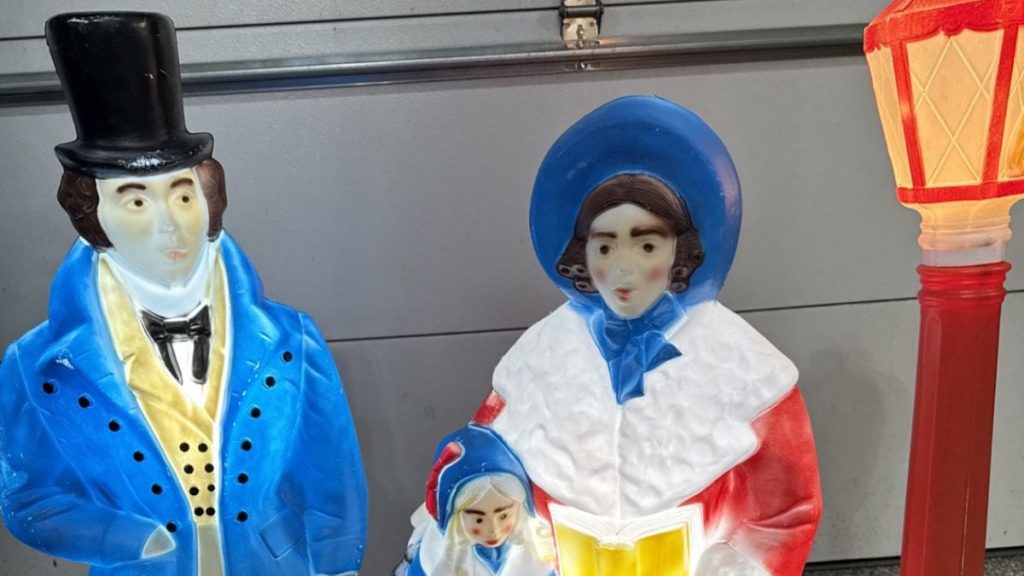
vintage Victorian-style blow mold Carolers

They don’t simply look like Christmas decorations.

They look like Christmas itself—the idealized version we’ve collectively inherited from greeting cards, department-store windows and old holiday movies.

Thomas has plenty of more common molds too.

But that’s another thing collectors learn eventually:

Common doesn’t mean bad.

The Santa everybody’s seen a hundred times might be exactly the Santa somebody remembers from childhood.

Rarity can make something expensive.

It doesn’t necessarily make it meaningful.


Two Friends, $150 Each—and a Bunch of Light Cords

Then came the business.

Not with investors.

Not with a warehouse.

Not with some elaborate five-year entrepreneurial plan.

It started with Thomas asking his friend for help sourcing a light cord.

How did The Blow Mold Boys begin?

Thomas: The shop started about three years ago, in 2023.

We started out selling single C7 light cords.

The first year we didn’t sell many of them, and we thought it was a bust.

Then the next year, the C7 singles sold out.

That’s when things got interesting.

Thomas and his friend had each put approximately $150 into the venture.

Three hundred dollars total. Sounds like a winning Shark Tank pitch.

The first year wasn’t particularly encouraging.

Then customers showed up.

The partners reinvested what they made, purchasing additional cords and expanding into other products.

And Thomas found another way to feed the business:

buying and reselling blow molds.

Thomas: As we were doing that, I was buying blow molds and flipping them for more money to help with the business, which we still do today.

The Blow Mold Boys originated basically because I asked my friend to help me get light cords. I knew he was more savvy with that, and he did it.

We both started with $150 each.

We don’t take much of our profit for ourselves because we keep buying more products.

That’s a wonderfully unglamorous small-business origin story.

“Hey, can you help me get some light cords?”

Three years later, you’re running a blow mold business.


Selling the Stuff That Keeps the Old Stuff Glowing

Light cords were the beginning.

Today, The Blow Mold Boys carry a considerably broader selection of replacement electrical and mounting components.

Thomas lists:

C7 single light cords, C7 double light cords, E26 large-bulb light cord kits, backing plates, plastic and metal butterfly clips, C7 vampire sockets, male and female vampire plugs, and SPT-1 wire.

This might not sound as exciting as finding a rare Poloron at an estate sale.

But it’s an important part of keeping vintage blow molds alive.

A decoration manufactured decades ago can survive beautifully while its electrical hardware does not.

Plastic lasts.

Parts disappear.

Cords deteriorate.

Sockets fail.

Backing plates get lost.

And that’s how a perfectly good blow mold ends up sitting unlit in a garage.

It’s one of the themes I kept encountering while writing The Glow That Won’t Go Out.

Preservation isn’t always glamorous.

Sometimes saving Christmas means replacing a cord.


What Actually Sells?

Thomas gets to see another side of collecting that individual collectors don’t necessarily see:

what people are actually buying.

What kinds of blow molds are consistently popular?

Thomas: A lot of the more popular pieces I sell are the soldiers, Santas and snowmen.

People also like the hard-to-find ones.

There’s just one problem with those.

Thomas: Usually when I get those, I keep them.

And there it is.

The fundamental flaw in opening a business that sells the exact things you personally collect.

Imagine running a bakery while being incapable of selling any particularly good cake.

Thomas buys blow molds partly to resell.

Then something unusual appears.

He looks at it.

The business owner says:

Sell it.

The collector says:

Absolutely not.

Guess which one wins?


The Haunted House That Never Made It to the Customer

Thomas gave me a perfect example.

What’s the best part of running the shop?

Thomas: The best part about running my shop is that me and my buddy have been best friends for years.

We like to bring vintage Christmas back to people’s houses.

And the best part is the hunt for the blow molds.

You’re always on the hunt for pieces that you never thought you could find—or something you didn’t want to pay that high price for. Hello, HGTV or A&E – here’s your next holiday reality show.

One business purchase included a Halloween haunted-house blow mold.

Presumably, the rational plan was:

Buy collection.

Separate inventory.

Price haunted house.

Sell haunted house.

Make profit.

Instead:

Thomas kept the haunted house.

And apparently this wasn’t an isolated incident.

Thomas: Usually when I get it, I keep it for my own collection. For example, the Halloween haunted house I picked up in a lot for our business, but I ended up keeping it for myself—as I have with many other ones too.

I just can’t keep them all.

This is why accountants should probably never allow blow mold collectors to classify inventory.


What Should You Charge for a Vintage Blow Mold?

If Thomas sees the buying and selling side regularly, I wanted to know whether he had a formula for pricing.

The answer is refreshingly simple.

There isn’t one.

What’s your advice to somebody selling a blow mold?

Thomas: There’s no real advice I can give to someone trying to sell their blow molds because every year people want different ones.

One year I can sell soldiers like crazy. Other years I have trouble.

You’ve got to find what people like and price it not too high, not too low.

That’s an important lesson for anyone who looks at a price online and assumes:

That’s what mine is worth.

Not necessarily.

Collector markets move.

Demand changes.

Condition matters.

Location matters.

Season matters.

And most importantly:

An asking price is not automatically a selling price.

The hottest item this Christmas might sit unsold next year.

Thomas sees soldiers, Santas and snowmen move consistently, but even those categories fluctuate.

So if you’re selling?

Research comparable pieces.

Look at condition.

Pay attention to what people are actually purchasing.

And price it where another human being might realistically want to buy it.


The Thrill of the Hunt Is Still the Best Part

For all the practical aspects of running The Blow Mold Boys—cords, clips, sockets, inventory and pricing—the thing Thomas enjoys most isn’t especially complicated.

Finding stuff.

That’s the addiction underneath the entire hobby.

You don’t know what’s at the next yard sale.

You don’t know what somebody is about to list online.

You don’t know what’s hiding in the back of a garage.

You don’t know whether the lot you’re buying for resale contains something you’ve been hunting for yourself for ten years.

Thomas said it perfectly:

“You’re always on the hunt for pieces that you never thought you could find.”

Anyone can order something that’s readily available.

The unforgettable finds are the ones you weren’t expecting.

The haunted house buried in a lot.

The Santa priced incorrectly at an estate sale.

The decoration you’ve refused to pay collector prices for suddenly sitting in front of you for twenty bucks.

That’s why collectors keep looking even after they have 100 pieces.

Or 300.

Or 1,000.

You’re never searching only for another blow mold.

You’re searching for the find.


From Dad’s Yard to The Blow Mold Boys

There’s something appropriately circular about Thomas’s story.

His dad put blow molds outside.

Thomas fell in love with them.

As he got older, he bought new pieces for Dad’s display.

Eventually those pieces followed Thomas when he moved.

The collection grew.

Then a need for replacement lighting turned into a conversation with a friend.

Two buddies each put in $150.

They tried selling C7 cords.

It didn’t work particularly well.

Until it did.

Then they reinvested.

Added products.

Bought blow molds.

Sold blow molds.

Kept too many blow molds.

And somewhere along the way, The Blow Mold Boys became a business.

Not because somebody looked at market research and identified a lucrative opportunity in illuminated polyethylene Christmas decorations.

Because two friends liked this stuff.

That’s how some of the best niche businesses begin.


There’s Just One Problem

Thomas has more than 100 blow molds.

He buys additional blow molds for the business.

Sometimes he sells them.

Sometimes he accidentally becomes emotionally attached to the inventory and moves it into his personal collection.

So what is the hardest part of simultaneously operating The Blow Mold Boys and being a collector?

Thomas asks the question every serious blow mold collector eventually confronts:

“Where do you store it?”

There it is.

The final boss of blow mold collecting.

Not price.

Not rarity.

Not faded paint.

Square footage.

A ceramic Christmas ornament can fit in a box.

A blow mold Santa is basically another person living in your house.

Snowmen don’t nest.

Soldiers don’t fold.

Haunted houses stubbornly remain the size of haunted houses.

Eventually every collector looks around and realizes they no longer own a garage.

They own a blow mold storage facility that happens to have a garage door.

And yet Thomas keeps hunting.

Of course he does.

Because somewhere out there is another piece he never expected to find.


Keeping the Glow Alive—One Cord at a Time

I’ve spent a lot of time thinking about why the people surrounding this hobby became such an important part of The Glow That Won’t Go Out.

Thomas represents another piece of that ecosystem.

There are the collectors who save these decorations.

The restorers who repair them.

The historians who document them.

The manufacturers creating new ones.

The people running displays.

And there are small businesses supplying the decidedly unromantic parts that allow an old decoration to light up again. Guys like Thomas. Guys like Tony DePasquale at blowmolds.com.

A vintage Santa without a functioning light is still a Santa.

But plug in a new cord…

Put him outside…

Wait until dark…

And suddenly somebody driving past sees exactly what Thomas saw when he was a kid looking at his father’s display.

That’s how this keeps going.

One collector becomes another.

One Christmas becomes the next.

And one old piece of plastic gets another December to glow.

Maybe Thomas and his buddy aren’t simply selling cords after all.

They’re selling another Christmas.


Meet the People Keeping the Glow Alive

Thomas and The Blow Mold Boys of Massapequa Park, New York, are part of a growing community of collectors, sellers, restorers and enthusiasts keeping vintage holiday blow molds in circulation.

The Glow That Won’t Go Out: The Complete Collector’s Guide to Vintage Holiday Blow Molds by Curtiss Wayne Andrews explores the manufacturers, history, identification, restoration and collecting culture behind these glowing pieces of American holiday history.

Because finding the blow mold is only half the story.

You’ve still got to plug the thing in.

From Collector to Creator: How Richard Gierlich Is Trying to Keep the Blow Mold Tradition Alive

His obsession started with his grandparents’ 48-inch Empire Santa. Then Richard Gierlich did something most collectors only dream about: he started making new blow molds.

By Curtiss Wayne Andrews

Most blow mold collectors spend their time looking backward.

We hunt for the Empire Santa that stood on somebody’s porch in 1974.

We search Marketplace for the General Foam snowman we remember from childhood.

We dig through old catalogs, inspect manufacturer markings, compare paint variations and occasionally drive an unreasonable distance because somebody posted three terrible photographs of what might be the piece we’ve been searching for.

Richard Gierlich did all of that.

Then he asked a considerably more complicated question:

What if I made one?

Not repaired one.

Not repainted one.

Not found one forgotten in somebody’s garage.

Actually made a new blow mold.

That question eventually became Richard’s Holiday Shop—and sent a lifelong collector into the decidedly less romantic world of product design, manufacturing, painting, molds, overseas production, freight, warehousing and preorders.

In other words, Richard discovered what happens before the blow mold reaches the lawn.

And his story begins exactly where so many blow mold stories begin.

At his grandparents’ house.


The Santa on the Porch

What first got you interested in blow molds?

Richard Gierlich: I first got interested in blow molds thanks to my grandparents. They had the Empire 48″ Santa that they would set on their porch every year, and as a kid, I always looked forward to seeing him.

My collection is pretty large now. I love both the new and old pieces, so I’m always looking for the newest stuff when it hits stores, but I also love finding that older piece on Marketplace or stumbling across a rare yard sale find.

That’s part of the fun of collecting for me—you never really know what you’re going to find.

That answer could have come from dozens of collectors I spoke with while researching The Glow That Won’t Go Out.

Different decoration.

Same story.

There was one at Grandma’s house.

Or Dad put one beside the driveway.

Or the neighbors had a Santa you could see glowing from the back seat of the family car.

We remember these things because Christmas decorations become landmarks in childhood.

Richard’s landmark was a four-foot Empire Santa.

And unlike many childhood decorations that disappear somewhere along the way, Richard knows exactly where that Santa is today.


The Blow Mold He Was Always Going to Inherit

Do you have a favorite piece?

Richard: Yes! My favorite is the 48″ Empire Santa I mentioned above.

Growing up, I always told my grandparents that I wanted him whenever they decided they no longer wanted him, or when the worst eventually happened.

My dad told me they originally purchased him from Sears when he was a baby, so that Santa has been part of our family for a long time.

When my grandfather passed away and my grandmother was cleaning out the house, she told me to take him home.

He stays inside now, and I love that my kids get to enjoy the same Santa that I grew up with.

Sadly, he did take a tumble inside one year and ended up with a crack in his hat, but I was able to fix him!

This is the part of collecting that price guides can’t measure.

What’s Richard’s Santa worth?

You could search completed sales.

Identify the variation.

Assess condition.

Calculate a market value.

And you’d still get the answer wrong.

Because Richard isn’t merely storing an Empire Santa.

He’s storing Christmas at his grandparents’ house.

Now his own children get to experience the same decoration.

Grandparents.

Son.

Great-grandchildren.

One plastic Santa connecting three generations.

That’s exactly why I called my book The Glow That Won’t Go Out.

Sometimes keeping the glow alive means finding a rare piece.

Sometimes it means repairing a crack in Santa’s hat.


Then Richard Decided to Make Blow Molds Himself

This is where Richard’s story takes an unusual turn.

Collectors routinely say:

“Why doesn’t somebody make this?” Like that Buc-ee blow mold we ranted about here.

Richard decided to find out.

The timing mattered.

General Foam Plastics had been one of the major names in American blow-mold manufacturing, and its products continued into the 2010s; collector documentation, for example, lists several General Foam Christmas-tree designs through 2017. 

When that era ended, Richard saw both a loss and an opportunity.

How did Richard’s Holiday Shop get into making new blow molds?

Richard: I’ve always had a love for the holiday industry.

While General Foam Plastics was still in business, myself and other collectors would always complain about seeing some of the same designs year after year.

So, when they closed, I eventually found a factory in China that was willing to work with me.

I had searched all over the U.S. first, but I couldn’t find anyone who could handle everything I needed, including the design work, painting, and molding.

The first design I came up with was a snowman, and he ended up being shipped to collectors all over the world.

That’s a sentence worth reading again.

A collector designed a snowman—and copies eventually went to collectors around the world.

Richard’s public product-development work also documents concepts including a 24-inch snowman, a companion Snowlady and a large Easter sign, while his more recent reflections describe just how much he learned about manufacturing, packaging, freight, storage, pricing and the difference between people liking an idea and actually purchasing it. 

Suddenly the guy searching yard sales was standing on the other side of the hobby.

He wasn’t asking:

“Who made this?”

He was asking:

“How do we make this?”


Making a Blow Mold Is the Easy Part—Except It Isn’t

There’s a romantic version of product creation that goes something like this:

Have idea.

Draw snowman.

Make snowman.

Sell snowman.

Christmas!

Richard discovered the actual version.

Design.

Engineering.

Molding.

Paint.

Minimum quantities.

Packaging.

Shipping.

Freight.

Warehousing.

Pricing.

Customer expectations.

And somewhere in the middle of all that, you presumably still need to sell the snowman.

Richard has written publicly that one attempted Grand Venture snowman revival taught him an important distinction: collectors may enthusiastically support an idea in principle but have different expectations when it’s time to purchase the finished product. 

That’s something most collectors never see.

We see the finished decoration sitting on a store shelf.

We don’t see the hundreds of decisions required to put it there.

Richard says he has also collaborated with designers Justin and Jerry on future concepts.

Are more Richard’s Holiday Shop designs coming?

Richard: I currently have an Easter sign planned, but due to warehouse and storage issues, I’ve had to pause the business until I can find a new place to operate out of.

While I know the preorder model can be annoying to some people, it’s the way I operate the business.

If I receive enough preorders, the mold goes into production.

If I don’t, everyone is refunded.

It allows me to create unique pieces without ordering a huge quantity and hoping they eventually sell.

That may sound less exciting than discovering a rare Santa at an estate sale.

But it’s part of the modern blow mold story.

The companies of the golden era could manufacture enormous production runs for national retailers.

A small independent creator faces a completely different economic equation.

Richard’s preorder approach effectively asks collectors to help prove demand before committing to a production run.

It’s not simply:

Do collectors want this?

It’s:

Do enough collectors want this enough to actually buy it?

Those are very different questions.

You have to give guys like Richard credit for having the courage and fortitude to really commit to making a product like a blow mold and seeing it to market. Right before COVID, I met with a 3D printer out of Costa Mesa, CA to inquire about the possibility of creating blow mold-style Christmas ornaments. While it was certainly a cool idea and something I was interested in, I couldn’t realistically pull the trigger at that time – not knowing the real manufacturing logistics related to overseas production or the real demand.

You can now buy a blow mold Christmas ornament manufactured by Mr. Christmas at Walmart for $5.97. Oh well.


Why Are Blow Molds Back?

If you’ve been collecting for any length of time, the resurgence is impossible to miss.

Vintage pieces have become desirable collectibles.

New blow molds are appearing in stores.

Long-dormant styles are being reconsidered.

Licensed characters have brought different buyers into the category. See my article about Taz.

And younger collectors are discovering decorations manufactured decades before they were born.

Richard thinks the explanation begins with one word.

Why have blow molds become popular again?

Richard: I think blow molds have become so popular again because of the nostalgia they bring.

For a lot of people, seeing one instantly reminds them of their childhood.

It might be an older collector who remembers their parents putting them out, a younger person who remembers seeing them at their grandparents’ house, or someone who remembers their family driving around looking at Christmas light displays.

I also think the fact that companies are releasing new designs every year has helped bring more people into the hobby.

We’re seeing characters and designs that collectors have wanted for years but that were never made before.

Then you have companies like Mr. Christmas that are actually listening to collectors and bringing back nostalgic pieces.

While those pieces aren’t the originals, they still capture that feeling—especially for people who can’t find or afford an original piece.

It gives another generation the chance to experience them and make their own memories.

There’s an important point there.

Nostalgia doesn’t necessarily require the original object.

Collectors understandably value originals.

But a newly manufactured decoration can become somebody else’s original.

The blow mold a parent buys today might be the one their child desperately searches for thirty years from now.

Tradition has to begin somewhere.


The Great Blow Mold Civil War: Vintage vs. New

Every collecting hobby eventually develops rules nobody actually agreed to.

What’s authentic?

What’s collectible?

What’s worth owning?

Richard has a refreshingly simple answer:

Who cares?

What advice would you give a new collector?

Richard: The biggest advice I can give is just to have fun!

Who cares if you love the new stuff, the old stuff, or both?

A lot of people get into the hobby because they see a new blow mold in a store that catches their attention, and that’s perfectly fine. Other collectors have been around for years and only collect vintage pieces.

One thing I’ve learned from being in the hobby for a long time is that opinions are always going to be strong.

Years ago, collectors complained that we kept seeing the same older designs and wanted something new.

Now that we’re getting new molds and designs every year, you’ll sometimes hear complaints about those too!

You can’t please everyone, and that’s okay.

Don’t let someone else’s opinion about what’s “collectible” determine what you enjoy. If you like it, collect it.

I couldn’t agree more.

A hobby stops being fun remarkably quickly when you’re collecting according to somebody else’s rules.

Want nothing but vintage Empire?

Wonderful.

Love new character molds?

Great.

Want a 1960s Poloron piece standing next to something you bought last Tuesday?

Plug them both in.

Christmas will survive.


Learn the History—But Don’t Turn It Into Homework

Richard does encourage new collectors to learn.

Manufacturers.

Designs.

Production history.

Differences between molds.

Those details add another layer to collecting.

That’s also one of the reasons I wrote The Glow That Won’t Go Out.

Knowing why a decoration looks the way it does, who manufactured it and where it fits into the industry’s history can transform an interesting piece of plastic into something much more meaningful.

But Richard makes another good point.

If researching every manufacturer’s catalog number doesn’t interest you?

That’s okay too.

You don’t need to pass a certification exam before you’re allowed to put a glowing Santa in your yard.


One Thing Every New Collector Should Worry About

There is one area where Richard gets considerably less relaxed.

Online scammers.

What should collectors watch for?

Richard: The biggest thing I would tell people to look out for is scammers.

If you’re buying online and something seems too good to be true, it probably is.

Don’t be afraid to ask questions, request additional pictures, or ask other collectors or group admins for their opinion before sending money.

I also recommend using PayPal Goods and Services when purchasing from someone you don’t know so that you have purchase protection if something goes wrong.

That’s particularly important when you’re hunting rare pieces.

Excitement makes people move quickly.

Scammers know it.

A photograph of a rare blow mold plus an improbably low price plus a seller insisting you need to send money right now should produce skepticism, not adrenaline.

The mold you’ve spent ten years searching for is exactly the one that can make you ignore warning signs.

Don’t.

There will always be another blow mold.


The Collector Who Crossed to the Other Side

The more I thought about Richard’s story, the more I realized why I wanted it included alongside the collector stories surrounding The Glow That Won’t Go Out.

Richard started exactly where many collectors start.

A decoration at his grandparents’ house.

He became a collector.

He learned the manufacturers.

He hunted vintage pieces.

He bought new ones.

And then he crossed an invisible line.

He became part of the process that creates the objects future collectors might someday hunt.

That’s remarkable when you think about it.

Somewhere, a Richard’s Holiday Shop snowman may be standing in a family’s Christmas display right now.

A child sees it every December.

Maybe that child loves it.

Maybe twenty-five years from now that person is scrolling through whatever replaces Facebook Marketplace, desperately trying to find another one.

And perhaps they’ll finally locate it.

They’ll plug it in.

It will glow.

And suddenly they’re eight years old again.

That’s how this works.

Richard inherited the Santa that once stood on his grandparents’ porch.

Now he’s helped create decorations that could become somebody else’s version of that Santa.

The technology changes.

The manufacturers change.

The collectors change.

But the reason these strange illuminated pieces of plastic matter?

That hasn’t changed very much at all.

Richard said it best:

Collect what makes you happy.

Because at the end of the day, that’s what the hobby should be about.

And every once in a while…

someone who loves collecting them decides to make one too.


The Story Continues in The Glow That Won’t Go Out

The Glow That Won’t Go Out: The Complete Collector’s Guide to Vintage Holiday Blow Molds by Curtiss Wayne Andrews explores the manufacturers, history, identification, restoration and collecting culture behind America’s glowing holiday decorations.

It’s also about something larger:

How one generation’s Christmas decorations become the next generation’s memories.

And Richard Gierlich’s journey—from his grandparents’ Empire Santa to creating new blow molds of his own—is a pretty wonderful example of why that glow isn’t going anywhere.

Go to his shop today and look around.

Every Blow Mold Deserves Another Holiday: Inside Tony DePasquale’s Mission to Save Vintage Christmas

The owner of BlowMolds.com has nearly 1,000 blow molds, hundreds of replacement parts—and an ambitious idea for what 3D printing could mean for the future of the hobby.

By Curtiss Wayne Andrews

There is a particular heartbreak known only to blow mold collectors.

You find it.

Maybe it’s buried behind a stack of artificial Christmas trees at an estate sale. Maybe it appears on Facebook Marketplace at 6:14 on a Saturday morning. Maybe you spot it sitting forlornly at the back of an antique mall booth.

It’s old.

It’s beautiful.

It’s exactly what you’ve been looking for.

And it’s missing its nose.

Or an antler.

Or an ear.

Or a candle flame.

Or one of those maddeningly specific little plastic pieces that disappeared sometime during the Reagan administration.

Twenty years ago, that might have been the end of the story.

Today, there’s a good chance Tony DePasquale can help.

The Man Behind BlowMolds.com

When I was researching The Glow That Won’t Go Out: The Complete Collector’s Guide to Vintage Holiday Blow Molds, I wanted the book to be about more than identifying old Empire Santas or determining whether a snowman was made by General Foam.

The bigger story was why these things are still here.

Because that’s what’s remarkable about blow molds.

They’re survivors.

They spent decades outside in December weather. They were dragged into attics, basements and garages every January. They were dropped, faded, cracked, scratched and occasionally subjected to the questionable repair techniques of somebody’s grandfather armed with duct tape and tremendous self-confidence.

Yet collectors keep bringing them back.

That led me to Tony DePasquale of New Brunswick, New Jersey, owner of BlowMolds.com by GNK Collectibles.

I featured Tony and his work in The Glow That Won’t Go Out because he’s part of a fascinating development in the hobby: modern technology is now helping preserve decorations created decades before that technology existed.

At BlowMolds.com, missing pieces can be recreated using 3D printing. The current catalog includes everything from noses, flames and antlers to lantern components, light plates, adapters, windows and other remarkably specific pieces. The company makes clear that these are aftermarket replacements rather than original-manufacturer parts. 

Tony’s philosophy can be reduced to one perfect sentence:

“Every Blow Mold Deserves Another Holiday.”

After featuring his story in the book, I wanted to go back and ask him more.

Not simply about replacement parts.

I wanted to know how someone ends up with around 1,000 blow molds, what he’s learned trying to recreate pieces manufacturers stopped producing decades ago—and whether 3D printing might eventually move from repairing vintage blow molds to actually creating them.

Here’s our conversation.


A Conversation With Tony DePasquale of BlowMolds.com

When did your fascination with blow molds begin? How big is your collection, and do you have any favorites?

Tony DePasquale: My love of Christmas displays goes back to childhood. Christmas was huge in my family: we went caroling, held family parties, and my father played Santa Claus.

I even proposed to my wife, Michelle, on Santa’s lap—with my father playing Santa. Michelle and I have been married for 33 years.

My blow mold collecting really took off when I answered a Craigslist listing for a few vintage pieces. The seller mentioned he had about 30 more in his shed, and I ended up bringing those home too.

Today, I have around 1,000 blow molds.

The Empire train is one of my favorites because I’ve always loved trains.

From 30 Blow Molds to 1,000

There may not be a more authentic blow mold collecting origin story than going to someone’s house for a few decorations and leaving with the contents of the shed.

Collectors understand how this happens.

You start with a Santa.

Then Santa looks lonely.

So you need Mrs. Claus.

Then perhaps a snowman.

Obviously the snowman needs some carolers.

Then you discover Empire made a train.

Several years later, you’re explaining to a perfectly reasonable person why your property now contains three storage buildings filled with illuminated polyethylene.

Thirty becoming 1,000 somehow makes perfect sense.


How did you come to own BlowMolds.com, and what is the store’s primary mission?

Tony: I first connected with GNK Collectibles when I needed replacement fawn ears for my own collection. That led to my helping produce replacement parts, and I eventually bought the business. I now operate BlowMolds.com through GNK Collectibles.

Our mission is summed up by our motto: “Every Blow Mold Deserves Another Holiday.”

A missing nose, ear, light plate, or other small piece shouldn’t mean the end of a decoration someone has loved for decades. We make replacement parts to help people put those pieces back on display.

That mission is evident in the site’s current catalog. Replacement parts span numerous manufacturers and styles, including highly specific components such as TPI reindeer antlers, General Plastics lantern panels and Empire/General Foam sleigh runners. 

And this is where Tony’s work intersects with the larger story I wanted to tell in The Glow That Won’t Go Out.

Preservation doesn’t always mean keeping something 100% original. Sometimes preservation means making it usable again.

A Christmas decoration sitting broken in an attic isn’t preserving much of anything.

Put its nose back on, install a light and place it in the yard?

Now somebody’s kid gets to remember it.

That’s how traditions survive.


Did you have 3D-printing experience before opening the store? What have been the biggest challenges?

Tony: I was already helping produce replacement parts on 3D printers before I bought the business.

The biggest challenge has been learning hundreds of parts and making sure each one fits the right blow mold. There can be differences between pieces that look nearly identical, so I pay close attention to photos, measurements, and customer feedback.

I don’t paint the parts. I print them in different colors of filament to get the color they need.

I also make vinyl stickers and made-to-order holiday signs.

This is an important detail for collectors.

A replacement isn’t necessarily as simple as saying, “I need a reindeer antler.”

Which reindeer?

Which manufacturer?

Which production variation?

How does it attach?

Tony’s current tabletop reindeer listings, for example, distinguish between Union and Poloron versions because their attachment systems differ. 

That’s restoration becoming detective work.


Are parts from certain manufacturers harder to replace than others?

Tony: The difficulty often comes down to the individual part rather than the manufacturer.

Some pieces have unusual shapes, attachment points, or variations between production runs. Photos and measurements help us identify the right version, and sometimes a customer’s feedback helps us refine the fit.

That’s something collectors should remember before ordering any replacement part.

Don’t assume.

Document.

Photograph the mold.

Photograph the attachment point.

Look for markings.

Measure the opening.

The difference between a replacement that works and one that doesn’t can come down to a surprisingly small detail.


Could 3D Printing Eventually Create the Blow Mold Itself?

This was the question I really wanted to ask Tony since about 6 years ago I met with a 3D printing company in Costa Mesa, CA to try and figure out how to make blow mold Christmas ornaments (which Mr. Christmas is now manufacturing and selling at Walmart for just $5.97 a piece).

Replacement noses and antlers are one thing.

But once you can digitally model missing components, an obvious question follows:

How far can this technology go?

Have you considered 3D printing an entire blow mold? Could it work?

Tony: Yes, and I’m working on something along those lines.

I’m interested in recreating smaller vintage pieces and making miniature versions of larger ones.

I’ve spent hours researching who owns the copyrights and trademarks for different designs, including whether some trademarks were ever registered. The history can be complicated, especially with pieces dating back to the 1960s and 1970s, so I’m taking my time with it.

Let’s just say you never know what might be 3D printed next.

Now that is interesting.

We’re watching two eras of plastic manufacturing collide.

The classic blow molds collectors love were products of industrial manufacturing: molds, machinery, production lines and companies capable of manufacturing thousands of decorations.

3D printing changes the economics.

It potentially makes extremely small production runs—and highly specialized replacement components—possible in ways that wouldn’t have made economic sense during the industry’s original era.

That doesn’t mean someone can simply reproduce any vintage design they choose; intellectual-property questions matter, exactly as Tony notes.

But the broader possibility is fascinating:

Could technology developed decades after the golden age of blow molds help keep the aesthetic alive?

We’re already watching the first part of that happen.


Tony’s Advice: Inspect Your Blow Molds Before Christmas

If you’re reading this with a garage full of Christmas plastic, Tony has another recommendation:

Don’t wait until December.

What advice would you give collectors about blow mold maintenance?

Tony: Check your blow molds before the holiday season, while there’s time to find or order anything missing.

Store them carefully, keep track of loose accessories, and avoid forcing a replacement part into place if it doesn’t fit.

Keep them in a dark storage space.

Sunlight is the enemy of blow molds, more so than heat.

If you need help identifying a part, send clear photos of the entire blow mold, the area where the part attaches, and any manufacturer markings.

Measurements of the opening or attachment point are especially helpful.

That’s particularly good advice heading into fall.

Replacement parts aren’t necessarily warehouse items sitting on a shelf waiting to ship. BlowMolds.com says its parts are printed to order, with current typical lead times around 7–10 days and potentially longer waits during busy periods. 

So September and October are much better times to discover Rudolph is missing an antler than December 18.

Tony’s site also publishes specific handling recommendations for 3D-printed parts, including guidance about bulbs, adhesives, drilling, heat and storage. 

Before You Put Up Your Display This Year

Tony’s advice inspired a checklist I’d recommend to any collector:

  1. Inventory your blow molds. Make sure everything you expect to have is actually there.
  2. Check removable parts. Look for noses, antlers, flames, lantern tops, signs and light plates.
  3. Inspect attachment points. Don’t force a replacement into brittle vintage plastic.
  4. Photograph unidentified damage. Get wide shots, close-ups and manufacturer markings.
  5. Take measurements. Especially openings, slots and attachment points.
  6. Test lighting before decorating day. Discovering a problem in the garage beats discovering it on a ladder.
  7. Limit unnecessary sunlight during storage. Tony specifically identifies sunlight as a major enemy.
  8. Order replacements early. Holiday repair season is not the time to discover you need an obscure 40-year-old plastic nose.

And when in doubt?

Ask someone who has approximately 999 more blow molds than a normal person.


This Is Why the Glow Won’t Go Out

When I chose the title The Glow That Won’t Go Out, I wasn’t simply talking about a light bulb inside a piece of molded plastic.

I was talking about persistence.

Companies disappeared.

Factories closed.

Molds were destroyed, sold or forgotten.

Christmas decorating changed.

Inflatables arrived.

LEDs arrived.

Tastes changed.

And still, every November and December, thousands of these old plastic Santas, snowmen, candles, angels, reindeer and Nativity figures emerge from garages and basements and light up again.

Why?

Because people keep caring about them.

Collectors rescue them.

Families inherit them.

Restorers repair them.

And people like Tony DePasquale figure out how to manufacture the tiny missing piece that allows something made half a century ago to survive another Christmas.

Tony’s motto gets the entire philosophy exactly right:

Every blow mold deserves another holiday.

I’d add only one thing.

Every time somebody repairs one and puts it back outside, they’re not merely saving an old decoration.

They’re preserving somebody’s Christmas memory.

And that’s ultimately what The Glow That Won’t Go Out is about.


Meet More of the People Keeping the Glow Alive

Tony DePasquale and the work of BlowMolds.com are featured in The Glow That Won’t Go Out: The Complete Collector’s Guide to Vintage Holiday Blow Molds by Curtiss Wayne Andrews.

The book explores the history, manufacturers, identification, collecting, restoration and enduring appeal of the glowing plastic decorations that became part of the American Christmas landscape—and the collectors helping ensure they don’t disappear.

For replacement parts or help identifying a missing component, visit BlowMolds.com.

Don Featherstone: The Man Who Turned Plastic Into American Nostalgia

From the Pink Flamingo to Christmas Santas, Don Featherstone helped create the colorful plastic world collectors are still chasing today.

There is a peculiar moment that happens when a blow mold collector spots an old piece at an estate sale.

You see the plastic first.

Then the shape.

Then the paint.

Then you flip it over.

You’re looking for a manufacturer’s mark, a date, a name—anything that might answer the question every collector asks:

What exactly did I just find?

And there is one name capable of making that discovery considerably more interesting:

Featherstone.

Long before vintage blow molds became prized pieces of holiday nostalgia, before collectors hunted Facebook Marketplace at dawn and drove three hours because somebody listed an old Santa as “plastic Christmas decoration $20,” there was Donald Featherstone.

And before the Santas, witches, ghosts, swans and countless pieces of plastic lawn art associated with his career, there was a bird.

A very pink bird.

THE FLAMINGO THAT CHANGED EVERYTHING

Don Featherstone arrived at Union Products in Leominster, Massachusetts, as a young art-school graduate in the 1950s.

Leominster wasn’t an accidental location. The Massachusetts city had become a center of America’s rapidly expanding plastics industry. Union Products was part of that world, manufacturing colorful decorations intended to transform the increasingly uniform yards of postwar suburbia. 

Featherstone had studied sculpture at the Worcester Art Museum’s school. Suddenly, instead of making fine art for galleries, he was being asked to create animals out of plastic.

It turned out to be the perfect assignment.

His early three-dimensional work for Union included figures and animals, but in 1957 came the assignment that would follow him for the rest of his life:

Make a flamingo.

There was one problem.

Massachusetts wasn’t exactly overflowing with flamingos.

Featherstone found his reference material in National Geographic. Working from photographs, he sculpted the birds in clay—one standing upright and another bending down as though feeding. Steel production molds were then created from the sculptures. 

The result was absurd, elegant and unmistakable.

Two coral-pink birds standing on thin metal legs.

The American lawn would never be quite the same.

https://images.openai.com/static-rsc-4/AgdW-iZKzlMKeZCdEjPJcNapiYuz3KLxmeXec7gjCSuJd-yTZohEkI2XkjYZBaN_X6gvbK2O3WX2MzKtMcaLJPYdLymh0Rl-0aFB3A8foBFEmCm1xCfMWK7NNqiVeq1CoytaTLhdRtgWXdT2sZX_c_uAsUsBKKrITsJk9M8h3jvjfekQMOuPP8Yom-oDdHlO?purpose=fullsize
https://images.openai.com/static-rsc-4/XR5vivzl6cBpRPghYSnp9O0qzUTzA7c0LWbQjgRHEj9YVEwc0C75xdYNrbvPV61uxvGXEbJET82jTZpvMZ6YKg2WYnJiwfqaPnO0f10Pzu3HGt4WLcsKimZnZjyzHmWbrUq9gsPYHEEbm_rmSTRgdk2MliWgNEXASojIRUZYZpvafYXJLRdzSyyd3R9v_BOo?purpose=fullsize
https://images.openai.com/static-rsc-4/aIBvk3fmRgqpnV6yAl9E6VqgR2p7hTP08bRVzqkdM0siBV_0zskEM_p_V4Tyftkt_S9TWBQ1E_mDeZRB3Q4zNzfg_8f33GFN5uKs35yzA0VyybgZenoQBXBwOw-BkYu0fL_L86gAN6-cGU0ZbCJVAnWs3wa7KWxPclCsHTYCQLcg3pjRJjJ5791o1YEKpCAB?purpose=fullsize

TROPICAL GLAMOUR FOR THE SUBURBS

The flamingo arrived at precisely the right moment.

Postwar American suburbs were exploding. Houses could look remarkably similar, and homeowners were looking for inexpensive ways to make their little patch of America feel different.

Featherstone understood that.

He later explained that the flamingo gave an ordinary homeowner a bit of tropical elegance that could instantly distinguish one suburban yard from another. 

It was affordable.

It was colorful.

And absolutely nobody was going to confuse it with the neighbor’s shrubbery.

Millions eventually entered American yards. The flamingo transcended lawn decoration and became a symbol of suburbia, Florida fantasy, kitsch, rebellion and eventually nostalgia. Smithsonian’s National Museum of American History now holds Featherstone flamingos in its collection. 

But collectors interested in holiday blow molds should remember something important:

The flamingo was only the beginning.

FROM FLAMINGOS TO AN ENTIRE PLASTIC UNIVERSE

Featherstone remained with Union Products for more than four decades.

And he kept sculpting.

Union’s catalogs eventually stretched far beyond lawn birds. The company’s output encompassed Christmas, Halloween, Thanksgiving, Valentine’s Day, St. Patrick’s Day and patriotic decorations, along with planters, animals and assorted lawn ornaments. Featherstone’s career ultimately took him from designer to company president before his retirement in 2000. 

That enormous output helped establish the visual vocabulary that vintage-plastic collectors recognize immediately today.

There were Santas.

There were snowmen.

There were holiday figures and Christmas lawn decorations.

There were ducks, geese, swans and other animals.

There were planters, mushrooms and garden figures.

There were Halloween pieces and seasonal characters.

By the late 1990s, Union’s range included more than 200 plastic lawn-art pieces, including Halloween figures and numerous versions of Santa Claus. 

This was plastic designed to make people smile.

And that distinction matters.

THE ARTISTRY COLLECTORS SOMETIMES MISS

Look carefully at a great vintage blow mold.

Ignore the fact that it’s plastic for a moment.

Look at the posture.

The expression.

The folds in Santa’s coat.

The curve of an animal’s neck.

The way a face changes when illuminated from inside.

Someone had to sculpt that.

That’s one reason Featherstone’s background matters. He wasn’t simply an executive approving novelty decorations. He was a trained sculptor working within the limitations—and possibilities—of mass-produced plastic.

The manufacturing process demanded something very different from traditional sculpture.

A form had to be visually readable from a distance.

It had to survive being molded.

It needed enough depth to catch light.

It needed recognizable features without delicate details that manufacturing couldn’t reproduce reliably.

And, once Union moved increasingly into blow molding in the 1970s, many designs had another unusual requirement:

They had to look good with a light bulb glowing inside them. Union initially produced its famous flamingos using molded halves; Smithsonian’s Lemelson Center notes that Union shifted the birds to blow-molding technology in the early 1970s. 

That combination of sculpture, manufacturing and illumination is part of what makes classic blow molds so distinctive.

They weren’t paintings translated into plastic.

They were designed as plastic objects.

SO WHAT ACTUALLY COUNTS AS A “FEATHERSTONE”?

This is where collectors need to be careful.

You’ll occasionally see a marketplace listing that says:

RARE VINTAGE FEATHERSTONE BLOW MOLD!!!

Sometimes that description is useful.

Sometimes it means:

I saw the word Featherstone somewhere on the internet and would now like $375.

The historically accurate distinction is that Union Products was the manufacturer.

Don Featherstone designed an enormous number of products during his decades at Union, but it isn’t safe to assume that every Union Products mold was personally sculpted by him simply because Union made it.

The Journal of Antiques and Collectibles specifically warns collectors about this confusion. 

That’s important when identifying vintage pieces.

Union Products and Don Featherstone are inseparable parts of the same story—but they aren’t interchangeable terms.

THE SIGNATURE THAT COLLECTORS LOOK FOR

Then there’s the signature.

By the 1980s, knockoff flamingos had become common enough that Union needed a way to distinguish the authentic article.

For the flamingo’s 30th anniversary, Featherstone’s signature was incorporated into the production mold.

Suddenly, the artist’s name wasn’t merely part of the history.

It was physically part of the object.

The signature also became a useful dating clue. Smithsonian notes that signed vintage examples were made from the original molds, while historical accounts place the addition of Featherstone’s signature around the flamingo’s 30th anniversary. 

After Featherstone retired, Union removed the signature.

Collectors noticed.

And they weren’t happy.

A boycott campaign followed, objecting to the removal of the creator’s name. The signature ultimately returned. 

Think about how strange—and wonderful—that is.

People were defending the artistic attribution of a plastic lawn flamingo.

But that tells you everything about what Featherstone had become.

He wasn’t merely the guy who designed a lawn ornament anymore.

He was its artist.

WHY ORIGINAL FEATHERSTONE PIECES MATTER TO COLLECTORS

There are plenty of old plastic decorations.

Why do collectors react differently when Featherstone’s name or a desirable Union pedigree enters the conversation?

Because collectors aren’t really collecting plastic.

They’re collecting provenance.

An older Union piece can connect several worlds at once: American plastics manufacturing, postwar suburban culture, mid-century design, seasonal decorating and childhood memory.

A signed Featherstone flamingo adds something else:

a direct connection to the person who created one of America’s most recognizable pieces of popular design.

Age also creates scarcity.

Early flamingos were made differently from later versions. Smithsonian notes that older polystyrene examples could become brittle and crack—particularly where their metal legs entered the body—and could fade badly after years outdoors. Later polyethylene versions were more durable. 

That means surviving early examples aren’t simply old.

They survived exactly the environment they were designed to inhabit.

Sun.

Rain.

Snow.

Garage rafters.

Basements.

Moving trucks.

Kids.

Lawnmowers.

And several decades of homeowners deciding whether that ridiculous pink bird was worth keeping.

For collectors, survival itself becomes part of the story.

CHRISTMAS MAY BE WHERE FEATHERSTONE’S LEGACY GLOWS BRIGHTEST

The flamingo became the celebrity.

But the holiday decorations may be where Featherstone’s influence feels most personal.

A flamingo lived on the lawn.

A Christmas blow mold lived in your childhood.

It stood beside Grandma’s porch.

It guarded the front steps.

It glowed beneath the living-room window.

Maybe it was Santa.

Maybe a snowman.

Maybe a candle, angel or toy soldier.

And when those decorations disappeared from stores, something strange happened.

People began wanting them back.

Not replacements.

The originals.

The scratches didn’t necessarily ruin them.

The faded paint didn’t always make them undesirable.

Sometimes those imperfections made them more powerful.

Because collectors weren’t trying to recreate a department-store display.

They were trying to recreate a feeling.

And Featherstone spent a career helping manufacture that feeling.

WHEN “TACKY” BECOMES AMERICANA

The pink flamingo spent decades being mocked as the ultimate example of bad taste.

Featherstone knew the joke.

He embraced it.

Yet history played a funny trick on everyone.

The disposable plastic lawn ornament became a museum object.

The inexpensive Christmas decoration became collectible.

The stuff people once shoved into garages became the stuff collectors now drive across state lines to find.

In 1996, Featherstone even received the Ig Nobel Prize for Art for the flamingo. 

It’s easy to laugh at that.

But there’s something genuinely significant underneath it.

Featherstone helped democratize decoration.

You didn’t need an expensive sculpture.

You didn’t need a professionally landscaped estate.

You needed a lawn and a few dollars.

And suddenly there could be two flamingos standing outside your ranch house.

Or Santa glowing beside your driveway.

THE END OF UNION—BUT NOT THE END OF THE GLOW

Featherstone retired in 2000 after more than four decades with Union.

Union Products itself eventually closed in 2006. The molds and rights changed hands, and Cado later acquired Union’s assets and continued producing the famous flamingos and other designs. 

Featherstone died in 2015 at age 79. 

But walk through an antique mall in November.

Visit a holiday flea market.

Scroll through a blow mold collector group.

Look at a print ad for the ABC show RJ Decker (a fictional Florida-based PI show).

Drive through an older neighborhood in December.

He’s still there.

Sometimes it’s a flamingo.

Sometimes it’s a Santa.

Sometimes it’s simply the design language of an era when somebody figured out that hollow molded plastic, a little paint and a light bulb could become something people would remember for the rest of their lives.

WHY DON FEATHERSTONE STILL MATTERS

There are designers who make expensive things.

There are artists whose work hangs in museums.

And then there are people who quietly change what ordinary life looks like.

Don Featherstone did that.

He helped turn America’s lawns into canvases.

He helped make molded plastic part of the visual language of the American holiday.

And he proved—perhaps accidentally—that something doesn’t have to be expensive to become meaningful.

That’s why collectors still flip over old plastic decorations looking for names and marks.

That’s why original Union pieces survive.

That’s why people still hunt Featherstone flamingos.

And that’s why a decoration somebody bought for a few dollars decades ago can now feel almost irreplaceable.

Because eventually you’re no longer collecting plastic.

You’re collecting the glow of somewhere you’ve already been.


WANT TO KNOW THE STORIES BEHIND THE BLOW MOLDS?

Don Featherstone and Union Products represent just one chapter in the remarkable history of America’s glowing plastic holiday decorations.

The Glow That Won’t Go Out explores the manufacturers, designers, collectors, forgotten molds and Christmas traditions that turned humble plastic lawn decorations into one of America’s most beloved forms of holiday nostalgia.

From Empire and General Foam to Union Products and beyond, it’s a celebration of the decorations we grew up with—and the collectors making sure they keep glowing.

→ Discover The Glow That Won’t Go Out

From Yard Relic to Retail Revival: How Gemmy Helped Blow Molds Glow Again

Vintage blow molds disappeared from store shelves. Collectors kept the flame alive. Then a new generation discovered that hollow plastic Santas, ghosts and snowmen still had plenty of life left in them.

There was a time when spotting a light-up plastic Santa in somebody’s yard didn’t require explanation.

He was simply Christmas.

The snowman stood beside him. Candles flanked the front door. A choir boy glowed near the shrubs. At Halloween, jack-o’-lanterns and witches took over. They weren’t called “retro décor,” “nostalgia pieces” or even “collectibles.”

They were decorations.

Then something interesting happened.

They disappeared.

And now, walk through the seasonal department at Lowe’s, browse Target or Walmart online, or wander through the holiday merchandise at other major retailers and you’ll see something that would have seemed unlikely 15 years ago:

The blow mold is back.

Not necessarily the blow mold your grandparents bought.

Not necessarily the one collectors are driving three hours to rescue from an estate sale.

But unmistakably its descendant.

And few companies have played a more interesting role in that comeback than Gemmy Industries.

The Blow Mold Never Really Died

To understand today’s revival, you first have to understand what vanished.

The golden-age holiday blow molds produced by companies such as Empire, General Foam, Union Products and others became fixtures of American yards during the second half of the twentieth century.

Their appeal was beautifully simple.

Hollow molded plastic. Painted details. A light inside.

Plug one in after sunset and an ordinary piece of plastic suddenly came alive.

But changing tastes, manufacturing economics and the rise of newer decorating technologies gradually transformed the seasonal aisle. Giant inflatables, LEDs, projections and animated decorations offered retailers entirely new categories of holiday spectacle.

Ironically, one of the companies most responsible for changing that landscape would eventually become an important player in bringing the blow mold aesthetic back.

Enter Gemmy

Gemmy didn’t begin as a blow mold company.

Founded in 1984, its first product line was actually ballpoint pens. The company moved into novelty products and eventually became famous for something that anyone alive around the turn of the millennium probably remembers:

Big Mouth Billy Bass.

Yes.

The singing fish.

In 2001, Gemmy introduced its Airblown inflatable line. Those self-inflating yard decorations fundamentally changed seasonal decorating. Suddenly homeowners could put an enormous Santa, snowman or Halloween monster in the yard and collapse the whole thing into a box afterward.

Gemmy followed with LightShow products, projection technology, animated figures and smart lighting. 

For traditional blow mold collectors, there is a delicious irony here.

The company that helped usher America into the giant-inflatable era would eventually help introduce another generation to molded plastic yard decorations.

The New Blow Mold Arrives

By the 2010s, something had changed culturally.

Nostalgia was becoming a major force in holiday decorating.

People who remembered the Christmas decorations of the 1960s, ’70s, ’80s and ’90s were now homeowners themselves.

Estate-sale hunters were discovering old Empire Santas.

Facebook groups connected collectors.

Photos of enormous vintage displays circulated online.

Shows like The Great Christmas Light Fight popped up and you could see huge collections alive in living color on your 4K flatscreen television.

Suddenly that glowing plastic snowman didn’t look outdated.

It looked wonderful.

Gemmy moved into vintage-inspired blow molds during this period. Collector documentation places its early modern blow mold production in the 2010s, with the line expanding significantly later in the decade. 

And eventually Gemmy began doing something the old manufacturers rarely could:

Combining the visual language of the traditional blow mold with modern licensed pop culture.

The Grinch.

Rudolph.

Mickey and Minnie.

Jack Skellington.

Oogie Boogie.

Frosty.

Star Wars.

Casper.

Suddenly the blow mold wasn’t merely being reproduced.

It was evolving.

Lowe’s and the New Blow Mold Aisle

Walk into Lowe’s during the right part of the holiday season and the influence is obvious.

Gemmy has developed numerous exclusive blow mold offerings for the retailer. Its 2024 Lowe’s Christmas assortment, for example, included 24-inch Santa, snowman, elf, penguin, teddy bear and Nativity figures. 

The following year brought items that would have been almost unimaginable during the Empire era: a four-foot Grinch, Casper holding a jack-o’-lantern, Jack Skellington and Oogie Boogie, and even a Christmas Stormtrooper holding a candy cane. 

Read that last sentence again.

A Stormtrooper Christmas blow mold.

Somewhere, an Empire Plastics Santa just felt a disturbance in the Force.

The 2026 Lowe’s seasonal assortment continues to list modern blow molds, including Gemmy’s Jack Skellington and Oogie Boogie designs alongside other manufacturers’ pieces. 

Meanwhile, Target currently lists Gemmy blow mold-style products ranging from licensed Halloween characters to Frosty the Snowman. Its Frosty, for example, is a 24-inch internally illuminated figure explicitly described as using “classic blow mold construction.” 

And Walmart now maintains entire shopping categories around modern Halloween blow mold décor, including pumpkins, ghosts, mummies, black cats and haunted-house designs. 

This isn’t an obscure collector phenomenon anymore.

The style has returned to mainstream retail.

Vintage vs. New: What’s Actually Different?

This is where collectors occasionally start fighting.

Mention modern blow molds in the wrong Facebook group and you’ll discover that people can become remarkably emotional about illuminated polyethylene.

So let’s settle something.

New blow molds aren’t vintage blow molds.

They aren’t supposed to be.

A genuine decades-old Empire, General Foam or Union piece has characteristics a new retail decoration cannot manufacture on demand.

Age.

Production history.

Regional associations.

Old manufacturing techniques.

Paint wear.

Variations.

Scarcity.

And, most importantly, provenance.

That faded Santa at the estate sale may have spent 35 Christmases standing beside the same family’s driveway.

You can’t injection-mold that history.

The Plastic Tells a Story

Older blow molds can also feel physically different.

Collectors learn to notice plastic thickness, translucency, seams, paint application, light openings, manufacturer markings and even the particular way a figure glows.

That knowledge is enormously useful when identifying an unmarked piece—which is one reason I devote significant attention to those details in The Glow That Won’t Go Out.

Modern production is designed around modern manufacturing, safety requirements, shipping, retail pricing and contemporary lighting.

Many newer figures employ LEDs rather than the simple incandescent lighting associated with older pieces. Gemmy’s current Frosty, for example, uses an energy-efficient internal LED. 

That changes the experience.

Not necessarily for better.

Not necessarily for worse.

Just differently.

The Biggest Difference May Be the Design Philosophy

Vintage manufacturers generally created holiday archetypes.

Santa.

Snowman.

Angel.

Candle.

Toy soldier.

Witch.

Ghost.

Pumpkin.

Carolers.

Nativity figures.

Modern manufacturers still make those—but licensing has radically expanded the vocabulary.

Today’s blow mold can be a traditional Santa standing beside Darth Vader’s employee.

That matters.

Because licensed characters may be one of the best gateways into the hobby.

A 19-year-old Nightmare Before Christmas fan might buy a Jack Skellington blow mold because she loves Jack.

Then she notices an old General Foam ghost at an antique mall.

Then an Empire pumpkin.

Then a Union Products witch.

And suddenly she owns 47 illuminated pieces of plastic and is explaining to her family why the guest bedroom is now called “seasonal storage.”

Congratulations.

A collector has been born.

What About the Blow Molds at Cracker Barrel?

Stores such as Cracker Barrel are interesting because they illustrate another branch of the same nostalgia economy.

The appeal of old-fashioned seasonal décor isn’t limited to exact reproductions of vintage lawn figures. Retailers increasingly sell holiday products designed to evoke the same emotional territory: classic Santas, glowing pumpkins, nostalgic tabletop decorations and retro Christmas imagery.

That’s an important distinction for collectors.

“Vintage-inspired” does not mean vintage.

“Blow mold style” does not necessarily mean traditionally blow molded.

And “looks like Grandma had one” definitely does not mean Grandma actually had one.

If you’re collecting rather than simply decorating, flip it over.

Look for marks.

Look for labels.

Check construction.

Research the manufacturer.

Don’t date an object based solely on its aesthetic.

A decoration manufactured last Tuesday can be extremely convincing after somebody gives it a faux-1957 paint job.

So Are New Blow Molds Collectible?

Absolutely.

But they’re collectible for different reasons.

Some collectors pursue discontinued modern pieces.

Others collect licensed characters.

Some want every variation in a particular Gemmy series.

Retail exclusives can develop their own following.

Certain designs sell quickly and become difficult to find after the season.

The 2025 Gemmy Casper debut, for example, was described by Halloween Daily News as one of that year’s most sought-after new pieces. 

Will today’s $60 blow mold become tomorrow’s $400 treasure?

Maybe.

Maybe not.

And that’s the wrong reason to buy it anyway.

Buy it because when you plug it in, you like what happens next.

That’s how most vintage collections started too.

New Doesn’t Diminish Old

I think collectors sometimes make the mistake of viewing modern reproductions as competition for vintage pieces.

I see the opposite.

Every new blow mold sitting under fluorescent lights at Lowe’s introduces the form to somebody who may never have seen an Empire or General Foam original.

Every new Grinch or Jack Skellington creates another opportunity for someone to discover why collectors get excited about a faded Santa manufactured before they were born.

Gemmy isn’t recreating the original blow mold era.

Nobody can.

That world existed because of a particular combination of American manufacturing, postwar consumer culture, suburban expansion, department stores and the wonderfully excessive holiday decorating tastes of several generations.

But companies such as Gemmy are proving something collectors already knew:

The basic idea still works.

Make a hollow plastic character.

Put a light inside.

Wait until dark.

Watch people smile.

More than half a century later, that’s still the trick.

The Glow Really Won’t Go Out

That’s ultimately why I called my book The Glow That Won’t Go Out.

The story of the blow mold isn’t simply the story of old plastic decorations.

It’s the story of persistence.

Companies disappeared.

Factories closed.

Molds changed hands.

Decorating trends moved on.

Inflatables arrived.

Projectors arrived.

Smart lights arrived.

And yet somewhere along the way, people began rescuing those old Santas from trash piles. Hat tip to Brandon (who you meet in the book).

They hunted down missing bulbs.

They repaired cracked plastic.

They compared base markings.

They drove across state lines for snowmen.

They built online communities.

And eventually retailers noticed.

Now the grandchildren of the original blow mold generation can walk into a big-box store and leave carrying a brand-new glowing plastic figure.

It isn’t 1974 again.

It shouldn’t be.

But when that new snowman lights up beside a weathered Empire Santa that’s been glowing for 50 years, something wonderful happens.

You can see the entire history of the hobby standing together in one yard.

Old glow.

New glow.

Same magic.

And judging by what’s showing up on store shelves again, the glow isn’t going anywhere.


Curtiss Wayne Andrews is the author of The Glow That Won’t Go Out: The Complete Collector’s Guide to Vintage Holiday Blow Molds, exploring the manufacturers, history, identification, restoration and collecting culture behind America’s illuminated holiday icons.