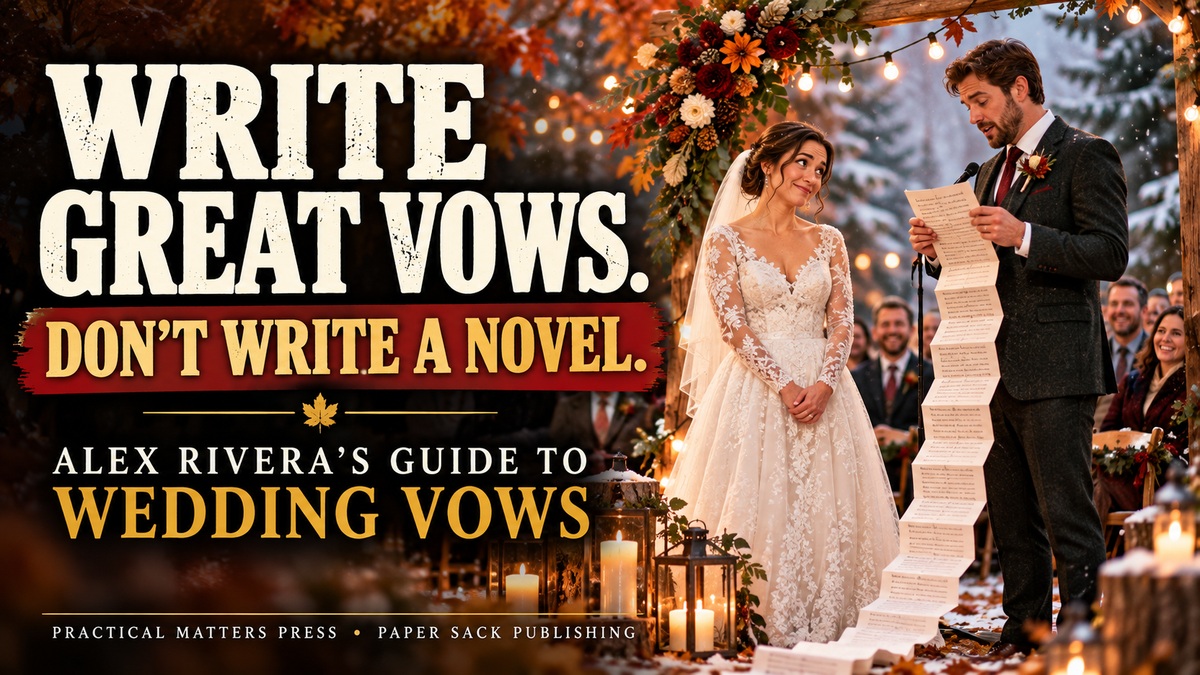
How to write wedding vows that are personal, funny, meaningful—and don’t make your guests stare desperately at the open bar
By Alex Rivera
Fall and winter weddings have an unfair advantage.
You’ve got changing leaves. Candlelight. Fireplaces. Velvet jackets. Evergreen branches. Snow if the universe is feeling cooperative.
Even a mediocre banquet hall suddenly looks like a Nancy Meyers movie once somebody puts enough candles in it.
And then comes the ceremony.
The music starts.
Everyone stands.
Two people who have spent months obsessing over flowers, invitations, seating charts, signature cocktails and whether Aunt Linda can safely be seated within 30 feet of Aunt Carol arrive at arguably the most important few minutes of the entire day:
The vows.
And that’s when one of them unfolds three sheets of paper.
Uh-oh.
Look, I’m a romantic.
I believe wedding vows matter.
I also believe your guests should not need an intermission during them.
So if you’re getting married this fall or winter and you’ve decided to write your own vows, congratulations.
You’re about to discover that telling someone you want to spend the rest of your life with them is surprisingly difficult when somebody hands you a blank piece of paper.
Let’s fix that.
First: Your Wedding Vows Aren’t Your Autobiography
This is mistake number one.
You sit down to write your vows and think:
“I should probably start at the beginning.”
No.
Your guests do not require the director’s cut.
You don’t need:
“It was September 17, 2019. I had just gotten out of my Toyota Camry…”
Skip ahead.
Good wedding vows aren’t the complete story of your relationship.
They’re the meaning of the story.
You can establish your history in a few sentences:
“Five years ago, I thought I was meeting someone for coffee. I didn’t know I was meeting the person who would eventually become my best friend, my favorite travel companion and the only human being I trust to tell me whether I’m being ridiculous.”
Done.
We’re moving.
Tell Them What You Actually Love About Them
Here’s where people often reach for Wedding Language™.
“You are my rock.”
“You complete me.”
“You are my best friend.”
None of those things are bad.
They’re just things approximately 14 million other people have said.
Instead, get specific.
Maybe you love that your partner calls their grandmother every Sunday.
Maybe they always make coffee first.
Maybe they can tell you’re having a bad day before you’ve said anything.
Maybe they’re the person who makes everybody feel included.
Maybe they have an inexplicable ability to remain calm while assembling IKEA furniture, which frankly should qualify them for sainthood.
Specificity makes vows feel true.
Compare:
“You’re the most caring person I’ve ever met.”
with:
“I love that you notice when somebody at a party feels left out—and somehow, five minutes later, they’re laughing with everyone else.”
Now I know something about this person.
That’s what you want.
Humor Is Good. A Roast Is Not.
I’m strongly in favor of funny wedding vows.
Weddings are emotional. Everyone is nervous. Somebody’s mother has already cried six times and it’s only 3:15.
A laugh is welcome.
But here’s the rule:
The joke should make your partner feel loved, not exposed.
Good:
“I promise to continue pretending I don’t notice when you adjust the thermostat immediately after I adjust the thermostat.”
Good:
“I promise to love you even during football season, which I now understand is apparently five months long.”
Riskier:
Anything involving exes.
Sex.
Debt.
Family drama.
Their body.
Something they’re genuinely insecure about.
The bachelor party.
That thing that happened in Cabo.
You know exactly which thing I’m talking about.
Your wedding ceremony isn’t open-mic night.
If you’re wondering whether a joke crosses the line, ask yourself:
Will my partner laugh when 120 people hear this?
If you’re not certain, delete it.
Fall and Winter Weddings Give You Great Material
This is where seasonal weddings can actually help your writing.
Don’t force pumpkins into your vows because you’re getting married in October.
But use the feeling of the season.
Fall is about change.
Winter is about warmth.
Both are about gathering.
Home.
Family.
Traditions.
Beginning one chapter as another season ends.
That’s fantastic material.
For example:
“There will be seasons when life feels exactly like today—beautiful, exciting and full of possibility. And there will be winters we don’t see coming. I promise to be beside you through both.”
That’s seasonal without sounding like you married a decorative throw pillow from HomeGoods.
For a Christmas-season wedding:
“I can’t promise every Christmas will look like this one. But I promise we’ll build traditions that are ours, create a home people want to come back to, and probably argue at least once every December about how many lights a tree actually needs.”
Heart.
Humor.
Promise.
That’s the combination.
Please Coordinate the Length
I cannot emphasize this enough.
Talk to each other.
You don’t have to share your vows beforehand.
You should agree on approximate length.
Otherwise:
Partner One:
“I love you. You’re my best friend. I promise to choose you every day for the rest of my life.”
47 seconds.
Partner Two reaches into jacket.
Unfolds manuscript.
Clears throat.
“Chapter One…”
Don’t do this to each other.
Agree on something like:
Two to three minutes.
That’s enough time to say something meaningful without your officiant developing lower-back pain.
A Simple Wedding-Vow Formula That Actually Works
If you’re staring at a blank page, here’s the structure I’d use.
1. Start with what they mean to you.
One or two sentences.
“Before you, I thought home was a place. You’ve taught me that sometimes it’s a person.”
Great.
Keep moving.
2. Tell one short story.
Not seven.
Choose a moment that reveals something about your relationship.
Maybe it was your first trip.
A difficult year.
A ridiculous date.
The moment you realized this was different.
Keep it brief.
3. Say what you admire.
Get specific.
Not just what you love about them.
What do you respect about them?
Their patience?
Work ethic?
Generosity?
Faith?
Courage?
Ability to deal with your family at Thanksgiving?
Again, sainthood.
4. Make actual promises.
This is the part people forget.
They’re called vows.
Vow is right there in the name.
Promise things.
Some serious:
“I promise to tell you the truth, especially when it’s difficult.”
“I promise to protect time for us when life becomes busy.”
“I promise to support the person you’re becoming, not just the person standing here today.”
And some lighter:
“I promise that when I say I’m ready to leave, I will make a sincere effort to actually be ready to leave.”
Specific promises are infinitely better than five paragraphs explaining how attractive your fiancé looked the first time you met.
Don’t Promise Perfection
There’s something else I’d avoid.
“I promise I’ll never disappoint you.”
You will.
Congratulations. You’re human.
“I’ll never make you angry.”
Oh, buddy.
Give it until Tuesday.
The best vows aren’t promises that nothing difficult will ever happen.
They’re promises about how you’ll respond when it does.
I’ll listen.
I’ll apologize.
I’ll show up.
I’ll tell you the truth.
I’ll protect our marriage.
I’ll keep laughing with you.
I’ll keep choosing you.
Those promises have some mileage on them.
Write Like You Talk
This may be my biggest piece of advice.
After you write your vows, read them aloud.
If you hear yourself saying something and immediately think:
“I have never spoken like this in my entire life,”
rewrite it.
Your wedding day should not transform you into a 19th-century poet.
You don’t suddenly need words like destiny, eternal flame, or beloved unless those are words you normally use.
Your partner fell in love with you.
Let them hear you.
Practice Them—But Don’t Memorize Them
Read your vows aloud several times before the wedding.
You’ll catch sentences that look wonderful on paper but are impossible to say without requiring additional oxygen.
You’ll also discover where you naturally pause.
But don’t obsess about memorizing every word.
Bring the paper.
Use a vow booklet.
Nobody cares.
You’re already wearing uncomfortable clothes in front of everyone you’ve ever met while attempting not to cry.
You have enough going on.
And Please Print Them
Your wedding vows should not arrive via iPhone.
I know.
We’re modern people.
But there’s something emotionally strange about watching someone pledge lifelong devotion and then swipe away a DoorDash notification.
Write them down.
Print them.
Put them in a small vow book.
Have your officiant hold them.
Just don’t spend the ceremony trying to remember whether your vows are in Notes, Google Docs or the text thread with your maid of honor.
The Best Vows Aren’t the Most Beautifully Written
Here’s what people misunderstand.
You don’t need to be a writer.
You don’t need a viral TikTok moment.
You don’t need to make every person in the room cry.
You don’t need to sound profound.
You need your partner to hear the words and think:
That’s us.
That’s the goal.
Maybe your vows are elegant.
Maybe they’re sentimental.
Maybe they’re funny.
Maybe your relationship has survived things that deserve acknowledgement.
Maybe you’ve built a blended family.
Maybe you’re starting later in life.
Maybe you’ve been together twelve years and everyone at the ceremony is thinking, Finally.
Whatever your story is, tell that story.
Not the version you think a wedding is supposed to have.
One Final Test
The night before the wedding—or preferably somewhat earlier, because the night before your wedding you will discover approximately 63 other things that apparently need immediate attention—read your vows and ask three questions:
Does this sound like me?
Does this sound like us?
Am I actually promising something?
If the answer is yes to all three, you’re probably there.
Then put the vows down.
Go get married.
The leaves will look beautiful.
The candles will glow.
Someone will cry.
Someone’s uncle will dance in a manner nobody requested.
And twenty years from now, you probably won’t remember whether the napkins were ivory or champagne.
But there’s a decent chance you’ll remember looking at the person standing across from you and telling them exactly why you chose them.
That’s worth getting right.
— Alex Rivera, author of The Ultimate Wedding Vow Playbook available on Amazon