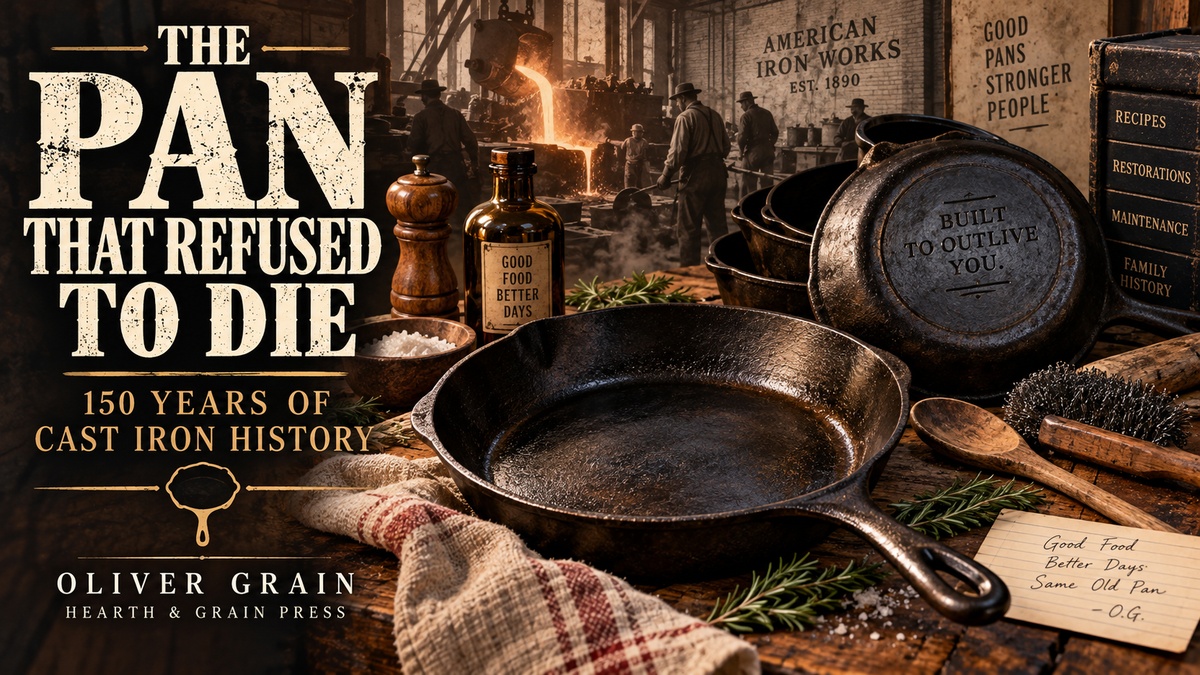
How Cast Iron Survived 150 Years of Kitchen Fads—and Somehow Became Cool Again
There is probably something in your kitchen right now that will be in a landfill before your cast iron skillet is even properly broken in.
Your air fryer?
We’ll see.
That digital meat thermometer with the Bluetooth app?
Godspeed.
The $300 countertop appliance you bought because a man on YouTube made cauliflower look like buffalo wings?
Enjoy it while it lasts.
But the black iron skillet sitting on your stove?
That thing may someday belong to somebody who hasn’t been born yet.
And that’s what I love about cast iron.
Before Cookware Needed an App
Cast iron’s story begins long before the American kitchen.
Humans had been casting iron into cooking vessels for centuries before the familiar American skillet emerged. Early iron pots were designed for cooking over an open fire, often with legs that allowed them to stand over hot coals.
The kitchen eventually changed.
Stoves replaced open hearths, and cookware changed with them. By the late 19th century, flat-bottomed cast-iron skillets designed for stovetop cooking had become commonplace.
And America became extraordinarily good at making them.
Factories in Pennsylvania, Ohio and elsewhere began turning molten iron into some of the finest cookware ever produced.
These weren’t luxury objects.
They were tools.
Heavy.
Simple.
Nearly indestructible.
Exactly the kind of thing I appreciate.
Then Came Griswold
If you start collecting old cast iron, it won’t take long before someone says the magic word:
Griswold.
The company’s roots in Erie, Pennsylvania, date to the 19th century, and Griswold became one of America’s best-known producers of cast-iron cookware. Vintage pieces are still prized by collectors today.
Pick up a good vintage Griswold skillet and you immediately understand some of the fascination.
Many are remarkably smooth.
Relatively light.
Beautifully balanced.
Turn one over and you’ll often find the famous Griswold cross logo cast into the bottom.
Suddenly you’re not simply holding a frying pan.
You’re holding industrial history.
And somewhere during the past century, that pan probably fried bacon.
A lot of bacon.
Which is considerably more useful than most museum pieces.
Meanwhile, in Sidney, Ohio…
Then there was Wagner.
The Wagner Manufacturing Company opened in Sidney, Ohio, in 1891. Within months it was already expanding production, and by the early 20th century Wagner had become a major name in American cookware.
Wagner wasn’t standing still, either.
The company experimented with nickel-plated cast iron and aluminum cookware, won awards at major expositions, expanded internationally and eventually introduced the familiar Wagner Ware branding.
By 1912, its plant had grown to around 160,000 square feet and employed roughly 300 people.
Think about that for a moment.
A century ago, Americans weren’t ordering skillets from an algorithm.
Somebody in Ohio was pouring molten iron into a mold.
Another person was finishing it.
Another inspected it.
It went into a box.
It went to a store.
Someone bought it.
They cooked dinner in it.
And there’s a decent chance that skillet still works.
When Two Great Names Became One Story
Eventually, the histories of Wagner and Griswold collided.
The Wagner family sold its company in 1952. Several years later, Griswold was acquired and its Erie foundry ultimately closed; Wagner and Griswold would eventually exist under common ownership, with later Griswold-branded cookware produced in Sidney.
For collectors today, those ownership changes matter.
Logos changed.
Patterns changed.
Manufacturing changed.
The bottom of an old skillet became something like a birth certificate.
That’s why experienced cast-iron hunters at flea markets inevitably perform the same ritual.
They see a skillet.
They pick it up.
They immediately flip it over.
We’re not being rude.
We’re checking its driver’s license.
Then America Fell in Love With “Nonstick”
Cast iron had a problem, however.
The future arrived.
By the middle of the 20th century, manufacturers were offering consumers something enormously appealing:
Convenience.
Lightweight aluminum cookware expanded.
Then synthetic nonstick coatings entered the kitchen.
Why wrestle with a heavy iron skillet when you could buy something lighter that promised eggs sliding effortlessly onto your plate?
Cast iron gradually lost its position as an everyday American kitchen essential. The rise of nonstick cookware during the 1960s and 1970s contributed to its decline.
Even Wagner experimented with the new world. In 1965, it offered Teflon-coated cast-iron skillets—an almost perfect artifact of the moment when old-fashioned cookware met modern convenience.
Imagine telling your great-grandfather:
“We improved your cast iron by covering the cast iron.”
He’d probably stare at you.
Then go outside.
But Cast Iron Had One Unfair Advantage
It wouldn’t die.
That turned out to be rather important.
Cheap cookware gets scratched.
Handles loosen.
Coatings deteriorate.
Trends change.
Cast iron just sits there.
Waiting.
Sometimes for decades.
That’s why so many of us have had the same experience.
You open a cabinet at your grandmother’s house.
Or clean out an old garage.
Or wander through an estate sale.
And there it is.
Black.
Crusted.
Maybe rusty.
Possibly looking like it was recovered from the Titanic.
Your first thought is:
This thing is ruined.
And very often, it isn’t.
That’s the magic trick.
Rust Isn’t a Death Certificate
One of the most satisfying things about cast iron is restoration.
You can find a neglected skillet covered in rust and grime and, depending on its condition, bring it back into service.
Clean it.
Remove the rust.
Season it properly.
Cook with it.
Again.
There aren’t many objects in modern life that give us that opportunity.
We tend to replace rather than restore.
Cast iron asks us to reconsider that instinct.
Before throwing something away, it asks:
Can this be saved?
That’s a question worth asking about more than frying pans.
And Then Cast Iron Became Cool Again
Eventually, something unexpected happened.
The cookware our grandparents used because it was practical became desirable precisely because it was old-fashioned.
Collectors started hunting Griswold and Wagner.
Cooks rediscovered cast iron.
Restoration communities appeared online.
Vintage skillets that had spent decades collecting dust began showing up in kitchens again.
Even Wagner itself has been revived, with modern cookware inspired by its historic designs; the company dates renewed interest in vintage and new cast iron to the mid-2010s.
We’ve somehow arrived at the wonderful moment where a 25-year-old cook can become genuinely excited about buying a 90-year-old frying pan.
I approve.
Your Pan Has a Biography
This is ultimately why I created The Cast Iron Keeper.
Most cast-iron books understandably focus on recipes.
But recipes aren’t the only things worth recording.
If you own cast iron—especially vintage or inherited pieces—your pans have stories.
Where did you find it?
Who owned it before you?
Who made it?
How old is it?
What condition was it in?
How did you restore it?
What seasoning method worked?
What didn’t?
What do you cook in it?
And eventually:
Who gets it next?
Because that’s the strange thing about buying a good cast iron skillet.
You might technically own it.
But if you take care of it properly, you’re really just its current caretaker.
Start Keeping the Story
Take one pan from your collection tonight.
Turn it over.
Look at the markings.
Look at the wear.
Think about where it came from.
If it’s vintage, research the manufacturer.
If it belonged to someone in your family, write down whose it was.
Record the recipes you love making in it.
Document your restoration and seasoning experiments.
Take a photograph.
Write the story.
Because someday somebody may pull that same skillet out of a cabinet and wonder:
Where did this come from?
And wouldn’t it be wonderful if they didn’t have to guess?
That’s what The Cast Iron Keeper is about.
Not merely keeping pans.
Keeping their stories.
Because the best cookware isn’t disposable.
And neither are the memories we make with it.
— Oliver Grain
Founder, Hearth & Grain Press
EVERY PAN HAS A STORY. KEEP YOURS.
The Cast Iron Keeper gives cast-iron owners a dedicated place to document their collection, restorations, seasoning and maintenance, favorite recipes, and the history behind the pans they hope to pass down.
→ GET THE CAST IRON KEEPER ON AMAZON
The pan may last 100 years. Make sure the story does too.