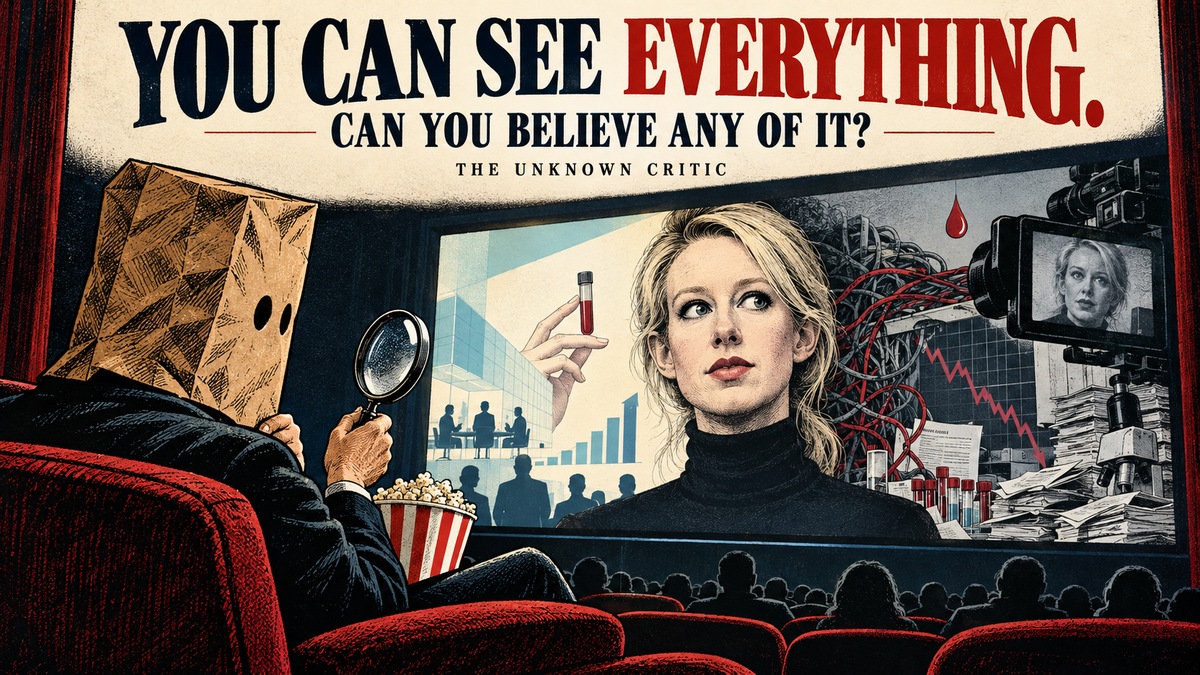
You Can See Everything brings Nathan Fielder into the Theranos aftermath—and gives corporate image management a very uncomfortable houseguest.
There are many ways to prepare for prison.
You can organize your affairs. Spend time with your family. Reflect on the decisions that brought you to this moment.
Or you can invite Nathan Fielder into your home.
Personally, I would choose the paperwork.
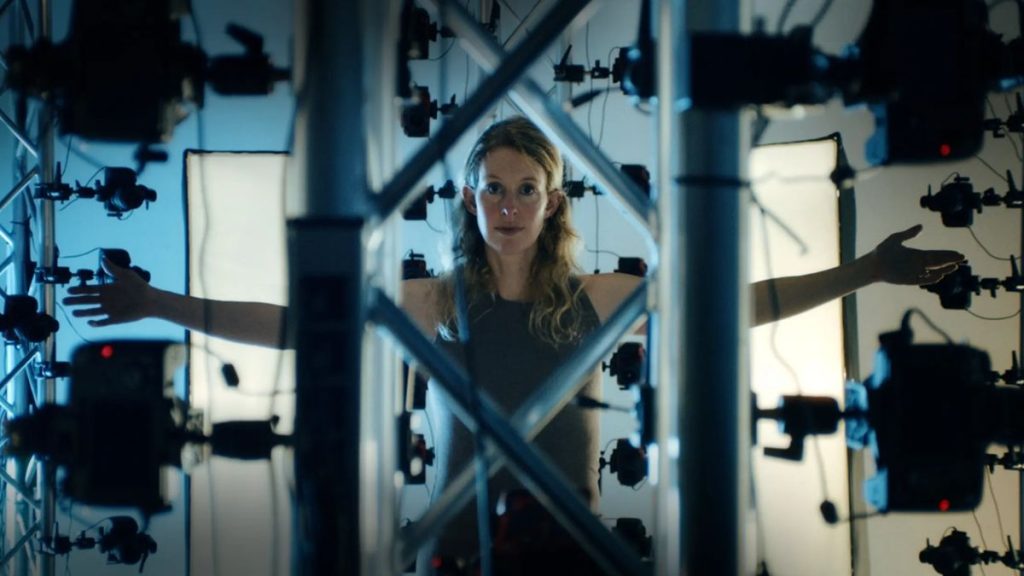
A24’s You Can See Everything, directed by Fielder and Lance Oppenheim, opens October 16. Its premise: Elizabeth Holmes invites a skeptical film crew to document her life beginning 34 days before she goes to prison. A24
This is an extraordinary choice.
Inviting filmmakers into your life to help people understand you is one thing. Inviting Nathan Fielder is like asking a building inspector to admire your curtains.
He may compliment the fabric.
He will also ask why the supporting wall is made of optimism.
The Product Didn’t Deliver. The Storytelling Department Remains Open.
Before we get seduced by the documentary premise, a little grounding.
Holmes was convicted in January 2022 of an investor-fraud conspiracy count and three investor wire-fraud counts. She was sentenced that November to 135 months in prison. The jury acquitted her on the patient-related counts it decided; her convictions concerned investors. United States Department of Justice
That is a consequential distinction.
It is also why “misunderstood entrepreneur” is an inadequate description of this story.
There is a difference between building something that fails and deceiving people about what you have built.
My toaster has failed.
It did not raise money by announcing that it would revolutionize breakfast through proprietary bread intelligence.
Although, given a sufficiently attractive presentation, I suspect somebody would have funded it.
ToastOS.
We’re not burning your bagel. We’re disrupting its moisture profile.
Why This Documentary Has My Attention
The intriguing thing about You Can See Everything is that its announced premise moves beyond another corporate-collapse timeline.
Film at Lincoln Center describes a film in which Holmes and her partner, Billy Evans, invite Fielder into their home while maintaining her innocence. The festival frames it as an examination of their relationship and the limits of documentary objectivity. It lists the runtime at 174 minutes. filmlinc.org
Nearly three hours.
That is a substantial commitment to watching people explain themselves.
I have relatives who can accomplish that over Thanksgiving dinner, but at least there’s pie.
The central question, for me, is this:
Does giving somebody access to your life make your account of that life more trustworthy?
You can show a camera your kitchen, your daily routine and your tender moments.
Those moments can be real.
Your explanation of the scandal can still be wrong.
A charming breakfast does not audit a balance sheet.
Radical Transparency, Now With Preferred Camera Angles
The title You Can See Everything is wonderfully provocative.
Because seeing everything and understanding everything are different activities.
I can see every button on my dishwasher.
I still don’t know why “eco” takes four hours.
A documentary camera gives us access. It records expressions, pauses, surroundings and the things people choose to say.
But access creates its own temptation: once we feel close to someone, we may start confusing intimacy with evidence.
“She seems so normal.”
Of course she does.
People who commit fraud also buy groceries. They have affectionate relationships. They remember birthdays. They can be pleasant to sit beside.
If wrongdoing reliably announced itself through thunder, sinister organ music and a visible cape, due diligence would be considerably cheaper.
The difficult question is whether we can recognize someone’s humanity without allowing it to swallow their accountability.
That is where this premise becomes more interesting than another round of “look at the outrageous founder.”
The Sympathy Trap
I’m not opposed to a documentary showing Holmes as a human being.
I would be suspicious of one that couldn’t.
People are complicated. Someone can experience real fear, love their family and have done serious wrong.
The emotional experience does not erase the conduct.
We understand this everywhere except the celebrity rehabilitation circuit, where a carefully lit interview can apparently function as a moral dishwasher.
Insert scandal.
Select “vulnerability.”
Wait for the soft piano.
Remove misunderstood visionary.
The danger is that an audience begins treating sympathy as a verdict.
“I feel bad for her” becomes “perhaps everybody was unfair.”
Those statements require different evidence.
You can feel compassion for a person facing consequences while believing the consequences have a legitimate basis.
You are permitted to have two thoughts at once.
I realize the internet has made that feel like operating heavy machinery without a license.
Enter the World’s Least Reassuring Houseguest
Fielder’s involvement makes this project especially intriguing because his public persona suggests a man unlikely to accept an elegant explanation simply because the room has excellent natural light.
That is an observation about the premise, not a verdict on the finished film.
I haven’t seen it yet.
But pairing an executive’s desire to be understood with a filmmaker associated with uncomfortable questions has obvious dramatic potential.
The imagined conversation writes itself:
“We want people to see the real us.”
“Okay. What does ‘real’ mean here?”
“The authentic version.”
“How will I distinguish that from the version you want me to see?”
“We were hoping you wouldn’t ask that until after lunch.”
The fascinating possibility is that the camera itself becomes part of the story.
Who is influencing whom?
Who decides what counts as revealing?
And when somebody says, “You can ask anything,” how long does that invitation survive an actual question?
Why This Belongs Beside Crash of the Titans
This is exactly the territory that interests me in Crash of the Titans — Corporate America’s 100 Epic Flops that Burned Billions.
The spectacle of corporate failure is entertaining.
The machinery of belief behind it is more revealing.
An ambitious pitch becomes a compelling story. The story attracts attention. Attention gets mistaken for validation. Soon, challenging the premise feels less like asking a business question and more like insulting everyone’s favorite inspirational poster.
At that point, a company can acquire something more dangerous than a bad idea:
An audience invested in the idea being good.
That is why I enjoy skewering executive mythology. It gives us such marvelous phrases as “visionary leadership,” which can mean anything from creating a useful product to speaking confidently beside a very large screen.
The useful question is less glamorous:
What works, and how do we know?
It rarely appears on a tote bag.
It should appear in more boardrooms.
Failure Is Not Automatically Fraud
Here’s another distinction worth preserving.
A failed company is not automatically a fraudulent company.
Businesses take risks. Products disappoint. Markets change. Perfectly honest people can make expensive mistakes.
If every bad launch required a criminal trial, the courthouse would need a separate annex for streaming executives.
But the reverse distinction matters too: describing wrongdoing as “failure” can make deliberate deception sound like an unfortunate product-development hiccup.
Corporate language loves this trick.
“We encountered challenges.”
“We fell short.”
“Mistakes were made.”
By whom?
A committee of weather conditions?
The value of examining these stories is learning to separate uncertainty, incompetence, hype and deceit. They can overlap, but they are not interchangeable.
The Question I’m Taking Into the Theater
I’m interested in You Can See Everything because its premise raises a harder question than whether Elizabeth Holmes can hold our attention.
She plainly can.
The question is what we do with that attention.
Do we use it to examine contradictions?
Or do we become so absorbed by the personality at the center that everybody outside the frame starts disappearing?
A compelling subject can dominate a film. A compelling founder can dominate a company.
Neither should get to dominate the definition of truth.
I’ll reserve judgment on the documentary’s filmmaking and conclusions until I’ve watched it. For now, the premise earns my curiosity—and a healthy supply of skepticism.
If you enjoy this collision of ambition, executive mythology and spectacular corporate consequences, Crash of the Titans is your companion reading.
Bring it for the billion-dollar blunders.
Stay for the recurring discovery that the person who says “trust me” most confidently may be the person who most needs a follow-up question.
As for the movie, I’m ready.
I have my ticket budget.
I have my questions.
And unlike a certain category of corporate presentation, I expect the popcorn machine to demonstrate that it works.
Would a documentary change how you see Elizabeth Holmes—or simply reveal how effectively people can keep selling their own story?