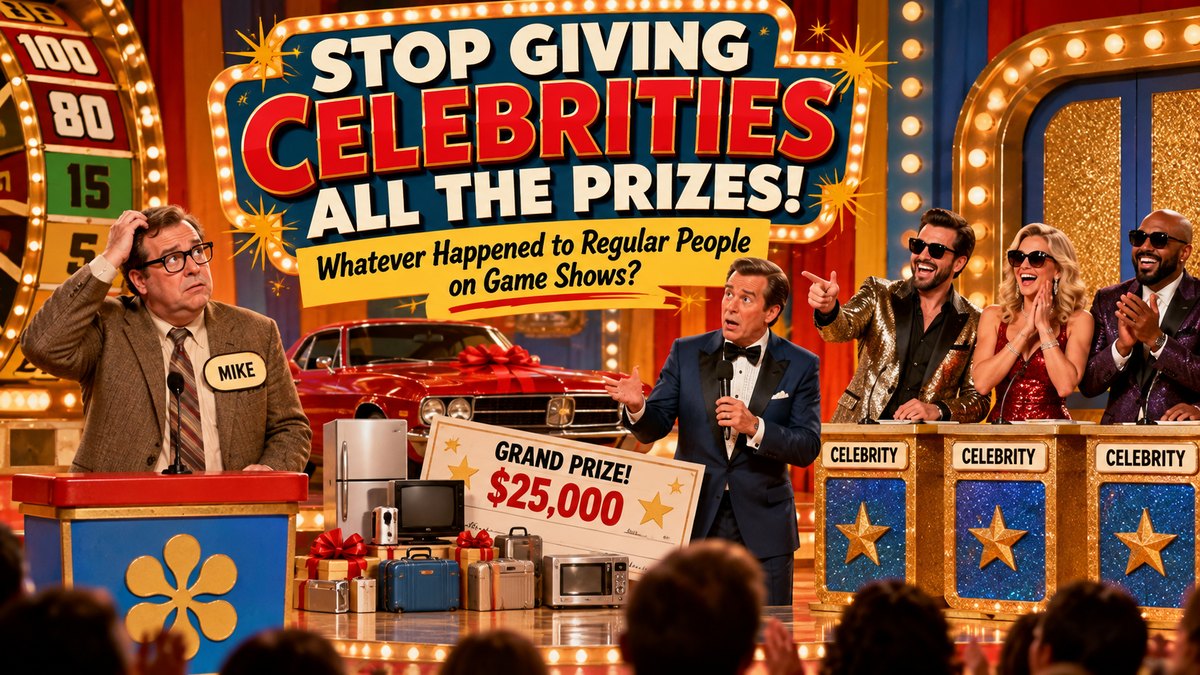
Once upon a time, ordinary Americans went on game shows to change their lives. Now celebrities go on them to remind us they’re still on television.
There was a beautiful time in American television when a dental hygienist from Toledo could walk onto a brightly lit soundstage, guess the price of a dishwasher, and leave with a new car, a trip to Aruba, and enough Rice-A-Roni to survive the apocalypse.
We called this a game show.
Today, that same dental hygienist can sit at home and watch a moderately recognizable actor from a canceled streaming comedy win $50,000 for charity by identifying a picture of a cantaloupe.
We call this Celebrity Game Night.
And apparently, television executives believe this represents progress.
Welcome to the modern game-show landscape, where everybody’s famous, everybody’s playing for charity, and the biggest mystery isn’t who’s going to win—it’s whether you recognize anyone on the panel.
Celebrity Everything, Everywhere, All at Once
Once upon a time, a celebrity edition was an event.
A special week of Wheel of Fortune. A tournament on Jeopardy!. A few famous faces on Family Feud.
It was a novelty. A little television dessert.
Now the dessert has become the entire buffet.
We’ve had Celebrity Family Feud, Celebrity Jeopardy!, Celebrity Wheel of Fortune, Celebrity Name That Tune, and Celebrity Who Wants to Be a Millionaire. Hell, there’s even a Celebrity Weakest Link. Who asked for that?
And that’s before we get into the celebrity editions of reality competitions, where people whose careers are based on being recognized compete for the opportunity to become even more recognizable.
At this rate, I’m expecting ABC to announce Celebrity Celebrity Family Feud, in which the relatives of reality stars compete against people who once shared an elevator with a Kardashian.
Hosted by a former contestant from The Bachelor, naturally.
I understand why networks do it. Celebrity recognition is an easy promotional hook. Famous contestants can attract their existing audiences. The charitable angle makes everyone feel good. And if the network owns a scripted series featuring one of the contestants, well, congratulations: you’ve just manufactured an hour-long commercial with a scoreboard.
But at what point did television decide that regular people weren’t interesting enough to play games anymore?
The Great American Dream Used to Come With a Showcase Showdown
Consider the beautiful absurdity of classic American game shows.
On The Price Is Right, somebody could lose their mind over a dinette set.
On Press Your Luck, a contestant could watch a cartoon Whammy steal enough money to pay off a mortgage.
On Sale of the Century, a person might risk thousands of dollars for the chance to purchase a deeply discounted grandfather clock that would immediately become the most intimidating object in their living room.
And on Wheel of Fortune, a contestant could go from struggling with rent to owning a brand-new car simply by solving a phrase like:
_ _ _ _ _ _ _ _ _ _ _
The answer was probably “FAMILY VACATION.”
The contestant would scream. The audience would scream. Pat Sajak would look mildly concerned that someone might actually injure themselves.
It was glorious.
Why?
Because these people had something real at stake.
A new car wasn’t just a prop. It was a new car.
A $25,000 check wasn’t a charitable donation announced between commercials. It could pay off a student loan, fund a child’s education, or finally replace the 1987 Oldsmobile currently held together with electrical tape and prayer.
We weren’t watching people play games.
We were watching ordinary people get an extraordinary opportunity.
When the Celebrity Needs a Charity to Make the Stakes Work
Let me be clear: I have nothing against celebrities playing for charity.
Charities do important work. Television exposure can raise awareness. And if an actor can win money for a worthy cause by correctly guessing that the survey’s number-one answer to “Name something you find in a bathroom” is “toilet,” terrific.
But let’s acknowledge the strange emotional gymnastics involved.
On an ordinary episode of Family Feud, a family might win $20,000.
That’s meaningful money.
On Celebrity Family Feud, a famous actor might win $25,000 for charity.
Also meaningful—but in a completely different way.
The contestant isn’t going home to explain to their spouse that the credit cards are finally paid off.
They’re going back to their trailer on a studio lot to prepare for an interview about their new prestige drama.
The emotional stakes have been outsourced.
We’re asked to cheer for the donation, which is admirable, rather than the life-changing possibility for the person standing behind the podium.
And yes, I realize some celebrities could use $25,000 themselves.
Especially the ones whose IMDb pages haven’t been updated since 2019.
But that’s a different show.
The Celebrity Identification Crisis
There’s another problem with celebrity game shows.
Half the time, I don’t know who these people are.
The host introduces someone with enormous enthusiasm:
“Please welcome the hilarious star of the hit series Bungalow Hearts, streaming exclusively on a platform you’ve never heard of!”
The audience erupts.
The camera cuts to a person I’ve never seen before.
Their name appears on screen.
Still nothing.
Apparently, they’re a major social-media personality, which in 2026 could mean anything from having six million followers to reviewing frozen chicken sandwiches in a parked Hyundai.
I’m not saying they’re undeserving of fame.
I’m saying that if the entire selling point of the show is that the contestants are celebrities, it would help if I recognized at least one of them without consulting Wikipedia.
Classic Match Game understood the assignment.
Charles Nelson Reilly. Brett Somers. Richard Dawson. Betty White.
These people were funny, distinctive, and knew how to turn a ridiculous fill-in-the-blank question into five minutes of television gold.
Even when you didn’t know every celebrity’s résumé, you quickly understood their personality.
Today’s celebrity panels sometimes feel like a networking event for people with excellent publicists.
And the comedy?
Let’s just say that identifying “butt” as a popular survey answer doesn’t automatically qualify as a groundbreaking contribution to American entertainment.
Hollywood’s Favorite New Genre: The Promotional Obligation
Of course, the celebrity-game-show explosion makes perfect business sense.
And that’s part of what makes it so depressing.
Networks have learned that a recognizable personality can be the attraction, the publicity campaign, and the cross-promotion all at once.
Why spend time introducing viewers to an ordinary contestant from Des Moines when you can feature an actor from your network’s Tuesday-night drama?
The actor gets exposure.
The drama gets promotion.
The charity gets money.
The network gets content.
The viewers get to watch somebody from a show they don’t watch struggle to remember the capital of Nebraska.
Everybody wins!
Except possibly Nebraska.
And the person from Des Moines who might have enjoyed winning a new refrigerator.
The celebrity format also gives programmers something they love: a familiar brand with an additional hook.
You already know Jeopardy!.
But what if the contestants were famous?
You already know Wheel of Fortune.
But what if the contestants were famous?
You already know Family Feud.
But what if the contestants were famous and Steve Harvey had to react to their answers as though civilization had just collapsed?
It’s less a programming strategy than a Mad Libs exercise.
CELEBRITY + EXISTING GAME SHOW = PLEASE WATCH OUR NETWORK.
In Defense of the Ordinary American With a Nametag
Here’s what I miss most.
The unpredictability of regular people.
Not the carefully cultivated unpredictability of a celebrity trying to demonstrate how relatable they are.
Actual unpredictability.
The contestant who gets so nervous they forget their own hometown.
The retired librarian who turns out to be an absolute assassin at trivia.
The grandmother who has watched The Price Is Right every weekday for forty years and knows the cost of a Whirlpool refrigerator more accurately than Whirlpool’s accounting department.
The guy who wins a speedboat despite living in an apartment in Phoenix.
These are the people who made game shows wonderful.
They weren’t promoting a movie.
They weren’t launching a podcast.
They weren’t appearing as part of a corporate synergy initiative.
They just wanted to win something.
And sometimes they did.
That’s a remarkably democratic idea for television: you don’t need an agent, a publicist, or 800,000 Instagram followers to have your moment under the lights.
You just need to be lucky, knowledgeable, entertaining, or exceptionally good at knowing the price of laundry detergent.
We Need More Prizemasters, Not More Celebrity Reunions
This is exactly why I became fascinated with the history of game shows in the first place.
In my book, The Unknown Critic Presents: Prizemasters, I explore the captivating world of television’s game-show culture—the personalities, programs, prizes, and peculiar magic that turned answering questions and opening briefcases into American entertainment institutions.
Game shows have always been strange.
That’s their charm.
They take simple human instincts—competition, luck, greed, hope, and the desire to own a brand-new washer and dryer—and turn them into spectacle.
At their best, they make ordinary people feel extraordinary.
And yes, celebrities have always been part of that history. Celebrity panelists were central to classics such as What’s My Line?, To Tell the Truth, and Match Game.
But here’s the distinction:
Celebrities used to help make the game entertaining. Now, too often, being a celebrity is the entire premise.
There’s a difference between inviting Betty White onto a panel to make everybody laugh and building an entire season around the question of whether a former reality contestant can identify a zucchini.
The first is entertainment.
The second is a casting department trying to justify its existence.
My Final Answer: Bring Back the Nobodies
I’m not demanding that every celebrity game show be canceled.
Keep some of them.
They’re fun occasionally. They raise money for charity. And every so often, a celebrity turns out to be genuinely hilarious or shockingly brilliant.
But can we please restore some balance?
Give me the elementary-school teacher trying to win a vacation.
Give me the auto mechanic who knows every presidential capital and state flower.
Give me the nervous accountant who suddenly realizes he’s one correct answer away from $100,000.
Give me the woman who spins the Big Wheel so hard that three stagehands need to inspect it afterward.
Give me contestants whose biggest television credit is appearing briefly in the background of a local news report about a county fair.
Because the greatest thing about the classic game show wasn’t the celebrity host, the flashing lights, or the fabulous prizes.
It was the possibility that somebody just like us might walk onto that stage and walk away with something wonderful.
And if the networks insist on giving us more celebrity editions, I have one final suggestion.
Celebrity The Price Is Right.
But instead of winning cars and vacations, the contestants have to guess the price of everyday groceries.
No assistance. No assistants. No publicists.
Just a famous actor standing in front of a box of Cheerios, trying to determine whether it costs $4.99 or $19.75.
Now THAT is television worth watching.
And if they lose?
They have to pay for their own groceries.
Come on down, Hollywood.
The Unknown Critic has spoken.
Love the golden age of game shows?
Before every quiz needed a celebrity and every prize came with a promotional obligation, television created a wonderfully strange world of buzzers, bonus rounds, charismatic hosts, spectacular prizes, and ordinary people chasing extraordinary wins.
Explore that history in The Unknown Critic Presents: Prizemasters—a celebration of the television game shows and personalities that captivated generations of viewers.