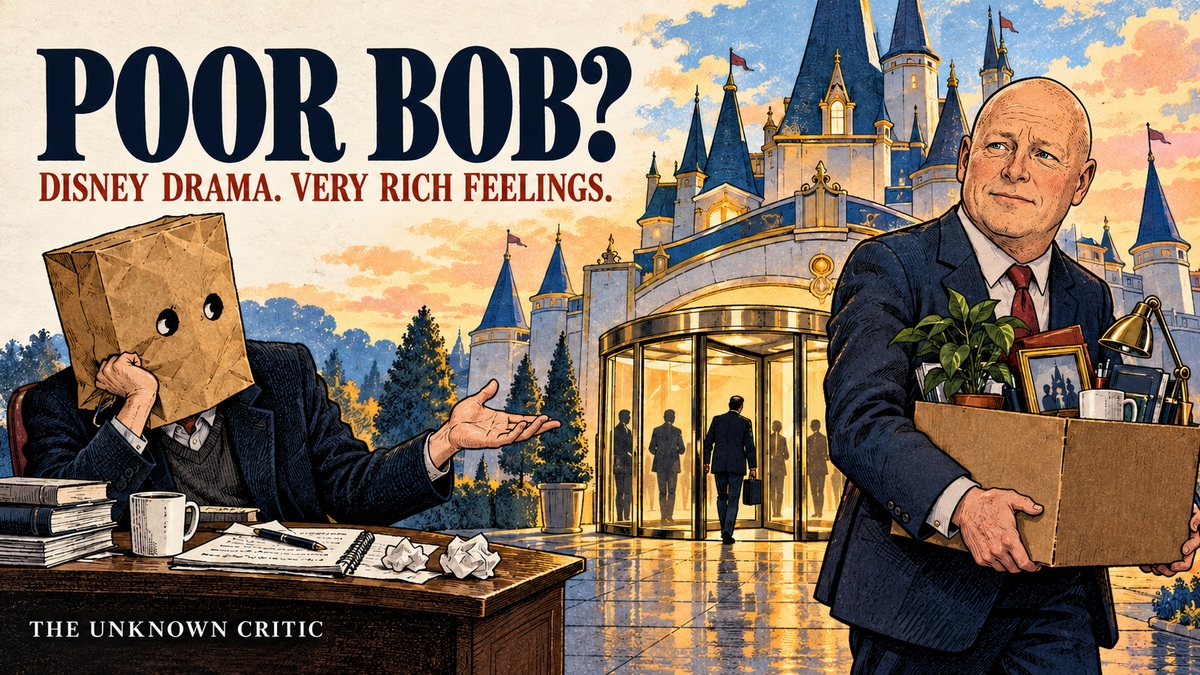
Review note: This commentary examines the published memoir excerpt, publisher information and launch coverage, rather than the complete book.
Bob Chapek has written a memoir about his time at Disney.
The Unknown Critic on Behind the Castle Walls—and the uncomfortable possibility that a CEO can be both accountable and badly treated.
This creates an immediate problem for me.
I have devoted considerable literary energy to mocking corporate executives. My book, Crash of the Titans: Corporate America’s 100 Epic Flops that Burned Billions, is practically a wildlife documentary about expensive men making questionable decisions.
Observe the CEO in his natural habitat.
He approaches the conference table.
He announces a transformation.
Several thousand jobs become “efficiencies.”
But Chapek’s Behind the Castle Walls: My Thirty Years at the Happiest Place on Earth, written with Don Yaeger and released by Gallery Books on September 29, 2026, introduces a complication: the executive wants us to meet the person underneath the quarterly earnings presentation.
And that person seems hurt.
Worse, he sometimes seems relatable.
I resent this development. I had jokes prepared.
The happiest place on earth has a very unhappy exit interview
The title alone deserves recognition.
Behind the Castle Walls.
Apparently, behind those walls are ambition, succession problems and an HR department that cannot resolve a conflict between two men named Bob.
Disney can coordinate fireworks, dancing elephants and a boat ride containing approximately nine million singing children.
Successfully transferring authority from Bob to Bob proved more challenging.
The official beginning was straightforward enough. Disney appointed Chapek CEO on February 25, 2020, while Bob Iger remained executive chairman, directing creative endeavors and overseeing the transition.
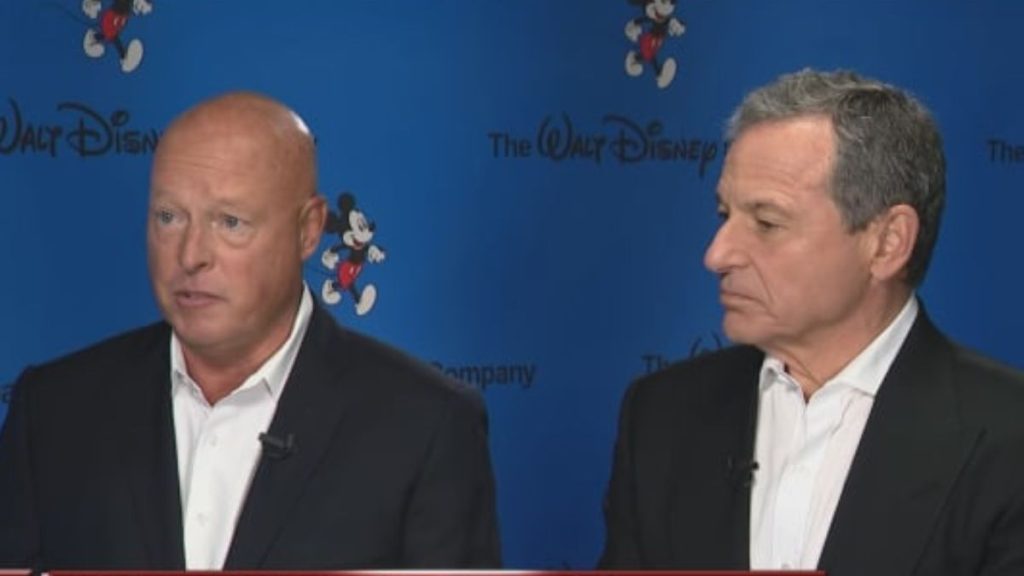
That was weeks before the pandemic turned running an entertainment company into an emergency exercise.
Congratulations on your promotion.
The parks are closing.
The theaters are closing.
The cruise ships are suddenly the least enchanting objects on water.
Please maintain shareholder confidence.
This is like being handed the keys to a beautiful hotel while someone casually mentions that the building has just become a submarine.
And it begs the question – did one Bob know something the rest of us didn’t at the time?
A succession plan with the predecessor still in the room
The arrangement also created an obvious leadership challenge.
How do you establish yourself when the person you succeeded still has an official role, deep relationships and a legacy that occupies more square footage than your office?
Imagine replacing a beloved school principal while the former principal remains in the building supervising “all educational endeavors.”
You can order printer paper.
For everything else, people still look down the hallway.
That doesn’t automatically prove sabotage. It does make clear authority important.
Corporate succession should involve more than moving a nameplate and hoping everyone experiences personal growth.
In Crash of the Titans, I’m interested in exactly this kind of institutional contradiction: companies praise decisive leadership, then sometimes construct systems in which responsibility is clear but authority is considerably less so.
You own the outcome.
Somebody else may still own the room.
Then the board performed a spectacular confidence reversal
Here are two documented events that do not require choosing a favorite Bob.
On June 28, 2022, Disney’s board unanimously extended Chapek’s contract for three years and publicly expressed confidence in his leadership.
On November 20, 2022, Disney announced Iger’s immediate return as CEO and Chapek’s departure.
Less than five months.
I have grocery-store mustard that has enjoyed a longer period of institutional support.
A board is entitled to change its assessment. Circumstances change. Performance matters.
But when the same institution moves from enthusiastic endorsement to replacement that quickly, the board deserves examination too.
Perhaps the successor failed.
Perhaps the selection process failed.
Perhaps the oversight failed.
Perhaps multiple people participated in the failure, but only one person’s photograph fit conveniently beneath the headline.
Accountability should have a wider lens than the departing executive’s forehead.
The memoir’s strongest argument is emotional
In the published excerpt, Chapek describes being dismissed by phone, alleges Iger undermined him, and writes about the damage to his reputation and family. He presents himself as an Indiana outsider who devoted decades to Disney. Those are his recollections and allegations, not independently established conclusions.
That framing makes him easier to understand.
You don’t need a corporate title to recognize the experience of believing you earned an opportunity, then feeling that the people who gave it to you never fully wanted you to succeed.
You don’t need executive compensation to understand humiliation.
Money can soften the practical consequences of losing a job. It cannot automatically prevent the experience from hurting.
A comfortable bank account and a bruised identity can occupy the same person.
Which is inconvenient for a critic who would prefer his characters divided neatly into “ordinary human” and “conference-room gargoyle.”
Sympathy is not an acquittal
Still, this is an executive memoir.
The author controls the camera.
He chooses where to point it, which scenes to include and how long we spend examining his least flattering angles.
That does not make the account false. It makes it a perspective.
A memoir can reveal something important without settling every dispute it describes.
Chapek’s launch coverage also revisits the controversies and business pressures of his tenure, including Disney’s response to Florida’s classroom legislation, the Scarlett Johansson dispute and streaming losses. These remain part of the leadership record; they do not disappear because the dismissal was painful.
The useful question is whether an account helps us distinguish circumstances, decisions and consequences.
The less useful question is whether the author successfully convinces us that every unpleasant development arrived from somebody else’s office.
Corporate memoirs occasionally read like expense reports for emotional damages.
I would like to see the receipts.
Why should the rest of us care?
Fair question.
Someone trying to pay rent may reasonably feel that the suffering of a former Disney CEO belongs several hundred places down the sympathy queue.
There are people whose unemployment means choosing between groceries and electricity.
There are other people whose unemployment means finding a publisher.
Those experiences are not equivalent.
But this story becomes worth examining when we stop treating it solely as one wealthy man’s grievance.
It raises questions familiar far below the executive floor:
What happens when a company makes someone responsible for a difficult transition?
What happens when the old leadership cannot fully let go?
How does an institution explain a reversal without admitting that its own judgment contributed?
Who gets to tell the story after someone leaves?
Those questions matter to employees who have never traveled anywhere on a corporate aircraft.
If a CEO can feel consumed by the organization he served, an employee has good reason to think carefully before calling that organization “family.”
Families have their problems.
Most do not issue a press release announcing that your predecessor is uniquely qualified to replace you.
The rich guy may have a point. That is deeply annoying.
Based on the published material (and his quite good interview with Patrick Bet-David), I can see why readers might find Chapek more human than his public image suggested.
I can also see why skeptics would want more than his interpretation before accepting the argument that he was unfairly undone.
Both reactions are reasonable.
He could have faced a difficult setup and made consequential mistakes.
He could have deserved criticism and deserved a more dignified exit.
The company could have needed different leadership and handled its succession poorly.
Life refuses to respect the simplicity of a thumbnail containing the words “HERO” and “VILLAIN.”
I consider this inconsiderate.
The Critic’s verdict
The excerpt and launch material make Behind the Castle Walls an interesting corporate counter-narrative: a chance to hear from the executive who became a shorthand for a troubled period at Disney.
They do not establish that his version is the final version.
For readers interested in leadership, reputation and corporate power, that tension is the attraction.
My recommendation is to approach it with curiosity and a functioning skepticism gland.
You may come away more sympathetic to Chapek.
You may remain unconvinced by parts of his defense.
You may also wonder why corporate succession involves so much emotional turbulence for people who constantly tell everyone else to embrace change.
That is where this story connects directly to Crash of the Titans: the distance between the polished language of leadership and the messy behavior of the humans practicing it.
I’m willing to feel bad for Bob.
I’m also willing to keep asking what he got wrong.
And I reserve the right to mock a company capable of producing The Lion King that still struggles with the basic concept of succession.
Explore The Unknown Critic Presents: Crash of the Titans—Corporate America’s 100 Epic Flops that Burned Billions for more expensive mistakes, executive egos and boardroom decisions that looked considerably better on the presentation slides.
What do you think? Can an executive be responsible for a company’s problems and still get treated unfairly—or do you lose sympathy when the compensation reaches yacht territory?