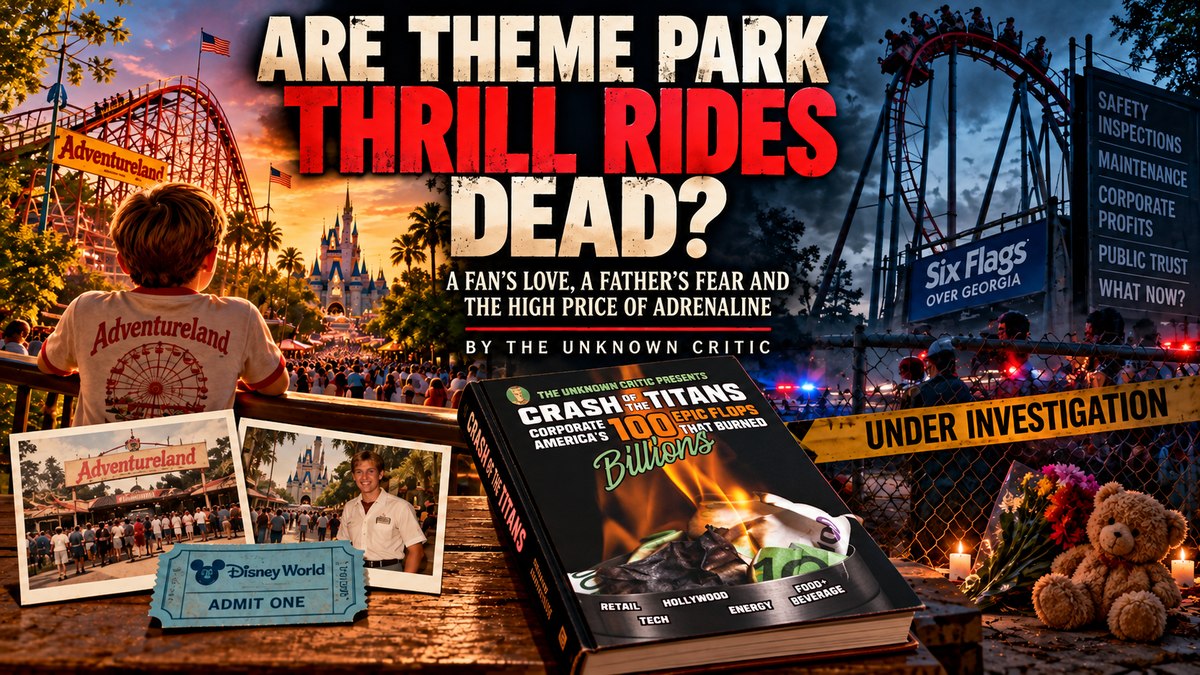
From childhood trips to Adventureland to working at Walt Disney World, I’ve spent my life loving theme parks. But after another tragedy, I have to ask: Has the amusement industry pushed the limits of thrill-seeking too far?
I love roller coasters.
Let me establish that immediately.
I love the click-click-click of the lift hill.
I love the moment your stomach realizes it has made a terrible mistake.
I love the screaming.
I love the ridiculous photographs they take of you at the worst possible moment, usually capturing an expression that suggests you’ve just learned your accountant has fled the country.
I love theme parks.
Always have.
Growing up in Iowa, trips to Adventureland were practically sacred events. To a kid from Des Moines, that park wasn’t just a collection of rides.
It was another universe.
There were roller coasters, carnival games, the smell of funnel cakes, the sound of screaming children and parents quietly calculating how much money they’d spent since entering the parking lot.
It was glorious.
I loved theme parks so much that I eventually went to work at Walt Disney World while attending college.
That’s right.
I didn’t just drink the theme park Kool-Aid.
I worked for the company that manufactured the Kool-Aid, put it in a collectible souvenir cup and charged $17.95 for a refill.
I’ve spent a lifetime fascinated by how theme parks work.
The storytelling.
The engineering.
The psychology.
The spectacle.
And, yes, the business.
But something happened this week that made me question an industry I’ve loved since childhood.
Something terrible.
And for once, the usual jokes aren’t enough.
A Tragedy at Six Flags Over Georgia
On October 12, 2026, a fatal incident occurred involving the Goliath roller coaster at Six Flags Over Georgia.
One person died, and several others were injured.
Witnesses described horrifying scenes. Riders were evacuated from the attraction, and authorities began investigating what happened.
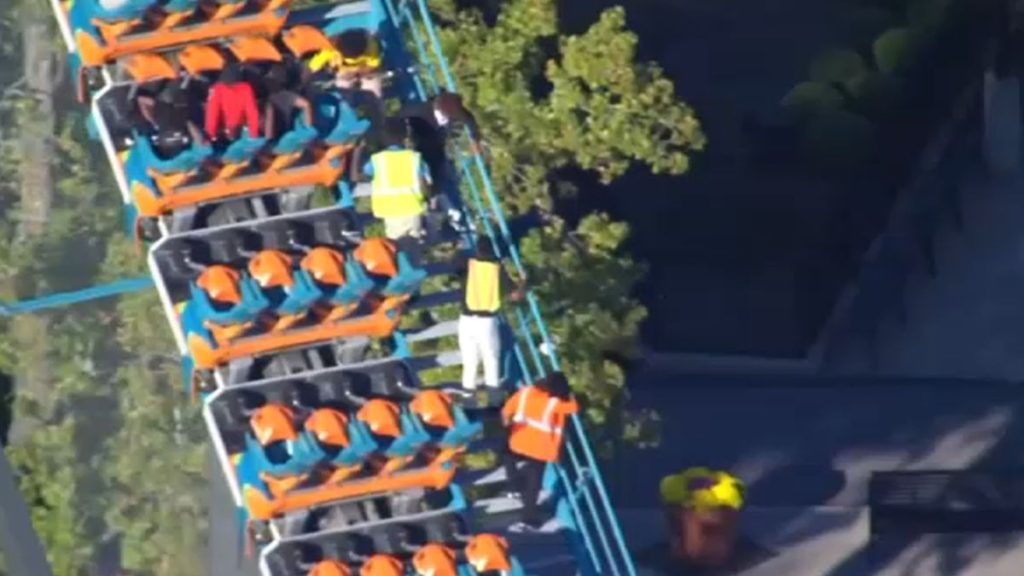
Six Flags subsequently announced precautionary closures of similar attractions across its parks. I’ve ridden this same version of Goliath at Six Flags Magic Mountain many times. Jarring, to say the least.
As I write this, the investigation is ongoing. The precise circumstances and cause have not been established publicly.
And that’s important.
Because the internet has already done what the internet does.
It has watched a few seconds of video, examined grainy photographs, read eyewitness accounts and assembled approximately 14,000 independent engineering investigations.
All before dinner.
Some people are blaming restraints.
Others are blaming maintenance.
Others are blaming the rider.
Others are blaming the company.
And some guy on Reddit has apparently reconstructed the entire incident using three screenshots and a diagram drawn in Microsoft Paint.
We don’t know enough yet.
But we know the most important thing.
Someone went to an amusement park expecting a day of fun and never came home.
That should stop every theme park enthusiast, operator and executive in their tracks.
The Entire Theme Park Business Is Built on a Beautiful Lie
Here’s the secret to thrill rides.
They’re supposed to convince you that you’re in danger.
While making absolutely certain that you aren’t.
That’s the business.
The roller coaster climbs 200 feet.
Your brain screams, “THIS IS A TERRIBLE IDEA.”
The train plunges toward the ground.
Your stomach attempts to resign.
You scream.
You laugh.
You get off.
And you immediately want to do it again.
Why?
Because the experience gives you the sensation of danger without the expectation of actual danger.
That’s the contract.
Scare me. Don’t hurt me.
It’s a pretty simple arrangement.
In fact, it’s the same arrangement I have with horror movies.
I want Michael Myers to terrify me.
I do not want Michael Myers waiting in the parking garage.
There’s a difference.
And when that distinction breaks down, the entire product becomes something else.
Adventureland Taught Me What Theme Parks Really Sell
Growing up in Iowa, Adventureland represented freedom.
It was a place where the ordinary rules of childhood temporarily disappeared.
You could ride something that made your mother nervous.
You could eat food that would be considered a medical emergency on any other day.
You could spend twenty minutes trying to win a stuffed animal that cost the park approximately 38 cents.
And somehow, those experiences became memories that lasted decades.
That’s the part corporate executives sometimes misunderstand.
Theme parks don’t really sell rides.
They sell memories.
The roller coaster is the delivery mechanism.
The memory is the product.
I don’t remember every turn of every coaster I rode as a kid.
I remember being there.
The anticipation.
The excitement.
The people I was with.
The feeling that something extraordinary might happen.
And eventually, working at Disney World gave me an entirely different appreciation for the machinery behind the magic.
Because behind every magical experience is an operation.
Staffing.
Training.
Maintenance.
Crowd management.
Transportation.
Food service.
Emergency procedures.
Thousands of details that guests are never supposed to notice.
When everything works, you call it magic.
When something fails, you discover just how much engineering and operational discipline that magic requires.
When Did Roller Coasters Become a Space Program?
Let’s discuss the industry’s escalation problem.
Once upon a time, a roller coaster was exciting because it had a hill.
Then somebody built a bigger hill.
Then a loop.
Then multiple loops.
Then suspended tracks.
Then launches.
Then vertical drops.
Then inversions that looked like an engineering firm’s attempt to draw a pretzel during a nervous breakdown.
Today, we’re measuring roller coasters in hundreds of feet, extreme speeds, inversions, acceleration forces and increasingly elaborate combinations of all four.
And naturally, the marketing follows.
TALLER!
FASTER!
STEEPER!
MORE INTENSE!
NOW FEATURING A DROP SO VIOLENT YOUR GRANDMOTHER WILL NEED TO UPDATE HER WILL!
I’m exaggerating.
Slightly.
But the competitive pressure is real.
Theme parks spend enormous sums building attractions designed to generate attention, attendance and repeat visits.
A new coaster isn’t merely a ride.
It’s a capital investment.
It’s a marketing campaign.
It’s a tourism driver.
It’s a reason to raise ticket prices.
It’s a reason for an annual-pass holder to renew.
And sometimes it’s a giant steel monument to the CEO’s desire to announce something impressive during an earnings call.
The question is whether the industry has allowed its appetite for spectacle to outrun the public’s appetite for risk.
The Executive’s Nightmare
Imagine you’re the CEO of a major amusement park company.
Congratulations.
You now have one of the strangest jobs in American business.
Your customers want you to terrify them.
Your shareholders want growth.
Your engineers want appropriate maintenance schedules.
Your operations teams need enough trained employees.
Your insurance company wants to sleep at night.
Your marketing department wants to announce the world’s first 900-foot upside-down flaming roller coaster.
And somewhere in the middle of all that is a parent holding the hand of a twelve-year-old.
That parent has one expectation:
Bring my kid back safely.
That’s it.
Not adjusted EBITDA.
Not attendance growth.
Not per-capita guest spending.
Not the projected return on a $30 million attraction.
Bring my kid back safely.
If you cannot deliver that, nothing else matters.
Welcome to the Crash of the Titans
This is precisely the kind of corporate dilemma that fascinates me.
In my book Crash of the Titans, I explore the spectacular ways enormous entertainment enterprises can lose their way.
Hollywood studios.
Big-budget productions.
Executive decisions.
Corporate ambition.
The strange tendency of very intelligent people to make extraordinarily expensive mistakes.
And while theme parks are a different business, they operate within a similar corporate ecosystem.
There’s constant pressure to grow.
Constant pressure to differentiate.
Constant pressure to justify investments.
And constant pressure to deliver bigger experiences.
But here’s the difference.
If a movie studio spends $250 million on a terrible film, the audience loses two hours and perhaps the will to live.
If a theme park makes a serious safety mistake, the consequences can be catastrophic.
You can recover from a box-office bomb.
Recovering public trust after a fatal incident is an entirely different proposition.
And that raises a question every theme park executive should be asking:
Are we managing attractions primarily as entertainment products, or as safety-critical systems that happen to entertain people?
Because the answer had better be both.
The Most Important Ride Is the One Nobody Notices
A park can spend millions on a new roller coaster.
But the most important investment may be something that never appears in an advertisement.
Inspection systems.
Preventive maintenance.
Replacement components.
Employee training.
Emergency-response rehearsals.
Clear operating procedures.
Independent safety reviews.
A workplace culture where an employee can stop a ride without fearing retaliation or being pressured to keep the line moving.
None of that sells T-shirts.
Nobody waits three hours for the Grand Opening of the New Preventive Maintenance Department.
Although, knowing Disney, they could probably create a charming mascot for it.
Marty the Maintenance Wrench!
Keeping the magic properly torqued since 1971.
I’d buy the shirt.
But the serious point is that safety investments are often invisible until something goes wrong.
And that’s exactly why they cannot be treated as optional.
A company should be able to explain how it verifies restraints, inspects components, investigates warning signs, trains operators and decides when an attraction must close.
Not because every guest wants an engineering lecture.
But because trust should be earned through demonstrable performance, not assumed because the park has a recognizable logo.
The Uncomfortable Question About Aging Attractions
Theme parks face another complicated issue.
Rides get older.
Some age beautifully.
Others require increasingly expensive maintenance, upgrades and specialized parts.
And eventually every operator faces a difficult decision.
Do you keep investing in an aging attraction?
Do you refurbish it?
Do you replace major systems?
Or do you retire it?
That’s not automatically an easy call.
A beloved roller coaster can be the identity of an entire park. Go to Six Flags Magic Mountain and imagine the park without the historic wooden coaster at the front – you know, the one made famous in National Lampoon’s Vacation. It just wouldn’t be the same.
Removing it can anger generations of fans.
Keeping it can require significant capital.
And operators have to distinguish between a ride that’s old and a ride that is no longer appropriate to operate.
Those aren’t the same thing.
A properly maintained older attraction isn’t inherently unsafe simply because it has been operating for decades.
Likewise, a newer attraction isn’t automatically safe because the paint is shiny.
The answer requires engineering evidence, inspection history, manufacturer guidance and a willingness to make unpopular decisions.
Even if that means closing a fan favorite.
Especially then.
But Aren’t Roller Coasters Statistically Safe?
Generally speaking, serious injuries on fixed-site amusement rides are uncommon relative to the enormous number of rides taken.
That’s worth acknowledging.
Millions of people safely experience amusement attractions.
The industry has developed sophisticated engineering, restraint systems, inspection practices and operating standards.
But statistics become emotionally complicated when we’re discussing children and families.
You can tell a parent that a catastrophic event is extremely rare.
That’s reassuring.
Until it happens.
Then the statistics don’t matter to that family.
And that’s why safety cannot simply be a probability calculation.
No operator can credibly promise that every conceivable risk has been eliminated.
But operators can demonstrate that foreseeable hazards are being systematically identified, reduced, monitored and addressed.
That’s what responsible management looks like.
Not promising perfection.
Building an organization that refuses to become comfortable with preventable danger.
The Social Media Problem
There’s another uncomfortable element to modern theme park tragedies.
They now unfold in real time.
Before authorities have finished responding, photographs appear online.
Video spreads.
Witnesses post.
Speculation multiplies.
And within minutes, millions of people are participating in a story whose facts may still be unknown.
That’s what happened around the breaking news from Georgia.
And while eyewitness accounts can be important, viral posts aren’t the same thing as investigative findings.
The existence of disturbing images doesn’t tell us why something happened.
The internet is excellent at distributing information.
It’s considerably less skilled at waiting for it.
For companies, this creates a new communications nightmare.
A statement that sounds too corporate seems cold.
A statement that speculates may be irresponsible.
Silence can appear evasive.
And an overly polished public-relations response can sound like somebody asked artificial intelligence to express condolences.
There is no perfect script.
But there is a correct priority.
People first. Facts second. Brand protection a distant third.
What Would Walt Do?
Having worked at Disney World, I find myself returning to the philosophy of the guest experience.
Disney’s famous operational emphasis on safety has long been central to its approach to running parks.
Safety isn’t supposed to be a feature.
It’s foundational.
That doesn’t make Disney immune to accidents, mistakes or scrutiny.
No company is.
But the underlying principle is important.
The guest experience cannot exist without guest confidence.
A beautiful castle doesn’t matter if parents don’t believe their children will be safe.
An extraordinary coaster doesn’t matter if people are afraid to board it for reasons beyond the intended thrill.
And a park’s reputation can take decades to build and a single event to seriously damage.
That’s the cruel reality of this business.
The better a park is at creating joy, the more devastating it becomes when that joy is interrupted by tragedy.
So Are Thrill Rides Dead?
No.
At least, I don’t think so.
And I certainly hope not.
I still love roller coasters.
I still love the anticipation of a new attraction.
I still love walking into a theme park and hearing that wonderful combination of music, mechanical noise, laughter and screaming.
I still believe there’s something extraordinary about an industry that can take steel, concrete, engineering and imagination and turn them into a childhood memory.
But perhaps we’re entering a period when the industry needs to reconsider what constitutes progress.
Maybe the next great coaster doesn’t need to be taller.
Maybe it doesn’t need to be faster.
Maybe the industry’s future lies in more sophisticated storytelling, better ride experiences, greater accessibility and stronger safety systems rather than endlessly chasing another world record.
Maybe the most impressive thing a park can announce isn’t another hundred feet of track.
Maybe it’s a renewed commitment to making sure every guest comes home.
That’s not particularly sexy marketing.
But it matters.
The Last Hill
I think back to Adventureland.
To being a kid in Iowa.
To standing in line, looking at a roller coaster and wondering whether I was brave enough to ride it.
I remember the fear.
I remember the excitement.
And I remember getting off, laughing, and immediately wanting another turn. I think my buddies and I once rode The Tornado 21 consecutive times.
That’s what theme parks are supposed to be.
Places where families create memories.
Places where children discover courage.
Places where adults temporarily remember what being children felt like.
Places where fear is manufactured, controlled and transformed into joy.
And when I think about the family affected by what happened at Six Flags Over Georgia, I can’t help thinking about the terrible difference between the memory they expected to make and the one they will now carry forever.
There isn’t a joke for that.
There shouldn’t be.
So no, I don’t believe thrill rides are dead.
But the industry needs to remember something.
The greatest thrill in any theme park isn’t surviving the ride.
It’s getting off, laughing with the people you love, and knowing you can do it all again.
That is the promise.
And every executive, engineer, operator and employee responsible for delivering it should treat that promise as sacred.
The Unknown Critic is the author of Crash of the Titans, an examination of entertainment-industry ambition, corporate decision-making and the spectacular consequences when big ideas collide with business reality.
This article reflects information available on October 12, 2026. The Six Flags Over Georgia incident remains under investigation, and no conclusions about its cause are intended.
Read Crash of the Titans on Amazon: https://www.amazon.com/gp/product/B0F87SVVPH